
- Release Year: 2023
- Platforms: Windows
- Publisher: SMU Guildhall
- Developer: SMU Guildhall
- Genre: Adventure
- Perspective: 3rd-person (Other)
- Game Mode: Single-player
- Gameplay: Exploration, Graphic adventure, Open World, Puzzle
- Setting: Alien, Desert, Fantasy
- Average Score: 70/100
Description
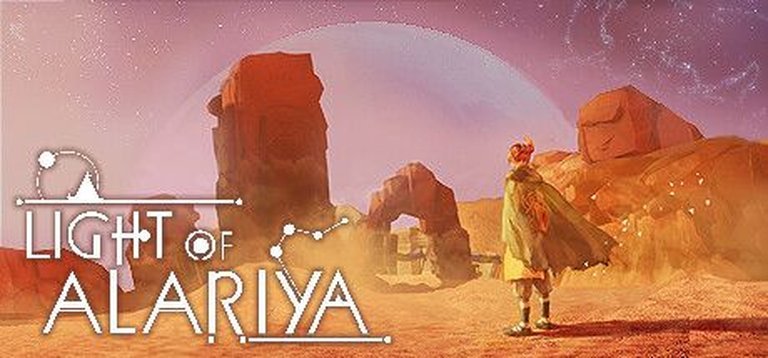
Light of Alariya is an open-world, third-person exploration puzzle set in a desert town where inhabitants fell asleep centuries ago to evade a devastating storm. As the last awakened hero, Rumi, you must guide the world’s goddess Ari through ancient alien temples to realign Constellation Crystals, restoring stellar power to awaken the civilization while uncovering mysteries through notes, memories, and murals.
Gameplay Videos
Where to Buy Light of Alariya
PC
Light of Alariya Guides & Walkthroughs
Light of Alariya Reviews & Reception
store.steampowered.com : If you’re after a short break from first-person shooters, or you would enjoy a calm, relaxing journey through a charming world, then you’ll want to at least try Light of Alariya.
Light of Alariya: Review
Introduction
In the ever-expanding cosmos of indie gaming, few stars shine as brightly as those forged in the crucible of academia. Light of Alariya, a 2023 creation from SMU Guildhall’s master’s students, emerges not just as a game, but as a bold declaration of ambition and learning. Developed over a grueling six-month sprint by 27 students and 26 collaborators from SMU’s Meadows School of the Arts, this open-world puzzle adventure stands as the program’s first foray into both expansive worlds and Unreal Engine 5. It tells the tale of Rumi, a lone hero tasked with reigniting the celestial power of her slumbering desert civilization by realigning alien temples. While its runtime—just 1–2 hours for the main story—might suggest brevity, Light of Alariya crafts a poignant, meditative experience that balances technical innovation with heartfelt storytelling. This review will dissect its journey from concept to launch, exploring how a student project navigates the treacherous waters of scope, artistry, and legacy.
Development History & Context
Light of Alariya was conceived as SMU Guildhall’s capstone Team Game Project (TGP), a rite of passage for aspiring developers. Its genesis in May 2022 coincided with the release of Unreal Engine 5, making it a high-stakes gamble for a team inexperienced with its groundbreaking features like Nanite, Lumen, and World Partition. The developers envisioned an ambitious “open-world exploration game” with sailing, whip-based combat, puzzle-solving, and narrative discovery—a scope far exceeding their six-month timeline. Early prototypes included physics-based puzzles and enemy encounters, but these were swiftly abandoned after playtests revealed “tedious” mechanics and unreliable systems. As Lead Producer Emma Anderson noted, the team’s initial vision was “over-scoped,” leading to a pivotal pivot: combat and boat upgrades were scrapped, replaced by a streamlined focus on light-based puzzles and environmental storytelling.
Technologically, the project was a trial by fire. Unreal Engine 5’s new tools presented both opportunities and pitfalls. For instance, the World Partition system enabled vast desert landscapes but caused conflicts with temple placements, requiring constant repositioning. The team’s inexperience with UE5’s audio middleware forced Sound Designer Su Chen to implement complex systems—like dynamic reverb and music triggers—via raw blueprints, a herculean effort that yielded mixed results. Despite these hurdles, the project’s “firsts”—Guildhall’s first open-world game and UE5 title—underscored its role as a learning laboratory. As Stern McGee, Lead Software Developer, reflected, “Research in pre-production minimized risks, but QA testing an open world was difficult and time-consuming.” The final release, shipped on UE5.0.3, bore the scars of these compromises, yet it remained a testament to the team’s resilience.
Narrative & Thematic Deep Dive
At its core, Light of Alariya is a fable about sacrifice and cyclical rebirth. Set on the desert planet Alariya, the narrative opens with a civilization plunged into centuries-long slumber by an apocalyptic storm, orchestrated by soothsayers to weather cosmic decay. Only the goddess Ari retains enough energy to awaken one hero: Rumi, a young woman tasked with restoring power to three crumbling Star Temples by realigning their Constellation Crystals. This premise unfolds through environmental storytelling—murals depicting forgotten history, journal entries hinting at societal hubris, and memories that reveal the cost of prolonged stasis.
Rumi’s journey is one of quiet determination. As the sole agent of change, she embodies hope, navigating ruins that symbolize both cultural memory and obsolescence. Her relationship with Ari, voiced with ethereal warmth, grounds the experience in emotional vulnerability. The narrative’s strength lies in its subtlety: there are no grand villains, only entropy and the passage of time. Thematically, the game explores stewardship—how civilizations must balance preservation with adaptation. The temples, once conduits of stellar power, now demand rediscovery, echoing real-world dilemmas of heritage and innovation. While the dialogue is minimal, the world’s lore is rich with melancholy beauty, making Alariya’s fate a resonant allegory for cultural survival.
Gameplay Mechanics & Systems
Light of Alariya’s gameplay is a masterclass in elegant simplicity, born from necessity. After discarding combat and sailing upgrades, the team distilled the experience to three core loops: desert traversal, temple navigation, and light-based puzzle-solving. Rumi’s whip, initially a combat tool, became a radiant energy beam used to interact with crystals and mirrors. This “light-emitting system” became the game’s backbone, requiring players to angle beams to activate celestial puzzles and unlock pathways—a mechanic praised for its tactile satisfaction.
Temple design underwent significant refinement. Early versions featured open-plan layouts that confused players; subsequent iterations introduced “gating,” where light-emitters restricted access until puzzles were solved. This approach, as Level Designer Jon Murray documented, “encouraged players to focus on one challenge at a time,” fostering a sense of discovery rather than frustration. Each temple—Jiach, Shu, and the final, unnamed sanctuary—serves as a thematic arena, with puzzles escalating from basic beam redirection to complex constellation alignments. Open-world elements, like optional mural collectibles, reward exploration but feel sparse, a casualty of the truncated timeline.
The UI, clean and minimalist, prioritizes immersion. A subtle compass and glow indicators guide players without hand-holding, while auto-save checkpoints prevent backtracking. However, technical flaws persist: physics-based interactions occasionally glitch, and the boat controls, while functional, lack polish. These shortcomings underscore the project’s student origins, yet the core loop—solving luminous puzzles in ancient halls—remains consistently engaging.
World-Building, Art & Sound
Alariya’s desert world is a character in its own right, rendered with UE5’s Lumen global illumination and Nanite geometry to create landscapes that shift from sun-bleached dunes to bioluminescent ruins. The art direction balances surrealism with accessibility: temples feature geometric patterns inspired by Mesopotamian ziggurats, while flora glows with an otherworldly palette. Lead Artist Yuchen Zhu’s team leveraged UE5’s Data Layers to dynamically adjust terrain around temples, ensuring seamless integration of landmarks without disrupting performance.
Sound design, led by Su Chen, elevates the atmosphere. Chen’s procedural whip sounds evolve from metallic clangs to ethereal hums as they interact with different materials, creating a tactile feedback loop. The original score, composed by SMU musicians, blends traditional desert motifs with ambient synths, enhancing the sense of isolation and wonder. Spatial audio cues—like the hum of a nearby crystal or the crunch of sand under Rumi’s feet—foster immersion, though Chen admits the trigger system sometimes faltered when players used the boat.
Together, these elements craft a world that feels both alien and intimate. The visual splendor of UE5’s rendering, combined with the haunting soundtrack, transforms Alariya from a setting into a living entity—one that whispers stories of a slumbering past.
Reception & Legacy
Upon its March 2023 release, Light of Alariya garnered a “Mostly Positive” reception on Steam (71% of 320 reviews), with players praising its “relaxing” atmosphere and “stunning” visuals. Critics like Notebookcheck lauded its brevity as a virtue, noting its suitability for “a calm journey through a charming world.” However, the short runtime and shallow puzzles drew criticism, with some reviewers lamenting the missed potential of its open world. Commercially, its free-to-play model on Steam and Epic Games Store ensured wide accessibility, though it remains a niche curiosity beyond academic circles.
Its legacy, however, transcends sales figures. For SMU Guildhall, the project was a crash course in professional development. As Producer Anderson’s retrospective revealed, the team’s struggles—scope bloat, communication gaps, and engine hurdles—became invaluable lessons. The “gating” system, born from playtest failures, is now cited in Guildhall curriculum as a case study in player guidance. Similarly, the UE5 workflow, once chaotic, informed subsequent student projects, proving that innovation often emerges from constraint.
Influence beyond academia is subtler but no less significant. Light of Alariya’s light-puzzle mechanics echo in titles like Light Tracer (2017), while its environmental storytelling aligns with the narrative minimalism of Child of Light (2014). As Stern McGee observed, “Cutting high-risk features earlier could have allowed more polish”—a mantra now echoed by indie developers worldwide.
Conclusion
Light of Alariya is a flawed gem, a testament to the transformative power of learning by doing. As a student project, it excels in vision and execution, even as it buckles under the weight of its ambitions. Its puzzles, though simple, are satisfying; its world, though small, is imbued with soul. The game’s greatest achievement lies not in its runtime or technical polish, but in its authenticity—a product of passion, collaboration, and the courage to pivot. For players, it offers a fleeting yet memorable journey into a world suspended between slumber and renewal. For developers, it stands as a blueprint: how constraint can breed creativity, and how a classroom project can resonate far beyond its walls. In the annals of video game history, Light of Alariya may be a minor footnote, but it is a luminous one—a reminder that even the smallest lights can awaken slumbering wonders.