
- Release Year: 2018
- Platforms: Macintosh, Nintendo Switch, PlayStation 4, Windows, Xbox One
- Publisher: Robot Riot UG
- Developer: Robot Riot UG
- Genre: Action
- Perspective: Side view
- Game Mode: Single-player
- Gameplay: Platform, Puzzle elements
- Setting: Classical antiquity, Fantasy
- Average Score: 62/100
Description
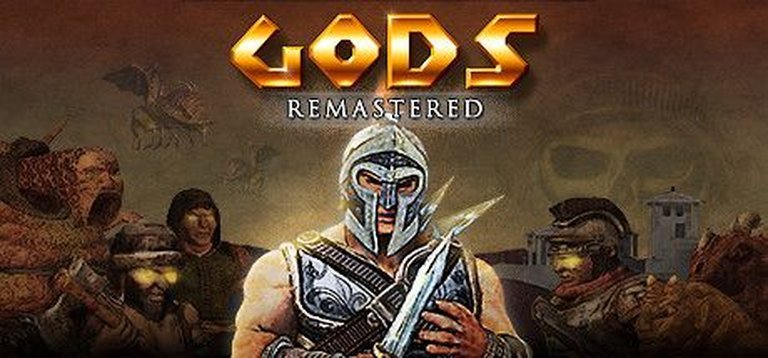
Gods: Remastered is a faithful update of the classic 1991 action-platformer, transporting players to a mythical Ancient Greece setting. This 2D scrolling adventure combines platforming challenges with puzzle elements in a side-view perspective, enhanced by updated visuals, improved lighting, and a refined soundtrack while retaining the original’s core level design and mechanics.
Gameplay Videos
Gods: Remastered Guides & Walkthroughs
Gods: Remastered Reviews & Reception
metacritic.com (56/100): Your appreciation of Gods Remastered is going to come down to whether you’re familiar with the original. By today’s standards, the general movement and combat is clunky, and the enemy appearances can be considered cheap. However, changing any of this would run the risk of destroying the memories that old players have of the title. If you’ve played the game before, this will be a nice nostalgia kick. Otherwise, new players might be better served elsewhere unless they are really into retro titles, warts and all.
opencritic.com (56/100): GODS Remastered is an odd remaster. The brand new visuals help give this incarnation of Ancient Greece a far more agreeable presentation with a proper lighting system, some much-improved character models and a soundtrack that helps do justice to the unforgettable original. But peel away those cosmetic changes and you’re left with a once brilliant action-platformer that has not aged well.
gamepressure.com (56/100): By only making skin deep improvements to the game and not touching any of the deep-seated flaws that lurk at the core of Gods original 1991 offering, Gods Remastered ends up being a largely disappointing and straight-laced remaster that will likely only appeal to the most die-hard of fans.
Gods: Remastered: A Time Capsule of 16-Bit Glory, Flaws and All
Introduction
In the pantheon of 1990s gaming deities, Gods stands as a formidable titan. Released by the legendary Bitmap Brothers in 1991, this Amiga/Atari ST platformer was lauded for its brutal difficulty, Simon Bisley’s iconic artwork, and John Foxx’s atmospheric soundtrack. Nearly three decades later, developer Robot Riot UG unleashed Gods: Remastered, a lovingly crafted homage promising to resurrect this cult classic for modern audiences. Yet, while the remaster succeeds as a faithful digital restoration—preserving the original’s soul while polishing its tarnished armor—it also serves as a stark reminder of how dramatically gaming’s DNA has evolved. This analysis argues that Gods: Remastered is both a triumph of preservation and a cautionary tale of nostalgia, offering contemporary players a portal to a bygone era but one that reveals the original’s aging mechanics with unflinching clarity.
Development History & Context
The Bitmap Brothers’ original Gods emerged in an era defined by technical constraints and bold ambition. Designed for Amiga and Atari ST systems, the game leveraged the 16-bit hardware’s capabilities to create a vast, mythological world teeming with intricate levels and adaptive AI. Its development was a product of its time: programmer Steve Tall and artist Mark Coleman pushed the hardware to its limits, while external composer John Foxx (as Nation 12) crafted a score that defined the game’s brooding atmosphere. Ports to consoles like the Genesis/Mega Drive and SNES followed, each with unique compromises—most notably, a higher speed that amplified the game’s punishing difficulty.
Fast-forward to 2018, when Robot Riot UG, a small German studio, secured official licensing from Bitmap Brothers’ owner Mike Montgomery. Their vision was clear: create a definitive edition that retained the original’s unforgiving core while modernizing its presentation. Using Unity, the team rebuilt Gods from the ground up, introducing 3D models, dynamic lighting, and a new soundtrack by Sound of Games. Yet, their approach was deliberately conservative. As Robot Riot’s FAQ stated, they aimed to “refurbish an oldtimer car,” not overhaul its engine. This fidelity to the 1991 blueprint meant the remaster inherited the original’s archaic design—flaws and all—while adding quality-of-life improvements like save points and smoother 60 FPS gameplay. The result was a project born from reverence, not revolution.
Narrative & Thematic Deep Dive
Gods presents a deceptively simple mythological quest: four guardians have usurped the citadel of the gods, and they offer a single favor to any hero who can reclaim it. The protagonist, a nameless warrior implied to be Hercules, accepts, demanding immortality and a place among the gods. The narrative unfolds through sparse environmental storytelling and cryptic trader dialogue, culminating in the hero’s ascension to Olympus as a being of light. The gods’ ambivalence—rooted in their hope for the hero’s failure—lends a tragic undercurrent to the tale.
Thematically, the game explores hubris and the ephemeral nature of divinity. The warrior’s quest for godhood mirrors the hubris of Greek myths, yet the gods’ reluctance to grant his request underscores their superiority. The narrative’s brevity—a stark contrast to modern RPGs—reflects 16-bit era constraints, where gameplay, not story, reigned supreme. The remaster doubles down on this minimalism, offering no expanded lore or character development. For veterans, this fidelity is nostalgic; for newcomers, it may feel hollow. As critic Mick Fraser noted, the story “pretty much lays itself bare on the first screen,” prioritizing action over exposition.
Gameplay Mechanics & Systems
Gods: Remastered adheres rigidly to the original’s gameplay loop, a blend of relentless platforming, resource management, and strategic combat. Players navigate four sprawling levels—City, Temple, Labyrinth, and the Underground—each divided into three stages. Progress demands pixel-perfect jumps, as the hero’s leap distance is fixed and unforgiving. Combat revolves around collecting and equipping ranged weapons (axes, fireballs, starbursts), with up to three of each type deployable simultaneously. A four-item inventory forces constant triage: keys, bombs, and health must be juggled, while puzzles often backtrack to leverage limited space.
The remaster’s “improvements” are technical rather than systemic. Controls are refined for modern controllers, and the jump to 60 FPS eliminates the original’s choppiness. Save points are liberally added—a stark contrast to the original’s checkpoint scarcity. Yet, the game’s core flaws remain unaddressed. The AI, once groundbreaking for its adaptability (enemies reposition based on player skill), now feels predictable. Inventory management is punitive: weapons vanish mid-boss battle without warning, and the shop’s refund logic is opaque. As PlayStation Universe’s John-Paul Jones observed, “deep-seated flaws lurk at the core,” with clunky movement and cheap enemy placements testing patience more than skill.
The inclusion of a speedrun mode and graphical toggle (original pixels vs. 3D overhaul) adds replayability, but these are cosmetic concessions. The remaster’s greatest strength is its authenticity; its greatest weakness, its unapologetic retention of outdated design.
World-Building, Art & Sound
The original Gods was a visual landmark for its era. Mark Coleman’s pixel art captured the grime and grandeur of Ancient Greece, with cyclopean architecture and grotesque monsters rendered in vivid, chunky detail. Simon Bisley’s cover art—featuring a hyper-muscular Hercules—became synonymous with the Bitmap Brothers’ aesthetic. The remaster’s 3D mode reimagines this world with dynamic lighting, textured environments, and fluid animations. Character models gain depth, though some critics found them “unnatural” (Nintendo Life), lacking the charm of the original’s sprites.
Sound, however, is the remaster’s most contentious element. The original’s iconic “Into the Wonderful” theme was excluded due to licensing issues, replaced by a new score by Sound of Games. While technically competent, it fails to evoke the same nostalgia. Sound effects, remastered by Lyrebird Studios, are divisive: players can toggle between classic and modern audio, but the latter is criticized for being “obnoxious” (Steam user Willykesport). The 3D mode’s soundtrack, however, injects life into environments like the labyrinth’s echoing corridors.
Ultimately, the remaster’s art direction honors its roots while bridging eras. The ability to switch between original pixels and modern visuals allows players to choose between authenticity and polish—a rare feat that caters to both purists and newcomers.
Reception & Legacy
Upon its 2018 release, Gods: Remastered received a mixed reception, mirroring the game’s own duality. Critics praised its faithfulness but lamented its dated mechanics. MobyGames tallied a 52% critic score, with publications like Jump Dash Roll (70%) praising its “platforming goods” and Garage Band Gamers (30%) dismissing it as “punishingly difficult.” OpenCritic’s 56% score underscored its niche appeal, while Steam’s user reviews (82% positive) reflected dedicated fanbases.
The game’s legacy is one of polarized nostalgia. For Bitmap Brothers enthusiasts, the remaster is a cherished artifact, preserving their memories of a golden age. Yet, it also exposes the original’s fragility: modern players accustomed to refined controls and forgiving design find its difficulty archaic. Its delisting in 2022—due to licensing restrictions—further cemented its status as a time capsule, sought-after but increasingly obscure.
Influence-wise, the original Gods was a trailblazer for its AI and environmental storytelling, but the remaster had negligible impact on industry trends. Instead, it stands as a testament to the Bitmap Brothers’ vision—a game that, for all its flaws, remains a unique artifact of 16-bit ambition.
Conclusion
Gods: Remastered is a paradox: a beautifully preserved relic that simultaneously honors and critiques its past. Robot Riot UG’s reverence for the original is evident in every frame and note, creating a definitive edition for veterans. Yet, the game’s unflinching fidelity also highlights the chasm between 1991 and 2018 design philosophies. Where modern players expect accessibility and fluidity, Gods demands memorization and resilience. Its greatest strength is its authenticity; its greatest weakness, its refusal to evolve.
For fans of the Bitmap Brothers, this remaster is an essential pilgrimage—a chance to relive a classic without the flickering CRTs and floppy disks. For newcomers, it is a history lesson: a glimpse into an era where difficulty was a feature, not a bug. In the end, Gods: Remastered is less a game and more a monument—a digital memento of when platforming was a brutal art, and heroes earned their godhood through sheer perseverance. Its place in history secure, it serves as both a reminder of gaming’s past and a cautionary ode to the passage of time.