
- Release Year: 2004
- Platforms: Windows
- Publisher: magnussoft Deutschland GmbH
- Developer: Team6 Game Studios B.V.
- Genre: Driving, Racing
- Perspective: First-person
- Game Mode: Single-player
- Gameplay: Driving, Power-ups, Racing, Vehicle Customization
- Setting: New York, North America
Description
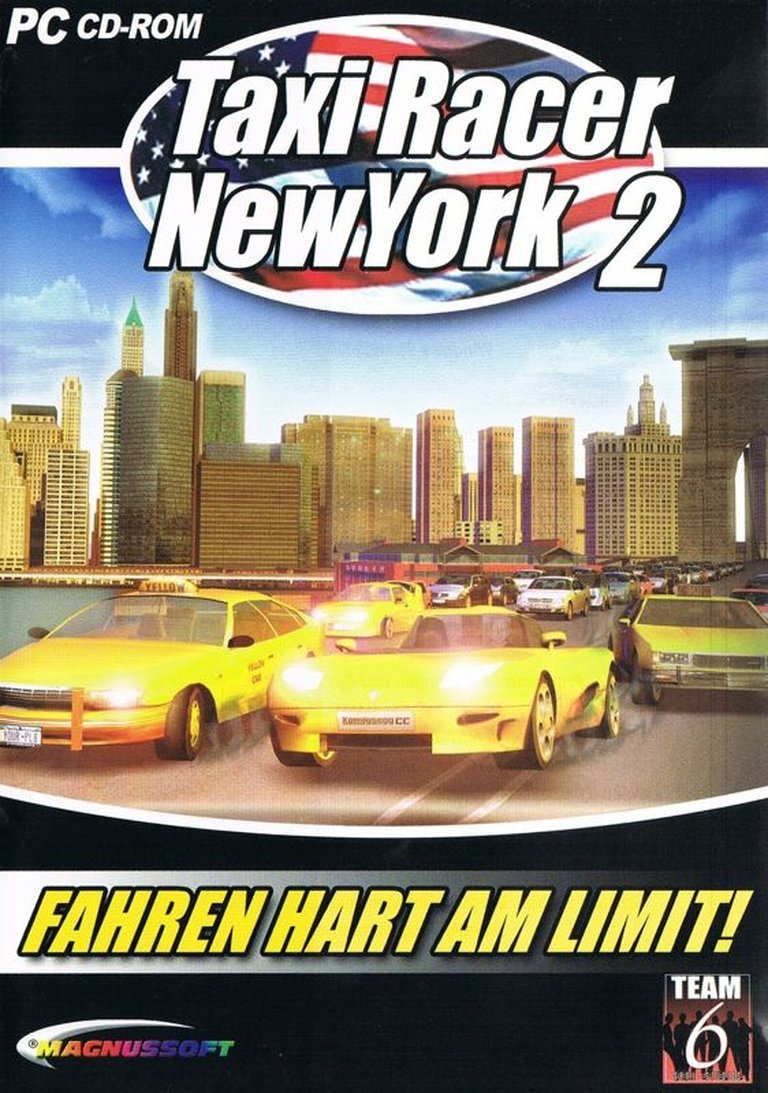
Taxi Racer: New York 2 is a racing and driving game set in New York City where players assume the role of a taxi driver, tasked with picking up passengers and delivering them to destinations as quickly as possible. Featuring an improved 3D engine with enhanced special effects, the game allows players to disregard traffic rules without penalty, earning more money for faster deliveries to invest in one of seven unlockable cars, while collecting power-ups to expedite journeys.
Gameplay Videos
Taxi Racer: New York 2 Free Download
Taxi Racer: New York 2 Cracks & Fixes
Taxi Racer: New York 2 Guides & Walkthroughs
Taxi Racer: New York 2 Cheats & Codes
PC
During gameplay press tilde to go to console, then enter the following cheats.
| Code | Effect |
|---|---|
| ADDCASH | Get Some Cash |
| NEXTMISSION | Complete Mission |
| FAILMISSION | Fail Mission |
| ROCK | Enable God Mode |
| GOD | Enable God Mode |
| GIMMEALLMISSIONS | Enable Cruise Mode |
| FREECAM | Enable Fly Mode |
| JUMP | Press Left Shift To Jump |
| SPEED | Press Left Shift For Turbo Boost |
| TELEPORT | Press R To Teleport To Random Locations |
| CAMERAEDITOR | Show Cameras |
| CARCAMEDIT | Move Camera |
| SETLIGHT | Show Light Settings |
| SHOWNODES | Show Nodes |
| SHOWSOUNDS | Show Sound-Lines |
| EXIT | Exit Game |
| CANNON | ? |
| MINIGUN | ? |
| ROCKET | ? |
| AMBIENTB | ? |
| AMBIENTG | ? |
| AMBIENTR | ? |
| CARCAMSETATTACHED | ? |
| CARCAMSETLERP | ? |
| CARCAMSETVIEWCAR | ? |
| CUTEPISODE | ? |
| CUTMISSION | ? |
| DIFFUSEB | ? |
| DIFFUSEG | ? |
| DIFFUSER | ? |
| FLARESAVE | ? |
| LENSFLARE | ? |
| LIGHTE | ? |
Taxi Racer: New York 2: Review
Introduction
In the pantheon of early 2000s arcade racers, Taxi Racer: New York 2 occupies a peculiar niche. Released in 2004 by Dutch developer Team6 Game Studios B.V. and published by magnussoft Deutschland GmbH, this sequel to Taxi Challenge New York promised a hyper-stylized, lawless tour of Manhattan. While overshadowed by titans like Crazy Taxi, the game endures as a cult artifact—a gleefully chaotic ode to automotive anarchy. Its thesis, though buried beneath janky mechanics and minimal polish, remains potent: what if New York’s streets were a playground for speed demons, where traffic laws were suggestions and cash rewards were earned through reckless abandon? This review dissects the game’s legacy, dissecting its design, context, and place in gaming history.
Development History & Context
Team6 Game Studios, a Dutch outfit founded in 1999, carved a niche for itself in budget racing games. Taxi Racer: New York 2 emerged from their ambition to refine their in-house 3D engine, boasting “enhanced special effects” over its predecessor. The 2004 release date placed it in a crowded market dominated by Need for Speed: Underground 2 and Crazy Taxi 3: High Roller. Technically constrained by its target hardware—Pentium III 600MHz CPUs and 32MB graphics cards—the game prioritized spectacle over realism. Its development team was lean: just seven credited individuals, including lead designer Ronnie Nelis and programmer Erwin de Vries. Notably, many contributors (like composer Niels Kleine) would later work on Team6’s Taxi Racer London 2 and Crime Scene Manhattan, suggesting a focus on iterative, low-budget innovation. The game’s German release via magnussoft positioned it as a budget title, reflecting a trend of mid-tier PC games struggling against AAA blockbusters.
Narrative & Thematic Deep Dive
Taxi Racer: New York 2 eschews traditional storytelling, presenting a bare-bones premise: you are a taxi driver, and your job is to ferry passengers across Manhattan. Yet beneath this simplicity lies a thematic embrace of urban chaos. The game’s lore, if it exists, is implied through gameplay: traffic laws are “disregarded without penalty,” collisions are inconsequential, and speed is the sole metric of success. This mirrors a post-9/11 fascination with New York as a space of controlled lawlessness—a city where the gridlocked streets become racetracks. The “illegal taxi races” mentioned in GamePressure’s description add a layer of subtext: the protagonist isn’t just a driver but a thrill-seeker, accruing “prestige” through reckless maneuvers. Passengers become incidental targets, their destinations merely checkpoints in a high-speed ballet of destruction. The lack of named characters or dialogue reinforces the game’s focus on pure arcade action, where the city itself is the antagonist and protagonist.
Gameplay Mechanics & Systems
At its core, the game revolves around two loops: the passenger delivery race and the car upgrade treadmill. After picking up fares, players must navigate Manhattan’s streets to drop-offs, with earnings tied directly to speed—faster trips yield larger tips. The physics engine defies realism, enabling “spectacular jumps on ramps and hills” (GamePressure) and drifting that would make a traffic officer faint. Seven unlockable cars range from sedans to a Koenigsegg—rarely seen in 2004 titles—each offering incremental upgrades. Power-ups (nitro boosts, jump assists) litter the streets, rewarding aggressive play.
The multiplayer component, supporting LAN/Internet matches, adds competitive layers like checkpoint races and “struggle” modes, though details are scarce. Controversially, the game’s cheat codes (via GG Mania) reveal a beta-like instability: commands like TELEPORT and GOD (invincibility) coexist with placeholder entries (CANNON, MINIGUN), suggesting rushed development. The lack of consequences for collisions or traffic violations creates a cathartic, albeit repetitive, experience. Yet the UI’s rudimentary design and the absence of a minimap hinder navigation, reducing strategy to trial-and-error.
World-Building, Art & Sound
New York is rendered as a neon-drenched, albeit generic, playground. The game’s 3D engine, while improved from Taxi Challenge New York, struggles with texture pop-in and flat architecture. However, it excels in atmosphere: dynamic times of day (morning to night) shift the city’s mood, from sun-drenched avenues to rain-slicked alleys. Car damage, though basic, adds tactile feedback—dents and scrapes accumulate, visualizing the player’s carnage. Sound design is functional yet immersive: Niels Kleine’s atmospheric soundtrack blends electronic beats with city ambience (sirens, honking), while engine roars and crunching metal provide satisfying feedback. The art direction leans into arcade excess, with exaggerated vehicle models and glowing power-up effects that prioritize readability over realism. Together, these elements create a stylized, if shallow, representation of New York—a neon-lit dream rather than a gritty portrait.
Reception & Legacy
Taxi Racer: New York 2 arrived with a whisper. MobyGames records a paltry 2.0/5 player rating (from a single user), while critical reception is nonexistent in the archives. Its German budget release and minimal marketing doomed it to obscurity. Yet a small community remembers it fondly: MyAbandonware users praise its “Koenigsegg car inclusion,” a rarity for the era. Reddit threads and abandonware forums debate its merits as a “so-bad-it’s-good” artifact.
Influence is hard to trace, but Team6’s DNA persists in later titles like Taxi Racer London 2. The game’s legacy lies in its unapologetic arcade ethos—a precursor to modern “simcade” hybrids, where realism is sacrificed for speed. It remains a footnote in the history of New York-set games, overshadowed by Grand Theft Auto and Midnight Club, yet its cult status among abandonware enthusiasts underscores a demand for unfiltered, consequence-free driving.
Conclusion
Taxi Racer: New York 2 is a time capsule of early 2000s arcade ambition. Its flaws—buggy physics, dated visuals, and a threadbare narrative—are undeniable. Yet beneath the jank lies a pure, exhilarating vision: a city transformed into a racetrack, where every lamppost is a launchpad and every stoplight a suggestion. As a piece of gaming history, it’s a flawed curiosity, but as an experience, it’s a testament to the joy of digital anarchy. For those who crave unadulterated speed over verisimilitude, this forgotten gem offers a neon-lit, crash-filled joyride through Manhattan. In a genre saturated with realism, its chaotic heart still beats.