
- Release Year: 2011
- Platforms: PlayStation 3, Windows, Xbox 360, Xbox One
- Publisher: Mastertronic Games Ltd., Noviy Disk, Square Enix Co., Ltd., Square Enix, Inc., Square Enix Limited
- Developer: Obsidian Entertainment, Inc.
- Genre: Role-playing (RPG)
- Perspective: Diagonal-down
- Game Mode: Co-op, LAN, Online Co-op, Single-player
- Gameplay: Action RPG, AI companions, Character movement, Dialogue choices, Direct controls, Focus energy, Gear customization, Leveling up, Loot Collection, Quest consequences, Skill trees, Special attacks, Stances
- Setting: Fantasy
- Average Score: 74/100
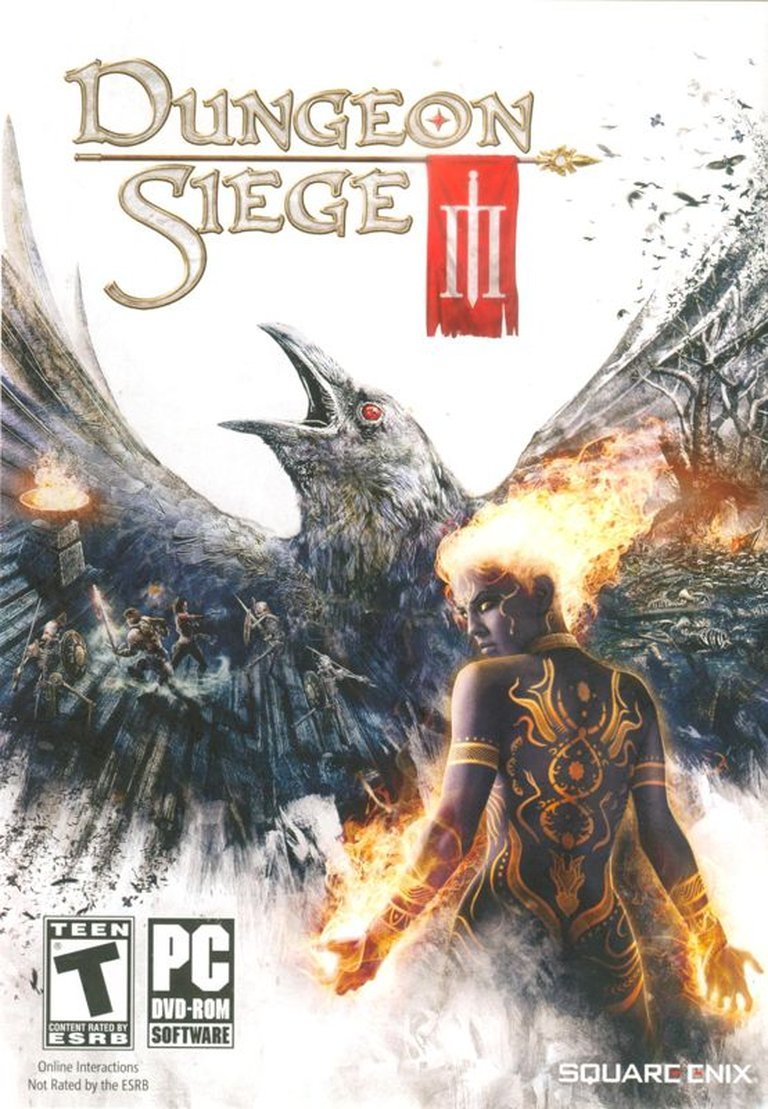
Description
Set in the medieval fantasy world of Ehb, Dungeon Siege III follows a land under attack by the enigmatic Jeyne Kassynder, who seeks to annihilate the Montbarron family—once the realm’s elite guards. Players assume the role of one of four heroes (Lucas, Anjali, Katarina, or Reinhart), each tied to the endangered lineage, on a quest to survive, uncover Kassynder’s motives, and prevent the kingdom’s collapse. This action RPG features direct combat controls, a companion system, and dialogue choices that dynamically shape the narrative and gameplay outcomes.
Gameplay Videos
Where to Buy Dungeon Siege III
Dungeon Siege III Free Download
Dungeon Siege III Mods
Dungeon Siege III Guides & Walkthroughs
Dungeon Siege III Reviews & Reception
metacritic.com (72/100): The story may not be the greatest, but the gameplay is solid and for that alone you should check it out.
pcgamer.com (78/100): It may not be the Dungeon Siege you remember, but this stunning, story-driven co-op dungeon crawler is entertaining just the same.
gamesradar.com : There are very few instances where it’s perfectly acceptable to fall asleep in the middle of playing a videogame.
gaminglives.com : This is not Dungeon Siege III and in the index of the Naughty Book, you’ll note that its first mistake was to pretend that it was.
Dungeon Siege III: Review
Introduction
Dungeon Siege III stands as a pivotal, yet controversial, entry in a series revered for its deep PC roots and seamless hack-and-slash action. Developed by Obsidian Entertainment and published by Square Enix in 2011, this third main installment marked a radical departure from its predecessors. Gas Powered Games, the creators of the original Dungeon Siege, had passed the torch, and the series was reborn as a console-first action RPG. This reinvention was both ambitious and divisive, blending real-time combat with RPG depth while stripping away the point-and-click mechanics of the past. As we delve into this ambitious reimagining, we must ask: did Obsidian’s bold gamble revitalize the franchise, or did it betray its legacy? Through an exhaustive analysis of its development, narrative, mechanics, and reception, this review argues that Dungeon Siege III emerges as a flawed yet compelling hybrid—a “RPG lite” gem that excels in action and camaraderie falters in narrative depth and PC optimization.
Development History & Context
The genesis of Dungeon Siege III is a story of seismic shifts. In 2010, Square Enix acquired the Dungeon Siege IP from Gas Powered Games, entrusting Obsidian Entertainment—a studio renowned for narrative-rich RPGs like Fallout: New Vegas and Neverwinter Nights 2—with the reins. Chris Taylor, the franchise’s original creator, served as advisor, lending credibility to Obsidian’s vision: to translate the series’ dungeon-crawling spirit to consoles while retaining its RPG soul.
Obsidian leveraged its proprietary Onyx Engine, enabling seamless world traversal with no load screens—a technical feat that impressed critics. However, this ambition came with constraints. The game was designed primarily for gamepads, leading to direct character controls and real-time combat, a stark contrast to the series’ mouse-and-keyboard point-and-click tradition. This choice, while streamlining action, alienated purists and resulted in a notoriously clunky PC port, with Rock Paper Shotgun lamenting its “verkorksten Maus-/Tastatur-Steuerung” (botched mouse/keyboard controls).
The 2011 gaming landscape was dominated by console action RPGs, with Diablo III looming on the horizon. Dungeon Siege III aimed to fill this void, offering a co-op-focused experience for a broader audience. Obsidian’s mandate was clear: simplify without dumbing down, and deliver accessible yet tactical combat. The result was a product caught between worlds—simultaneously a console-native triumph and a PC compromise.
Narrative & Thematic Deep Dive
Set 150 years after Dungeon Siege, the game’s narrative unfolds in the war-torn kingdom of Ehb. The once-venerated 10th Legion has been decimated by Jeyne Kassynder, a zealous revolutionary who manipulated public sentiment to dismantle the monarchy. Players assume the role of one of four Legion descendants—Lucas Montbarron (knight), Anjali (fire-elemental archon), Katarina (witch-hunter), or Reinhart (mage)—each with unique ties to the kingdom’s fractured legacy.
The plot is a tapestry of political intrigue and moral ambiguity. Kassynder, revealed to be an archon seeking to reawaken her creator gods, embodies the theme of corrupted idealism. Her crusade against the Montbarron family forces players to question the cost of order. Obsidian’s signature dialogue wheel, reminiscent of Mass Effect, offers choices that subtly alter quests and faction alliances, though critics like IGN noted their “cosmetic consequences” rather than world-shaping impact. The narrative excels in character dynamics: the banter between companions (e.g., Katarina’s sarcastic wit) injects levity, while Kassynder’s tragic descent adds gravitas. Yet, the main quest suffers from linearity, with GameSpot decrying its “tedious” pacing and fetch quests.
Thematically, the game explores legacy and redemption. The 10th Legion’s fall from grace mirrors the player’s journey to restore honor, while Kassynder’s arc questions whether vengeance ever achieves justice. Obsidian’s world-building, though undercut by a short campaign (averaging 10–12 hours), shines in side quests that flesh out Ehb’s factions—the royalists, Azunite Church, and Legion remnants. These vignettes, however, feel disconnected from the core plot, leaving the narrative feeling like a collection of compelling moments rather than a cohesive epic.
Gameplay Mechanics & Systems
- Dungeon Siege III*’s gameplay is its undeniable strength, a masterclass in streamlined action RPG design. The real-time combat eschews traditional mana potions in favor of “Focus,” a resource regenerated through active fighting. Players face enemies directly, with attacks and movements mapped to a gamepad’s analog stick and face buttons. This fluidity is amplified by a stance system: each character switches between one-handed, two-handed, or defensive configurations, unlocking unique abilities. Lucas, for instance, trades his shield for a two-handed sword to cleave through crowds, or uses a one-handed blade for precise blocks.
The skill system is a highlight. Each character has nine active abilities and ten passive talents, with five tiers of improvement. Abilities can be specialized—e.g., Anjali’s fire spells can focus on area damage or single-target intensity—and tied to focus spheres, which are collected mid-combat. This encourages aggressive play, as idling starves the player of resources. The absence of health potions, replaced by timed regeneration, further reinforces the “always fighting” ethos.
Companion AI is remarkably effective, autonomously using abilities to support the player. In co-op (2–4 players), the system shines: players vote on decisions, dynamically scaling difficulty, and drop-in/drop-out functionality ensures seamless collaboration. However, progress is saved only for the host—a baffling oversight noted by Memeburn as a “waste of time” due to potential griefing. Loot, while abundant, is overwhelming. MobyGames’ descriptions reveal a deluge of gear with cryptic stats (“doom,” “chaos”), making inventory management a chore. Despite these hiccups, combat remains visceral and rewarding, with Game Informer praising its “frantic action” and tactical depth.
World-Building, Art & Sound
Obsidian crafts a visually distinct Ehb, blending medieval fantasy with steampunk flourishes. The Onyx Engine renders lush environments—from Raven’s Rill’s rain-slicked alleys to the sun-scorched Aranoi Desert—with dynamic lighting and detailed textures. Critics lauded the “evocative landscapes” (GameSpot) and character models, with armor upgrades visibly enhancing appearances. The isometric perspective, while restrictive, emphasizes tactical positioning, and seamless transitions between areas maintain immersion.
Sound design, however, is a mixed bag. Jason Graves’ score is serviceable but lacks memorability, described as “decent” but “not exceptional” (Reference.org). Voice acting ranges from stellar (Liam O’Brien as Reinhart) to stilted, with Joystiq damning it as “horrible.” Environmental sounds—clanging steel, crackling fire—add texture, yet the audio fails to elevate the atmosphere beyond functional. The game’s true artistry lies in its co-op integration: the shared camera, though criticized for being “unnecessarily limiting” (The Telegraph), fosters camaraderie during chaotic battles. In essence, Dungeon Siege III’s world is a feast for the eyes, but its auditory palate leaves much to be desired.
Reception & Legacy
Upon release, Dungeon Siege III received “mixed or average” reviews (Metacritic: 72/100 PC, 71/100 PS3, 72/100 Xbox 360). Critics lauded its combat and co-op, with 360 LIVE calling it “one of the better examples of the genre on this generation of consoles.” However, the story and loot system drew ire. IGN dismissed the plot as “tedious,” while Rock Paper Shotgun lamented its “tretelinearity” (tedious linearity). The PC port was尤其 panned; Eurogamer noted its “16:10 aspect ratio” support and rigid controls as evidence of “less important” optimization.
Commercially, the game performed modestly, buoyed by Square Enix’s marketing and the Treasures of the Sun DLC (2011), which added a desert biome and raised the level cap to 35. Its legacy is nuanced. On consoles, it’s remembered as a solid “RPG lite” experience, praised for its accessibility. On PC, it’s a cautionary tale of half-hearted ports. Yet, Obsidian’s influence endures: the stance system and co-op dynamics presage mechanics in later titles like Diablo IV. As RPGFan noted, it’s a “good filler until bigger things arrive”—a sentiment that encapsulates its historical position: a bridge between eras, not a landmark, but a worthy waypoint.
Conclusion
- Dungeon Siege III* is a study in contradictions. It sacrifices the series’ PC complexity for console agility, delivering combat that is both accessible and deep. Its narrative, while uneven, offers compelling characters and moral choices. Its flaws—a shallow plot, loot bloat, and PC woes—are undeniable, yet they overshadow its triumphs: fluid combat, brilliant co-op integration, and a world ripe for exploration.
For modern players, Dungeon Siege III remains a hidden gem, especially on console. It is not the definitive Dungeon Siege experience, but it is a worthy evolution—a testament to Obsidian’s ability to reinvent franchises. In the pantheon of action RPGs, it occupies a unique space: flawed but fun, ambitious but imperfect. As the dust settles on Ehb, one truth remains: Dungeon Siege III may not have been the siege the franchise needed, but it was the one it deserved—a bold, human, and undeniably entertaining romp through a world of fire, steel, and redemption.