
- Release Year: 2015
- Platforms: Windows
- Publisher: Just For Games SAS
- Genre: Compilation
- Perspective: Overhead
- Game Mode: Single-player
- Gameplay: Hidden object, Puzzle
- Setting: Adventure, History, Mystery
Description
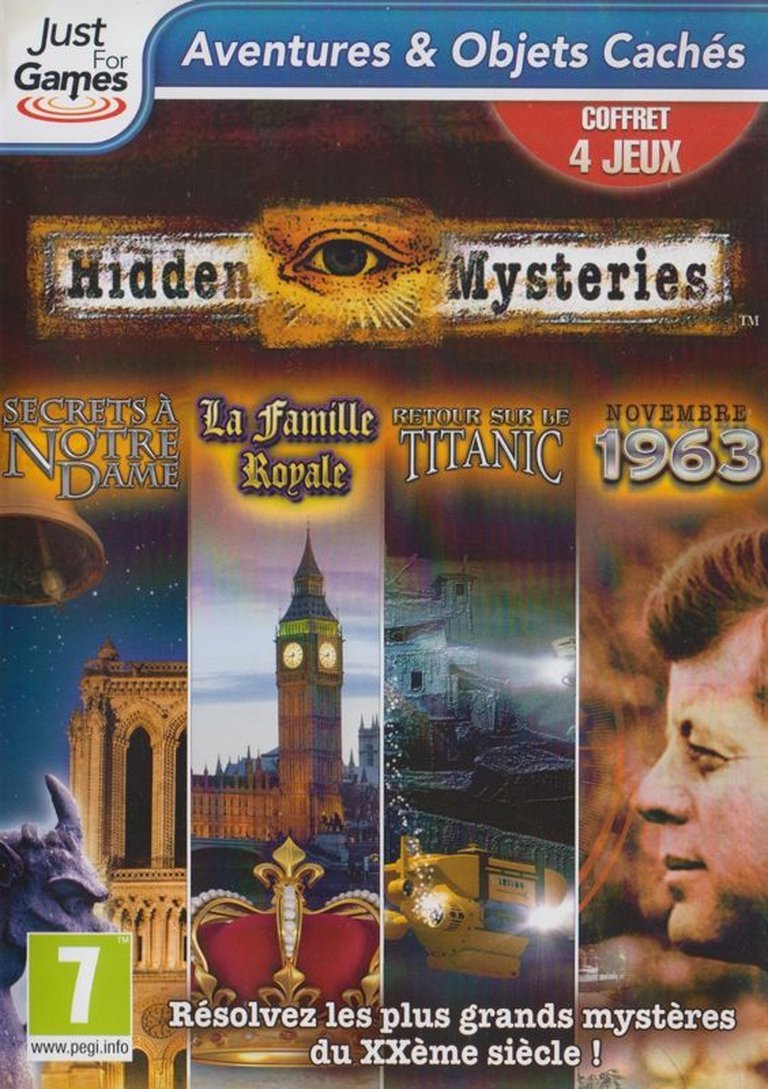
Hidden Mysteries: Coffret 4 Jeux is a 2015 compilation bundle for Windows that brings together four hidden object games from the Hidden Mysteries series: ‘Notre Dame – Secrets of Paris,’ ‘Royal Family Secrets,’ ‘Return to Titanic,’ and ‘JFK Conspiracy.’ Each game invites players to immerse themselves in richly detailed historical settings, uncovering hidden objects and solving puzzles tied to iconic mysteries like the sinking of the Titanic, the Kennedy assassination, the lore of Notre Dame Cathedral, and the secrets of European royalty.
Hidden Mysteries: Coffret 4 Jeux: Review
Introduction
In an era saturated with digital entertainment, few genres capture the simple yet addictive pleasure of “hidden object” (HOG) adventures quite like the Hidden Mysteries series. Born from the fertile ground of casual gaming in the late 2000s, this franchise thrived on merging historical intrigue with accessible puzzle-solving. Hidden Mysteries: Coffret 4 Jeux, released in March 2015 by Just For Games SAS, stands as a curated time capsule of this phenomenon. Bundling four titles—Notre Dame – Secrets of Paris (2011), Royal Family Secrets (2012), Return to Titanic (2012), and JFK Conspiracy (2013)—the compilation offers a journey through distinct historical epochs: medieval France, Tudor England, the ill-fated RMS Titanic, and Cold War America. Yet, while each game boasts a meticulously researched backdrop, their collective presentation underscores a critical paradox: the series excelled at recreating places but struggled to transcend the repetitive mechanics of the HOG genre itself. This review will dissect the compilation’s historical ambition, structural design, and lasting relevance within the broader landscape of interactive storytelling.
Development History & Context
Hidden Mysteries: Coffret 4 Jeux emerged from the prolific output of developer Gunnar Games, a studio synonymous with the casual HOG boom. Operating during a period when digital distribution platforms like Big Fish Games dominated the market, Gunnar Games specialized in “historical fiction” adventures—reimagining real-world events through the lens of accessible, puzzle-driven gameplay. The compilation’s 2015 release date is telling: it arrived as the HOG genre’s peak began to wane, overshadowed by the rise of narrative-driven games and mobile gaming. Technologically, the games are emblematic of their era: built on simple 2D engines with static scenes, limited animation, and CD-ROM distribution. The lack of voice acting (beyond text narration) and reliance on point-and-click interfaces reflect the constraints and conventions of early 2010s casual design.
Publisher Just For Games SAS, a French distributor, targeted the compilation toward European audiences seeking budget-friendly “coffrets” (bundles) of established titles. This approach capitalized on the French market’s appetite for localizing and repackaging Western HOG games, evidenced by competitors like Dark Parables Collection: Coffret 4 Jeux (2014). The compilation’s very existence—four games spanning 2011–2013 on a single disk—highlights the era’s trend of recycling popular HOGs into physical anthologies, a model now largely supplanted by digital storefronts. Gunnar Games’ vision, while commercially successful, was artistically conservative: prioritize historical atmospheres over innovation, ensuring accessibility for casual players over depth for enthusiasts.
Narrative & Thematic Deep Dive
Each title in Coffret 4 Jeux explores a unique historical tragedy, framing it as a solvable mystery through the player’s intervention. The narratives are linear and character-driven, emphasizing agency within predetermined fates.
-
Hidden Mysteries: Notre Dame – Secrets of Paris (2011):
Set in 1899, this game casts the player as the chief investigator tasked with recovering the stolen Crown of Thorns from Notre Dame Cathedral. The plot weaves real lore (e.g., the relic’s veneration) with fictional intrigue, involving a secret brotherhood guarding the crown. Themes of faith vs. greed dominate, as the player uncovers a conspiracy implicating a disgraced priest. Dialogue is functional, serving as a vehicle for clues rather than character development, but the setting’s Gothic grandeur elevates the story. -
Hidden Mysteries: Royal Family Secrets (2012):
Here, the player assumes the role of a handmaiden falsely accused of stealing the Queen’s brooch, imprisoned in the Tower of London. The narrative blends Tudor history with supernatural elements, as the player’s spectral guide aids in proving innocence. Themes of betrayal and justice are central, contrasting the opulence of the monarchy with the claustrophobic terror of the Bloody Tower. The plot hinges on uncovering royal secrets to prevent a rebellion, though historical accuracy takes a backseat to melodrama. -
Hidden Mysteries: Return to Titanic (2012):
This entry adopts a paranormal twist: the player, using a false alias, boards the Titanic only to be trapped in its wreckage. To appease a vengeful spirit, they must “rewrite history” by freeing trapped souls. Themes of tragedy and redemption permeate the narrative, leveraging the Titanic’s real-world legacy while inventing a ghostly purgatory. The game’s strength lies in its empathy for the victims, though the supernatural premise dilutes the historical gravitas. -
Hidden Mysteries: JFK Conspiracy (2013):
The most ambitious thematically, this game explores the JFK assassination through the lens of inherited trauma. The player, haunted by their mother’s visions of Dallas, investigates the event via flashbacks. Themes of truth and memory are compelling, but the narrative leans into conspiracy tropes (e.g., missing film rolls, coded messages) without substantiating them. The personal connection to history adds emotional weight, yet the plot’s resolution feels abrupt.
Across all four games, the Hidden Mysteries formula prioritizes historical tourism over nuanced storytelling. While settings are meticulously researched, characters exist as archetypes, and dialogue rarely transcends exposition. The thematic core—that individuals can alter history’s trajectory—provides satisfying escapism but rarely engages with the moral complexities of the events depicted.
Gameplay Mechanics & Systems
Hidden Mysteries: Coffret 4 Jeux exemplifies the HOG genre’s core loop: find hidden objects in cluttered scenes, solve inventory-based puzzles, and progress via linear, chapter-based narratives. The compilation’s mechanics are consistent across all titles, revealing both the genre’s strengths and its stagnation.
Core Gameplay:
– Hidden Object Scenes: Each game features 10–15 scenes per chapter, with lists of objects to find. Objects are often anachronistically placed (e.g., a modern flashlight in 1899 Paris), prioritizing visual clutter over logical immersion. “Seek-and-find” variations include silhouette matching and “find the differences,” but these quickly feel repetitive.
– Inventory Puzzles: Found objects are used to unlock new areas or solve environmental puzzles (e.g., assembling a key to escape a dungeon). Puzzles are straightforward, rarely requiring lateral thinking, and solutions are often telegraphed through visual cues.
– Mini-Games: Integrated between HOG scenes, these range from jigsaw puzzles to pattern-matching. While thematically appropriate (e.g., decoding ciphers in JFK Conspiracy), they are shallow and unmemorable, serving as filler rather than challenges.
Innovation and Flaws:
– Character Progression: None exists. Players are passive observers, with no upgrades or skill trees. This reinforces the genre’s casual appeal but limits replayability.
– UI and Controls: The interface is minimalist, with a static inventory bar and clickable hotspots. While intuitive, it feels dated by modern standards, lacking even basic quality-of-life features like a zoom function.
– Difficulty: Pegged at a “PEGI 7” rating, the games are forgiving. Hints recharge quickly, and object lists often highlight partial matches. This accessibility alienates players seeking genuine challenge.
The compilation’s greatest flaw is its mechanical homogeneity. Despite diverse settings, the gameplay loop remains identical across all four games. After the initial novelty of exploring Notre Dame or the Titanic, repetition sets in, revealing the genre’s inability to evolve beyond its template.
World-Building, Art & Sound
Hidden Mysteries: Coffret 4 Jeux’s primary strength lies in its world-building, which transports players to historically rich environments. Each game crafts a distinct atmosphere through art direction and sound design, though both are hampered by technological limitations.
Art Direction:
– Notre Dame: Gothic grandeur dominates, with stained-glass windows and stone archways rendered in warm, earthy tones. The art is detailed but static, lacking dynamic lighting to enhance mood.
– Royal Family Secrets: The Tower of London’s oppressive gloom is evocative, featuring dim dungeons and regal chambers. Character designs are rudimentary, with stiff animations.
– Return to Titanic: The sunken ship’s decay is captured through muted blues and greens, with rust and debris creating a haunting seascape. However, the “ghostly” aesthetic feels underutilized.
– JFK Conspiracy: 1960s Dallas is rendered in sepia tones, evoking period authenticity. Yet, locations (e.g., the Texas School Book Depository) feel generic, prioritizing functionality over immersion.
Sound Design:
– Music: Each game features period-appropriate orchestral scores—e.g., eerie organ music for Notre Dame, somber strings for the Titanic. While effective, tracks loop endlessly, becoming grating.
– Sound Effects: Ambient sounds (e.g., cathedral bells, ship creaks) add texture, but object-collection cues are repetitive. Voice acting is absent, relying on text dialogue and sound bites like “Key Found!”
The art and sound collectively succeed in immersive tourism, placing players within iconic locales. Yet, the static visuals and repetitive audio fail to sustain engagement, reducing historical settings to backdrops for mechanical puzzles. The compilation’s greatest achievement is its ability to make history feel tangible, even if the gameplay cannot match that ambition.
Reception & Legacy
Upon its 2015 release, Hidden Mysteries: Coffret 4 Jeux received minimal critical attention, reflecting the niche status of physical HOG compilations. MobyGames lists no critic reviews, and contemporary gaming outlets largely ignored the bundle. Commercially, it targeted budget-conscious players, evidenced by its €15 price point on French retailers like E.Leclerc and eBay listings. Reception from players was muted but not hostile; reviews on forums praised the historical settings but lamented the “dated” and “repetitive” gameplay.
Legacy:
– Within the Genre: The compilation exemplifies the Hidden Mysteries series’ legacy as a workmanlike HOG factory. It sold well enough to sustain sequels (e.g., Gates of Graceland in 2012) but never innovated, leaving it overshadowed by contemporaries like Mystery Case Files.
– Historical Impact: The series preserved interest in historical events for casual players, though it rarely encouraged deeper engagement. Return to Titanic and JFK Conspiracy introduced younger audiences to these tragedies, but their supernatural or conspiratorial framing often trivialized real-world complexities.
– Modern Context: Today, the compilation feels like a relic of a bygone era. The rise of narrative-driven games (Outer Wilds, Return of the Obra Dinn) has redefined how players engage with history, rendering Coffret 4 Jeux’s approach quaint. Its influence is limited to niche corners of the HOG community, where it remains a “curio” rather than a benchmark.
In essence, Coffret 4 Jeux represents the twilight of a genre: mechanically stagnant but historically charming. It preserved the idea of interactive history even as the medium evolved beyond it.
Conclusion
Hidden Mysteries: Coffret 4 Jeux is a time capsule of the casual gaming boom, a bundle of four competent but unremarkable HOGs united by their historical ambition. The compilation excels in transporting players to meticulously researched settings—from the hallowed halls of Notre Dame to the eerie depths of the Titanic—yet it falters in gameplay innovation. The repetitive hidden-object loops, shallow puzzles, and linear narratives feel archaic by modern standards, reducing rich history to a backdrop for mechanical exercises.
As a piece of gaming history, the compilation is fascinating. It encapsulates a moment when HOGs dominated casual play, and publishers like Just For Games bundled them into physical anthologies for audiences seeking affordable escapism. Yet, its legacy is one of preservation, not evolution. While the Hidden Mysteries series introduced countless players to historical events, it rarely challenged the conventions of the genre, leaving it overshadowed by more ambitious titles.
For modern audiences, Coffret 4 Jeux is a niche curiosity—best appreciated by HOG enthusiasts seeking a dose of nostalgia or history buffs willing to overlook gameplay flaws. For others, it serves as a reminder of a simpler time when “point-and-click” adventure meant solving a jigsaw puzzle in a cathedral rather than unraveling the cosmos. In the grand tapestry of video game history, this compilation is a footnote—a well-preserved artifact from an era when history was a destination, not a journey. Verdict: A historically charming but mechanically dated relic, worth exploring only for the devoted or the curious.