
- Release Year: 1998
- Platforms: Amiga, Linux, Macintosh, Windows
- Publisher: 1C Company, Interplay Entertainment Corp., MC2-Microïds, Monolith Productions, Inc., Snowball.ru, Titan Computer GbR
- Developer: Monolith Productions, Inc.
- Genre: Action
- Perspective: First-person
- Game Mode: Online PVP, Single-player
- Gameplay: First-person, Mecha, Mission-based, Moral choices, Shooter, Vehicular combat
- Setting: Futuristic, Sci-fi
- Average Score: 86/100
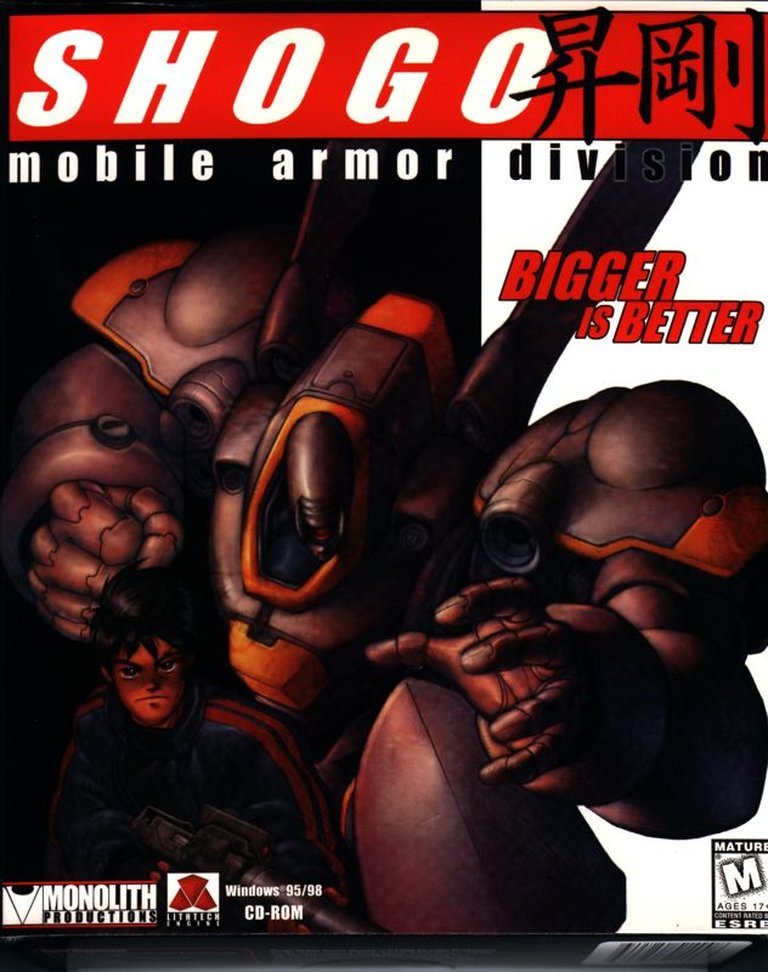
Description
Set in a futuristic sci-fi world, Shogo: Mobile Armor Division follows protagonist Sanjuro, a commander in the United Corporate Authority army who pilots a Mobile Combat Armor (MCA) giant mech. The game alternates between intense first-person on-foot combat with firearms and mech-based warfare where players control towering robots through urban battlefields. Players must hunt down Gabriel, the leader of the terrorist organization the Fallen, while navigating a linear narrative with branching choices that alter the story’s outcome, all set against a backdrop of anime-inspired aesthetics and critical hit mechanics.
Gameplay Videos
Where to Buy Shogo: Mobile Armor Division
Shogo: Mobile Armor Division Free Download
Shogo: Mobile Armor Division Cracks & Fixes
Shogo: Mobile Armor Division Mods
Shogo: Mobile Armor Division Guides & Walkthroughs
Shogo: Mobile Armor Division Reviews & Reception
metacritic.com (92/100): If there is any justice in the world Shogo will be looked back on as one of the best 3D games of its time. Personally speaking, apart from ‘Half-Life’, Shogo is the best game I’ve played this year.
ign.com (90/100): Shogo proves that first-person shooter titles can still offer something unique and genuinely fun.
Shogo: Mobile Armor Division Cheats & Codes
PC
Press ‘T’ to enter the ‘Talk’ function, then type the code and press ENTER.
| Code | Effect |
|---|---|
| mpgod | God mode |
| mpkfa | Full health, ammo, and armor |
| mphealth | Full health |
| mpammo | Full ammo |
| mparmor | Full armor |
| mpclip | Toggle clipping mode / spectator mode |
| mppos | Show or hide player position coordinates |
| mpcamera | Adjust camera angle |
| mplightscape | Adjust lighting |
| mpmech | Change mech model |
| mpanime | Japanese anime style explosions |
| mptears | Infinite ammo |
| mpbigguns | All characters have huge weapons |
| mpteleport | Teleport to level spawn point |
| mponfoot | Toggle mech/on-foot mode |
| mpvehicle | Toggle bipedal/vehicle mech mode |
| mpwpos | Toggle weapon position adjustment |
| mpwmpos | Toggle weapon muzzle position adjustment |
| mppm | Toggle player movement speed adjustment |
| mppa | Toggle player movement speed adjustment |
| mpboyisuck | Kill all AI/NPCs in the level |
| mpmimimi | All weapons with full ammo |
| showframerate1 | Display frame rate |
| MPFRAMRATE 1 | Turn frame rate on |
| MPFRAMRATE 0 | Turn frame rate off |
| mptriggers | Toggle trigger box visualization |
| world | Level select (followed by level name, e.g., world 01_Ambush) |
Shogo: Mobile Armor Division: Review
Introduction
In the crowded landscape of late-1990s first-person shooters, few titles dared to blend the adrenaline-fueled chaos of Quake-style gunplay with the towering spectacle of giant robot combat. Shogo: Mobile Armor Division (1998), a product of Monolith Productions, emerged as a bold, genre-defying experiment. It promised a universe pulsating with anime-inspired melodrama, visceral mech-on-mech warfare, and a narrative that dared to explore corporate greed and personal tragedy. Yet, its release coincided with an industry titan: Half-Life, which arrived just two weeks later and overshadowed Shogo both critically and commercially. Today, Shogo stands as a fascinating relic—an ambitious, flawed masterpiece that captured the zeitgeist of anime fandom while struggling against its own technological and design constraints. This review deconstructs Shogo’s legacy, examining its development, narrative, gameplay, artistry, and enduring impact, arguing that despite its imperfections, it remains a cult classic that championed innovation in a genre defined by conformity.
Development History & Context
The Studio
Monolith Productions, founded in 1994 by former Edmark employees, was a scrappy studio with a penchant for pushing boundaries. After the success of Blood (1997), they pivoted to create Shogo under the codename “Riot: Mobile Armor,” later “Metal Tek.” The team, led by producer John L. Jack and designer Craig Hubbard, was small but passionate. Hubbard, in retrospect, admitted the project was “a grim reminder of the perils of wild optimism and unchecked ambition” due to inexperience and scope creep. The studio’s dual focus on developing Shogo and the LithTech engine simultaneously strained resources, forcing compromises that would haunt the final product.
The Vision
Shogo’s core concept was revolutionary: a first-person shooter seamlessly integrating on-foot infantry combat with piloting anime-style mechs (Mobile Combat Armors, or MCAs). The vision was heavily inspired by Japanese mecha anime, particularly Patlabor and Appleseed, emphasizing realism over fantasy. Craig Hubbard aimed for a story-driven experience, stating, “We wanted to create a game with a plot and characters that mattered, unlike MechWarrior which was all game, no story.” This narrative ambition was rare for 1998, where shooters often prioritized action over plot. The game’s branching paths, culminating in two distinct endings, were a bold experiment in player agency.
Technological Constraints
Shogo debuted Monolith’s proprietary LithTech engine, a first-generation 3D framework that promised dynamic lighting, terrain deformation, and multiplayer support. However, the engine was unstable at launch, plagued by texture corruption and performance issues. Hubbard noted that the team abandoned ambitious features (e.g., seamless mech-on-foot transitions) six months before release, focusing instead on making the game “fun” rather than “great.” The split from Microsoft in 1998 added further strain; Monolith bought back the LithTech rights, becoming a self-publisher. This limited distribution, as major retailers sidelined Shogo in favor of better-funded titles, contributing to its commercial struggles.
The Gaming Landscape
1998 was a brutal year for FPS innovation. Half-Life redefined the genre with its scripted sequences and immersive storytelling, while Unreal and SiN pushed graphical boundaries. Shogo arrived amidst this maelstrom, and its release date proved fatal. As Hubbard lamented, “Two weeks before Half-Life’s release, we knew we’d be overshadowed.” Critics also compared it unfavorably to Blood II (another LithTech title), which, despite its flaws, garnered more attention. Shogo’s niche anime aesthetic further alienated mainstream audiences, cementing its status as a “love it or hate it” title.
Narrative & Thematic Deep Dive
Plot
Set on the mineral-rich moon Cronus, Shogo casts players as Sanjuro Makabe, a bitter UCA (United Corporate Authority) pilot haunted by past losses. His brother, best friend, and girlfriend Kura were killed in a mission years prior. Now, Sanjuro is tasked with hunting Gabriel, the enigmatic leader of the terrorist group The Fallen. The plot spirals into a web of betrayal, as Sanjuro uncovers that Kura might still be alive and that the UCA’s motives are far from altruistic. The narrative unfolds through cutscenes and in-game dialogue, culminating in player-driven choices that alter the game’s climax—either siding with the UCA or allying with Gabriel’s rebellion.
Characters
Sanjuro embodies the “tragic hero” archetype, his sarcasm masking deep-seated trauma. His love interest, Kathryn, Kura’s sister, adds emotional complexity, while Gabriel’s charismatic villainy shades the conflict. Supporting characters like the comedic technician “Toll Willie” inject levity, but the narrative’s strength lies in its melodramatic authenticity. As Hubbard intended, the characters feel ripped from a mecha anime, complete with exaggerated dialogue and dramatic turns.
Dialogue
The script oscillates between brilliant and cringe-worthy. Sanjuro’s one-liners (“It’s kinda complicated” regarding his love life) are intentionally over-the-top, echoing anime tropes. Yet, moments like a fetch quest involving a lost cat (a gatekeeper demands its return before yielding a key) feel tonally jarring. Critics universally noted the cheese factor, but Hubbard defended it as “part of the anime charm.” The voice acting, however, elevates the material, particularly Sanjuro’s world-weary delivery.
Underlying Themes
Shogo explores the dehumanizing cost of war, corporate greed, and the fragility of duty. The UCA’s quest for kato (a faster-than-light fuel) mirrors real-world resource conflicts, while Sanjuro’s personal vendetta against Gabriel questions the morality of blind obedience. Themes of redemption and identity permeate the story, especially as Sanjuro grapples with Kura’s “death.” These ideas, though clumsily executed, were ahead of their time in a genre typically devoid of introspection.
Gameplay Mechanics & Systems
Core Gameplay Loops
Shogo alternates between two distinct modes: on-foot infantry combat and MCA mech battles. On-foot sections play like a corridor shooter, with Sanjuro navigating claustrophobic bases and city streets. MCA segments offer open-city destruction, where players leap between skyscrapers, squish cars, and engage in mech duels. The lack of free transitions between modes (e.g., you can’t eject from your mech mid-combat) is a missed opportunity, but the segmentation ensures variety.
Combat
Combat is Shogo’s triumph. The critical hit system, where stylish kills restore health, rewards aggressive play and adds a risk-reward layer. Weapons are gloriously over-the-top: the Bullgut missile launcher fires quad-rockets, while energy weapons create satisfying bloom effects. Mech combat, however, suffers from physics inconsistencies. MCAs move with balletic agility, defying their tonal weight, and enemy AI is buggy—mechs often freeze after hits, allowing players to exploit recoil animations for easy kills. On-foot combat is tighter but marred by repetitive enemy designs and frustratingly high difficulty on harder settings.
Character Progression
Progression is linear, with weapons and mechs doled out at key story beats. Players choose from three MCAs: the slow but powerful Andra 35 Predator, the agile but frail Shogo Akuma Series 12, or the balanced Ordog. Each handles identically in terms of controls, differing only in stats, a design choice that simplifies but lacks depth. On-foot progression is standard, with health pickups and ammo caches mitigating resource scarcity.
UI
The interface embraces its anime aesthetic, featuring angular HUD elements and vibrant color schemes. The minimap and objective markers are functional if unremarkable. A notable innovation is the dynamic objective system, where secondary tasks (e.g., escorting a scientist) evolve organically, though these missions often devolve into tedious “babysitting.”
Innovative/Flawed Systems
- Critical Hit System: A brilliant mechanic that encourages precision but lacks explanation (purple flashes signify critical hits).
- MCA Vehicle Mode: Transforming mechs into unarmed vehicles is pointless, as it offers no strategic advantage.
- Level Design: Highlights include a wind-affected sniping level and rooftop-hopping sequences, but later levels descend into mazes, with identical hallways and poor navigation.
- AI Issues: Enemies exhibit inconsistent behavior—sometimes ignoring attacks, other times reacting superhumanly.
World-Building, Art & Sound
Setting
Cronus is a fusion of industrial grime and futuristic grandeur. Mining facilities, neon-drenched cityscapes, and the UCA’s flagship Leviathan create a believable, lived-in universe. The moon’s low-gravity environment influences level design, with platforms encouraging verticality. However, the setting’s potential is underutilized; Cronus feels more like a backdrop than a character.
Atmosphere
Shogo’s atmosphere is a study in contrasts. Gory, blood-soaked combat juxtaposes with poignant character moments, creating a tonal whiplash. The anime aesthetic permeates everything—from character designs to environmental details—evoking Ghost in the Shell’s grit and Gundam’s spectacle. Yet, the somber mood often clashes with the game’s cartoonish violence, resulting in a disorienting but unique vibe.
Visual Direction
Powered by LithTech, Shogo showcased impressive effects for its time: dynamic lighting, particle explosions, and detailed mech animations. Character models, angular and expressive, capture anime’s angular style. However, low-poly counts and texture repetition betray the engine’s infancy. MCA designs are standout, with the Akuma’s sleek silhouette and Predator’s bulk feeling distinct. Environments vary from sterile corridors to sprawling cityscapes, though the latter suffer from pop-in and draw distance issues.
Sound Design
Adaptive music by Guy Whitmore and Daniel Bernstein elevates the experience, shifting tempo during combat and swelling during dramatic moments. Sound effects are visceral—mech footfalls rumble, weapons crackle, and critical hits trigger satisfying squelches. Voice acting is solid, though Sanjuro’s sarcastic quips occasionally grate. The J-rock-inspired theme song and in-game radio chatter (e.g., “Toll Willie in the booth!”) reinforce the anime-inspired world.
Reception & Legacy
Critical Reception
Shogo was a critical darling, averaging 82% on MobyGames. The Adrenaline Vault awarded it a perfect 100%, calling it “as good as it gets” and “on the very short list” of great 3D games. Critics praised its anime flair, critical hit system, and mech combat, with IGN noting it proved “FPS titles can offer something unique.” However, complaints were consistent: short campaign (4-6 hours), AI flaws, and a convoluted plot. PC Gamer lamented its lack of longevity, while GameSpot criticized the “maze-like” levels. Retrospectively, it’s seen as a “flawed gem”—GameSpot’s 8.1/10 review now reads as prescient of its cult status.
Commercial Reception
Commercially, Shogo was a disaster. It shipped 100,000 units at launch but sold just 20,000 copies during the 1998 holiday season, overshadowed by Half-Life and Unreal. Self-publishing limited its reach, and Mark Asher of CNET observed that “the only FPS that’s done really well is Half-Life,” implying Shogo’s failure signaled a market saturation. This underperformance led to the cancellation of its expansion packs, Shugotenshi and Legacy of the Fallen.
Reputation Evolution
Over time, Shogo’s reputation has shifted from “mediocre” to “cult classic.” Fans celebrate its ambition, unique fusion of genres, and modding potential. The LithTech engine’s open-source release (2001) fueled a thriving community, with ports to Linux, Mac, and even Amiga. Critics now acknowledge its influence on later titles like F.E.A.R. (which originated as a “spiritual sequel” to Shogo). As Eurogamer noted, it’s “Monolith’s forgotten mech shooter”—a title that “crushed it underfoot like I would crush a wounded bee with my leather boots,” yet endures in nostalgia.
Influence
Shogo’s legacy lies in its proof of concept. It demonstrated that FPS and mech sim could coexist, influencing games like Titanfall and MechWarrior 5. Its branching narrative prefigured modern RPGs, while LithTech powered titles like Aliens Versus Predator 2. Monolith’s post-Shogo work, especially No One Lives Forever, refined its narrative ambitions, cementing the studio’s reputation for innovation. Though it never achieved mainstream success, Shogo remains a touchstone for mech enthusiasts and anime fans alike.
Conclusion
Shogo: Mobile Armor Division is a game of contrasts—a diamond in the rough, polished by ambition but marred by execution. Its synthesis of FPS and mech combat was visionary, its anime-inspired world rich with potential, and its narrative themes daring for 1998. Yet, technical hiccups, AI shortcomings, and the specter of Half-Life relegated it to cult status. In the end, Shogo’s legacy is one of influence. It proved that a small studio could defy genre conventions, that mech games could thrive outside simulations, and that anime aesthetics could enrich Western gaming. For all its flaws, Shogo remains a testament to the power of creative risk-taking—a flawed, unforgettable masterpiece that, like its MCAs, towers over its contemporaries in spirit if not in scale. Verdict: An essential, flawed classic that deserves rediscovery.