
- Release Year: 2000
- Platforms: Windows
- Publisher: Microïds
- Developer: Microïds
- Genre: Compilation
- Game Mode: Single-player
Description
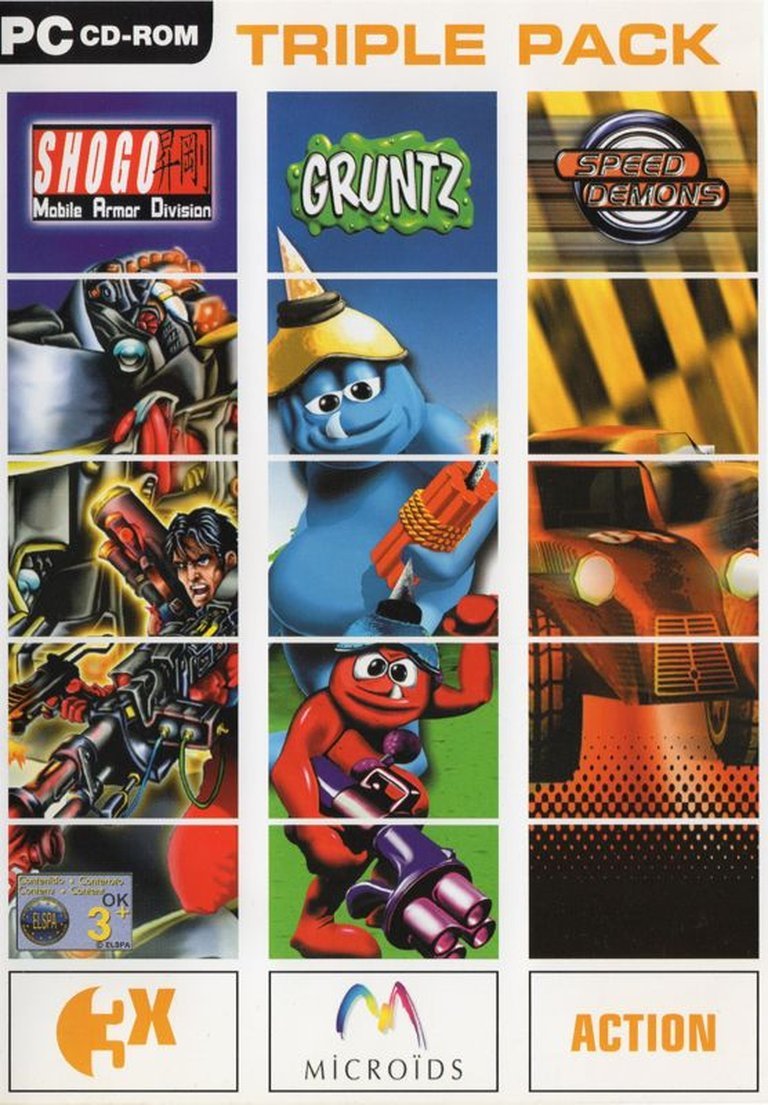
Released in 2000 by French publisher Microïds, the Microïds Triple Pack – Action is a compilation bundling three distinct action games: Shogo: Mobile Armor Division, Gruntz, and Speed Demons. Each title offers a unique action experience with its own premise, ranging from futuristic mech combat and cartoonish strategy to high-speed racing, providing players with diverse gameplay styles and settings within a single collection.
Microïds Triple Pack – Action: Review
Introduction
In the annals of video game history, compilations often serve as time capsules, capturing the zeitgeist of an era through the lens of their constituent titles. Released in 2000 by French publisher Microids (then Microïds), the Microïds Triple Pack – Action stands as a fascinating artifact of the late-90s PC gaming landscape—a curated anthology of three distinct action experiences that, while thematically disparate, collectively reflect the studio’s ambitious expansion beyond its adventure game roots. This compilation bundles Shogo: Mobile Armor Division, Gruntz, and Speed Demons, offering players a journey through cyberpunk mech combat, cartoonish puzzle-platforming, and arcade-style racing. Microids, founded in 1985 by Elliot Grassiano, had transitioned from simulation pioneers to a multi-continental publisher by the late ’90s, yet this pack reveals its calculated foray into high-octane genres during a transitional period. Its value lies not just in the games themselves, but as a microcosm of Microids’ strategic evolution and the experimental spirit of PC action gaming at the turn of the millennium. Through exhaustive analysis of each title, their development contexts, and their place in Microids’ broader legacy, this review argues that the Triple Pack—while uneven—remains a vital document of a publisher’s diversification and the enduring appeal of distinct action subgenres.
Development History & Context
Microids’ journey to the Triple Pack is rooted in its identity as a French studio navigating the volatile waters of late-90s game development. Founded by Grassiano, an engineer turned programmer, the company initially thrived on simulations like 500 cc Grand Prix (1986) and edutainment titles before pivoting to publishing and distribution in 1995. By the late ’90s, Microids had established international subsidiaries in Canada, the UK, and Italy, employing over 200 personnel and leveraging partnerships with publishers like Broderbund and Activision for global reach. However, the late ’90s were turbulent: while Microids was gaining prominence through its adventure games (e.g., Amerzone in 1999), it concurrently sought to broaden its portfolio into mainstream action genres to mitigate risks associated with niche narrative-driven titles.
The three games in the Triple Pack encapsulate this diversification:
– Shogo: Mobile Armor Division (1998): Developed by Monolith Productions, this first-person shooter was published by Microids in Europe. It emerged from the golden age of PC shooters, blending mech-on-foot combat with Mobile Suit Gundam-inspired giant robot battles. Its inclusion in the Triple Pack signified Microids’ strategy to secure established Western-developed action titles for European distribution.
– Gruntz (1999): A puzzle-platformer developed by Saffire, this title represented Microids’ interest in accessible, family-friendly action. Created by ex-LucasArts designer Clif Skluzacek, it combined cartoonish charm with strategic puzzle-solving, reflecting the studio’s expansion into edutainment-adjacent genres.
– Speed Demons (1999): A futuristic arcade racer from Saffire, it targeted the burgeoning extreme sports market. Its inclusion highlighted Microids’ attempt to capitalize on the popularity of titles like Need for Speed and Wipeout, aligning with the era’s appetite for high-speed, visually striking experiences.
Technologically, the compilation operated within the constraints of 1999–2000 Windows gaming. Shogo relied on LithTech Engine 1.0, pushing early 3D graphics with its mech transformations; Gruntz used 2.5D sprites for its cartoon worlds; Speed Demons employed sprite-based pseudo-3D for arcade racing. The gaming landscape in 2000 was saturated with PC action titles—competing against heavyweights like Quake III Arena and Deus Ex—and Microids’ Triple Pack positioned itself as a budget-friendly alternative, offering three titles at a fraction of individual purchase prices. This was a savvy move for a publisher balancing risk and reach, reflecting the era’s trend toward genre consolidation in compilations.
Narrative & Thematic Deep Dive
While action games often prioritize mechanics over story, the Triple Pack’s titles offer surprisingly rich, if varied, narratives that reflect their distinct genres and thematic preoccupations.
Shogo: Mobile Armor Division delivers a cyberpunk narrative steeped in corporate espionage and existential conflict. Players assume the role of Sanjuro Makabe, a mech pilot for the authoritarian UCA (United Corporate Authority) fighting a rebellion on the planet Cronus. The story unfolds through cinematic cutscenes and in-game dialogue, exploring themes of loyalty, betrayal, and the dehumanizing nature of war. Makabe’s journey from loyal soldier to reluctant rebel intersects with a love interest, Kazuki Tetsuhara, and a mysterious conspiracy involving alien artifacts. The narrative leverages its Gundam influences to critique unchecked corporate power, with giant mechs serving as both tools of oppression and symbols of fragile humanity. Dialogue is serviceable, emphasizing action over deep characterization, but the lore—expanded through terminal logs and environmental storytelling—adds layers to a world where mech combat is as much a political statement as a military necessity.
Gruntz adopts a whimsical, fairy-tale narrative that subverts action-game conventions. Players guide “Gruntz” through a board-game-like quest to rescue the King Gruntz, who has been imprisoned by the evil Lord Dredd. Each level is a puzzle-filled realm with cartoonish antagonists (e.g., “Fungineers” and “Slimez”) and dialogue-driven interactions. The theme centers on playful rebellion: Gruntz use absurd gadgets like “Goo-Guns” and “Tongue Twisters” to outwit foes, emphasizing strategy over brute force. The narrative’s charm lies in its meta-humor, breaking the fourth wall to lampoon gaming tropes (“Press the button to save the game!”). Thematically, it celebrates cooperation and ingenuity, with two-player co-op enabling collaborative problem-solving. While the story is simplistic, its lighthearted tone provides a stark contrast to the Triple Pack’s grittier titles, highlighting Microids’ range.
Speed Demons eschews narrative depth in favor of arcade thrills, framing its races as illegal tournaments in a dystopian future. Players join the “Speed Demons” crew, competing against rival gangs in neon-drenched cityscapes and off-road terrains. The plot is thin—win races to unlock new vehicles and territories—but it reinforces themes of speed, rebellion, and underground culture. Characters are archetypes (e.g., the “Hotshot” racer and the “Mysterious Mechanic”), and dialogue is minimal, focusing on trash-talking rival crews. This aligns with the game’s core appeal: immersion in high-octane competition where narrative serves as a catalyst for action. Thematically, it reflects late-90s fascination with extreme sports, transforming racing into a form of youthful defiance against a sterile, corporatized world.
Collectively, the Triple Pack’s narratives traverse cyberpunk gravitas, cartoonish absurdity, and arcade catharsis, reflecting Microids’ effort to cater to diverse player preferences while maintaining thematic cohesion through rebellion—be it against corporations, tyrannical rulers, or societal norms.
Gameplay Mechanics & Systems
The Triple Pack’s gameplay is a study in contrast, with each title offering distinct mechanics that exemplify their respective genres.
Shogo: Mobile Armor Division pioneers a hybrid FPS/mech combat system that was innovative for its time. Players seamlessly switch between ground-level infantry combat and piloting 15-meter-tall “Armors,” each with unique weapons and movement capabilities. Core gameplay loops involve objective-based missions (e.g., escorting allies, destroying bases) with mech combat at its center. The mech battles are visceral—featuring rocket salvos, melee strikes, and destructible environments—while infantry sections offer tactical variety with sniping and grenades. A standout feature is the “Jetpack,” enabling vertical mobility and emergent tactics. However, the system suffers from inconsistent AI and occasional mission monotony. Character progression is minimal, with weapon upgrades tied to mission completion, but the customization of mechs (e.g., swapping arms and legs) adds depth. The UI is functional, with a minimalist HUD for health/armor and a detailed inventory screen, though the control scheme for mech transformations could feel clunky. Shogo’s legacy lies in its ambition to fuse scale and speed, even if execution was uneven.
Gruntz redefines action as puzzle-platforming, blending exploration with strategic combat. Players control Gruntz across 35+ levels, each brimming with environmental hazards, enemy puzzles, and collectible “Powerz” (e.g., “Lava Boots” for traversing molten terrain). Combat is turn-based: Gruntz and enemies take turns moving and attacking, requiring careful positioning and item usage (e.g., “Goo-Guns” to immobilize foes). The core loop is puzzle-solving: using gadgets to manipulate enemies, avoid traps, and reach the exit. Multiplayer co-op enhances this, allowing two players to coordinate actions (e.g., one distracting enemies while the other solves a switch puzzle). Progression is nonlinear, with “Gruntz Quests” offering branching paths. The UI is intuitive, with an inventory system for managing gadgets and a minimap for navigation. However, the game’s difficulty spikes in later levels, and the cartoonish visuals can obscure puzzle elements. Gruntz’s strength lies in its accessibility and co-op depth, making it a rare action title emphasizing brains over brawn.
Speed Demons embodies arcade racing with its emphasis on reflexes and shortcuts. Players race across 24 tracks spanning cities, deserts, and futuristic circuits, using nitro boosts and drifting to gain an edge. The core loop involves qualifying in tournaments to unlock vehicles (e.g., hoverbikes, antigravity cars) and new tracks. Combat is limited to ramming rivals or deploying power-ups (e.g., “EMP bombs”), shifting focus to pure speed. The game supports split-screen multiplayer for up to four players, capitalizing on the era’s local co-op culture. Progression is tied to earning “Demons” (in-game currency) for upgrades, though vehicle customization is superficial. The UI is arcade-centric, with lap timers and position indicators, but the controls are floaty, leading to frustrating drift mechanics. Speed Demons’ innovation lies in its “Stunt System,” where performing aerial tricks earns nitro refills, rewarding risk-taking. Yet, its lack of depth compared to contemporaries like Gran Turismo limits long-term appeal.
Together, these systems showcase Microids’ willingness to embrace diverse action paradigms, from the experimental hybrid of Shogo to the accessible puzzles of Gruntz and arcade simplicity of Speed Demons. While Shogo’s ambition and Gruntz’s co-op shine, Speed Demons feels like a lesser entry, highlighting the pack’s inherent unevenness.
World-Building, Art & Sound
The Triple Pack’s worlds, art styles, and soundscapes are as diverse as their gameplay, each contributing to distinct atmospheres that defined late-90s PC action aesthetics.
Shogo: Mobile Armor Division immerses players in a dense cyberpunk world, blending high-tech dystopia with Eastern influences. Cronus is a rain-soaked planet rife with neon-lit cities, industrial wastelands, and decaying megacorporate complexes, evoking films like Blade Runner. The mechs are meticulously detailed, with bulky, utilitarian designs contrasting sleeker UCA and rebel factions. Environments are destructible—walls crumble under rocket fire, vehicles explode dynamically—enhancing immersion. The art direction favors dark, moody palettes, punctuated by the glow of holographic interfaces and muzzle flashes. Sound design is critical: the heavy footsteps of mechs, the whir of transforming joints, and the cacophony of combat ground the experience. The soundtrack, a blend of industrial and electronic, amplifies tension during missions. While graphical limitations of the era result in dated textures, the world-building’s strength lies in its consistency, making Cronus feel lived-in and politically charged.
Gruntz constructs a vibrant, cartoon universe that defies grimdark trends. Its world is a patchwork of themed realms—from “Goo Lagoon” (a swamp) to “Boneyard” (a desert graveyard)—rendered in 2.5D with exaggerated, stylized environments. Characters are whimsical: Gruntz have googly eyes and expressive animations, while enemies like “Slimez” ooze personality. The art draws inspiration from Looney Tunes, with bright colors, exaggerated physics (e.g., springy jumps), and exaggerated sound effects (boings, splats). Sound is playful: a jaunty, upbeat score accompanies exploration, while combat features comedic “boing” and “splat” effects. The UI embraces the cartoon aesthetic with comic-book-style fonts and animated icons. This cohesive art direction makes Gruntz’s world feel like an interactive cartoon, where danger is always tempered by humor. Its art and sound prioritize charm over realism, creating a welcoming space for co-op gameplay.
Speed Demons opts for a high-contrast, neon-drenched future. Tracks are set in sprawling metropolises with glowing skyscrapers, underground tunnels, and tropical circuits, all rendered in vibrant, saturated colors. Vehicles are sleek and futuristic, with glowing trails and turbo effects. The art direction mirrors Wipeout, emphasizing speed through motion blur and dynamic camera angles. Sound design focuses on auditory intensity: the roar of engines, screeching tires, and an electronic soundtrack with pounding beats. Environmental details are minimal, but the sense of velocity is palpable. The UI is arcade-bright, with flashy HUD elements and speedometer animations. While visually striking, the world lacks depth, feeling more like a series of race courses than a cohesive setting. Still, the art and sound synergize to create an adrenaline-fueled atmosphere, perfect for competitive multiplayer.
Across the Triple Pack, art and sound serve as genre signifiers: Shogo’s grittiness, Gruntz’s whimsy, and Speed Demons’ spectacle. While none reach the heights of contemporaries, each succeeds in establishing immersive worlds that enhance their respective gameplay loops.
Reception & Legacy
Upon release in 2000, the Microïds Triple Pack – Action received little critical fanfare, reflecting its niche status as a budget compilation. Shogo garnered moderate praise for its mech innovation (e.g., PC Gamer noted its “bold fusion of genres” but criticized its inconsistent AI). Gruntz was lauded for its co-op and humor, with Computer Gaming World calling it “a charming surprise” but lamenting its short length. Speed Demons was dismissed as derivative, with GameSpot scoring it 5.0, citing “uninspired racing.” Commercially, the pack had minimal impact, overshadowed by AAA titles like Diablo II and The Sims. Microids itself was undergoing restructuring during this period, merging with MC2 in 2003 and later facing acquisitions, which may have limited sustained marketing for the compilation.
Yet, the Triple Pack’s legacy has evolved over time. Shogo is now remembered as a cult classic, cited in discussions of innovative mech design and its influence on titles like Titanfall. Its blend of scale and speed anticipated trends in modern shooters. Gruntz has become a beloved co-op title, preserved in gaming communities for its unique puzzle-combat mechanics and nostalgic charm. Speed Demons, while less enduring, exemplifies the era’s arcade-racer saturation, serving as a historical footnote. Microids, through its later adventures like Syberia, largely abandoned action compilations, focusing instead on narrative-driven experiences. However, the Triple Pack remains a testament to the publisher’s experimental phase, showcasing its willingness to diversify beyond its comfort zone. It also highlights the era’s compilation culture, where budget bundles offered varied experiences for a single price—a model resurfacing in modern services like Xbox Game Pass.
Influence-wise, the pack’s titles had limited direct impact, but Shogo’s mech combat and Gruntz’s co-op puzzles resonate in indie games like Lethal Company and Cult of the Lamb. Microids’ legacy as a publisher is now tied to adventure games, but the Triple Pack stands as a reminder of its ambitious, if fragmented, past.
Conclusion
The Microïds Triple Pack – Action is a time capsule of late-90s PC gaming ambition and a microcosm of Microids’ evolution from simulations to a multi-genre publisher. While the compilation is uneven—Shogo’s innovative mech combat and Gruntz’s charming co-op puzzles shine, while Speed Demons feels dated and shallow—it offers a compelling cross-section of action subgenres that defined the era. The games’ narratives, mechanics, and art styles reflect both Microids’ strategic diversification and the broader gaming landscape’s experimentation. Though it lacked initial acclaim and commercial impact, the Triple Pack has accrued cult status over time, preserving the legacy of Shogo and Gruntz while exemplifying the risks and rewards of genre-spanning compilations.
For modern players, the pack serves as a historical artifact, offering a glimpse into an era before genre consolidation, when studios like Microids could bundle a cyberpunk shooter, a cartoon puzzler, and an arcade racer into one affordable package. Its flaws are evident—dated graphics, inconsistent AI, and shallow gameplay in places—but its ambition and variety remain commendable. In the pantheon of video game compilations, the Microïds Triple Pack – Action may not be a masterpiece, but it is an essential piece of Microids’ history and a testament to the creative chaos of late-90s PC gaming. It stands as a reminder that even in an era dominated by AAA blockbusters, niche compilations could carve out unique spaces, leaving indelible marks on the medium’s evolution.