
- Release Year: 2000
- Platforms: Windows
- Publisher: Focus Multimedia Ltd., Hasbro Interactive, Inc., Mindscape Germany GmbH
- Developer: Minds Eye Productions
- Genre: Educational
- Perspective: Diagonal-down
- Game Mode: Single-player
- Setting: Fantasy
- Average Score: 70/100
Description
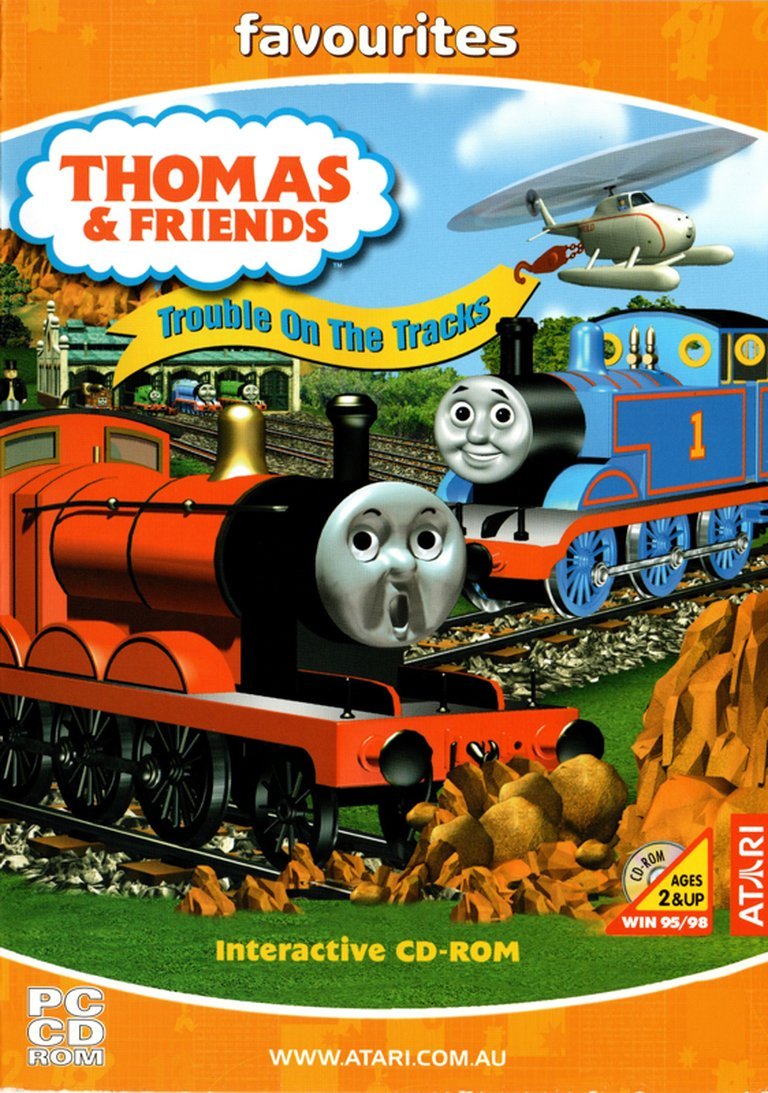
Thomas & Friends: Trouble on the Tracks is an educational adventure set on the fictional island of Sodor, where players help rescue and repair James the Tank Engine after he derails due to excessive speed. The game involves interactive tasks like collecting coal, operating a crane to lift James back onto the tracks, installing new parts such as a lamp and whistle, and painting James to restore him to his original condition.
Gameplay Videos
Thomas & Friends: Trouble on the Tracks Free Download
Thomas & Friends: Trouble on the Tracks Guides & Walkthroughs
Thomas & Friends: Trouble on the Tracks Reviews & Reception
metacritic.com (70/100): For a kids game, this is very good. I remember playing this as a kid, and I had a lot of fun With it. The animation hasn’t dated well, but the game is still a solid 7/10!
Thomas & Friends: Trouble on the Tracks: Review
Introduction
In the golden age of licensed edutainment, few franchises captured the hearts of children quite like Thomas & Friends. Among its digital adaptations, Trouble on the Tracks (2000) stands as a beacon of interactive storytelling, transforming the beloved world of Sodor into a hands-on adventure. Developed by Minds Eye Productions and published by Hasbro Interactive, this Windows CD-ROM game masterfully blends narrative, education, and nostalgia. It is not merely a game but a digital storybook where players become instrumental in saving James the Red Engine after a derailment. Its legacy endures not just as a childhood relic, but as a benchmark for how licensed properties can adapt to interactive media while preserving their core values of teamwork, responsibility, and community. This review deconstructs the game’s intricate design, contextual significance, and lasting impact to affirm its place in video game history.
Development History & Context
Thomas & Friends: Trouble on the Tracks emerged from the creative ecosystem of Minds Eye Productions, a studio specializing in edutainment titles like The Great Festival Adventure. The production was a monumental undertaking, employing a team of 75 credited individuals, including industry veterans such as CEO Thomas Dusenberry, Senior Producer Teresa Chubet, and Chief Creative Officer John Sutyak. This manpower underscored the game’s ambition to deliver a polished, narrative-rich experience. Technologically, it was constrained by the Windows CD-ROM era of 2000, requiring a Pentium 166 MHz processor, 32 MB RAM, and DirectX 7.0 compatibility. The game utilized Bink Video for cutscenes, a middleware choice that enabled pre-rendered CGI sequences—rare for children’s software at the time.
The development vision was clear: to adapt a classic Thomas and the Breakdown Train episode into an interactive format while embedding educational objectives. This aligned with a booming edutainment market dominated by titles like Reader Rabbit and Spy Fox, where licensed properties (e.g., Barney, Tonka) thrived. Hasbro Interactive’s involvement reflected a strategic push to leverage the Thomas & Friends brand’s global popularity across multiple media. The game’s release on November 3, 2000, coincided with the franchise’s transition from Britt Allcroft’s era to HiT Entertainment, positioning it as a bridge between the Railway Series’ roots and modern digital storytelling.
Narrative & Thematic Deep Dive
The game’s narrative is a masterclass in linear storytelling tailored for young audiences. It opens with a coal shortage on Sodor, prompting Sir Topham Hatt to dispatch James. Overconfidence leads to James derailing at a sharp bend—a dramatic sequence rendered in CGI, complete with sparks, screeching metal, and his driver/fireman leaping to safety. The subsequent rescue mission unfolds through a chain of events: Harold locates the derailed James, the Horrid Lorry reluctantly delivers coal, and Thomas leads the repair effort. This mirrors the Thomas and the Breakdown Train episode but expands it into a multi-act player-driven saga.
Characters are faithfully represented, with Michael Angelis (UK) and Robin Smith (US) narrating, lending authenticity. James’s arc—from proud splendor to despair, then redemption—anchors the story, teaching consequences of recklessness (“I can’t slow down!”) and the value of community. The Fat Controller’s role as a benevolent authority reinforces themes of responsibility, while Percy’s quiet diligence and Thomas’s plucky leadership exemplify teamwork. Dialogue is simple yet purposeful: James’s moans (“I’ll never be splendid again!”) and the Horrid Lorry’s grumpy complaints (“Collecting coal makes me very grumpy!”) inject personality. Underlying themes include empathy (helping a hurt friend) and problem-solving (repairing a crane, matching weights), subtly woven into gameplay to reinforce educational goals without overt lecturing.
Gameplay Mechanics & Systems
As a point-and-click adventure, the game eschews complex controls in favor of intuitive interaction, ideal for its 4–6-year-old audience. Its core loop revolves around eight activities, each escalating in difficulty across three levels, culminating in James’s restoration.
- Find James: Players guide Harold across Sodor’s landscapes, clicking hotspots to locate James while avoiding the mischievous Tiger Moth. This teaches spatial awareness and pattern recognition.
- Collect Coal: A dexterity-based mini-game where players load coal into the Horrid Lorry while avoiding tools—a clever metaphor for carefulness. Levels demand 5, 7, or 9 loads, integrating basic counting.
- Mend the Breakdown Crane: A puzzle requiring players to select and fit cogs into a crane mechanism, fostering problem-solving.
- Find a Whistle for James: A memory game where players match engine whistles, with variations across levels (e.g., engines whistle once in Level 3).
- Load the Troublesome Trucks: A physics-lite activity balancing weights on a bridge, introducing basic physics concepts.
- Find a Lamp for James: A sequencing task where players arrange lamps on a shelf, reinforcing order and memory.
- Repair James: A creative finale allowing players to “repair” and repaint James, rewarding effort with visual satisfaction.
- Get James Ready: A final step involving coal and water allocation, symbolizing readiness and responsibility.
The UI is clean and functional, with a diagonal-down perspective that immerses players in Sodor’s world. Progression is linear but rewarding, with printable certificates (e.g., “Master Search and Rescue Navigator”) and jigsaw puzzles extending engagement. Activities are designed to be replayable, with subtle variations (e.g., different engine whistle sets) encouraging mastery. While not innovative by modern standards, the system’s cohesion—tying each activity to James’s restoration—creates a satisfying narrative cohesion.
World-Building, Art & Sound
Trouble on the Tracks excels in bringing the Island of Sodor to life. The game’s world-building is meticulous, featuring iconic locations like Tidmouth Sheds, Brendam Docks, and the Coal Mines, each rendered in a vibrant, storybook style. The art direction prioritizes clarity and warmth, with bold colors and simple shapes that reflect the show’s aesthetic. Cutscenes use in-house CGI that, while jagged by today’s standards, captured the 3D charm of the TV series’s early models. Environmental details—like Harold’s six rotor blades (a goof noted by fans) or Edward’s misaligned whistle—add charm and are often discussed in fan communities.
Sound design is equally meticulous. Marcus Fielding’s original score evokes the show’s themes: Thomas’s jaunty tune during missions, Percy’s gentle melody in quieter moments. Sound effects—from coal clattering to engine chugs—are crisp and immersive. Voice acting is stellar, with Angelis and Smith delivering performances that feel extensions of their TV roles. The Horrid Lorry’s gruff US voice (based on Budgie the Little Helicopter’s Chuck) adds comic relief, while James’s sighs of despair elicit empathy. Bink Video cutscenes seamlessly blend dialogue and action, making the story cinematic. Together, these elements create an auditory-visual tapestry that feels authentically Sodor, transforming the game into a sensory pilgrimage for fans.
Reception & Legacy
At launch, Trouble on the Tracks resonated deeply with its target audience. Commercially, it thrived in the edutainment market, published internationally by Mindscape and Focus Multimedia. Critical reviews were scarce, but user feedback on platforms like MyAbandonware reflects adoration, averaging 4.74/5 based on 295 votes. Players praised its “nostalgia” and “solid” activities, though some noted technical hiccups (e.g., compatibility issues with modern Windows). Metacritic lists no critic scores, but user reviews on IMDb and Metacritic laud its “fun” factor and replayability.
Legacy-wise, the game remains a cult classic. It preserved the Thomas narrative in interactive form during an era of HiT Entertainment’s shift toward CGI models, featuring rare assets like Thomas’s unused “hurt face.” Its influence is evident in later titles like Thomas Saves the Day (2003) and Special Delivery (2008), which adopted its rescue-narrative template. Abandonware communities keep it alive, with archives like the Internet Archive offering playable copies. Fan wikis meticulously document its trivia—from goofs (e.g., Harold’s extra blades) to unused audio clips—underscoring its enduring appeal. In broader gaming history, it stands as a paragon of licensed edutainment, proving that simplicity, narrative, and thematic integrity can outlast technological novelty.
Conclusion
Thomas & Friends: Trouble on the Tracks is more than a game; it is a digital time capsule that encapsulates the magic of Sodor. While its visuals and technical specs feel antiquated, its gameplay design—tying educational activities to a heartfelt narrative—remains exemplary. It excels in teaching empathy, problem-solving, and teamwork without sacrificing fun, proving that edutainment need not be pedantic. For a generation of children, it was a first step into interactive storytelling, fostering a love for both trains and gaming. Though overshadowed by modern mobile titles, its legacy persists in fan communities and as a benchmark for licensed adaptations. In the annals of video game history, Trouble on the Tracks is not merely a relic but a testament to the enduring power of well-crafted, character-driven experiences. Verdict: A timeless masterpiece of interactive storytelling that continues to chug along in the hearts of fans.