
- Release Year: 2002
- Platforms: Windows
- Publisher: Walk On media publishing
- Developer: Toon 8 Games
- Genre: Action, Compilation, Driving, Puzzle, Racing, Sports, Strategy, Tactics
- Perspective: Side view
- Game Mode: Hotseat, Single-player
- Gameplay: Arcade, Artillery, Beat ’em up, Board game, brawler, Cards, Fighting, Paddle, Platform, Pong, Shooter, Tile matching puzzle, Tiles
- Setting: Classical, Egypt (Ancient), Futuristic, Japan (Ancient, Medieval), Sci-fi
Description
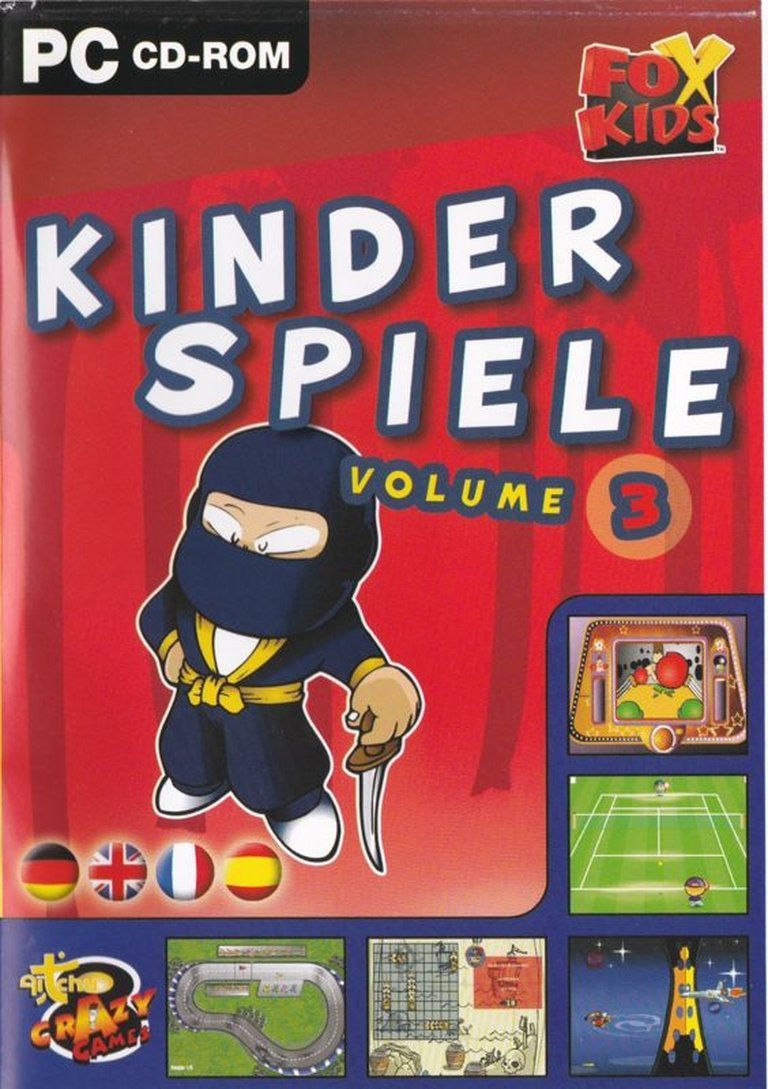
Fox Kids Kinder Spiele: Volume 3 is a diverse compilation of casual games released in 2002 for Windows, featuring a wide array of gameplay styles including shoot ’em ups, puzzles, sports, reflex challenges, platformers, and more. The games are designed to be played directly from a CD without installation and are accessible with instructions available in multiple languages including English, French, German, and Spanish. Players can engage in various activities from shooting ghosts and aliens, solving puzzles and mazes, racing and fighting, to navigating platform adventures, all within a browser window interface.
Fox Kids Kinder Spiele: Volume 3: Review
Introduction
In the crowded landscape of early 2000s casual gaming, Fox Kids Kinder Spiele: Volume 3 emerges as a curious artifact—a German-language compilation of 31 microgames packaged as a browser-based experience on CD-ROM. As a product of Toon 8 Games and Walk On Media Publishing, it embodies the transitional era of PC gaming, where CD-ROMs offered multimedia experiences before broadband dominance. This anthology, part of the Fox Kids Kinder Spiele series, transcends mere nostalgia by serving as a time capsule of European casual game design. Its quirky array of arcade, puzzle, and platformer minigames reveals both the technological constraints and creative ambitions of the era. This review argues that while Volume 3 lacks narrative cohesion, its eclectic design and cultural significance as a licensed product from the declining Fox Kids brand offer a unique window into the localizations and mechanical innovations of pre-social gaming digital playgrounds.
Development History & Context
Studio and Vision
Developed by Toon 8 Games—a studio with sparse historical records—and published by Walk On Media Publishing in 2002, Volume 3 was conceived as a budget-friendly compilation targeting European families. The games run directly from a CD-ROM in a browser window, requiring no installation—a nod to the era’s slow internet speeds and parental concerns about downloads. Despite its German title (Kinder Spiele meaning “Children’s Games”), the interface supports English, French, German, and Spanish instructions, reflecting a pan-European localization strategy.
Technological Constraints
The game is a product of Windows 98/XP’s early browser-based game ecosystem. It relies on Adobe Flash Player (evidenced by security prompts) and demands minimal hardware: a Pentium 200 CPU, 16MB RAM, and a 20X CD-ROM drive. The SuperVGA graphics were intentionally simple to run on low-end PCs, with games confined to small browser-window rectangles. This design choice prioritized accessibility over visual fidelity, mirroring the era’s shift from CD-ROM “big box” games to casual digital content.
Gaming Landscape
Released in 2002, Volume 3 emerged amid seismic shifts. The Fox Kids brand was winding down (officially replaced by 4Kids TV in the US), and casual gaming was exploding via websites like Miniclip. Meanwhile, compilations like Hoyle Kids Games and Crazy Taxi 3 dominated the PC market. Toon 8 capitalized on this by leveraging Fox Kids’ recognizable branding—a final hurrah for a brand whose legacy includes Digimon and Power Rangers but was fading post-Disney acquisition. The compilation’s structure—grouped into “Shoot ’em Up,” “Reflection,” “Sport,” “Skill/Reflex,” “Platform,” and “Others”—reflects a pre-categorization approach to game genres, where “arcade” and “puzzle” were still distinct buckets.
Narrative & Thematic Deep Dive
Anthology Structure and Absence of Central Narrative
As a compilation, Volume 3 lacks overarching narrative. Instead, it offers fragmented micro-stories within individual games:
– Escape 3 positions the player as a ghost-fighter defending against hordes of “grey ghostly characters,” repeating three levels indefinitely.
– Ghost House tasks players with guiding a “cute little girl” through a zombie-infested house by clicking directional arrows on coffins—a rare horror-themed entry softened for children.
– Aïtchu 3 follows a ninja searching for his pig, Sowsi San, in King Fugu’s aquatic domain—a serialized platformer with cutscenes.
Thematic Nuances
The compilation’s themes are dictated by its genres:
– Skill/Reflex games like Big Splash (fairground dunking) and Corrida (bullfighting-as-Space Invaders) celebrate carnival culture.
– Puzzle games (Diamonds, Reverse 2) abstract strategy from real-world conflicts.
– Platformers (Ozy Rush, Aïtchu 3) borrow from Egyptian (mummy) and Japanese (ninja) mythology, hinting at Fox Kids’ global branding. Notably, Mashed Monkeys’s “mercyless” monkey-hunting underscores the era’s casual acceptance of cartoon violence.
Dialogue and Localization
Dialogue is minimal, confined to instructions (e.g., “Dunk the girl by hitting the clown’s hands”). The German title and multilingual support suggest a deliberate European market expansion, contrasting with US-centric Fox Kids content like Kirby: Right Back at Ya!—a dub known for heavy censorship. Here, localization prioritizes accessibility over cultural adaptation, with no evidence of the aggressive edits seen in 4Kids’ anime dubs.
Gameplay Mechanics & Systems
Core Mechanics by Category
– Shoot ’em Up: Mouse-controlled precision defines games like Snipe (unstable reticle, 30-second target shooting) and SSD (side-scrolling space shooter). Pigs War combines keyboard movement (arrow keys) with mouse aiming, a hybrid control scheme.
– Reflection/Puzzle: Labyrinth uses mouse-tracing for maze navigation with a limited viewport, while USS (Battleship) offers turn-based strategy.
– Sport: Fat Punch is a “keyboard mashing” boxing game, Tennis Open mirrors Pong’s simplicity.
– Skill/Reflex: Crazy Cars pits two players in spike-equipped cars bursting balloons—a dual-iteration of Tron-like light cycles. Fireman inverts Space Invaders by fighting fires from above.
– Platform: Aïtchu 3 is a full-fledged platformer with swimming segments; Ozy Rush uses click-to-elevate platforms for a mummy character.
– Others: Jackpot 2 is a slot machine; Last Fight a two-player beat ’em up.
Innovations and Flaws
– Innovation: Ghost House’s coffin-arrow mechanic prefigures modern click-based puzzle design. Big Splash’s pie-throwing/dunking combo rewards timing over reflexes.
– Flaws: The browser-window constraint shrinks playfields, making Labyrinth’s mouse-tracing frustrating. Escape 3’s repetitive boss fights and Catapult’s fixed-shot artillery lack progression. Limited multiplayer support (1-2 players) restricts replayability versus contemporary PC compilations.
UI and Accessibility
The main menu uses a tabbed browser interface for categories, but game entry triggers Adobe Flash security warnings—a technical relic. Instructions are clear but multilingual support is inconsistent: Puzzle 2’s jigsaw timer is intuitive, but Reverse 2 (Reversi) omits rules.
World-Building, Art & Sound
Visual Direction
Games adopt distinct 2D styles:
– Shoot ’em Up: Pixelated sprites (Escape 3’s ghosts) and vibrant colors (SSD’s space nebulae).
– Skill/Reflex: Mashed Monkeys’s cartoonish violence contrasts with Ozy Rush’s muted Egyptian palette.
– Platform: Aïtchu 3’s aquatic levels use blue gradients for depth, while Ozy Rush’s mummy character evokes 1990s platformers.
The small browser windows (max 640×480) compress visuals, but sprites remain crisp.
Sound Design
Sound effects are rudimentary: Balltrap’s “Poool!” clay pigeon shatters, Big Splash’s pie-throws lack impact. No unified soundtrack exists; each game has minimal looping tunes. Ghost House’s zombie groans and Fat Punch’s punch impacts are the standout audio cues.
Atmosphere and Themes
– Carnival Aesthetic: Snipe, Balltrap, and Big Splash evoke fairground attractions.
– Horror Lite: Ghost House replaces fear with whimsy, using cartoon zombies and a lost girl.
– Global Influences: Aïtchu 3’s ninja quest and Ozy Rush’s mummy reflect Japan-Egypt hybridization in Fox Kids’ library.
Reception & Legacy
Critical and Commercial Reception
No contemporary reviews survive, but MobyGames’ sparse data (collected by 5 players) suggests niche appeal. Its German market focus and lack of US distribution limited visibility. As a Fox Kids product, it capitalized on the brand’s 2002 decline—months before Disney’s acquisition—making it a footnote in the network’s history.
Evolution and Influence
– Digital Preservation: Aïtchu 3 was re-released online in 2015, proving its enduring appeal.
– Genre Precedents: Crazy Cars’s balloon-bursting mechanic foreshadows Mario Kart-like weapon systems. Labyrinth’s mouse-tracing influenced later hidden-object games.
– Compilation Legacy: It shares DNA with 2000s PC compilations like Hoyle Kids Games but predates mobile app stores. Its browser-based design bridges CD-ROM and web gaming eras.
Cultural Impact
As a licensed product, it exemplifies Fox Kids’ post-Pokémon diversification. The absence of US localizations (unlike Fighting Foodons or Ultimate Muscle) highlights European markets’ appetite for compilations. Its multilingual support also anticipates modern regional indie games.
Conclusion
Fox Kids Kinder Spiele: Volume 3 is a patchwork of mechanical ingenuity and technological limitation. As a compilation, it lacks narrative cohesion but thrives in its genre diversity—from Escape 3’s arcade loops to Aïtchu 3’s platforming depth. Its browser-based design and multilingual accessibility reflect a pre-YouTube era’s approach to casual gaming, while its reliance on Fox Kids’ legacy underscores the brand’s fading influence in 2002. Though flawed by repetitive loops and constrained visuals, its microgames offer a microcosm of early 2000s European game design—a snapshot of how CD-ROMs packaged global play before broadband and app stores. For historians, it’s a vital artifact of localization and anthology design; for players, a charming if dated curiosity. In the annals of gaming, it stands as a testament to the creativity of constraints: a digital scrapbook from an era when “casual” meant compact, not disposable.