
- Release Year: 2015
- Platforms: Linux, Macintosh, Windows
- Publisher: Demigiant
- Genre: Driving, Racing
- Perspective: Diagonal-down
- Gameplay: 2D scrolling, Direct control, Space flight
- Setting: Futuristic, Sci-fi
- Average Score: 87/100
Description
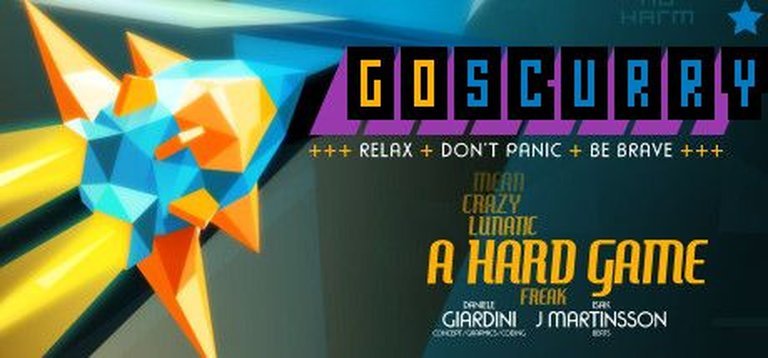
Goscurry is a futuristic rhythm-based racing game set in a surreal, stylized landscape where players pilot a ship on an ever-assembling road suspended above an abstract world. The core objective is to reach as many cities as possible while navigating sharp corners, evading hazards, and maintaining calm through various modes—including the intense Speedfreak—all synchronized to an original electro-beat soundtrack. With five distinct difficulty levels, unlockable ships, and online leaderboards, the game blends high-speed action with rhythmic precision in a sci-fi setting.
Gameplay Videos
Where to Buy Goscurry
PC
Goscurry Mods
Goscurry Guides & Walkthroughs
Goscurry Reviews & Reception
metacritic.com (89/100): A must in the infinite runner game genre! Graphics – Minimalism and a unique color palette make it a piece of art! Gameplay – Simple and practical to the point that it doesn’t need nothing else. Music – Along with the fine hypnotic graphics it will make you forget everything.
pixelpacas.com (80/100): Every time I want to put Goscurry down I can’t help thinking “just one more try” and getting sucked in again.
gamesreviews2010.com (80/100): Goscurry is a hard electro-beat racing game that’s both relaxing and exhilarating.
wraithkal.com : ‘Goscurry’ Review: Fast, Faster… Funnest!
Goscurry: Review
Introduction
Goscurry is a paradox: a game that demands absolute focus while inducing a meditative trance, a title that tests reflexes yet instructs players to “relax and follow the rhythm.” Released in January 2015 by Demigiant, this minimalist arcade racer has carved out a unique niche in the indie landscape, becoming a cult favorite for its hypnotic blend of high-speed challenge and visual serenity. Its legacy lies not in narrative complexity or technical spectacle, but in its masterful execution of a singular, potent idea: to transform simple controls into a transcendent, music-driven experience. This review argues that Goscurry is a masterpiece of minimalist design, where every element—from its procedurally generated roads to its pulsating electro-beat soundtrack—coalesces into an unforgettable state of “videogame trance” that few titles have ever achieved.
Development History & Context
Created by solo developer Daniele Giardini of Demigiant, Goscurry emerged from a vision to distill arcade purity into its most essential form. The game’s journey began as a free prototype in April 2013, later appearing in the Humble Bundle in December 2013 before its full Steam launch on January 16, 2015. Giardini collaborated closely with composer Isak J. Martinsson (of Killmonday Games), whose electro-beat soundtrack became the game’s rhythmic backbone. Technologically, Goscurry leveraged Unity’s versatility, enabling cross-platform releases for Windows, macOS, and Linux—remarkable for a niche indie title. Its development unfolded during a period when the indie scene was booming, with games like Super Hexagon and Race the Sun defining the “endless runner” genre. Goscurry distinguished itself by emphasizing rhythm over reflexes, offering a Zen-like counterpoint to the frantic pace of contemporaries. The game’s evolution from free prototype to a polished, award-winning title (it was a Microsoft Dream.Build.Play 2017 finalist) underscores its design integrity and resonant appeal.
Narrative & Thematic Deep Dive
Goscurry shies away in traditional narrative, instead weaving a subtext through its surreal, minimalist environment. Players pilot a ship along an infinite road suspended over a stylized landscape, encountering cryptic messages painted on buildings: “IS THERE AN END?”, “HELP ME,” or random numerical sequences. These fragments hint at a story of existential isolation—a lone traveler seeking meaning in an endless, procedurally generated void. The game’s themes revolve around endurance and the psychological toll of perpetual motion. The instruction “BE BRAVE, DON’T PANIC” serves as both a gameplay mantra and a thematic core, confronting players with the tension between calm and chaos. In “Paranoid” mode, where players must crash through obstacles instead of avoiding them, the theme of embracing adversity becomes literal. The absence of explicit dialogue or character development forces players to project their own narratives onto the journey, turning each run into a personal meditation on persistence and the futility of seeking a final destination.
Gameplay Mechanics & Systems
At its core, Goscurry is a study in controlled chaos. Players steer a ship with arrow keys (or a controller) along a perpetually assembling road, jumping over gaps and dodging walls with split-second precision. The controls are deceptively simple—left/right to steer, spacebar for drifting—but their responsiveness is “intoxicatingly precise,” as noted by Rock, Paper, Shotgun. The game’s genius lies in its five escalating modes:
– Training: A hazard-free tutorial with a dynamic camera.
– Hard: Introduces obstacles and camera challenges.
– Pro: Features a fixed camera angle, complicating spatial awareness.
– Speedfreak: Overrun with boosters, demanding lightning-fast reflexes.
– Paranoid: Players must crash through purple walls, inverting avoidance logic.
Progression is tied to unlocking five visually distinct ships plus the “Psycho” ship (via achievements), which amplifies difficulty while increasing score multipliers. An online leaderboard fuels replayability, with Steam Trading Cards and badges adding meta-appeal. The core loop—”just one more try”—is bolstered by instant respawns, eliminating friction between failure and redemption. While the gameplay risks repetition, the mode variety and unlockables ensure sustained engagement, making it a quintessential arcade experience where mastery is measured in milliseconds.
World-Building, Art & Sound
Goscurry’s world is a triumph of stylized minimalism. The landscape—a “surreal dreamscape” of polygonal cities and pastel-hued terrains—unfolds with hypnotic fluidity. The perpetually generated road, suspended over this abstract void, creates a sense of infinite possibility, while sharp 90-degree turns and abrupt hazards inject tension. The art direction, described as “simple yet gorgeous” (Rock, Paper, Shotgun), uses bold colors and geometric shapes to evoke a retro-futuristic aesthetic. Critically, the visuals never distract; they complement the gameplay, with “blink-and-you’ll-miss-it” humor (e.g., cheeky text on buildings) adding charm.
Sound design is equally integral. Isak J. Martinsson’s electro-beat soundtrack is a “phenomenal” force (Pixel Pacas), syncing with road generation and hazards to create a rhythmic cadence that guides players. The music crescendos during “Speedfreak” modes, transforming chaos into a euphoric dance. This audio-visual synergy induces the “videogame trance” praised by IGN Italia, where players lose themselves in the flow state. The absence of traditional sound effects (beyond the thud of crashes) underscores the soundtrack’s dominance, making Goscurry as much a music game as a racer.
Reception & Legacy
Upon release, Goscurry earned near-universal acclaim from critics and players alike. Rock, Paper Shotgun lauded it as “happiness in a tiny rocketship,” while IndieGames hailed it as a “true modern arcade game” for its punishing difficulty and sublime controls. On Steam, it maintains a 100% positive rating (41 reviews), with players praising its “addictive” nature and “great soundtrack.” Metacritic’s user score sits at 8.9/10 (“Generally Favorable”), with reviewers calling it a “must in the infinite runner genre” (Tanibus). Commercially, it found a niche as a $4.99 cult hit, later expanded via ports and Steam Trading Cards.
Goscurry’s legacy lies in its influence on the rhythm-arcade genre. It popularized the “endless runner” variant where rhythm dictates pace, inspiring titles like Audioshield and Race the Sun. Its minimalist aesthetic also influenced indie design, proving that depth could emerge from simplicity. The game’s Microsoft Dream.Build.Play finalist status cemented its credibility, while its enduring appeal—over a decade post-release—speaks to its timeless design. It remains a benchmark for “one more try” addiction, demonstrating how focused vision can create an unforgettable experience.
Conclusion
Goscurry is a masterpiece of distilled design, where every element—from its procedurally generated roads to its electro-beat heartbeat—coalesces into a sublime, trance-like experience. It eschews narrative complexity in favor of pure, unadulterated gameplay, proving that the most potent games often have the simplest premises. Its five modes and unlockable ships offer surprising depth, while its minimalist aesthetic and hypnotic soundtrack create an atmosphere of zen-like intensity. Though its repetitive loop may not suit all, its “just one more try” design is flawlessly executed. As a cult classic, Goscurry stands as a testament to indie ingenuity, a game that turns split-second reflexes into moments of transcendent flow. In a crowded gaming landscape, it remains a singular achievement—a “hard electro-beat” symphony that dares players to panic, then rewards them with euphoria. For fans of arcade and rhythm games, it is not just a title to play, but a state of mind to inhabit.