
- Release Year: 1996
- Platforms: Windows
- Publisher: Bomico Entertainment Software GmbH, Inscape
- Developer: Epic Multimedia Group Limited
- Genre: Adventure
- Perspective: 1st-person
- Game Mode: Single-player
- Gameplay: Puzzle elements
- Setting: Cyberpunk, dark sci-fi
- Average Score: 75/100
Description
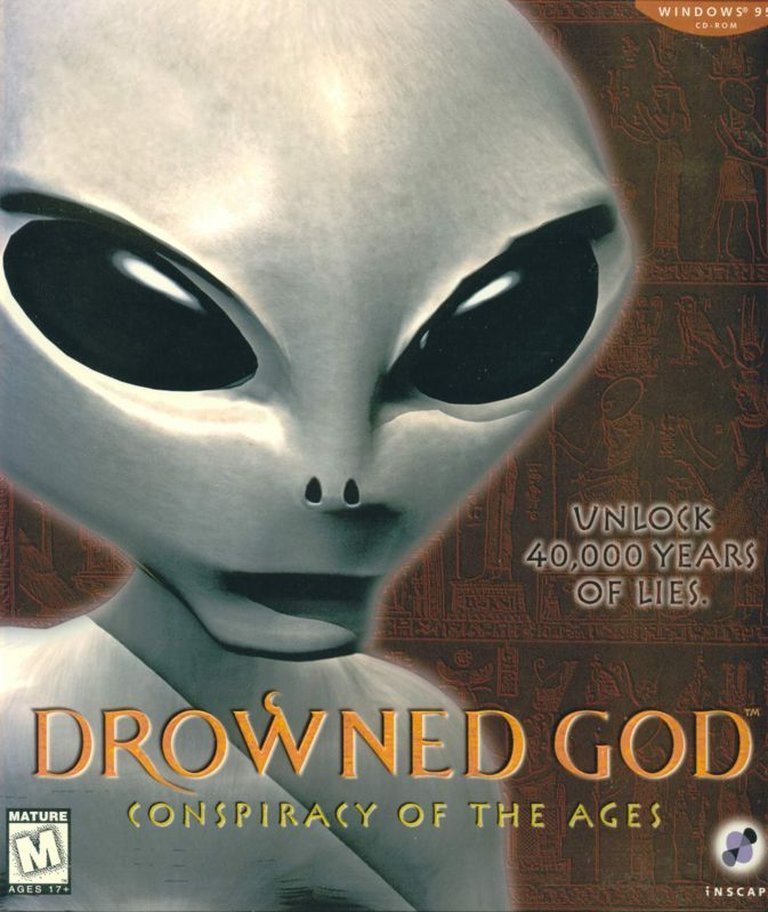
Set in a cyberpunk/dark sci-fi world, ‘Drowned God: Conspiracy of the Ages’ reveals humanity’s engineered origins through alien artifacts, including the Ark of the Covenant, Philosopher’s Stone, Rod of Osiris, and Holy Grail. Players traverse time and alternate dimensions to solve puzzles linked to historical conspiracies, using a first-person interface inspired by Myst to navigate pre-rendered environments and unlock secrets.
Gameplay Videos
Where to Buy Drowned God: Conspiracy of the Ages
PC
Drowned God: Conspiracy of the Ages Free Download
Drowned God: Conspiracy of the Ages Patches & Updates
Drowned God: Conspiracy of the Ages Mods
Drowned God: Conspiracy of the Ages Guides & Walkthroughs
Drowned God: Conspiracy of the Ages Reviews & Reception
myabandonware.com (80/100): This game has a lot of references to real esoteric concepts, figures, and histories. The more you know about that stuff, the more you’ll get out of this game. Otherwise it may get confusing. But it’s still a real ride nonetheless
Drowned God: Conspiracy of the Ages: Review
Introduction:
In the pantheon of 1990s adventure games, few titles are as audacious, enigmatic, or as profoundly flawed as Drowned God: Conspiracy of the Ages. Developed by Epic Multimedia Group and published by Inscape in 1996, this Windows-exclusive point-and-click adventure dared to be unlike anything else: a sprawling, conspiracy-laden narrative that posited human history as a meticulously crafted lie orchestrated by ancient aliens, weaving together the Knights Templar, the Illuminati, the Holy Grail, the Ark of the Covenant, Area 51, and the Philadelphia Experiment into a single, unfathomable tapestry. Its legacy is a fractured one, born from a unique origin story—a forged manuscript by creator Harry Horse (Richard Horne)—marred by technical instability and narrative opacity, yet enduringly fascinating for its sheer, unbridled ambition. This review argues that Drowned God stands as a quintessential artifact of its era’s peak CD-ROM multimedia experimentation, a flawed masterpiece of paranoid world-building whose greatest strengths lie in its unparalleled density of ideas and haunting atmosphere, even as its gameplay and technical execution often undermine its own grand vision.
Development History & Context:
The genesis of Drowned God is as bizarre as its narrative. British artist and writer Harry Horse (real name Richard Horne) conceived the game not as a direct translation of a pre-existing story, but as a multimedia adaptation of his own audacious literary hoax from 1983. This forgery, the Diary of a Plagiarist, presented itself as a lost 19th-century manuscript (attributed to the coincidentally named poet Richard Henry Horne) detailing a vast conspiracy where canonical works like Shakespeare’s plays were plagiarized from Atlantean texts dictated by extraterrestrial entities. When the forgery was exposed, Horse faced legal trouble and fines, shelving the manuscript for over a decade until his exposure to Myst and The 7th Guest in the mid-1990s ignited the idea that a first-person, puzzle-driven adventure game could be the perfect vessel for this sprawling, conspiratorial tale (Wikipedia, howsoonisnow.org, Grokipedia).
Horse, along with co-creator Alastair Graham and producer Algy Williams, assembled the Epic Multimedia Group team. Development began under Time Warner Interactive, but shifted to Inscape (a subsidiary of HBO and Warner Music Group) when Time Warner Interactive closed. The budget swelled to an estimated $3 million, a significant sum for the time, leading to notable scope reductions. Intended worlds were reordered, and the final realm (Chokmah/Area 51) was significantly cut despite numerous pre-existing assets. The team included puzzle designers Chris Maslanka and John Morris, artist Greg Boulton (known for the “Sledgehammer” video), and ambient music duo Miasma. William S. Burroughs was originally slated for narration but tragically passed away before recording (Wikipedia, howsoonisnow.org, MobyGames).
Released on October 31, 1996, for Windows 95 on CD-ROM, Drowned God entered a market saturated with imitators of Myst‘s pre-rendered slideshow style. The genre was booming, defined by atmospheric exploration, intricate puzzles, and often cryptic storytelling. Technical constraints were paramount: CD-ROM capacity limited video quality (using Smacker Video), Windows 95 compatibility dictated design, and multimedia integration was cutting-edge but often temperamental. The game sold well initially, hitting the top 10 in US charts within weeks, reportedly moving 34,000 copies in its first fortnight and over 60,000 by early 1998. However, its reputation quickly soured due to severe bugs, crashes, audio issues, and a lack of effective patches from the fledgling developer and publisher. Inscape itself collapsed within a year of release, and plans for a sequel (CULT, focusing on Area 51) vanished following Horse’s death in 2007. A 2024 digital re-release by Next Path Media on Epic Games Store and Steam (2025) aimed for preservation, offering supplementary material but reportedly retaining many original bugs (Wikipedia, MobyGames, PCGamesN, Steam).
Narrative & Thematic Deep Dive:
Drowned God presents a narrative so dense, recursive, and steeped in esoteric lore that it often feels less a coherent story and more a playable conspiracy theory compendium. The player character awakens within the Bequest Globe, a central hub containing the Cryptowheel device. Guided by cryptic holographic masks named Kether (blue, representing logic and order) and Malchut (red, representing emotion and chaos), the player is tasked with traversing four surreal, themed realms – Binah (Arthurian/Stonehenge), Chesed (Mesoamerican/Submarine), Din (Industrial Steampunk/Carnival), and Chokmah (Area 51-esque desert) – to recover four powerful artifacts: the Ark of the Covenant, the Philosopher’s Stone, the Rod of Osiris, and the Holy Grail. The core revelation, delivered gradually through environmental storytelling, found documents, and character monologues, is that humanity was genetically engineered by god-like aliens (“The Legion”) from Orion. These aliens guided civilization through history via these artifacts, manipulating events and suppressing the truth of their origins. Ancient myths (Osiris, Atlantis, Great Flood), secret societies (Knights Templar, Priory of Sion, Illuminati), and historical events (Philadelphia Experiment, Roswell) are reframed as fragments of this vast cover-up (MobyGames, Wikipedia, TVTropes, Grokipedia).
The narrative structure is deliberately fragmented. The player experiences glimpses of past lives upon entering their name into the Bequest Globe, assigning a numerical “planetary symbol” (1-9). Progression is driven by collecting Major Arcana Tarot cards, which unlock new areas and lore. Characters encountered are often spectral projections or trapped entities: a drunken Templar guarding the Grail, a tormented Morgana Le Fay, a decaying Templar in a tower, Horus imprisoned in a water tank, the Man in Black (an MJ12 agent), and the enigmatic Relic Hunter (a failed predecessor). Dialogue is deliberately cryptic, filled with metaphor, contradiction, and references to Kabbalah, numerology, and obscure history (“As above, so below,” “GENESIS,” “Pandora is open”). The narrative culminates in the failure to retrieve the Ark (revealed as a nuclear warhead) and a tripartite ending: siding with Kether leads to a technocratic dystopia, siding with Malchut to a genetic dystopia, while choosing the central chamber leads to contact with the Legion, who ominously declare, “We are coming, for we are Legion.” The ending credits feature a narration of the murder of Osiris, tying the game’s core mythological framework to its conspiratorial premise (Wikipedia, TVTropes, MobyGames, Grokipedia).
Thematic depth lies in its relentless questioning of historical truth and the nature of control. It explores the idea of “forbidden knowledge” suppressed by organized religion (e.g., the Library of Alexandria’s destruction) and preserved by secret societies. It delves into the manipulation of perception through media and technology (e.g., Arcadia Corp in Chokmah). Body horror and imprisonment are recurring motifs, reflecting the idea of humanity (and even the gods) as trapped by history, ideology, or circumstance. The game blurs the line between fiction and reality, drawing inspiration from real conspiracy theories and figures (Aleister Crowley, Carl Jung, JFK assassination) while presenting its own internally consistent, albeit wildly speculative, alternate history. Its most potent theme is perhaps the seductive danger of absolute answers – the game presents its grand conspiracy as the ultimate truth, yet the fragmented delivery and lack of clear resolution leave the player questioning the very nature of the “truth” being offered (TVTropes, Grokipedia, howsoonisnow.org).
Gameplay Mechanics & Systems:
Gameplay adheres strictly to the conventions of the mid-90s point-and-click adventure genre popularized by Myst. Players navigate a first-person world through pre-rendered, static “slideshows” – high-quality full-motion video (FMV) clips depicting movements and transitions between locations. Interaction is mouse-driven, with the cursor changing to indicate actions: an arrow for movement, a face for picking up/placing Tarot cards, and the Eye of Providence for interacting with objects or puzzles. Inventory management is minimal, primarily consisting of collected Tarot cards and occasionally spheres or the Drowned Book used in specific receptacles (MobyGames, Wikipedia).
The core gameplay loop revolves around exploration and puzzle-solving. Navigation can be counter-intuitive, often requiring backtracking through static environments to find missed hotspots. Puzzles are the primary obstacle and source of frustration. They range from logical deductions based on environmental clues and historical lore (e.g., arranging Einstein and Newton’s dialogue chronologically) to abstract challenges involving pattern recognition, symbol matching, code-breaking (Morse code), and adaptations of classic board games like Nine Men’s Morris and Lights Out. Many puzzles are integrated into the narrative, requiring players to understand the game’s unique cosmology (e.g., using numerical values derived from the player’s name to access areas). However, the game is infamous for its opacity. Clues are often sparse, obtuse, or buried within lengthy, cryptic monologues. Trial-and-error is frequently required, and the lack of a comprehensive hint system or in-game glossary (beyond the original manual) leads to frequent dead-ends and reliance on external walkthroughs (MobyGames, Wikipedia, TVTropes, Grokipedia, howsoonisnow.org).
Technical issues significantly mar the experience. Audio mixing is notoriously poor, with critical dialogue often drowned out by looping environmental sounds and the repetitive soundtrack, and crucially, no subtitles are available. Save systems were unreliable, prone to corruption and crashes, especially notorious in the US release. Bugs included being locked out of areas, puzzle triggers failing, and game instability in the final act. While four patches were released post-launch, many issues persisted for years. The 2024/2025 re-release reportedly retains many of these original bugs despite claims of fixes, limiting its accessibility for modern players without workarounds (MobyGames, Wikipedia, howsoonisnow.org, Steam).
World-Building, Art & Sound:
Drowned God’s greatest strength lies in its unparalleled atmosphere, meticulously crafted through its world-building, art direction, and sound design. The game’s visual style is a unique blend of eerie claymation stop-motion and high-quality pre-rendered CGI. Characters and key objects (like the Bequest Globe, NOAH machine) possess a tangible, organic, slightly grotesque quality, lending them an unsettling presence. Environments are surreal amalgams: windswept plains surrounding Stonehenge in Binah, decaying Aztec temples and sunken submarine interiors in Chesed, a vast, oppressive steampark carnival and mechanical maze in Din, and the orange-tinted, desolate landscape near Area 51 in Chokmah. The art direction, led by Alastair Graham and Harry Horse, excels at creating a pervasive sense of mystery and decay. Textures are rich, lighting is dramatic (often using chiaroscuro), and composition frequently incorporates symbolic imagery (eyes, keys, geometric patterns). The game’s visual language effectively communicates its themes of hidden knowledge, ancient technology, and psychological unease (Wikipedia, MobyGames, howsoonisnow.org).
Sound design is equally crucial, though deeply flawed. The ambient soundtrack, composed and performed by the duo Miasma, is a haunting mix of ethereal drones, industrial clanks, unsettling melodies, and moments of near-whimsy. It does an excellent job of defining the mood of each realm, from the oppressive dread of Din to the eerie calm of the Bequest Globe. However, the constant repetition of tracks and the problematic audio mixing severely undermine immersion. Voice acting, delivered by actors including Horse himself, ranges from adequate to compelling, but the lack of subtitles renders much of the dialogue incomprehensible, a critical flaw given the narrative’s reliance on spoken exposition and cryptic clues. Sound effects (ticking, machinery, water) are well-integrated but contribute to the overall sensory overload and lack of clarity (MobyGames, Wikipedia, howsoonisnow.org).
The world-building is dense and immersive, even when the narrative is opaque. Each realm is thematically coherent, drawing from specific historical or mythological sources while being filtered through the game’s unique lens of alien intervention and conspiracy. The inclusion of real-world locations (Stonehenge, Area 51) alongside fantastical ones (Morgana’s Roost, the Theatre of Memory) creates a pervasive sense of the uncanny. The game excels at suggesting vast, unseen histories and hidden connections, encouraging players to piece together the lore from scattered documents, environmental details, and character interactions. This richness is its defining characteristic, creating an atmosphere of profound mystery that often transcends the limitations of its gameplay and technical execution (Wikipedia, TVTropes, howsoonisnow.org).
Reception & Legacy:
Upon release, Drowned God received mixed-to-negative reviews, averaging around 68% according to MobyGames based on 12 critic scores. Common praise was reserved for its ambitious concept, unique atmosphere, striking visuals, and the sheer density of its conspiracy-laden narrative. Publications like Just Adventure (83%), Quandary (80%), PC Player (Germany) (80%), and CNET (80%) lauded its intellectual scope, haunting style, and challenging puzzles. Ray Ivey of Just Adventure famously called it “the strangest, creepiest, most psychedelic adventure game I’ve yet to come across,” finding enjoyment in its deliberate obscurity (MobyGames). Steve Ramsey of Quandary appreciated the “shadowy and secretive feelings” generated by the visuals and audio, though noted the dialogue difficulty (MobyGames). Newsweek’s Steven Levy and Patricia King found it “richly detailed and original” (MobyGames).
However, criticism was fierce and often focused on fundamental flaws. Vince Broady of GameSpot (62%) encapsulated the prevailing negative view: “the great premise is buried… under a mediocre Myst clone.” He lambasted the “hopelessly difficult” and “derivative” puzzles, the counter-intuitive navigation requiring excessive backtracking, and the “overused soundtrack” with “droning background effects” that drowned out crucial dialogue. He concluded the story was “almost totally lost” (MobyGames, Wikipedia). Bob Strauss of Entertainment Weekly (58%) quipped it was “so obscure, you’d be better off perusing something more comprehensible—like the collected works of Zoroaster,” criticizing its failure to coalesce its many ideas (MobyGames). German magazine PC Action (49%) found players “lose themselves very quickly in the unmanageable tangle of symbols, puzzles, machines, and artifacts” and criticized the Myst-like interface (MobyGames). Complaints about bugs, crashes, and the lack of a subtitle option were ubiquitous. GameSpot infamously listed it among the “Most Disappointing Games of 1996” (Wikipedia).
Over time, Drowned God‘s reputation has undergone a fascinating transformation. Its initial commercial success (top 10 sales) was quickly overshadowed by its technical failings and publisher collapse, rendering it relatively obscure for years. However, its sheer uniqueness and the tragic end of its creator, Harry Horse (who died in 2007 alongside his wife in circumstances ruled a murder-suicide, casting a dark mystique over the game), fueled a dedicated cult following. Retrospectives, particularly from Hardcore Gaming 101 and preservation-focused sites like howsoonisnow.org, re-evaluate it positively as a quintessential artifact of CD-ROM era ambition – a “flawed masterpiece” whose dense mythology and surreal atmosphere predated and arguably exceeded the conspiracy-driven narratives of later games like Deus Ex. Its influence is niche but notable within the adventure game preservationist community and among enthusiasts of FMV games and alternative history. The 2024/2025 re-release, despite persistent bugs, brought renewed attention, bundled with supplementary materials (art book, pitch docs) that contextualize its development and deepen appreciation for its ambitious, albeit cut, scope (Wikipedia, MobyGames, howsoonisnow.org, Grokipedia, PCGamesN).
Conclusion:
Drowned God: Conspiracy of the Ages stands as a profoundly contradictory artifact of video game history. It is a game of staggering ambition and breathtakingly poor execution. Its narrative – a sprawling, almost unhinged fusion of ancient astronaut theory, secret society lore, historical conspiracy, and esoteric mysticism – remains unmatched in its sheer, overwhelming density. It dares to propose a single, all-encompassing explanation for human history, framed as a grand, terrifying secret. Yet, this vision is consistently undermined by gameplay that is often obtuse, frustrating, and reliant on external aids, and technical issues (audio mixing, bugs, crashes) that plagued it from launch and persist in modern re-releases. Its world-building and atmosphere, however, are exceptional. The claymation aesthetic, haunting soundtrack, and surreal, historically-infused environments create an unforgettable sense of dread and mystery that transcends its narrative coherence.
Ultimately, Drowned God‘s place in video game history is secured not by its polish or playability, but by its unparalleled audacity and its status as a unique, time-capsule expression of 1990s multimedia ambition and post-Cold War paranoia. It is a game that demands patience, often rewards confusion, and leaves players with more questions than answers. Its enduring legacy lies in its role as a fascinating, flawed curiosity – a testament to a era when developers dared to bury players in conspiracies and clay, and a reminder that sometimes, the most memorable experiences come from the most deeply flawed and profoundly strange creations. It is less a game to be “completed” and more an experience to be navigated, a dark, labyrinthine tomb of ideas whose greatest treasure is the unsettling journey itself. Its tragic end, intertwined with its creator’s, only deepens the enigma, ensuring Drowned God remains an indelible, if unsettling, footnote in the annals of interactive entertainment.