
- Release Year: 2013
- Platforms: Windows
- Publisher: Gogii Games Corp., Intenium GmbH
- Developer: Silverback Productions
- Genre: Adventure
- Perspective: 1st-person
- Game Mode: Single-player
- Gameplay: Hidden object, Mini-games, Puzzle elements
- Setting: Fantasy
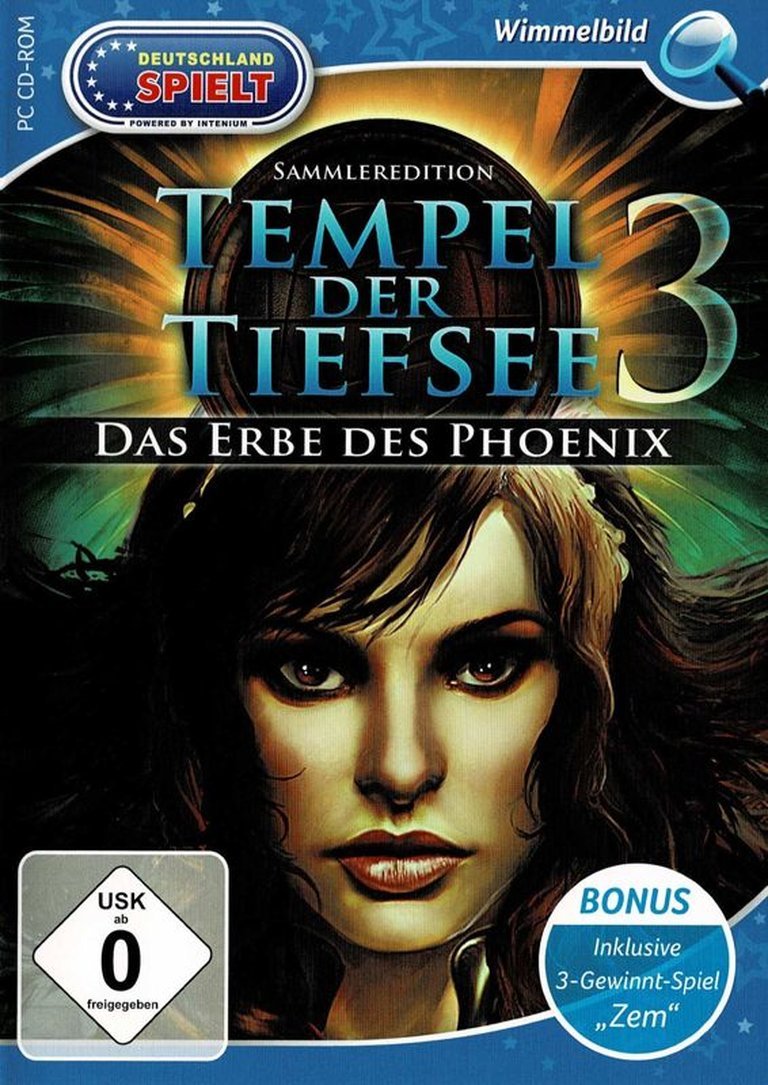
Description
After awakening from a century-long slumber, Empress Anna must once again save her people from peril as she confronts a cursed colossus threatening her homeland. Guided by the ghost of Jacob and an ancient phoenix, she explores a mysterious floating temple city deep beneath the ocean, solving hidden object scenes, puzzles, and mini-games to locate the sacred codex and rescue her vanished tribe before the ancient terror destroys everything.
Gameplay Videos
Empress of the Deep 3: Legacy of the Phoenix Guides & Walkthroughs
Empress of the Deep 3: Legacy of the Phoenix Reviews & Reception
jayisgames.com : An extremely enjoyable and fresh experience with stunningly gorgeous scenery.
Empress of the Deep 3: Legacy of the Phoenix: Review
Introduction
In the pantheon of hidden-object adventure games, few franchises blend mythological grandeur with serene exploration as effectively as Empress of the Deep. As the third chapter in Silverback Productions’ aquatic saga, Legacy of the Phoenix (2013) arrives at a pivotal moment, tasked with concluding Empress Anna’s arc while expanding the series’ mystical tapestry. This review posits that while the game excels as a visually sumptuous, atmospheric escape—echoing the dreamlike immersion of Myst—it ultimately struggles with repetitive gameplay and technical limitations that temper its narrative ambition. Its legacy lies not in innovation, but in its unwavering commitment to crafting a world where beauty and tranquility overshadow occasional flaws.
Development History & Context
Silverback Productions, a studio renowned for its lushly realized hidden-object games, developed Legacy of the Phoenix as the culmination of Anna’s journey against her evil twin, Pandora. Building on the foundations of The Darkest Secret (2010) and Song of the Blue Whale (2011), the team sought to weave Greek mythology and phoenix-rebirth motifs into a cohesive finale. Released digitally on August 23, 2013, and later as a Collector’s Edition (2014), the game operated within the technological constraints of its era: requiring a modest 1.0 GHz processor, 512 MB RAM, and DirectX 8.1 for PC (or Mac OS X 10.6+) with under 1 GB of storage. These specs underscored its accessibility, targeting casual players with aging hardware.
The 2013 gaming landscape saw hidden-object adventures (HOAs) dominate casual platforms like Big Fish Games, where Legacy of the Phoenix competed with series like Dark Parables and Mystery Case Files. Its release coincided with a shift toward digital-first distribution, reducing reliance on physical media. Silverback’s vision—prioritizing environmental storytelling over challenge—aligned with HOA trends, yet the Collector’s Edition model (including bonus content and an integrated strategy guide) reflected an industry push for added value, foreshadowing modern DLC practices.
Narrative & Thematic Deep Dive
Legacy of the Phoenix picks up after Anna’s imprisonment of Pandora, only to find her tribe imperiled by a “cursed colossus” in a floating temple city. Guided by the ghost of Jacob and an ancient phoenix, Anna escapes her burning sky-palace to unravel the mystery of her vanished people. The narrative unfolds across three acts: the fiery escape, the exploration of the deserted floating city, and the confrontation with the colossus.
Characters embody the game’s thematic core of duality. Anna represents compassion and duty, while the two-headed wizard—an enigmatic feline companion—embodies moral ambiguity, his dialogue riddled with distrustful riddles. The phoenix serves as a symbol of rebirth, its ashes central to the “holy codex” quest. Dialogue remains functional but occasionally stilted, with the wizard’s voice acting criticized for being “overly melodramatic” (JayisGames). Themes of trust and betrayal permeate interactions, forcing players to question alliances—a subtle nod to Anna’s internal struggle against her twin’s lingering influence. Despite plot holes (e.g., unexplained vanishances), the world’s ruins and machinery convey more than the script alone, reinforcing the series’ strength in environmental storytelling.
Gameplay Mechanics & Systems
The core gameplay loop adheres to HOA conventions: hidden-object scenes (HOS), environmental puzzles, and item-driven progression. Legacy of the Phoenix distinguishes itself with three difficulty modes—Casual (generous hints), Expert (reduced aids), and Hardcore (minimal handholding)—catering to both novices and veterans.
- Hidden-Object Scenes: Varied into three types (list-based, multiples, “morphing” objects), these scenes feature vibrant, well-composed designs but suffer from repetition and grainy textures in later stages. Critically, some items are “cleverly concealed,” requiring keen observation (JayisGames), though the rechargeable hint system mitigates frustration.
- Puzzles: Task-centric challenges (e.g., slider puzzles, machinery repairs) prioritize accessibility over complexity. As one reviewer noted, they’re “not as involved as minigames in other hybrids,” appealing to players seeking relaxation over challenge.
- Innovative Systems: A spirit amethyst—charged by captured fairies—removes barriers, while cat-activated teleporters reduce backtracking. Inventory management is streamlined, with a journal tracking objectives and a map revealing explored areas (though lacking fast-travel).
Flaws emerge in linearity and navigation. The absence of fast-travel and vague objectives create friction, exacerbated by reused HOS assets and occasional bugs. The two-headed wizard’s voice acting, labeled “disgusting” by some, further disrupts immersion. While Hardcore mode offers replayability, the experience remains largely linear, limiting long-term engagement.
World-Building, Art & Sound
Legacy of the Phoenix excels in crafting a mythological dreamscape. The floating city—adorned with azure domes, golden machinery, and force fields—evokes awe, contrasting with the burning sky-palace’s urgency. Environments blend illustrated realism with 3D elements, where hand-painted backdrops (e.g., Scroll Temple’s ancient tomes) and fluid animations (e.g., phoenix flight) create depth. Lighting and shadows enhance mood: the colossus’s ominous glow and the city’s ethereal twilight evoke serenity and dread.
Sound design is atmospheric yet uneven. A “hypnotic” score (JayisGames) complements exploration, with themes like the floating city’s melody luring players into tranquility. However, voice acting is inconsistent—Jacob’s spectral whispers contrast sharply with the wizard’s theatrical delivery. Sound effects (machinery hums, water drips) ground the world, but audio glitches occasionally mar immersion. The Oceania-inspired setting (per MobyGames) adds unique flavor, distinguishing it from European fantasy tropes.
Reception & Legacy
Upon release, Legacy of the Phoenix garnered mixed-to-positive reviews. Critics lauded its “stunningly gorgeous scenery” and “puzzle variety” (JayisGames), with the Collector’s Edition’s Zem II match-3 game and strategy guide cited as value-adds. Yet, gameplay repetition, grainy graphics, and confusing navigation drew ire. Metacritic’s absence of critic reviews reflects its niche appeal, while MacGameStore’s 3.4/5 rating highlights polarization: some called it “extremely enjoyable” for relaxation, while others decried it as “frustrating” and “terrible.”
Over time, the game’s reputation has solidified as a flawed but atmospheric entry. While it lacks the innovation of predecessors, its influence persists: the Collector’s Edition model (bonus content, integrated guides) became a genre staple, and its mythological storytelling inspired titles like Spirits of Mystery: Song of the Phoenix. Players nostalgic for HOA’s golden era still cherish its world-building, though modern standards for fast-travel and clarity have exposed its age.
Conclusion
Empress of the Deep 3: Legacy of the Phoenix is a paradox—a game of breathtaking beauty marred by mechanical imperfection. It succeeds as a meditative journey through a mythic realm, where floating cities and phoenixes captivate the imagination. Yet, its repetitive HOS, technical shortcomings, and linear design prevent it from transcending genre conventions.
For fans of the series or hidden-object enthusiasts seeking relaxation, Legacy of the Phoenix remains a worthy albeit imperfect adventure. Its Collector’s Edition—with Zem II and concept art—enhances replay value, while Hardcore mode challenges veterans. Ultimately, its legacy endures not as a revolutionary title, but as a testament to the power of atmosphere. In a genre often criticized for formula, Legacy of the Phoenix reminds us that sometimes, the allure of escape lies not in challenge, but in the quiet beauty of a world lost to time.
Verdict: 7.5/10 – A visually stunning, serenely paced journey best suited for players prioritizing immersion over challenge.