
- Release Year: 1999
- Platforms: Windows
- Publisher: Swing! Entertainment Software GmbH
- Genre: Compilation
- Average Score: 72/100
Description
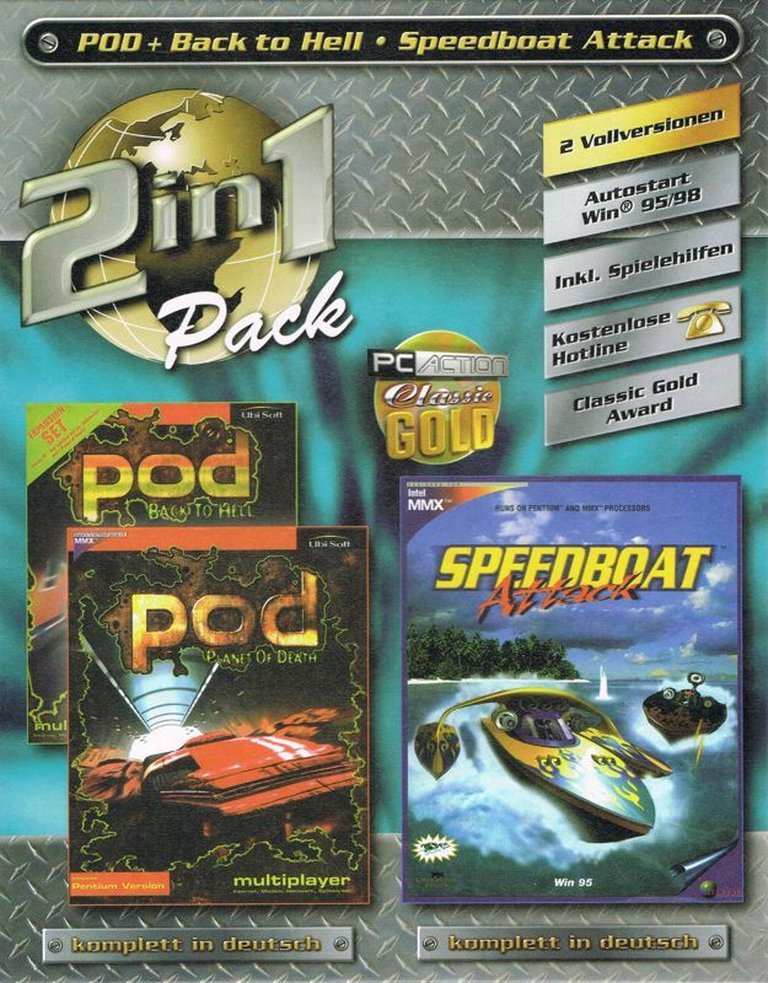
Released in 1999 on Windows, this compilation bundle from Swing! Entertainment Software GmbH combines three racing games: POD, POD: Back to Hell, and Speedboat Attack. The original POD and its sequel Back to Hell offer futuristic racing on extraterrestrial tracks, while Speedboat Attack shifts focus to high-speed aquatic challenges across various water-based environments. The package delivers diverse racing experiences on a single CD-ROM.
2 in 1 Pack: POD + POD: Back to Hell / Speedboat Attack: Review
Introduction
This compilation stands as a fascinating, if flawed, time capsule of mid-to-late 1990s PC gaming ambition. Released in 1999 by German publisher Swing! Entertainment Software GmbH, the 2 in 1 Pack: POD + POD: Back to Hell / Speedboat Attack bundles three titles that individually represent different facets of the era’s technological experimentation and genre exploration: the groundbreaking (if divisive) futuristic racer POD, its ambitious expansion Back to Hell, and the lesser-known aquatic combat game Speedboat Attack. While POD garnered significant attention for pushing hardware boundaries with MMX instruction set support and early 3D acceleration, and Back to Hell aimed to expand its universe, Speedboat Attack served as a contrasting, simpler action title. Together, they encapsulate the transitional period when PC gaming was rapidly evolving beyond software rendering into the hardware-accelerated future. This review will dissect the historical context, design merits, thematic depth, technical implementation, and enduring legacy of this unique compilation, arguing that despite its inconsistencies and dated mechanics, it remains a significant artifact documenting a pivotal moment in racing game evolution.
Development History & Context
The compilation’s genesis is rooted firmly in Ubisoft’s ambitious push into PC racing during a period of intense technological flux. POD (1997), developed internally at Ubisoft under director Fabrice Valay, was positioned as a flagship title to showcase the nascent power of Intel’s MMX instruction set found in Pentium MMX and Pentium II processors. Its marketing heavily emphasized this “first game to use MMX” claim, though as later revealed and critiqued, MMX was primarily utilized for Dolby Surround audio processing rather than the graphical rendering itself. Ubisoft, recognizing the importance of 3D graphics acceleration, became an early adopter of the 3dfx Glide API, releasing POD as one of the first games optimized for the Voodoo 1 chipset. This technological focus was a direct response to the rapidly maturing PC hardware landscape, where games like Ridge Racer and Need for Speed were setting visual standards, and developers scrambled to leverage new capabilities like hardware texture mapping and higher resolutions.
POD: Back to Hell (later known as Extended Time in France) arrived swiftly in late 1997 as an official expansion, demonstrating Ubisoft’s commitment to the IP. Developed as a standalone add-on (requiring the base game), it was designed to extend the POD experience with additional content – new tracks, vehicles, and updates – including the then-current “Game Service” for online multiplayer racing via Ubisoft servers. Its inclusion in the 1999 compilation alongside the original POD offered substantial value.
The third component, Speedboat Attack (1997), developed by Criterion Studios and published by Telstar Electronic Studios, presents a stark contrast. While POD was a high-profile, tech-demo showcase, Speedboat Attack was a more straightforward, arcade-style aquatic combat racer, likely included in the pack to broaden its appeal and provide variety. Its development context involved different studios and publishers, indicating the compilation functioned as a curated “value pack” rather than a unified anthology.
The compilation itself, released in Germany in 1999, arrived during a saturated market. By this time, POD had been superseded by more polished racers like Midtown Madness and Need for Speed: High Stakes. Its German release, with a USK rating of 6, and the “Big Box” packaging (as evidenced by eBay listings) positioned it as an accessible, budget-friendly entry point for players seeking futuristic racing action and potentially some online experiences, even if the initial technological hype had cooled. The cancellation of the planned Nintendo 64 port of POD further underscores the shifting landscape towards PCs and consoles with more advanced 3D capabilities like the PlayStation and Sega Saturn/Dreamcast.
Narrative & Thematic Deep Dive
The thematic and narrative elements diverge significantly between the compilation’s components, reflecting their different design goals.
POD presents a surprisingly coherent albeit simple dystopian sci-fi narrative. Set on Io, a moon of Jupiter colonized by humanity, the premise establishes a compelling high-stakes scenario: a mining accident unleashes a deadly, rapidly spreading fungus, transforming the prosperous colony into a “Planet of Death” (p.o.d.). With most of the population evacuated, a desperate remnant remains. The narrative revolves around the survivors souping up vehicles to participate in deadly races throughout the desolate cityscape. The ultimate prize is the last remaining starship, offering escape from the doomed moon. The player, as the narrator and racer, progresses through increasingly challenging circuits culminating in the “HQ” race. Upon victory, as the fungus engulfs the final launch platform, the player abandons their vehicle just in time to escape, witnessing the horrifying climax: Io consumed by the fungus and reborn as a giant flower in space. This narrative arc effectively blends sci-fi horror (the fungal apocalypse) with a brutal, every-man-for-himself survival instinct, framing the racing not just as sport, but as a desperate lottery for life. Themes of corporate greed (implied in the mining accident), ecological disaster, and the fragility of colonial outposts are woven into the backdrop. The lack of deep character development is mitigated by the first-person perspective, immersing the player directly in the role of the desperate survivor.
POD: Back to Hell functions primarily as a content expansion rather than a narrative sequel. While it adds new tracks and fantastical vehicles (like flying cars and a witch on a broom), it doesn’t significantly advance the core story of Io’s fungal apocalypse or introduce new thematic layers. Its “Back to Hell” title and “Extended Time” alternative suggest a return to the high-intensity, dangerous racing environment, but the narrative context remains the same as the base game. The new vehicles add a layer of fantastical absurdity to the otherwise grounded survival premise, potentially diluting the serious tone but offering variety in gameplay expression.
Speedboat Attack stands in stark contrast. Based on its description and typical gameplay of aquatic combat racers of the era, it lacks any discernible narrative or thematic depth. Its focus is purely on arcade action: high-speed boat racing, likely with weapon pickups and combat against opponents or environmental hazards. There is no indication of a story, setting beyond generic aquatic locales, or themes beyond straightforward competition and destruction. Its inclusion in the pack highlights the compilation’s dual nature: offering both a narrative-driven sci-fi experience (POD) and a pure, mindless action alternative (Speedboat Attack).
Gameplay Mechanics & Systems
The gameplay experiences within the compilation are highly varied, reflecting the distinct goals of each title and the technological constraints of their era.
POD (Core Game):
* Core Loop & Physics: POD offers a futuristic racing experience viewed from a behind-the-car perspective, akin to Wipeout or Extreme-G. The core loop involves selecting a vehicle, a circuit, and competing against AI opponents or other players. The physics are notably “arcade” – cars are incredibly fast and handle with a distinct drift or slide, emphasizing speed over simulation realism. Braking is often unnecessary on basic tracks, encouraging aggressive cornering and the discovery of shortcuts. This approach prioritized high-speed thrills and accessibility over technical driving depth.
* AI & Difficulty: The game boasted a significant technological claim: AI opponents that dynamically adjusted their driving style based on the player’s performance. This promised a more challenging and engaging single-player experience than static AI. However, contemporary reviews suggested this system wasn’t always perfectly implemented, sometimes feeling predictable or not providing a sufficiently varied challenge.
* Innovation & Multiplayer: POD‘s true legacy lies in its technological ambition. It was one of the first games to bundle significant support for 3D acceleration (Glide API for 3dfx Voodoo 1/Voodoo 2, later Direct3D). This resulted in dramatically higher resolutions (up to 1024×768), smoother frame rates, superior texture filtering, and visual effects like fogging – a world away from the blocky, low-framerate software-rendered versions. The multiplayer options were remarkably robust for the time, supporting LAN, modem, null-modem cable, and split-screen (2-4 players) modes. Critically, it included Ubisoft’s “Game Service,” allowing players to find opponents online via Ubisoft’s servers – a significant step for online PC gaming in 1997.
* Customization & Vehicles: The base game offered a selection of distinct vehicles, each with different handling characteristics. While not deep simulation, this added variety. The expansion Back to Hell significantly expanded this roster.
POD: Back to Hell (Expansion):
* Content Addition: This expansion primarily serves as a content injection for POD. Its core gameplay mechanics remain identical to the base game. The key additions are:
* 16 New Tracks: Offering more varied environments and challenges, including some downloadable from Ubisoft’s website. These tracks extended the game’s longevity significantly.
* 8 New Vehicles: Including the aforementioned fantastical ones like flying cars and a witch on a broom. These introduced new physics possibilities (flight, potentially different weight/speed characteristics) and visual flair, though their impact on core racing dynamics might have been limited.
* Game Service Updates: Provided access to the latest version of Ubisoft’s online matchmaking service.
* Patches & Enhancements: Included updates to improve gameplay, stability, and compatibility with various 3D cards and audio hardware.
* Windows Themes: A unique, if gimmicky, addition of POD-themed Windows desktop elements (icons, cursors).
* Impact: Back to Hell transformed POD from a tech-demo/single-player experience into a much more substantial multiplayer-focused package, especially for those invested in the core gameplay loop.
Speedboat Attack:
* Core Loop & Mechanics: As an aquatic combat racer, Speedboat Attack shifts the focus to action. Gameplay likely involves high-speed boat racing across water-based courses, incorporating weapon pickups (missiles, mines, etc.) for attacking opponents. The physics would be tuned for水上 maneuvering – sharp turns, potentially different acceleration/deceleration characteristics compared to land vehicles. The core loop is simpler: race, destroy rivals, reach the finish line. The emphasis is on arcade combat and reflexes rather than the pure speed or technical driving of POD.
* Multiplayer: While specific details are scarce in the provided sources, games like Speedboat Attack typically featured local multiplayer (split-screen) modes, allowing players to compete and blast each other directly. Online play might have been less common or technically feasible for this type of title in 1997 compared to POD‘s dedicated service.
* Contrast with POD: Where POD emphasized speed, technical graphical prowess, and a unique sci-fi setting, Speedboat Attack offered a more visceral, combat-oriented, and thematically straightforward aquatic experience. Its value in the compilation lies purely in providing a different genre flavor and potentially more accessible local multiplayer.
Compilation Value: The pack’s strength lies in the sheer volume and variety of content. Players received the original POD with its graphical innovation and robust online framework, the expansive Back to Hell content doubling the tracks and vehicles, and the distinct arcade action of Speedboat Attack. This represented significant value proposition in 1999.
World-Building, Art & Sound
The visual and auditory presentation of the components vary considerably, reflecting their different budgets and design philosophies.
POD & Back to Hell:
* Setting & Atmosphere: Io is rendered as a desolate, futuristic colony in decay. The environments range from sleek, metallic urban complexes overrun by fungus to more rugged, industrial mining landscapes and alien-looking terrain. The fungal threat is subtly suggested through environmental details – decaying structures, strange flora, and an overall sense of abandonment and creeping biological horror. The atmosphere is one of desperate isolation and high-stakes competition within a dying world. Back to Hell‘s new tracks likely expanded these environments, potentially introducing more fantastical or hazardous locations fitting the expansion’s name.
* Art Direction & Graphics (Software): In software mode (running on non-3dfx hardware), POD was visually underwhelming by contemporary standards, as noted by critics. Textures were low-resolution and blocky, the frame rate could struggle, and the 3D world lacked detail. This was a common issue pre-acceleration.
* Art Direction & Graphics (Hardware Accelerated – 3dfx Glide): This is where POD truly shone for its time. The Glide API unlocked the Voodoo 1/2’s potential. Textures became sharper and more detailed, the frame rate was consistently high and smooth, enabling the game’s signature speed, and visual effects like fogging (used effectively to obscure distant objects and create atmosphere) were employed. The sense of speed was palpable. The car models, while simple polygons, were distinct. The environments, while sometimes repetitive, offered a convincing futuristic scale in accelerated mode. It represented the cutting edge of consumer PC graphics in 1997.
* Sound Design: The soundtrack, primarily one long track (“Race Music”) composed by Gaëlle Gauthier, Gilles Gries, Daniel Masson, and Raphaël Merono, is a notable industrial/ambient piece. It’s moody, driving, and fits the futuristic, desperate setting perfectly. Sound effects were functional – engine noises, skids, collisions – but not particularly groundbreaking. The MMX support primarily enhanced the stereo and Dolby Surround processing of this audio, creating a more immersive soundscape.
Speedboat Attack:
* Setting & Atmosphere: As a boat racer, the setting is inherently different – oceans, rivers, harbors, archipelagos. The atmosphere is likely one of open-water speed and intense, fast-paced combat, lacking the dark, narrative-driven tone of POD. It’s pure action escapism.
* Art Direction & Graphics: The provided sources lack specific details, but typical late-90s aquatic racers featured water effects (though often basic), boat models, and coastal/island environments. Graphics would likely have been functional, perhaps benefiting from some 3D acceleration if supported, but unlikely to reach the visual heights of accelerated POD. The focus would be on clear raceways and distinct boat designs.
* Sound Design: Sound would consist of boat engine revs, water splashes, weapon fire, and explosions, paired with a more generic, high-energy electronic soundtrack typical of arcade racers. It would serve the action but lack the thematic depth of POD‘s score.
Reception & Legacy
The reception of the compilation’s components, both at launch and retrospectively, is complex and multifaceted, revealing the game’s dual nature as both a technological pioneer and a flawed experience.
Contemporary Reception (POD Base Game):
* POD launched amidst significant hype surrounding its MMX and 3D acceleration features. Critical scores were mixed but often highlighted its technical prowess:
* Next Generation awarded it three stars out of five, stating, “Pod is a fantastic ride, with high-color graphics at high resolution and a steady, high frame rate. It could very well be the prettiest racing game you can buy right now.” This captures the core strength of the accelerated version.
* GameSpot scored it 7.5/10, acknowledging its speed and graphics while noting potential flaws.
* IGN was notably harsher, giving it 4.5/10, criticizing the “horrendously slow 3D engine” in software mode, blocky graphics, bad controls, and lackluster sound/score. Player reviews on MobyGames echo this, with one declaring “This game just plain sucks” and criticizing performance even on intended hardware (Pentium MMX + Voodoo 1).
* Commercial Performance: Despite the mixed reviews, POD was commercially successful, reportedly selling 3 million copies, partly fueled by its bundling with new PCs featuring MMX processors (OEM version).
* The core criticism centered on the software-rendered version being technically poor and the gameplay itself feeling shallow or unresponsive compared to contemporaries. The MMX audio optimization was seen by many as a misleading marketing point, diverting attention from the lack of MMX use in graphics rendering.
POD: Back to Hell:
* As an expansion, Back to Hell received less standalone critical attention. MobyGames lists a critic average of 72% based on 4 reviews, suggesting it was generally seen as a solid, if not revolutionary, addition. Its value proposition – significant new content – was likely appreciated by fans of the base game. Player ratings (3.3/5) indicate moderate satisfaction.
Speedboat Attack:
* This title appears to have flown under the radar critically. Its inclusion in the compilation suggests it was seen as secondary content, likely valued for its local multiplayer appeal rather than its single-player merits or technical innovation. No significant contemporary reviews are readily available in the sources.
Long-Term Legacy & Evolution:
* POD‘s primary legacy lies in its role as a technological demonstrator. It was undeniably one of the first games to truly showcase the transformative power of 3D graphics acceleration (specifically Glide) on the PC. It proved that hardware acceleration wasn’t just a gimmick but could create dramatically superior visual experiences – high resolutions, smooth frame rates, better textures, and atmospheric effects. This paved the way for the wave of Glide-optimized games that followed and accelerated the adoption of 3D cards among PC gamers.
* Its online multiplayer (“Game Service”) was also forward-thinking, providing a dedicated matchmaking platform at a time when online PC gaming was still cumbersome.
* However, its gameplay legacy is more modest. The racing mechanics, while fast, were often criticized for feeling imprecise or shallow compared to the increasingly refined simulations and arcade racers emerging in the late 90s (Gran Turismo, Need for Speed: High Stakes, Midtown Madness). Its unique sci-fi narrative and setting didn’t spawn a long-running series with deep lore.
* The 2 in 1 Pack itself represents the era of compilation releases, bundling older or less prominent titles with expansions to offer value. Its continued presence in the retro market (eBay listings for sealed “Big Box” copies sell for €30-€100+) indicates a niche collector’s interest, primarily for the POD components and their historical significance. The German market focus is evident in the packaging and USK rating.
* POD was later re-released on GOG.com in 2011, ensuring its availability on modern systems with updated compatibility, cementing its status as a cult classic artifact of the early 3D acceleration era.
Conclusion
The 2 in 1 Pack: POD + POD: Back to Hell / Speedboat Attack is a compelling and somewhat contradictory piece of gaming history. It bundles a landmark technological showcase (POD) with its ambitious expansion (Back to Hell) and a contrasting, simpler action title (Speedboat Attack). While POD in its hardware-accelerated form delivered stunning visuals for its time and robust online features, its core racing gameplay often failed to match its technical ambition, suffering from imprecise controls and shallow mechanics when judged by contemporary or modern standards. Back to Hell successfully addressed longevity through substantial content, while Speedboat Attack offered a straightforward, if less memorable, alternative.
Ultimately, the compilation’s significance transcends its immediate playability. It stands as a vital document of the PC gaming landscape in 1997-1999 – a period defined by frantic technological experimentation, the seismic shift from software to hardware rendering, and the marketing hype surrounding features like MMX. POD‘s role in driving 3D accelerator adoption is undeniable. The pack itself represents a common distribution strategy of the era, maximizing value by bundling older and newer content from the same publisher.
As a product for today’s player, its flaws are apparent: aged mechanics, a lack of narrative depth in Speedboat Attack, and the stark contrast between the accelerated and software-rendered versions of POD. However, for the enthusiast or historian, it offers a fascinating glimpse into a pivotal moment. Verdict: While not a flawless or universally enjoyable experience by modern standards, the 2 in 1 Pack: POD + POD: Back to Hell / Speedboat Attack earns its place as a historically significant compilation. Its value lies not in timeless perfection, but in its potent embodiment of late-90s PC gaming ambition, technological transition, and the specific, pioneering achievements of POD. It’s a fascinating, if uneven, artifact worth exploring for its historical context and as a relic of a time when pushing hardware boundaries was often the primary driver of innovation.