
- Release Year: 1999
- Platforms: Windows
- Publisher: Animedia Entertainment, Family Soft Co., Ltd.
- Developer: Family Soft Co., Ltd.
- Genre: Action
- Perspective: Side view
- Game Mode: Single-player
- Gameplay: Fighting
- Setting: Contemporary
Description
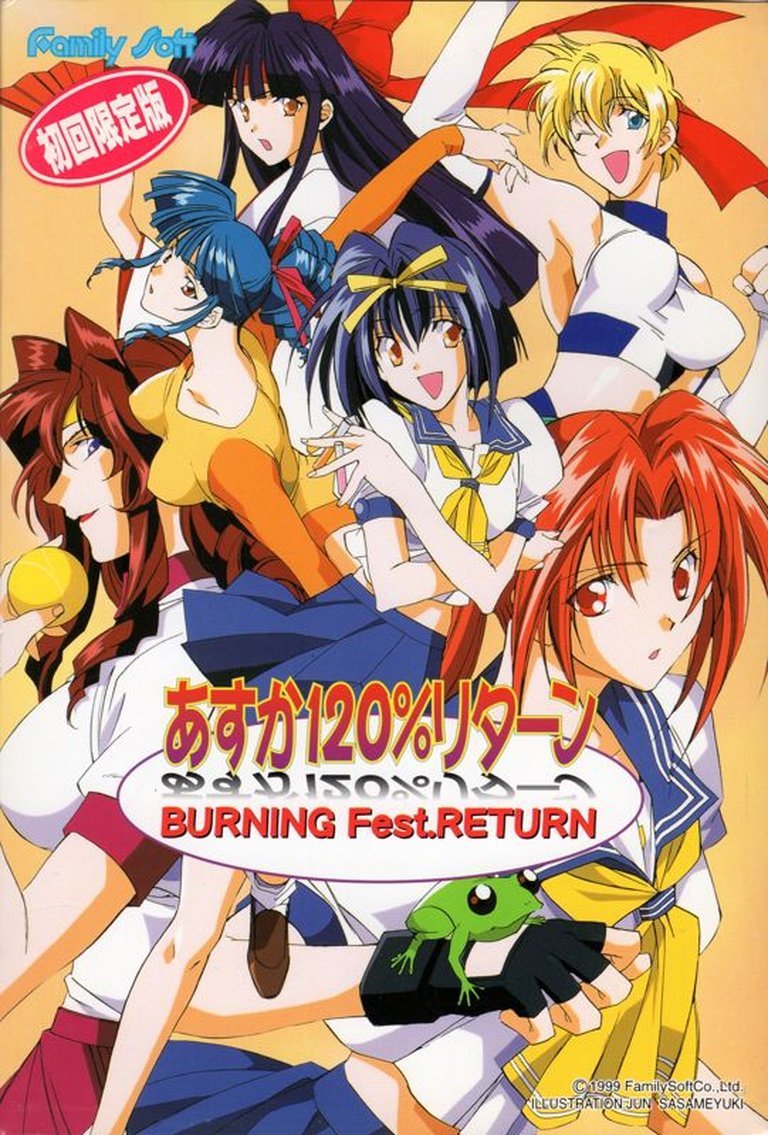
Asuka 120% Return: BURNING Fest. is a 2D fighting game set in the prestigious Ryōran Private School for Women, where students from various clubs participate in an annual martial arts tournament called the ‘Club Rivalry Budget Contest Mega Fight’ to compete for increased funding. After the Chemistry Club’s repeated failures, its president Tetsuko Ōgigaya recruits and trains Asuka Honda to become the champion, requiring players to battle through side-scrolling matches against rival club members with fast-paced combat and anime-inspired visuals. This 1999 Windows entry adapts the core gameplay and sprites from ‘Asuka 120% Limited: Burning Fest. Limited’ but features newly updated illustrations.
Gameplay Videos
Asuka 120% Return: BURNING Fest. Cheats & Codes
PlayStation (PSX)
Enter Game Shark, CodeBreaker, or button sequence codes at the main menu or character selection screen as described.
| Code | Effect |
|---|---|
| 8005A42C 0007 | Unlock All Characters |
| 8005B00C 4B00 | P1 Infinite HP |
| 8005B00E 3200 | P1 Infinite Defense Bar |
| 8005B010 0078 | P1 Infinite SP |
| 8005B01A 01C9 | P1 SP related |
| 8005B270 4B00 | P2 Infinite HP |
| 8005B272 3200 | P2 Infinite Defense Bar |
| 8005B274 0078 | P2 Infinite SP |
| 8005B27E 01C9 | P2 SP related |
| 801E053C 0063 | Meter Always At 120% P1 |
| 801E053E 0063 | Meter Always At 120% P2 |
| 801E053E 0044 | Meter Always At 100% P1 |
| 801E053E 0044 | Meter Always At 100% P2 |
| 800C271C 00C0 | Unlimited HP (Player 1) |
| Up, Up, Down, Down, Left, Right, Left, Right, X, Circle (three times), then R1 | Unlock Secret Character |
Sega Saturn
Enter Pro Action Replay/GameShark codes or perform button sequences at the appropriate screens.
| Code | Effect |
|---|---|
| Hold L, R, or L and R, then press A | Alternative costume colour |
| Press L or R | Access bonus options at configuration screen |
| 1608A044 00FF | Unlimited Life for Player 1 |
| 1608A04C 120F | Unlimited Super 120% for Player 1 |
Asuka 120% Return: BURNING Fest.: A Retrospective of Speed, Style, and the End of an Era
Introduction
In the frenetic, sprite-saturated landscape of late-1990s fighting games, few series carved out a niche as distinct or enduring as Asuka 120% BURNING Fest.. Long before the term “anime fighter” became industry shorthand, this Japanese bishōjo franchise, born from the creative crucible of Fill-in-Cafe, offered a potent cocktail of high-octane combat, vibrant character design, and a uniquely charming premise: a martial arts tournament fought by high school club representatives. Asuka 120% Return: BURNING Fest., released on September 24, 1999 for Windows, stands not only as the final chapter in the original Fill-in-Cafe-developed saga (via Success Corporation) but as a fascinating microcosm of the era’s experimentation, technological transition, and the bittersweet evolution of a passionate, niche creation. This review delves deep into the history, mechanics, artistry, and legacy of this often-overlooked gem, arguing that Return represents a crucial refinement of a series that, despite its obscurity, played a significant role in influencing the trajectory of faster, more stylized 2D fighters that would follow.
Development History & Context
The story of Return is inextricably linked to the turbulent history of its creator, Fill-in-Cafe. Founded by the visionary Masatoshi Imaizumi, this tiny studio (operated by just two core programmers) defied the resource constraints of the mid-90s to birth a truly unique fighting game. Their initial offering, Asuka 120% BURNING Fest. (1994) for the FM Towns and Sharp X68000 PCs, immediately distinguished itself through its all-female cast drawn by then-rising manga artist Aoi Nanase, its zany club-based combat system, and its blistering pace. Imaizumi’s design philosophy, heavily influenced by the mech beat-em-up Mad Stalker (which Fill-in-Cafe also developed), prioritized mobility and aggressive, combo-centric gameplay over the deliberate footsies and fireball wars of contemporaries like Street Fighter II.
The series evolved rapidly across eleven versions on various platforms (FM Towns, X68000, PC-Engine, Saturn, PlayStation) between 1994 and 1999, showcasing Fill-in-Cafe’s relentless iteration. Key milestones included the simplified controls of Maxima (1995) for the PC-Engine, the expanded roster and refined systems of Special (1996) for PlayStation, and the significant graphical overhaul and gameplay shake-up of Limited (1997) for Saturn. Limited marked the apex of Fill-in-Cafe’s original vision, featuring larger sprites and the most robust combat engine, but it also proved to be their final major release. The studio reportedly filed for bankruptcy around 1998, a victim of the brutal Japanese arcade and console market.
This is where Return enters the narrative. Acquiring the rights to the Fill-in-Cafe library, publisher FamilySoft tasked Success Corporation (the team behind the SNES/PlayStation beat-em-up Makeruna! Makendō 2, whose PlayStation port was also handled by Imaizumi) with developing a final entry for the burgeoning Windows PC market. Released simultaneously with PlayStation’s Final BURNING Fest. (also by Success), Return acted less as a radical reimagining and more as a polished, definitive conclusion. It meticulously adapted the core gameplay, character roster, and visual foundation of the Saturn’s Limited version – the high point of Fill-in-Cafe’s original design – while incorporating minor tweaks and, crucially, newly updated character illustrations. This wasn’t just a port; it was a loving farewell, a technical refinement wrapped in the familiar, vibrant package that defined the series, now delivered to a new platform audience before the turn of the millennium.
Narrative & Thematic Deep Dive
While the narrative of the Asuka 120% series is never its primary focus, it provides essential context and charm that permeates the game’s atmosphere. The setting is the prestigious Ryōran Private School for Women, an institution catering to the daughters of Japan’s elite. Annually, the school’s clubs engage in the “Club Rivalry Budget Contest Mega Fight,” a tournament where the victor secures increased funding for their respective club. This premise brilliantly grounds the fantastical fighting in relatable (if exaggerated) schoolyard politics: club rivalry, pride, and the desperate need for resources. It transforms brawls between a cheerleader and a karateka into a battle for club survival, imbuing each match with a layer of narrative purpose beyond simple combat supremacy.
The narrative engine is propelled by the Chemistry Club’s desperation. Repeatedly humiliated in past tournaments, their formidable president, the stern and calculating Tetsuko Ōgigaya, scouts and rigorously trains the prodigiously talented first-year student, Asuka Honda. Asuka becomes the club’s unlikely champion, thrust into the tournament to redeem their honor. This simple underdog story provides the backbone for the arcade mode. Each character’s path through the tournament reveals glimpses of their personality and relationships. We learn of Tamaki Shindō’s (Tennis Club) burdensome role as the principal’s daughter and reigning champion seeking to maintain her image. Torami Honjō’s (Karate Club) obsessive desire for a rematch against Tamaki after her runner-up defeat. Kiyoko Mitarai’s (Softball Club) complex about her name constantly being misinterpreted as a toilet reference. Karina Toyoda’s (Biology Club) playful rivalry with Asuka and dependence on her pet frog “Kero-pyon.” Even the imposing school principal, Genichirō Shindō (a hidden boss), and the snarky narrator-turned-fighter Ichiko Furutachi (Journalism Club) add distinct flavor.
The dialogue, presented before and sometimes after matches (though Return streamlines this compared to earlier versions), is light, often humorous, and character-driven. It emphasizes the girls’ personalities – Megumi’s (Cheerleading) ditzy cheerfulness, Shinobu Kawasaki’s (Gang Leader from a rival school) intense focus on revenge against Tamaki – and the petty rivalries and friendships that define high school life. While lacking deep narrative complexity, the story succeeds in its goal: it provides a charming, cohesive justification for the chaotic spectacle of anime-style club warfare, making the characters more than just fighting archetypes. They are students, clubmates, rivals, and friends first, fighters second – a thematic core that gives the series its unique, endearing identity amidst a sea of more straightforward fighting game narratives.
Gameplay Mechanics & Systems
Return inherits and refines the combat engine perfected in Limited, making it arguably the most technically advanced and accessible version of the original Fill-in-Cafe vision. Its core mechanics, while appearing simple on the surface, offer remarkable depth and speed that were ahead of their time for the late 90s.
- The Clash System: The most distinctive and innovative feature. If two players execute moves that collide simultaneously (e.g., a projectile meets another projectile, or a melee attack clashes mid-air), neither character takes damage. Instead, the clash enters a “second phase.” Players can then choose to cancel out of the clash into a different move, a dash, a jump, or a throw. This mechanic, born from the Mad Stalker lineage, creates incredible potential for reads, counter-play, and spectacular, momentum-shifting exchanges. A successful clash can completely alter the flow of a round, turning a defensive block into an aggressive opportunity or vice-versa. It rewards players who understand their opponent’s movesets and timing, adding a unique layer of strategic depth beyond simple block strings or projectile wars.
- Universal Input System: A radical simplification compared to the complex, character-specific motions of Street Fighter II or Fatal Fury. Asuka 120% features a largely universal command input for special moves across the entire roster (typically Quarter Circle Forward + Punch/Kick). This dramatically lowered the barrier to entry, allowing players to pick up any character and immediately access their core tools. This accessibility was a hallmark of the series and a direct influence on later fighters like Treasure’s Guardian Heroes (which shared staff) and even indirectly paved the way for games like the Guilty Gear series’ later focus on more approachable, though still deep, systems.
- The 120% Super Meter: The series’ namesake refers to its special gauge. Filling the meter to its maximum (100%) grants access to powerful super moves. However, the true uniqueness begins once it exceeds 100%, reaching the titular “120%” state. At this point, the meter slowly drains, but during this overcharged state, the player has unlimited access to their super moves, allowing for devastating, combo-extended supers that can turn the tide of a match instantly. Managing this meter – deciding when to unleash supers for damage versus saving it for the game-changing 120% state – is a crucial strategic element.
- Character-Specific Club Styles: While inputs are universal, each character’s abilities are entirely unique, derived from their club affiliation:
- Asuka (Chemistry): Projectile-based, throwing volatile beakers and creating explosions.
- Kumi (Rhythmic Gymnastics): Utilizes ribbons, hoops, and acrobatic mobility for aerial control and tricky setups.
- Tamaki (Tennis): Employs her racket for powerful baseline shots, volleys, and devastating smash attacks.
- Ryūko (Volleyball): Focuses on spike attacks, blocks, and quick dashes reminiscent of volleyball movement.
- Megumi (Cheerleading): Uses pom-poms for flashy, multi-hit attacks and crowd-boosting effects.
- Torami (Karate): Delivers powerful, single-hit strikes, chops, and a devastating energy blast.
- Karina (Biology): Summons her frog Kero-pyon for traps, licks, and bio-acid attacks.
- Cathy (Pro-Wrestling): Executes powerful grapples, suplexes, and signature wrestling moves.
- Kiyoko (Softball): Unleashes incredibly fast and sharp underhand pitches.
- Nana (Japanese Dance): Wields a naginata and a folding fan for graceful yet deadly strikes.
- Shinobu (Gang Leader): A fierce brawler with kicks and powerful energy techniques.
- Tetsuko (Chemistry President): Shares Asuka’s chemistry theme but with her own distinct variations and emphasis on raw power.
- Genichirō (Principal): A powerful boss character with slow, devastating attacks.
- Ichiko (Journalism): Uses her microphone as a weapon, emitting damaging sound waves and shocking reports.
This diversity ensures a vastly different play experience for each character, encouraging mastery and matchup knowledge.
- Mobility and Aggression: Movement is fast and fluid, featuring double jumps and generally low recovery times on moves. This encourages an aggressive, rushdown playstyle, aligning perfectly with the combo-centric clash system. The game prioritizes constant action and pressure over defensive turtling.
- UI and Presentation: The interface is clean and functional for its era. Character select screens, life bars (often featuring club crests), super meters, and win poses are presented distinctly. Return‘s Windows version benefits from the technical refinements of the era, offering generally stable performance and clearer visuals than many console ports of the time.
In essence, Return delivers a fighting game that is simultaneously highly accessible (universal inputs) and deeply strategic (clash management, 120% meter, character matchups). Its speed, unique mechanics, and distinct character styles create a combat experience that feels both fresh and familiar, standing as a testament to Fill-in-Cafe’s original design brilliance, now polished by Success for a final bow on PC.
World-Building, Art & Sound
The world of Asuka 120% is built on the potent foundation of the Japanese high school setting, amplified by the specific eccentricities of the Ryōran Private School. The club tournament premise is simple yet effective, providing a ready-made justification for diverse conflicts and aesthetics. Each club represents a microcosm of a different subculture within the school – the studious Chemists, the athletic Volleyball players, the popular Cheerleaders, the disciplined Karatekas, the nerdy Biologists, the rebellious Gang Leader. This creates a vibrant ecosystem where the “world” is the school itself, its grounds (implied through stage design like the gym, courtyard, rooftop, and Chemistry lab), and the annual, all-consuming tournament. The world-building is less about intricate lore and more about establishing a believable, slightly exaggerated slice of life where these fantastical battles feel plausible within the context of club rivalry and teenage drama. The presence of the stern Principal as a final boss adds a layer of institutional authority to the youthful chaos.
The art direction, particularly in Return with its “newly updated illustrations,” is the series’ most defining visual legacy. While Limited introduced larger, more detailed sprites, Return features artwork by Jun Sasameyuki (replacing the original series illustrator Aoi Nanase, who had moved on). Sasameyuki’s style retains the core Asuka 120% aesthetic – bright, saturated colors, large expressive eyes, wildly varied and often gravity-defying hairstyles, and distinctive club-themed outfits – but with a slightly different, perhaps slightly more modernized (for 1999) polish. The characters are undeniably bishōjo, but the art avoids pure titillation; it leans into charm, personality, and the inherent fun of the concept. Stages, while relatively simple backgrounds (gym, rooftop, etc.), are effective in conveying their setting and maintain the series’ bright, energetic palette. The visual presentation, from character designs to win poses, radiates a sense of joyful, unapologetic anime flair that was a hallmark of its era and genre.
Sound design is integral to the Asuka experience. Keishi Yonao’s soundtrack, a constant across the series, provides a fitting backdrop. The music leans heavily into energetic, synth-driven J-pop and rock, with catchy melodies and driving beats perfectly complementing the fast-paced gameplay. Tracks like the iconic character select theme and the intense battle music are memorable and infectious. Sound effects are crisp and distinct: the shing of a tennis racket, the pop of a beaker breaking, the thud of a volleyball serve, the cheers of a pom-pom hit – they reinforce the club-based actions and add satisfying impact to the clashes and combos. The voice acting, a staple since Final/Return, brings the characters to life. The Japanese cast (featuring prominent seiyuu like Yukana Nogami (Megumi), Noriko Hidaka (Kiyoko), Kae Araki (Karina), and Masaki Miki (Kumi in this version)) delivers energetic performances that capture each character’s personality – Tamaki’s composed elegance, Asuka’s determination, Torami’s fiery competitiveness, Ryūko’s energetic enthusiasm. The combination of Yonao’s music, crisp SFX, and strong voice acting creates a cohesive and engaging auditory experience that significantly enhances the game’s charm and identity.
Reception & Legacy
Upon its release in 1999, Asuka 120% Return: BURNING Fest. arrived at a pivotal moment in the fighting game landscape. The boom sparked by Street Fighter II had long since peaked, and the market was saturated. The PlayStation, Sega Saturn, and Nintendo 64 were nearing the end of their lifecycles, while the PC gaming market in Japan was still establishing its dominance for this type of title. Consequently, Return, like its PlayStation counterpart Final, received relatively little mainstream critical attention in the West, and detailed reviews of the Windows version are scarce in the archives. Its reception was largely confined to its dedicated niche in Japan.
The earlier entries in the series had garnered mixed-to-positive, but rarely spectacular, scores. Famitsu awarded Maxima (PCE) a 21/40, Special (PS1) a 23/40, and Final (PS1) a slightly better 28/40, reflecting a series that was appreciated for its unique qualities but perhaps not deemed a top-tier contender against giants like the Street Fighter Alpha, The King of Fighters, or later Soul Calibur titles. Ted Thomas’s review of Excellent for J-Pop.com advised against importing it, suggesting it was more of a niche interest. GameSpot’s 7.1 review of Excellent similarly presented it as a competent but not essential import. Return, being the final iteration on PC, likely existed in a similar space – appreciated by fans of the series and the bishōjo fighting game subgenre, but overlooked by the broader gaming press.
However, true legacy often transcends contemporary reviews. The Asuka 120% series, and the combat systems pioneered by Fill-in-Cafe, have had a more significant and lasting influence than its initial reception suggested. The core combat engine developed by Imaizumi, featuring its extreme speed, universal inputs, clash mechanics, and emphasis on cancels and aggression, became a direct blueprint for several influential titles:
- Treasure Games: The most direct lineage. After Fill-in-Cafe’s dissolution, key personnel moved to the legendary developer Treasure. The DNA of Asuka 120% is palpable in:
- Yuu Yuu Hakusho: Makyou Toitsusen (1994): An early fighter using similar mechanics.
- Guardian Heroes (1996): While a beat-em-up, its complex combo system, clash mechanics, and fast-paced action clearly show the Fill-in-Cafe influence. Treasure’s subsequent fighters often retained this speed and aggression.
- Phantom Breaker Series: The 2D fighters developed by 5pb. (initially Mages) consciously draw heavy inspiration from Asuka 120%‘s combat philosophy, particularly the clash mechanics and fast-paced combo-driven action.
- Influence on the “Anime Fighter” Boom: While not a direct ancestor to modern giants like Guilty Gear or Melty Blood (which drew more from SNK and Type-Moon aesthetics respectively), Asuka 120%’s success in Japan proved the viability and marketability of fast, highly-stylized 2D fighters with anime aesthetics. It demonstrated that depth and accessibility could coexist, and its unique mechanics paved the way for experimentation within the subgenre that flourished later.
The series itself saw a resurgence of interest in the 2010s with fan translations of obscure entries like LimitOver. More recently, the legacy has been actively revitalized. Announcements for Asuka 120% Reborn (aimed at Mega Drive/Switch) and Asuka 120% O-Nyuu (featuring 3D models) signal a desire to bring the franchise to modern audiences. The confirmed Asuka 120% EXALLENT for arcades (announced at EVO Japan 2024) by exA-Arcadia further underscores the enduring appeal of the core gameplay and brand. The series has even featured prominently in tournaments like EVO Japan 2020, finding a new home in the fighting game community’s appreciation for niche, mechanically deep classics.
Conclusion
Asuka 120% Return: BURNING Fest. is far more than just a final footnote or a simple PC port. It is the crystallized essence of a unique and influential fighting game series, lovingly refined and presented as a definitive conclusion. While its narrative is charmingly simple and its presentation is undeniably a product of its late-90s bishōjo boom origins, its true brilliance lies in its gameplay. The clash system, the 120% super meter, the universal yet character-specific inputs, and the blistering speed combine to create a combat experience that is simultaneously highly accessible, strategically deep, and relentlessly exciting.
As the final word from the original Fill-in-Cafe/Success era, Return stands as a testament to Masatoshi Imaizumi’s innovative design. It preserved and polished the core vision that made the Asuka 120% series a cult classic in Japan and a hidden gem for overseas importers. Its influence, though less direct than contemporaries like Street Fighter or The King of Fighters, is undeniable in the DNA of games developed by Treasure and the broader trend towards faster, combo-centric anime fighters. While it may never reach the mainstream heights of its peers, Asuka 120% Return: BURNING Fest. deserves its place in video game history as a bold, creative, and mechanically superb fighting game that dared to be different. It is a vibrant, energetic, and deeply satisfying experience that captures a specific moment in gaming history and, thanks to recent revival efforts, promises to continue delighting players for years to come. It is, unequivocally, a burning festival of speed, style, and spectacular fighting that still burns brightly.