
- Release Year: 2012
- Platforms: Windows
- Publisher: astragon Software GmbH, Nordic Games GmbH
- Developer: Deck13 Interactive GmbH
- Genre: Adventure
- Perspective: 3rd-person
- Game Mode: Single-player
- Gameplay: 3D, Fixed camera, Graphic adventure, Point and click, Puzzle elements
- Setting: Historical
- Average Score: 56/100
Description
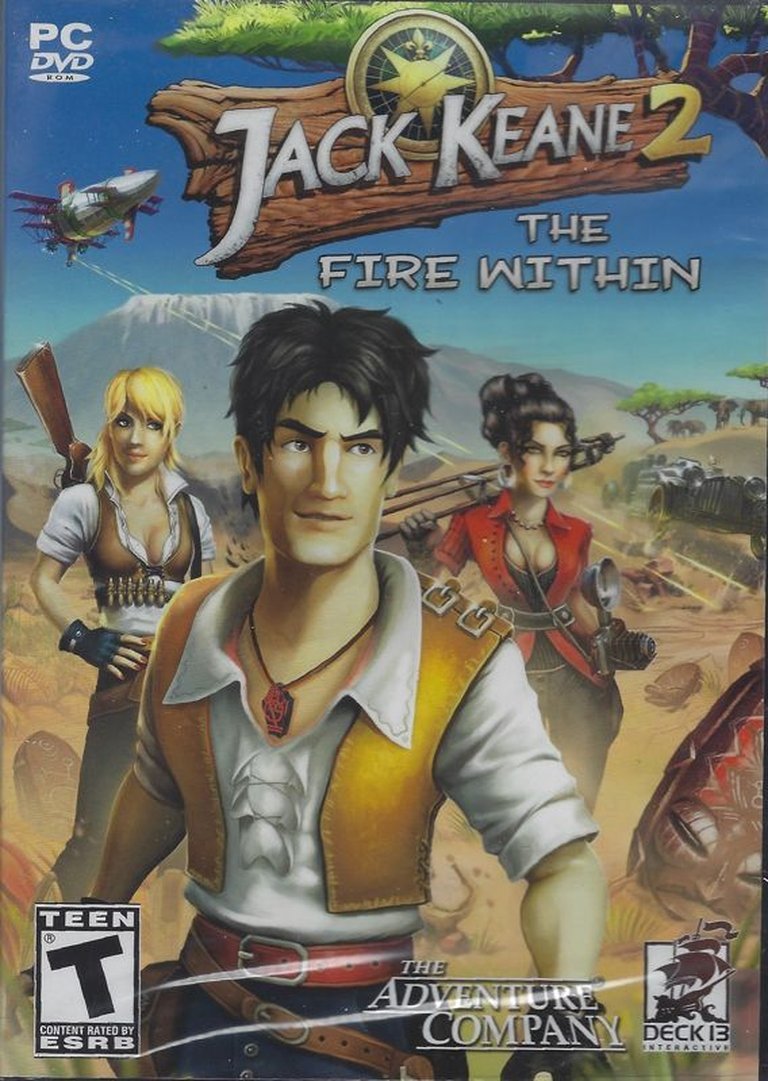
Five years after his first adventure, the charming rogue Jack Keane returns in ‘Jack Keane 2: The Fire Within’, teaming up with spirited Texan Amanda in 1890s Shanghai to hunt for a mysterious treasure guarded by an imprisoned shaman. This graphic adventure features puzzle-solving challenges, a 3D environment with fixed camera angles, and mouse-driven controls that evoke the spirit of classic point-and-click games like Monkey Island.
Gameplay Videos
Where to Buy Jack Keane 2: The Fire Within
Jack Keane 2: The Fire Within Guides & Walkthroughs
Jack Keane 2: The Fire Within Reviews & Reception
metacritic.com (52/100): While the picky controls and fixed camera angle can be annoying at times, Jack Keane 2 provides witty writing and attractive art combined with sensibly logical puzzles to provide a pretty good adventure.
gamesradar.com : But while you might discover a few gorgeous sights on your trip, you’ll find that the game is riddled with problems that makes Jack’s voyage ultimately one of frustration.
gamingbolt.com : The promise of a reinvented genre is never upheld in Jack Keane 2.
gamesreviews.com (60/100): The charisma, quirkiness and charm of the great point and clicks, however, are woefully absent.
gameboomers.com : The effect, of course, is that the game is very heavily plot driven, which is just fine, because the plot is an entertaining story.
Jack Keane 2: The Fire Within: Review
1. Introduction
Five years after his globe-trotting misadventure with Dr. T, the perpetually luckless but irrepressible British rogue Jack Keane returns in Jack Keane 2: The Fire Within (2012). Developed by German studio Deck13 Interactive and published by astragon Software, this sequel promises a “cinematic, fast-paced” adventure that reinvigorates the classic point-and-click formula with modern 3D visuals and dynamic sequences. Yet, while the game inherits its predecessor’s Monkey Island-esque charm and comedic spirit, The Fire Within emerges as a deeply polarizing experience. Its ambitious globe-spanning narrative and colorful world-building are undermined by technical hiccups, an unwieldy interface, and puzzles that vacillate between simplistic and illogical. This review dissects Jack Keane 2 as a product of its era, dissecting its triumphs and tribulations to determine whether it deserves a place in adventure gaming history—or merely a footnote.
2. Development History & Context
Deck13 Interactive, a studio with a pedigree in German adventure classics like Ankh, embarked on Jack Keane 2 with a clear mission: to modernize the point-and-click genre. Building on the foundation of their 2007 original, the team sought to blend traditional adventure mechanics with contemporary sensibilities. Using their proprietary Fledge 3D engine (paired with PhysX for physics and FMOD for audio), they aimed to create vibrant, cinematic environments while retaining genre staples like inventory puzzles and dialogue choices. The game was released on November 7, 2012, for Windows, later appearing in a Complete Edition (2013) bundling both titles.
Contextually, Jack Keane 2 arrived during a transitional period for adventure games. While titles like The Walking Dead (2012) were redefining the genre with narrative weight, Deck13 doubled down on lighthearted, escapist fun. The 1890s setting—spanning Shanghai, Hamburg, and the Nile Valley—reflected a colonial-era romanticism reminiscent of Indiana Jones films. Yet, the studio’s resources were stretched thin; the game’s 186 credits list (per MobyGames) reveal a lean team juggling ambitious scope with technical constraints. Initial reviews noted a “show-stopping” framerate bug (PCGamingWiki), hinting at rushed optimization—a common pitfall for mid-budget titles competing with AAA offerings. Despite Deck13’s pedigree in reviving German adventures (alongside Ankh), The Fire Within struggled to escape the shadow of its more polished predecessors.
3. Narrative & Thematic Deep Dive
The narrative thrusts Jack Keane into a Shanghai prison in 1899, where he shares a cell with a dying shaman guarding the legendary treasure of Ukumba—the “Eye of Fate.” Before perishing, the shaman imparts a cryptic clue and a fragment of a mystical amulet, setting Jack and his Texas cohorts, Amanda, on a quest across continents. The plot—a treasure hunt pitted against the villainous Professor Umbati—unfolds with globe-trotting abandon, from German factories to African jungles and Jack’s own subconscious.
Thematically, the game leans into self-aware absurdity, lampooning adventure tropes with meta-humor. A literate gorilla obsessed with cookbooks (a direct Donkey Kong nod, per GamesRadar+) and jabs at “Germans having no sense of humor” (Gamingbolt) underscore its playful deconstruction of genre clichés. Characters like the pragmatic Amanda and the bookish Eve provide a love triangle, with dialogue choices subtly influencing relationships and endings—though these consequences feel superficial.
However, the script stumbles in execution. Critics (Adventure Gamers, Game Over Online) derided the humor as “cringe-inducing dad-jokes,” while repetitive dialogue (“that’s not possible” responses) and underdeveloped accents grated on players. The narrative’s potential—exploring Jack’s growth beyond his “hapless” persona—is squandered in favor of episodic set pieces. Despite its vibrant settings, The Fire Within lacks the emotional depth of contemporaries, reducing its themes to treasure, rivalry, and slapstick.
4. Gameplay Mechanics & Systems
Jack Keane 2’s core gameplay hybridizes classic point-and-click with 3D traversal and combat. The interface offers three control schemes: point-and-click, click-and-drag, and WASD/keyboard. All suffer from clunky implementation: fixed camera angles obscure interactive hotspots, while imprecise jumping mechanics (triggered via right-click or spacebar) often result in frustrating platforming failures. A “highlight” button aids item discovery, but small objects remain elusive.
Inventory puzzles dominate, blending logic with trial-and-error. Players combine items (e.g., wetting pillow stuffing to create a signal mirror) to solve environmental challenges. While puzzles are “sensibly logical” (Gaming Nexus), their solutions can be obtuse, with sparse feedback leading to aimless wandering. Combat introduces a turn-based card system: enemies signal attacks in slow motion, requiring players to select counter-moves from a “hand” of cards. This mechanic, inspired by Monkey Island’s sword fights, feels gimmicky and repetitive, as success hinges on memorizing patterns rather than strategy.
Character-switching adds variety—players briefly control Amanda or Eve during multi-character puzzles—but this rarely evolves beyond simple delegation. Branching dialogue offers fleeting choice consequences, though character interactions feel scripted. Ultimately, The Fire Within’s systems create friction: the interface and puzzles clash with its “cinematic” ambitions, turning exploration into a chore.
5. World-Building, Art & Sound
Deck13’s Fledge engine renders a stylized 3D world bursting with personality. Environments range from the grimy confines of Shanghai Prison to the sun-drenched Nile banks, offering lush vegetation and detailed machinery. Character designs are expressive, though facial animations suffer from “uncanny” stiffness (Gamingbolt). The art direction prioritizes cartoonish vibrancy over realism, aligning with the game’s comedic tone.
Sound design is a mixed bag. Voice acting is generally competent—Amanda’s return voice actress Lani Minella (Nancy Drew) offers familiarity—yet accents often veer into caricature. The orchestral soundtrack swells during action sequences, though audio glitches (e.g., cutting sound effects) mar immersion (PCGamingWiki). Highlights include dynamic set-pieces like an airship chase or a zeppelin pursuit, which create “welcome illusions of action” (Adventure Gamers) without demanding reflexes.
Yet, the world’s beauty is undermined by technical flaws. Texture pop-in, erratic animations, and a “drab” palette (Game Over Online) diminish immersion. While the subconscious sequences—abstract, surreal vistas—show creativity, they amplify puzzle obscurity. Ultimately, The Fire Within’s world-building excels in ambition but falters in execution, leaving players admiring vistas rather than inhabiting them.
6. Reception & Legacy
Upon release, Jack Keane 2 received a mixed-to-negative critical reception, with a MobyGames average of 67% and Metacritic score of 52. Praise centered on its humor (“a giggle-fest,” GamesRadar+), puzzles, and visuals. German outlets like Spielemagazin (85%) lauded its “sympathetic adventure” qualities, while GameStar (81%) credited Deck13 for reviving the genre. Conversely, Western critics skewered its technical issues: Adventure Gamers (40%) called it “frustrating,” and Game Over Online (61%) deemed it “mediocre at best.”
Player reviews on Steam were similarly divided, with a “Mixed” rating (46% positive) citing clunky controls and bugs. Over time, the game’s reputation stabilized as a flawed but charming footnote. Its legacy lies in Deck13’s evolution: while The Fire Within failed to innovate, the studio later crafted darker, more successful titles like The Surge. For adventure enthusiasts, it remains a curiosity—a relic of an era where genre experiments often stumbled under technical constraints. Its inclusion in the Jack Keane: Complete Edition (2013) ensures niche preservation, but it has not inspired direct imitators.
7. Conclusion
Jack Keane 2: The Fire Within encapsulates the ambitions and perils of mid-2010s adventure gaming. Deck13’s vision of a “cinematic, 21st-century adventure” (Steam) yields moments of delight—its globe-trotting narrative, whimsical humor, and vibrant art create a compelling framework. Yet, this promise is consistently undermined by a “clumsy interface” (Adventure Gamers), illogical puzzles, and persistent technical gremlins. The game’s identity crisis—straddling classic point-and-click and 3D action—results in friction, leaving players torn between its charm and frustrations.
Ultimately, The Fire Within is a flawed, uneven experience. It serves as a testament to Deck13’s creative ambition but also a cautionary tale of execution. While it fails to achieve the heights of its inspiration, Monkey Island, it remains an affectionate, if messy, love letter to adventure gaming. For genre historians, it’s an artifact of a transitional era; for players, it’s a recommendation only for the most forgiving of treasure hunters. Verdict: A passable but forgettable sequel, worth revisiting only for its undiluted pulp spirit—not its technical prowess.