
- Release Year: 1998
- Platforms: Macintosh, Windows
- Publisher: Intellivision Productions Inc.
- Developer: Intellivision Productions Inc.
- Genre: Compilation
- Perspective: Varied
- Game Mode: Single-player
- Average Score: 67/100
Description
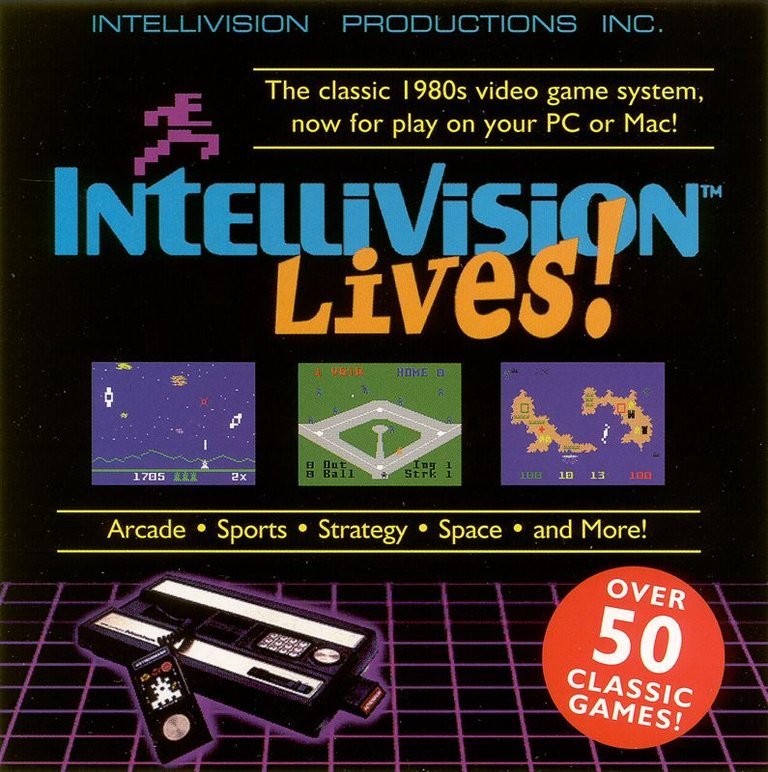
Intellivision Lives! is a comprehensive compilation and multimedia package that emulates nearly every Intellivision game originally published by Mattel Electronics and INTV Corp. (excluding licensed titles), along with unpublished prototypes. It features hyper-text multimedia presentations offering detailed histories, instructions, trivia, screenshots, box covers, marketing data, interviews, videos, and commercials for each game, creating an extensive interactive archive of the classic console’s era.
Gameplay Videos
Intellivision Lives! Free Download
Intellivision Lives! Cheats & Codes
PlayStation 2
| Code | Effect |
|---|---|
| At the title screen for B-17 Bomber, press Select to bring up the keypad, then highlight the 0 position and press X, then highlight the 1 position and press X | 200 lives and unlimited fuel |
| At the main menu, choose Thin Ice and press X. At the controller configuration screen, hold R2 on the second controller and press X on the first controller | Play Voochko On Ice |
Intellivision Lives!: Review
Introduction
Step into the digital amber of 1998, where the ghosts of console wars past were resurrected not on dusty cartridges, but on a single CD-ROM. Intellivision Lives! isn’t merely a game—it’s a time capsule, a museum, and a love letter to an era when Mattel Electronics dared to challenge Atari’s dominance. As a compilation of over 60 Intellivision titles—spanning from 1979 to 1990—this landmark release by Intellivision Productions offered more than nostalgia; it delivered a meticulously preserved slice of gaming history. Its thesis is simple yet profound: to bridge the gap between the 8-bit past and the multimedia present, ensuring that the Intellivision’s legacy wouldn’t crumble like its plastic controllers. In doing so, it redefined what a retro compilation could be, setting a precedent for both preservation and presentation that echoes in modern compilations like Atari 50: The Anniversary Celebration.
Development History & Context
The genesis of Intellivision Lives! is a story of resurrection and rebellion. In 1997, former Mattel Electronics programmers Keith Robinson and Stephen Roney—veterans of the “Blue Sky Rangers,” the nickname given to Mattel’s dev team—founded Intellivision Productions. Their mission? To salvage the Intellivision IP from the ashes of the 1983 industry crash and INTV Corporation’s subsequent bankruptcy. This wasn’t just about games; it was about reclaiming a cultural artifact.
Technologically, the project was a triumph of reverse engineering. Carl Mueller Jr., a Michigan student, had independently reverse-engineered the Intellivision’s hardware, enabling emulation. His work, combined with ROM dumps from enthusiasts like Sean Kelly and William Moeller, formed the bedrock of the emulator. The team faced Herculean challenges: the General Instrument CP1610 CPU, custom STIC graphics chip, and PSS sound chip lacked comprehensive documentation. Yet, they achieved cycle-accurate simulation, ensuring gameplay remained faithful to the 1979–1990 originals.
The gaming landscape of 1998 was ripe for this endeavor. The PlayStation and Nintendo 64 ruled consoles, but PC gaming was ascendant, and a nascent retro-gaming scene demanded access to classics. Intellivision Lives! capitalized on this, targeting both nostalgic adults and curious newcomers. Its initial release—on hybrid Windows/Mac CD-ROM—was a commercial risk, but the free Intellipack demos (1997) had already proven the market’s hunger for digital Intellivision. By 2003, Crave Entertainment expanded to consoles (PS2, Xbox, GameCube), and in 2010, the Nintendo DS port brought tactile touch-screen controls to the collection. Each iteration balanced technical constraints with the creators’ vision: “It’s not just about playing old games,” Robinson noted, “it’s about understanding why they mattered.”
Narrative & Thematic Deep Dive
While devoid of a traditional plot, Intellivision Lives! weaves a compelling narrative through its multimedia tapestry. It chronicles the Intellivision’s rise as a challenger to Atari’s 2600, highlighting its superior graphics and sophisticated library—titles like Utopia (1981), a precursor to strategy games, and Night Stalker (1982), a proto-survival horror. The multimedia presentation is a masterclass in historical storytelling: developer interviews reveal how “fresh-from-college” programmers coded Astrosmash in mere kilobytes, while timelines detail Mattel’s ill-fated foray into video games.
Beneath the surface lies a thematic dichotomy: innovation versus obsolescence. Games like Space Spartans (1982) showcase the Intellivision’s technical ambition with its Intellivoice module, while unreleased prototypes like Duncan’s Thin Ice exemplify the “what-ifs” of canceled projects. The licensed-title omissions (Bump ’N’ Jump, Masters of the Universe) are absences that speak volumes—legal battles that fractured the Intellivision’s identity. Yet, the collection’s true narrative is one of cultural preservation. As Robinson stated, “We weren’t just saving code; we were saving the stories of the people who made it.” This ethos transforms the compilation into an interactive documentary, where each game is a chapter in the untold history of console gaming.
Gameplay Mechanics & Systems
Intellivision Lives!’ gameplay is a dual-layered experience: the emulated titles themselves and the surrounding meta-systems that contextualize them. The core loop is deceptively simple: select a game, play, repeat. Yet beneath this lies a sophisticated emulation framework that prioritizes authenticity. Games like NFL Football (1979) retain their top-down strategic depth, while Armor Battle (1979) replicates its tank-combat physics with pixel-perfect precision. Save states and rewind functionality—modern conveniences absent in the 1980s—soften the difficulty curve, making these relics accessible.
Control, however, remains the collection’s Achilles’ heel. The Intellivision’s iconic 16-directional disc and 12-button keypad are notoriously difficult to map to modern inputs. Keyboard emulation is functional but clunky; third-party controllers like the Gravis GamePad Pro were recommended for fidelity. The DS port ingeniously used the touch screen to simulate keypad overlays, but the absence of a true d-pad compromised games requiring 16-way precision, such as Vectron.
The meta-systems, however, elevate the experience. The “hyper-text multimedia presentation” acts as a living encyclopedia. Unlockable developer interviews (e.g., Peter Takaichi on Astrosmash’s design), historical timelines, and trivia sections transform passive gameplay into active learning. Achieving high scores in Night Stalker unlocks vintage commercials, rewarding engagement with tangible relics of 1980s marketing. This integration of gameplay and historiography creates a feedback loop where the player becomes both gamer and historian.
World-Building, Art & Sound
The world of Intellivision Lives! is a paradox: it simultaneously immerses players in the 1980s and embraces modernity. The PC/Mac interface evokes a digital museum, with high-resolution scans of box art, overlays, and manuals arranged in a browsable gallery. Console ports like the PS2 version adopt a 3D “pizza parlor” hub—a nod to arcade culture—though this feels tonally dissonant given the Intellivision’s home-centric origins.
Visually, the games remain unapologetically blocky, preserving the General Instrument CP1610’s 160×96 resolution. CRT scanline filters and upscale options balance authenticity with modern clarity. The art direction is a study in 8-bit minimalism: Astrosmash’s meteors and Frog Bog’s lily pads are rendered with bold, limited palettes that emphasize playability over detail.
Sound design is equally faithful. Chiptune melodies from composers like George Sanger (Thunder Castle) and the iconic Astrosmash jingle evoke the era’s audio quirks. The multimedia browser’s background music, though criticized as repetitive, serves as a sonic anchor. Most compelling are the archival sounds: the crackle of 1980s commercials, the anecdotes in interviews, and the Intellivoice module’s synthesized speech in Space Spartans. These elements coalesce to create an atmosphere not of retro kitsch, but of living history.
Reception & Legacy
Upon release, Intellivision Lives! received mixed but generally favorable reviews. Critics lauded its comprehensiveness—FamilyPC Magazine awarded it 93%, calling it “the next best thing to a real Intellivision”—but lamented control issues. IGN’s 6/10 verdict summed up the dichotomy: “still blocky after all these years, sure…but these games really need the controller.” Console ports fared similarly; the PS2/Xbox versions averaged 64% on Metacritic, praised for unlockables but criticized for clunky remapping. The DS port (2010) earned a 6/10 for portability but touch-screen inaccuracies.
Commercially, the compilation thrived. The 2003 console releases sold millions, buoyed by nostalgia marketing. Its true legacy, however, lies in cultural impact. Intellivision Lives! pioneered the “museum compilation” model, inspiring later compilations like Intellivision Rocks (2001) and Atari 50. It preserved games from obscurity—unreleased titles like Deep Pockets (1990) saw the light of day—and fostered the homebrew scene, as the emulator’s robustness allowed for new Intellivision development.
The Intellivision brand’s endurance testifies to this legacy. Atari’s 2024 acquisition of the IP and the 2025 Intellivision Sprint plug-and-play console—featuring 45 emulated games—directly trace back to Lives!’ preservation efforts. As Robinson reflected, “We didn’t just revive the games; we revived the conversation about their place in history.”
Conclusion
Intellivision Lives! is more than a compilation; it’s a landmark in gaming archaeology. Its flaws—awkward controls, licensed omissions—are overshadowed by its ambition: to make history interactive. By merging authentic gameplay with exhaustive multimedia, it created a template for future retro collections that prioritizes context over mere replication. For those who remember the Intellivision’s heyday, it’s a poignant revisitation; for newcomers, it’s a masterclass in gaming’s evolution. In an industry obsessed with the new, Intellivision Lives! remains a vital reminder that some legacies deserve to live again. As a time capsule of digital ambition, it earns its place not just in nostalgia, but in the annals of game preservation. Verdict: Essential.