
- Release Year: 2004
- Platforms: Windows
- Publisher: Brighter Minds Media, Inc., Russobit-M
- Developer: FiniteMonkey, Inc.
- Genre: Action, Educational
- Perspective: 1st-person / Top-down
- Game Mode: Single-player
- Gameplay: Action, Matching, Minigames, Puzzles, Strategy
- Setting: espionage, Spy
Description
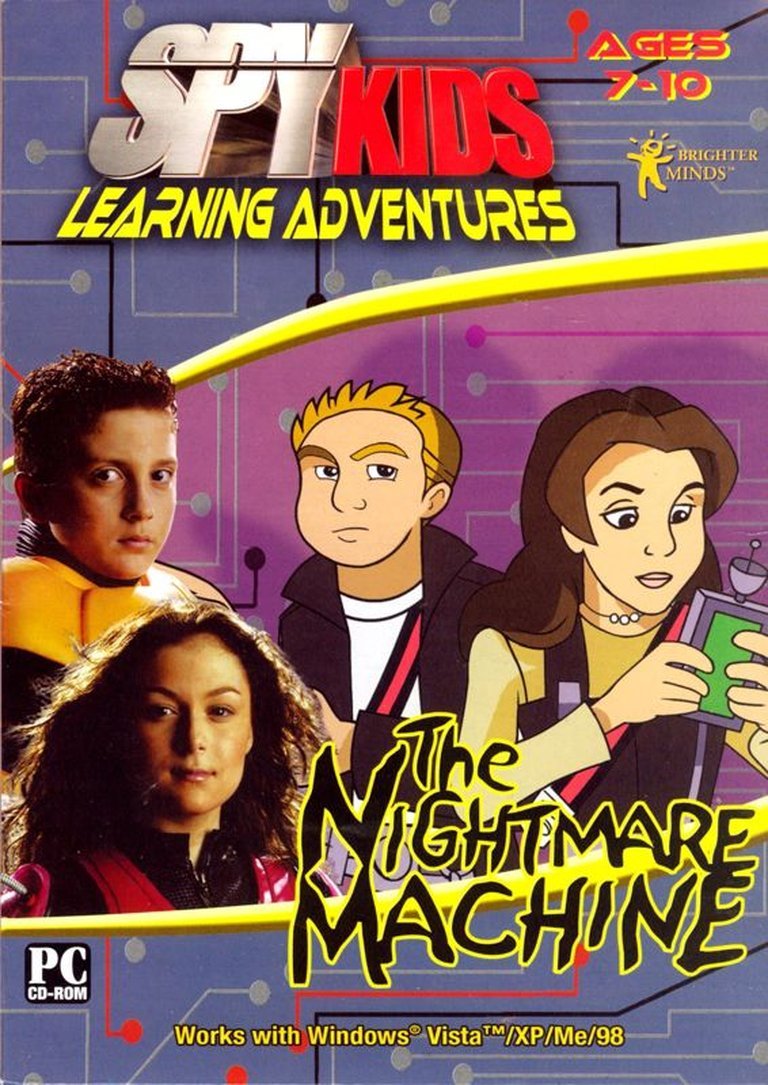
In Spy Kids Learning Adventures: Mission: The Nightmare Machine, Carmen and Juni are dispatched to Antarctica to destroy a diabolical machine broadcasting nightmares to adults worldwide. The game features an animated comic-book narrative where players solve math and logic puzzles from a downloadable puzzle book and complete eight themed minigames, including strategic penguin-feeding, pattern-matching, ice-floe navigation, word-building, and supersonic tone battles against ice giants.
Spy Kids Learning Adventures: Mission: The Nightmare Machine Reviews & Reception
retro-replay.com : Spy Kids Learning Adventures: Mission: The Nightmare Machine delivers a hybrid gameplay experience that blends traditional puzzle-solving with action-based minigames.
Spy Kids Learning Adventures: Mission: The Nightmare Machine: Review
Introduction
In an era when educational games often sacrificed fun for pedagogy, Spy Kids Learning Adventures: Mission: The Nightmare Machine (2004) emerged as a refreshing anomaly. Part of a licensed series spun from Robert Rodriguez’s blockbuster Spy Kids films, this Windows-exclusive title dared to merge espionage thrills with rigorous academic challenges. Developed by FiniteMonkey, Inc. and published by Brighter Minds Media, it tasked players with guiding sibling agents Carmen and Juni through Antarctica to disable a machine broadcasting nightmares to adults. Yet its true legacy lies not in its licensed tie-in status, but in its ingenious fusion of narrative, puzzle-solving, and arcade-style minigames—a design philosophy that still feels remarkably prescient. This review dissects its ambitious synthesis of learning and entertainment, arguing that The Nightmare Machine stands as an unsung model for educational game design.
Development History & Context
Origins and Vision
FiniteMonkey, Inc., a relatively obscure developer, conceived The Nightmare Machine as the third entry in a four-game Spy Kids Learning Adventures series. Led by Creative Director Randy Meredith and Project Manager Nikki Bataille Lange, the team’s vision was explicitly dual-purpose: to capture the film’s playful spy aesthetic while embedding curriculum-aligned math, logic, and literacy skills. The choice of Antarctic setting—rare in gaming at the time—allowed for thematic novelty, framing education as a global rescue mission. As MobyGames credits reveal, the studio assembled a 49-person team, including voice actors reprising Carmen (Lisa Peterson) and Juni (Kameron Williams), ensuring brand authenticity.
Technological Constraints and Market Context
Released on CD-ROM for Windows in 2004, the game operated within limitations typical of its era. Low-resolution graphics, pre-rendered comic-style cutscenes, and mouse-driven gameplay reflected the technical constraints of budget educational titles. Its timing was pivotal: the mid-2000s saw a surge in licensed children’s games, but few balanced commercial viability with pedagogical integrity. Publishers Brighter Minds Media (U.S.) and Russobit-M (Russia) targeted a niche demographic: parents seeking “edutainment” that felt organic, not forced. This context highlights the game’s ambition: to create a seamless experience where solving algebraic problems felt as heroic as dodging ice floes—a radical departure from the drill-and-practice software dominating classrooms.
Narrative & Thematic Deep Dive
Plot and Characterization
The narrative unfolds across Antarctic locales, from frozen wastelands to the titular Nightmare Machine’s core. After adults worldwide suffer insomnia from broadcast nightmares, Carmen and Juni—voiced with youthful exuberance—are dispatched to dismantle the device. The story, delivered via animated comic panels with speech bubbles, prioritizes accessibility over complexity. Yet it weaves subtle themes of empowerment and critical thinking: Carmen’s analytical approach contrasts with Juni’s impulsiveness, teaching players that “spy work” requires both brains and agility. Villains like ice giants (defeated via sonic puzzles) embody abstract fears—another clever integration of psychological and educational motifs.
Dialogue and Integration of Learning
Dialogue is concise but purposeful, turning instructions into character-driven banter. When Carmen urges, “Use the tuning fork to match the giant’s frequency,” she’s both advancing the plot and teaching musical pitch—a masterclass in organic learning integration. The puzzle book’s answers trigger story progression, creating a tangible reward for academic effort. This synergy transforms rote exercises into narrative stakes: solving a logic puzzle isn’t just about points; it’s about disabling security lasers or unlocking rocket skates. The result is a rare educational game where failure feels like a plot twist, not a penalty.
Gameplay Mechanics & Systems
Hybrid Gameplay Loop
The Nightmare Machine’s brilliance lies in its dual-challenge structure: a physical puzzle book (included or downloadable) and eight story-driven minigames. This hybrid approach caters to diverse learning styles. Book puzzles require offline contemplation, fostering focus, while minigames offer kinetic, immediate feedback.
- Puzzle Book Mechanics: Math and logic problems (e.g., calculating ice floe speeds or decrypting patterns) are embedded in the narrative. Players input answers via the game, with incorrect responses prompting gentle hints—a safeguard against frustration.
- Minigame Variety: Each minigame innovates within genre conventions:
- Penguin Path: A grid-based strategy game where tossing fish manipulates penguin movement.
- Ice Wall: A memory-matching game with concealed patterns.
- Jump the Ice Floes: A Frogger-clone testing timing and spatial reasoning.
- Alphabetical Spire of Doom: A word-building exercise on a hexagonal grid.
- Antarctic Gothic: A rhythm-based boss battle where matching tones defeats giants.
- Others (e.g., Run In Up the Spire) combine math (odd/even snowballs) with platforming.
Progression and UI
Progression is linear but paced to alternate cerebral and action phases. The UI, stripped of clutter, uses intuitive icons (e.g., a fish icon for “Penguin Path”) and on-screen prompts. Timed challenges (e.g., Disable The Autodestruct) inject urgency but remain forgiving, prioritizing encouragement over punishment. This design ensures accessibility while rewarding replayability—minigames can be replayed to improve scores, turning education into iterative mastery.
World-Building, Art & Sound
Art Direction and Atmosphere
The Antarctic setting is rendered as a vibrant, exaggerated comic book world. Jagged ice caverns and the Nightmare Machine’s neon-blue chambers use bold outlines and saturated colors, evoking the films’ hyper-stylized aesthetic. Character animations are fluid—Carmen’s spy gadgets “prrrt” to life with playful sound effects—while environmental details (e.g., penguins waddling) add charm. This artistry transforms a frozen wasteland into a character-driven playground, where even falling ice blocks feel whimsical rather than threatening.
Sound Design and Voice Acting
Voice acting anchors the experience. John Jackson’s gravelly narration lends gravitas to mission briefings, while Peterson and Williams capture the siblings’ sibling dynamic—Carmen’s confidence and Juni’s humor shining through. Sound effects (tuning forks, rocket skates) are crisp, and the score shifts between tense (during Jump the Ice Floes) and triumphant (after puzzle solves). Though not groundbreaking, the audio complements the visuals, reinforcing the game’s tone of playful urgency.
Reception & Legacy
Launch Reception and Commercial Performance
Upon release, The Nightmare Machine flew under mainstream critical radar. MobyGames lists only a 3.5/5 player rating, with no professional reviews—a fate common in licensed educational titles. Commercially, it occupied a narrow niche: praised by parents for its seamless learning integration but overlooked by mainstream gaming media. Its Russian release via Russobit-M (2005) underscores a limited global footprint, reflecting the challenges of marketing edutainment beyond dedicated audiences.
Long-Term Influence and Historical Significance
Over time, the game’s reputation has evolved among educators and preservationists. Its “puzzle book + minigames” framework prefigured modern educational titles like Kerbal Space Program’s blend of theory and practice. Notably, it avoided the “chocolate-covered broccoli” trap of many 2000s educational games, proving that narrative and mechanics could coexist. Though its technical limitations (Windows-only, dated graphics) restrict accessibility today, it remains a case study in mission-driven design: where every challenge serves a story, and every story teaches.
Conclusion
Spy Kids Learning Adventures: Mission: The Nightmare Machine is a time capsule of 2000s edutainment ambition—flawed yet visionary. Its Antarctic odyssey may lack the graphical polish of AAA titles, but its synthesis of math puzzles, spy theatrics, and comic-book charm creates a cohesive, engaging world. FiniteMonkey’s refusal to dumb down content for younger audiences, while ensuring accessibility, makes it a model for learning-through-play. Though its legacy is confined to niche circles, it endures as a testament to a simple truth: the best educational games don’t just teach skills—they make players feel like heroes. In a world where screen time is often debated, The Nightmare Machine stands as a reminder that interactivity, when married to purpose, can transform learning into an adventure.