
- Release Year: 2007
- Platforms: Windows
- Publisher: Elephant Entertainment, LLC, K2 Network, Inc., Papaya Play
- Developer: Dream Execution Technology Co., Ltd.
- Genre: Action
- Perspective: 1st-person
- Game Mode: Online PVP
- Gameplay: Arcade action, Shooter, Vehicular
- Setting: Fictional, Modern Day
- Average Score: 56/100
Description
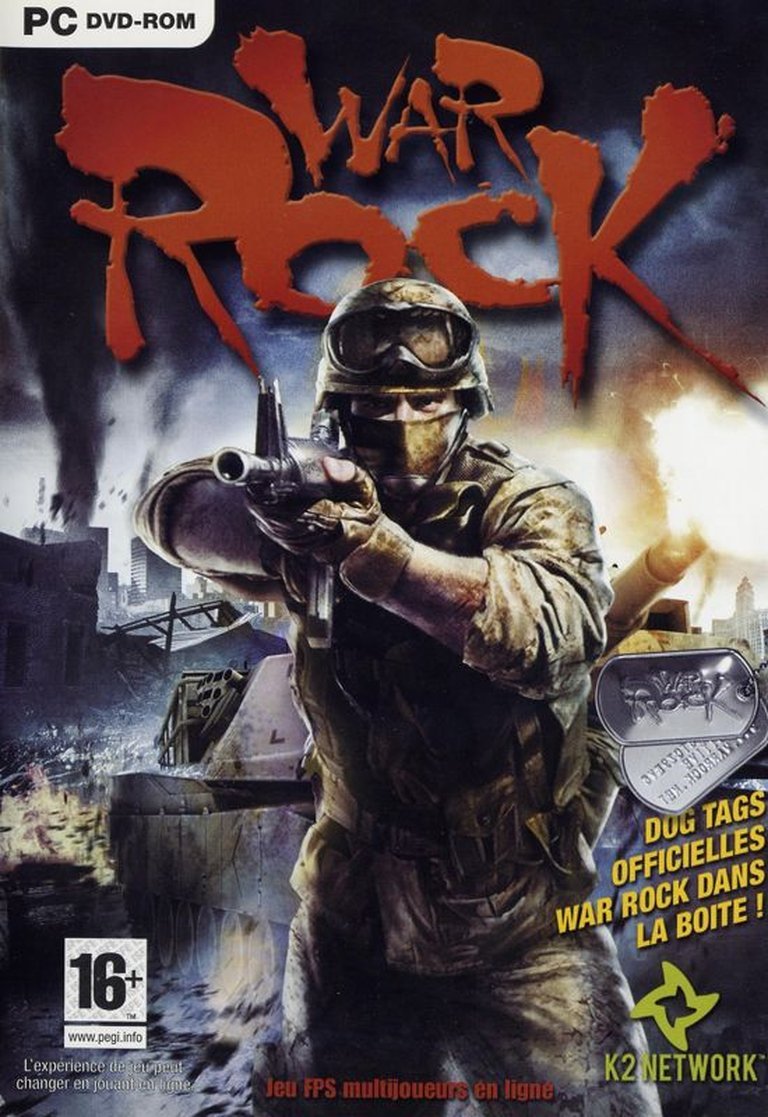
War Rock is a free-to-play online shooter set in a fictional modern-day conflict between the NIU rebels and the Derbaran Military, featuring three distinct map types—Close Quarters Combat (16 players), Urban Ops (24 players), and Battle Group (32 players)—with game modes including Explosive (bomb planting/defusing) and Deathmatch (team-based objectives). Players gain experience to unlock and lease weapons, can command vehicles like tanks and helicopters, and access premium benefits for enhanced progression and server customization.
Gameplay Videos
Where to Buy War Rock
PC
War Rock Free Download
War Rock Patches & Updates
War Rock Guides & Walkthroughs
War Rock Reviews & Reception
metacritic.com (53/100): War Rock is a mediocre online first-person shooter that feels more like an economic experiment than an actual retail product.
ign.com : War Rock delivers an online first person shooter that’s hampered by unfortunate technical issues.
gamesradar.com : While innovation is good, this game isn’t, particularly.
worthplaying.com : War Rock, developed by Dream Execution, is an online FPS game in the style of EA’s Battlefield 2, allowing you to experience online battlefields on a large scale, supporting vehicles for land, sea and air.
War Rock Cheats & Codes
PC
| Code | Effect |
|---|---|
| 123123 | Unlimited Health |
| opqw1`2 | Unlimited Health |
| hubert152200 | Unlimited Health |
| [F4] pressed 4x | Cheat in death match (effect not specified) |
War Rock: Review
Introduction
In the mid-2000s, as free-to-play models began their global ascent, War Rock emerged as a bold, if flawed, experiment in the first-person shooter (FPS) genre. Developed by South Korean studio Dream Execution and published internationally by K2 Network, this 2007 title promised a synthesis of Counter-Strike‘s tactical intensity and Battlefield‘s vehicular chaos, all wrapped in a free-to-play package. Yet War Rock remains a cautionary tale of ambition undermined by persistent technical decay, predatory monetization, and an unyielding tide of cheating. This review deconstructs War Rock‘s legacy—a game that, despite its glaring faults, inadvertently shaped the trajectory of online shooters by embodying both the promise and peril of early free-to-play models. Its story is one of explosive potential squandered, leaving behind a fragmented fanbase and a lingering question: could a better execution have made it a genre cornerstone?
Development History & Context
War Rock was born from the vision of Dream Execution Technology Co., Ltd., a South Korean developer keen to export its domestic free-to-play ethos to Western markets. While the Korean version launched in 2004, the international debut in 2007 coincided with a pivotal moment: the West was skeptical of “freemium” business models, often dismissing them as unsustainable novelties. As recounted by former developer Nemico, trade shows like E3 and GDC were filled with ridicule toward F2P, yet War Rock persisted as one of the first FPS titles to champion the model outside Asia. Technologically, the game utilized the proprietary Jindo engine, optimized for accessibility with modest system requirements (e.g., Pentium III 800 MHz, 512MB RAM) to attract casual gamers. This contrasted sharply with contemporaries like Battlefield 2, which demanded high-end hardware. The multiplayer-centric design—with no single-player campaign—reflected developer priorities: rapid, repeatable engagements over narrative depth. However, the lack of user-dedicated servers (all were publisher-controlled) proved a fatal flaw, centralizing power and crippling the game’s ability to police itself against exploits and cheaters.
Narrative & Thematic Deep Dive
War Rock‘s narrative is a minimalist backdrop: a civil war in the fictional nuclear-ravaged Republic of Derbaran, pitting the government’s yellow-clad Derbaran Military against the green-uniformed National Independence Union (NIU) rebels. This setting, as noted by sources like Wikipedia and en-academic, was intentionally vague—merely a conduit for multiplayer combat. Players assume no personal roles beyond class archetypes: the healing Medic, vehicle-repairing Engineer, long-range Sniper, close-quarters Assault soldier, or anti-vehicle Heavy Trooper. Dialogue is nonexistent beyond in-game commands, and character development is nonexistent. Thematically, the game’s structure inadvertently critiques war’s futility through repetition: the 30-day weapon leasing system (where powerful guns “expire” after use) mirrors military-industrial obsolescence, while the pay-to-win divide between premium and free players becomes a stark metaphor for economic disparity. Yet these themes remain unexplored, buried beneath gameplay loops that prioritize mechanical grind over storytelling.
Gameplay Mechanics & Systems
War Rock‘s core gameplay is a hybrid of FPS archetypes, executed with mixed results.
-
Game Modes & Maps:
The game offered three scalable experiences:- Close Quarters Combat (CQC): Small, infantry-focused maps (e.g., Marien) for up to 16 players, featuring a Counter-Strike-like bomb-defusal mode (“Explosive”). Dying forced players to sit out rounds, emphasizing caution and strategy.
- Urban Ops: Medium-sized maps for 24 players, blending infantry combat with light vehicles (jeeps, boats).
- Battle Group: Large-scale battles (32 players) with armored vehicles (tanks, helicopters, jets) and Battlefield-style flag control (“Conquest Mode”).
-
Combat & Movement:
Combat favored “arcade action” over realism, with players able to sprint, roll (consuming stamina), and drop prone for quick cover. Headshots were lethal, encouraging twitch reflexes, but lag (a recurring issue) often nullified skill. Vehicle handling was praised as accessible, though physics were simplistic. -
Progression & Monetization:
Players earned experience points and Dinar (in-game currency) to lease weapons (e.g., FAMAS, PSG-1 sniper) and gear, lasting 30 days. This created a punishing grind for free players, while premium subscribers (paying up to $15/month) gained XP/Dinar bonuses, exclusive weapons, and private server access. The model sparked accusations of “pay-to-win,” as noted by GameSpot and player reviews, with premium-only gear like the M134 Minigun creating insurmountable advantages. -
Classes & Roles:
Five classes encouraged teamwork: Medics healed (albeit awkwardly via proximity syringes), Engineers repaired vehicles, Snipers provided overwatch, Assault soldiers offered versatility, and Heavies countered vehicles. However, mode limitations often reduced their utility.
World-Building, Art & Sound
War Rock‘s world-building was functional but unremarkable. The fictional Derbaran, geographically situated between Central Asian nations (en-academic), served as a generic warzone with maps ranging from ruined cities (Velruf) to arid deserts (Khali). Atmosphere was secondary to action, with environments offering basic tactical cover but little environmental storytelling.
Artistically, War Rock was a product of its era. As IGN lamented, its graphics were “ugly” and dated, with low-polygon models, repetitive textures, and crude animations. While its modest requirements allowed broad accessibility, it paled against Battlefield 2‘s visual fidelity. Sound design followed suit: gunfire and engine noises were passable but unmemorable, while the soundtrack was generic orchestral fare. Voice acting was absent, replaced by text-based commands.
Reception & Legacy
War Rock polarized critics and players at launch, with reception mirroring its inherent contradictions.
-
Critical Response:
Aggregate scores reflected this divide. Metacritic (53/100) and GameSpot (5.5/10) condemned its technical flaws and monetization, while IGN (5.9/10) called it “mediocre.” Yet niche outlets like Freehare (100%) and Freegame.cz (97%) praised its accessibility and frenetic pace. Eurogamer’s scathing 3/10 review epitomized mainstream sentiment: it derided the game as a “second-rate FPS” with an “unfair” subscription model. -
Player Sentiment:
Player reviews on platforms like MobyGames and Steambase (59/100) echoed criticism of cheating, pay-to-walled content, and bugs. One reviewer lamented: “hackers have spoiled this game,” while another noted, “if you pay, you’re God; if you don’t, you’re just a poor noob.” Yet a vocal minority cherished its arcade chaos, with nostalgia threads citing its unique blend of modes and community events (e.g., clan tournaments with real-world prizes). -
Legacy:
War Rock‘s true impact lies in its role as an industry catalyst. It demonstrated F2P’s viability in Western FPS markets, paving the way for titles like CrossFire and Warface. However, it also became a textbook case of mismanagement: its inability to curb cheating and its exploitative pricing ($15/month for “everything”) set cautionary precedents. As Nemico noted, its introduction of skins/cosmetics influenced later games, often with similarly divisive pay-to-win results. Today, War Rock endures as a niche relic, its servers still running but overshadowed by more polished successors.
Conclusion
War Rock was a Frankenstein’s monster of FPS concepts: stitching Counter-Strike‘s rounds, Battlefield‘s vehicles, and MMO-light progression into a free-to-play Frankenstein. Yet its execution was fatally flawed, undone by technical instability, a predatory economy, and an apathy toward cheating that rendered it unplayable for months at a time. While its core gameplay—arcade gunplay, diverse modes, and class synergy—offered fleeting moments of brilliance, these were consistently drowned out by frustration.
Verdict: War Rock occupies a paradoxical space in gaming history. It was a bold, flawed pioneer that inadvertently shaped the free-to-play landscape while embodying its earliest sins. For historians, it is a vital artifact of the mid-2000s F2P experiment; for players, it is a cautionary tale of ambition squandered. Though its legacy is tarnished, War Rock‘s ghost lingers in every modern F2P shooter that borrows its blueprints—proving that even broken revolutions can leave an indelible mark.