
- Release Year: 1996
- Platforms: Android, iPad, iPhone, Linux, Macintosh, Nintendo Switch, PlayStation 4, Wii, Windows 16-bit, Windows
- Publisher: Atari Europe S.A.S.U., Humongous Entertainment, Inc., Majesco Entertainment Company, Night Dive Studios, LLC, Russobit-M, Tommo Inc., UFO Interactive Games, Inc.
- Developer: Humongous Entertainment, Inc.
- Genre: Adventure, Educational
- Perspective: First-person
- Game Mode: Single-player
- Gameplay: Exploration, Minigames, Puzzle-solving
- Setting: Bedroom, Fantasy
Description
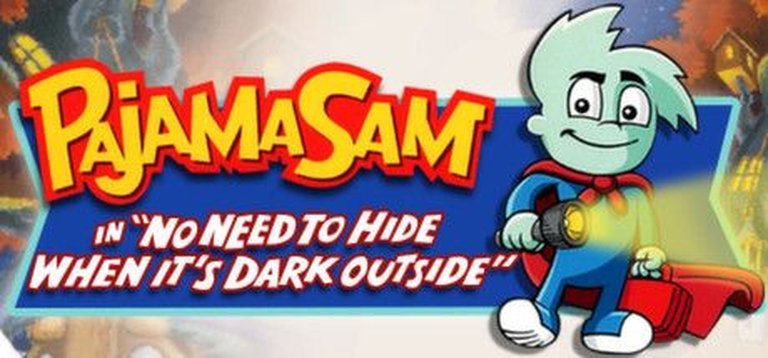
Pajama Sam: No Need to Hide When It’s Dark Outside follows young Sam, who transforms into his superhero alter ego Pajama Sam to conquer his fear of the dark. After venturing into the Land of Darkness inside his closet and having his belongings stolen by mischievous trees, players guide Sam through this whimsical world. Along the journey, they solve puzzles, collect useful items like an oil can and magnet, interact with quirky characters such as Otto the boat and King the mine car, and help Sam retrieve his stolen gear while learning to overcome his fear.
Gameplay Videos
Where to Buy Pajama Sam: No Need to Hide When It’s Dark Outside
Pajama Sam: No Need to Hide When It’s Dark Outside Free Download
Pajama Sam: No Need to Hide When It’s Dark Outside Guides & Walkthroughs
Pajama Sam: No Need to Hide When It’s Dark Outside Reviews & Reception
store.steampowered.com : If your child has any lingering fear of the dark, this software is a must!
athinkerinspace.blog : it was a joy to replay this one as an adult.
Pajama Sam: No Need to Hide When It’s Dark Outside Cheats & Codes
PC
Add ‘SputmDebug=90996’ to the ‘hegames.ini’ file in config mode to enable Debug Mode. Then use the following codes:
| Code | Effect |
|---|---|
| SputmDebug=90996 | Enables Debug Mode |
| Ctrl+E | *can’t think of a name* |
| Ctrl+O | *see Ctrl+E* |
| Ctrl+F | Fast Mode |
| I | Item Select |
| C | Path Select |
| G | Room Select |
| Ctrl+G | ScummVM |
Pajama Sam: No Need to Hide When It’s Dark Outside: Review
1. Introduction
In the pantheon of childhood gaming memories, few titles shimmer as brightly as Pajama Sam: No Need to Hide When It’s Dark Outside. Released in 1996 by Humongous Entertainment, this point-and-click adventure transcends its “edutainment” label to become a luminous beacon of interactive storytelling. It’s a game where a boy’s fear of the dark becomes a surreal odyssey, blending whimsy with profound emotional resonance. As a professional historian, I argue that Pajama Sam stands as a masterclass in children’s interactive entertainment—a rare gem that balances sophisticated design with accessibility, creating an experience that remains hauntingly relevant nearly three decades later. This review dissects its enduring legacy, from its innovative mechanics to its philosophical underpinnings, revealing why it endures not just as a nostalgic artifact, but as a benchmark for narrative-driven gameplay.
2. Development History & Context
Humongous Entertainment, co-founded by LucasArts veteran Ron Gilbert and Shelley Day, entered the mid-1990s riding the success of franchises like Putt-Putt and Freddi Fish. Pajama Sam marked a bold pivot: a human protagonist navigating a world born of childhood anxiety. Gilbert’s experience with the SCUMM engine—pioneered in Monkey Island—was repurposed for CD-ROM, enabling lush hand-drawn backgrounds and complex character animations. The technological constraints of the era were ingeniously leveraged: backgrounds were inked by hand but colored digitally, eliminating dithering for a vibrancy that still pops.
Targeted at children aged 3–8, Pajama Sam arrived during the “golden age” of edutainment, competing with titles like Carmen Sandiego and Reader Rabbit. Yet it distinguished itself through higher production values and replayability, a rarity in the genre. As Gilbert envisioned, the game would “help kids confront their fears through play,” a philosophy embodied by its randomized puzzles and non-linear paths. The 1996 Electronic Entertainment Expo (E3) showcased an early prototype where Sam resembled a pumpkin—a design later referenced in Pajama Sam 3—underscoring the team’s iterative, player-centric approach. This synergy of veteran design and youthful ambition cemented Pajama Sam as a cornerstone of Humongous’ creative zenith.
3. Narrative & Thematic Deep Dive
The narrative unfolds with decept simplicity: Sam, a blue-skinned boy obsessed with his comic-book hero Pajama Man, braves his closet to “capture Darkness” in his lunchbox. Instead, he tumbles into the titular Land of Darkness—a surreal dreamscape where sentient trees confiscate his gear. The plot, however, is a Trojan horse for deeper themes.
At its core, the game is a psychonaut journey (as one reviewer aptly termed it). Sam’s adventure is ambiguously real or imagined—a product of his subconscious navigating fear. The Land of Darkness mirrors his bedroom (toys become landmarks, Darkness’ tree-house echoes his closet), blurring reality and fantasy. This duality is clearest in Darkness himself: not the villain of Sam’s comics, but a lonely being who confesses, “Why would you be afraid of me if I’m the one being stuffed into a box?” Their Tic-Tac-Toe duel becomes a metaphor for disarming fear through empathy.
Characters pulse with life. Otto the boat, who fears water (“Wood sinks! I’m wood!”), learns buoyancy from Sam, while Carrot the carrot (a proto-hippie revolutionary) lampoons corporate greed in World Wide Weather. Dave Grossman’s LucasArts-infused dialogue elevates these interactions: the “Brain Tickler” quiz parodies game shows with humor (e.g., accepting “movie studios” as what makes a star shine), and Darkness’ kitchen erupts into a comic opera of singing utensils. Even minor moments—like Wink and Blink’s Doors of Knowledge debating philosophy—inject existential wit. The result is a narrative that entertains while teaching that fear is often a shadow we cast ourselves.
4. Gameplay Mechanics & Systems
Pajama Sam pioneers randomized replayability in children’s gaming. Each playthrough shuffles the locations of Sam’s three core items (mask, flashlight, lunchbox) behind distinct puzzle paths. On the first run, “easy” chains breeze by (e.g., retrieving the mask via a dancing table), while replays unlock “hard” scenarios with elaborate logic (e.g., a magnet retrieval requiring navigation of a gravity-defying bookcase passage). This mechanic, though uneven (some hard chains feel tedious, like mindless clicking), extends longevity and mimics the unpredictability of childhood imagination.
The puzzles blend logic with whimsy. King the minecart’s oiling sequence teaches cause-and-effect, while the “Nuggets” minigame (a Snake-like gem collector) tests reflexes. The “Brain Tickler” quiz cleverly integrates with exploration—players must physically check water meters or flowers to answer questions. Yet the game falters in execution: sock-hunting (a sidequest) often frustrates with poorly hidden items, and the exit button’s deceptive placement (lower-left corner, not a menu) confuses newcomers. UI simplicity is a double-edged sword: it empowers young players but risks oversimplification for veterans. Still, the freedom to tackle objectives in any order creates a sandbox feel rare for the genre, encouraging experimentation and discovery.
5. World-Building, Art & Sound
The Land of Darkness is a triumph of surrealist world-building. A colossal red-leafed tree houses Darkness’ domain, its branches straddling lava-filled mines and a paint-bubbling geyser field. Every location pulses with personality: the wishing well grants selfish wishes (“Who’s the Wishing Well here, you or me?”), and the river’s sentient trees enforce border patrol via “Fantastic Racism.” These environments, built on SCUMM’s flexibility, reward curiosity—clicking a geyser triggers Otto’s tedious “Gratuitous Educational Content,” or a candle group hosts dynamic dialogues.
Artistically, the game marries hand-drawn charm with technical ambition. Backgrounds, inked by Todd Lubsen and colored digitally, lack dithering, making hues pop against the moody palette. Character animation, however, is inconsistent: lip-syncing in cutscenes feels natural, but Sam’s poses occasionally clash with his model. The standout is Darkness’ kitchen, where utensils sing in rhyming couplets—a visual and auditory feast. Sound design amplifies the atmosphere: Jeremy Soule’s score shifts from bouncy river themes to ominous mine melodies, while Pamela Adlon’s voice acting (Sam) infuses impatience and courage. Even ambient sounds—the drip of lava, the creak of mine tracks—immerse players in Sam’s psyche. The result is a world that feels both fantastical and intimately human.
6. Reception & Legacy
Pajama Sam debuted to critical acclaim, scoring 87% on MobyGames based on 13 reviews. Quandary and World Village lauded its empathy toward children’s fears, calling it “a must” for kids afraid of the dark. Electric Playground awarded it 9.5/10, praising the “continuity of excellence” in Humongous’ work. Yet some critiques held merit: SuperKids deemed it too simple for older players, while Oldies Rising noted its short lifespan. Players echoed this duality, averaging 4.0/5 on MobyGames—one review dubbing it a “psychonaut” triumph, another criticizing uneven puzzles.
Commercially, it sold nearly 3 million units and won 50 awards, cementing Humongous’ reputation. Its legacy endures in three sequels (1998–2003) and ports across Wii, iOS, and modern platforms. The randomized puzzle system influenced later Junior Adventures, while its themes of fear normalization resonate in titles like Inside Out. Yet its true impact lies in emotional resonance: as one blog noted, it taught a generation that “mind wandering” isn’t unproductive—it’s heroic. The game’s re-release on Steam (97% positive user reviews) and its inclusion in “essential early gamer” lists affirm its timeless relevance.
7. Conclusion
Pajama Sam: No Need to Hide When It’s Dark Outside is a flawed masterpiece. Its uneven puzzles and occasional UI hiccups prevent perfection, yet these flaws are dwarfed by its brilliance. In blending Monkey Island-style wit with childlike wonder, it created a universe where fear is not an enemy to vanquish but a friend to befriend. The randomized replayability, the kitchen opera, and Darkness’ poignant “Why fear me?” line—these are not just game mechanics but life lessons wrapped in pixels.
As a historian, I rank it among the 1990s’ most influential children’s games. It didn’t just entertain; it validated childhood imagination as a tool for growth. Nearly three decades later, when players return to Sam’s closet, they don’t just find a game—they find a mirror. And in that reflection, they see that the dark isn’t scary at all. It’s just waiting to be understood.
Verdict: An enduring classic that redefined edutainment, Pajama Sam is not merely a relic of CD-ROMs—it’s a testament to the power of play. For children, it’s a gateway to adventure; for adults, a reminder that courage starts in the closet. 9/10—a luminous star in gaming’s constellation.