
- Release Year: 1978
- Platforms: Atari 2600, Windows, Xbox 360
- Publisher: Atari Corporation, Atari, Inc., Microsoft Corporation
- Developer: Atari, Inc.
- Genre: Puzzle
- Perspective: Top-down
- Game Mode: Hotseat, Single-player
- Gameplay: Board game, Cards, Mental training, Tile matching puzzle, Tiles
- Average Score: 28/100
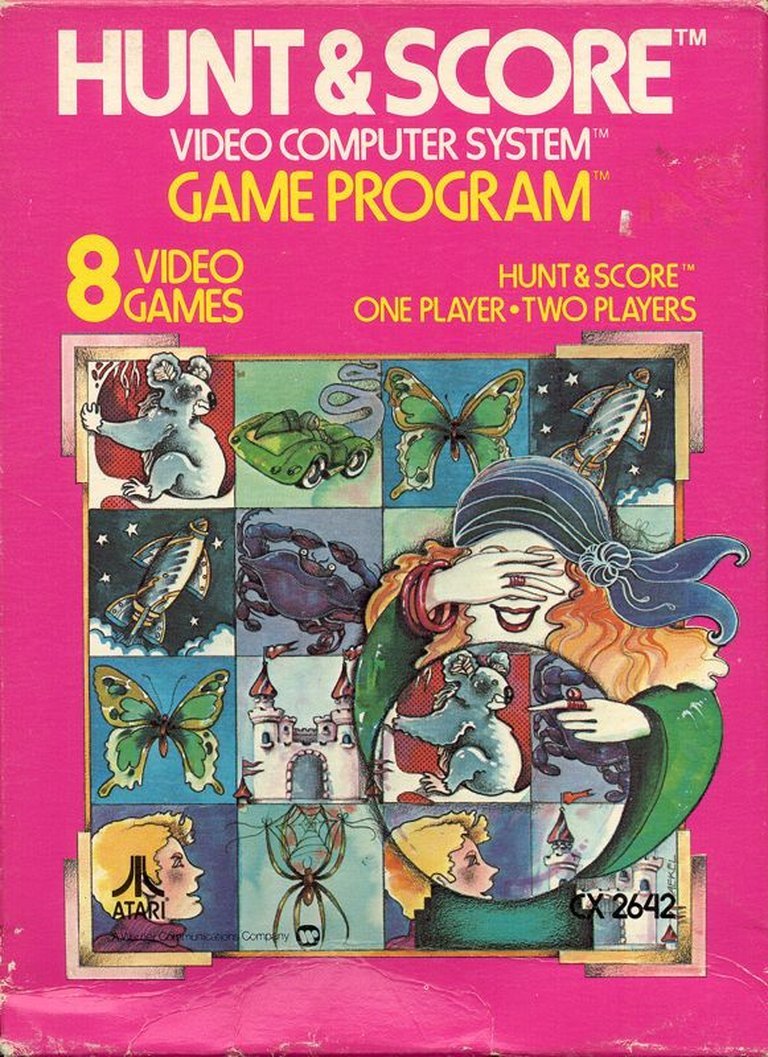
Description
Hunt & Score is a classic tile-matching puzzle game for the Atari 2600, where players take turns flipping numbered tiles to find matching pictures hidden beneath. The game challenges memory and concentration as players aim to accumulate the most points by revealing pairs. It offers variations including different grid sizes (16 or 30 tiles), the ability to handicap opponents, and optional wild cards to add strategic depth.
Hunt & Score Free Download
Atari 2600
Hunt & Score Guides & Walkthroughs
Hunt & Score Reviews & Reception
atariarchive.org : it’s fine… but it’s certainly one of the least exciting games in the VCS’s 400+ cartridge library.
mobygames.com (28/100): Less fun than the card game version
honestgamers.com : Hunt & Score is a fun matching game.
Hunt & Score: A Deep Dive into Atari’s Classic Memory Game
Introduction
In an era defined by the Atari 2600’s revolutionary leap from dedicated consoles to programmable cartridges, 1978 emerged as a pivotal yet turbulent year. Amidst this landscape, Hunt & Score (later rebranded as A Game of Concentration) surfaced as a digital translation of the timeless card game “Concentration.” Far more than a simple diversion, this title encapsulates the ethos of its time: a bold experiment in repurposing analog pastimes for the living room, leveraging the novel Atari Keypad controller to bridge the gap between tactile and digital play. Yet, its legacy is equally defined by the constraints of its era—a product of hardware limitations and shifting market winds. This review dissects Hunt & Score not merely as a game, but as a cultural artifact, examining its design philosophy, technical execution, and enduring place in gaming history.
Development History & Context
Atari’s Vision and Technological Constraints
Developed by Atari, Inc., Hunt & Score was programmed by Jim Huether (as credited on MobyGames) and released in October 1978, coinciding with a wave of titles—Basketball, Hangman, and Codebreaker—aimed at showcasing the Atari 2600’s versatility. The game was conceived to exploit the newly released Keypad controller, a peripheral designed to facilitate non-joystick interactions. Atari’s directive was clear: create games that justified specialized hardware, transforming mental exercises into digital experiences. However, the Atari 2600’s primitive hardware—limited to 128 bytes of RAM and 4KB ROM cartridges—imposed severe restrictions. Graphics and audio were rudimentary, forcing Huether to prioritize functionality over flair. As the Atari Archive notes, Hunt & Score “could have worked just fine without” the Keypad, underscoring its tenuous connection to the peripheral it ostensibly supported.
The Gaming Landscape of 1978
1978 was a gauntlet for Atari and the nascent console industry. Retailers, wary of video games as a passing fad (a fate befalling CB radios and calculators), slashed orders. Atari produced 800,000 units for the holiday season, but retailers purchased only 550,000, contributing to a staggering drop in profits—from $40 million in 1977 to $2.7 million. Dedicated consoles like the Magnavox Odyssey2 and Fairchild Channel F dominated, while personal computers (Commodore PET, TRS-80, Apple II) siphoned off enthusiasts. Hunt & Score emerged as part of Atari’s holiday blitz, a calculated move to revitalize sales. Yet, its niche appeal—targeting families and children—failed to capture mainstream attention, highlighting a broader industry struggle to define video games beyond action and sports titles.
Narrative & Thematic Deep Dive
Plot and Characterization
Hunt & Score eschews traditional narrative, embodying the minimalist ethos of early 8-bit gaming. There are no characters, dialogue, or story arcs—only a grid of numbered tiles hiding symbols. The “plot” is the player’s cognitive journey: to match pairs of hidden icons (e.g., deer, sailboats, cars) through memory and deduction. This abstraction is intentional, mirroring the card game’s focus on pattern recognition over storytelling. As a retro review from HonestGamers observes, the game taps into a primal human impulse: “People like finding things that they know are somewhere around, but that are hidden.”
Underlying Themes
The core theme is cognitive training, positioning gaming as a mental exercise rather than pure entertainment. Each match reinforces short-term memory, while the pressure to recall tile locations echoes real-world tasks like locating misplaced items or solving puzzles. The absence of narrative depth is a feature, not a bug; it emphasizes universality, allowing players to project their own engagement onto the sterile grid. Wild cards introduce a layer of strategy, symbolizing adaptability—any tile can become a match, reflecting life’s unpredictable variables. Yet, this simplicity is double-edged: without narrative or emotional hooks, the game risks feeling mechanical, as one MobyGames reviewer quipped, “Concentration is not a very fun game.”
Gameplay Mechanics & Systems
Core Loop and Variations
The gameplay is distilled to its essence: players take turns selecting two tiles via the Keypad, revealing symbols. A match clears the tiles, awards points (1 or 2, toggled by the difficulty switch), and grants another turn. A mismatch ends the turn, passing control to the opponent (or the computer in single-player). Eight variations exist:
– Grid Sizes: 16 tiles (4×4) for quick sessions or 30 tiles (5×6) for extended challenges.
– Wild Cards: Optional tiles matching any symbol, adding tactical depth.
– Handicapping: Allows balancing skill asymmetry between players.
– Single-Player: The AI scores for mismatches, encouraging accuracy over speed.
Controls and UI
The Keypad input is functional but cumbersome. Players enter tile numbers, press # to confirm, or * to erase—a process that feels more like data entry than fluid interaction. As Atari Archive notes, games like Flag Capture proved grids could be navigated with joysticks, rendering the Keypad an underutilized crutch. The UI is austere: a monochromatic grid, score display, and turn indicator. Symbols are rendered as simple, pixelated icons, recognizable yet unremarkable save for the “wonderfully evocative deer” (per HonestGamers), a rare standout.
Innovation and Flaws
Hunt & Score innovates by porting “Concentration” to consoles, pioneering the memory-match genre. Yet, its mechanics are iterative, not revolutionary. The reliance on rote memory can lead to tedium, exacerbated by repetitive sound effects. Wild cards offer novelty but feel gimmicky, failing to elevate the experience beyond the card game. The absence of tiebreakers in multiplayer matches—where ties devolve into “hell-raising arguments” (HonestGamers)—exposes design oversights. Ultimately, the game is a faithful adaptation but not an exciting one, as one player review summarized: “Less fun than the card game version.”
World-Building, Art & Sound
Visual Direction and Atmosphere
The game’s world is a self-contained grid, devoid of lore or environmental storytelling. Symbols—castle icons, rabbits, flying saucers—are abstracted to their most basic forms, prioritizing clarity over detail. The background is a solid color, shifting hues post-game as a rudimentary victory animation. This minimalism creates a focused, almost meditative atmosphere, where the player’s attention is solely on the tiles. However, the starkness highlights hardware limitations; symbols lack context, making the grid feel like a testing ground rather than a lived space.
Sound Design
Audio is Hunt & Score‘s most divisive element. Two sound effects dominate:
– Success: A cheerful, ascending beep sequence.
– Failure: A “hauntingly dark” (HonestGamers) descending melody.
These tones are functional but grating, as MobyGames reviews note, prompting players to mute the game. The audio lacks dynamic range, looping ad nauseam and failing to enhance engagement. It underscores the era’s audio constraints, where complexity was sacrificed for simplicity.
Atmospheric Contribution
The visuals and sound collaborate to create a tense, isolating experience. The grid becomes a battlefield of memory, with each tile flip a calculated risk. Yet, without ambient layers or thematic music, the world feels sterile. This aligns with the game’s purpose: it is a tool for mental exercise, not an immersive narrative. As such, its art and sound serve functionality over artistry, a trade-off inherent to the 2600’s limitations.
Reception & Legacy
Launch Reception
Upon release, Hunt & Score received muted attention. Critical reviews were scarce, with contemporary publications like TV Gamer (1983) noting its basis on the “old memory game Pair” without acclaim. Commercially, it was a mid-tier performer, selling steadily through the late 1980s (13,000 units during Atari Corporation’s tenure). Modern aggregators paint a bleaker picture: MobyGames lists a Moby Score of 4.8/10 and a critic average of 33–36%, with player reviews averaging a dismal 1.4–1.5/5. Retrospectives, such as Woodgrain Wonderland (2016), dismiss it as offering “mild amusement but still not much of a video game.”
Evolution of Reputation
The game’s reputation has been shaped by nostalgia and historical reevaluation. Early adopters, like the HonestGamers reviewer, recall it as a “timeless memory” from childhood, praising its replay value from randomized tile layouts. Yet, this sentiment is countered by critiques of its repetitive nature and dated design. The 1980 rebranding to A Game of Concentration—aligning it with the card game—was a savvy move, but it couldn’t salvage its commercial decline. By 1988, sales plummeted to 70 copies annually, marking it as a relic.
Influence and Legacy
Hunt & Score holds a niche place in gaming history as a pioneer of the memory-match genre. It preceded titles like Dr. Ditto (1995) and Ravensburger’s Memory (2022), establishing a blueprint for tile-based puzzles. However, its influence is limited; it failed to inspire imitators, likely due to its niche appeal. Its true legacy lies in its role as a time capsule of 1978 Atari: a testament to the studio’s experimental spirit amid industry turmoil. Modern compilations like Atari Vault (2016) preserve it as a curiosity, reminding players of a simpler era when “mental training” was a viable genre.
Conclusion
Hunt & Score is a microcosm of early console gaming: ambitious yet constrained, innovative yet limited. It faithfully translates “Concentration” to the digital realm, leveraging the Atari 2600’s keypad for a functional, if flawed, experience. Its strengths lie in its purity of purpose and historical significance—it is a bridge between analog and digital play, a relic of when Atari dared to reimagine childhood games on television. Yet, its weaknesses are equally telling: repetitive gameplay, grating audio, and a lack of narrative depth prevent it from transcending its era.
As a piece of history, Hunt & Score is invaluable. It showcases the ingenuity of developers like Jim Huether working within tight technological confines and reflects the volatile market of 1978. As a game, it is a niche curiosity best appreciated by retro enthusiasts seeking a snapshot of gaming’s formative years. In the pantheon of Atari 2600 classics, it neither achieves the legendary status of Adventure nor the ubiquity of Space Invaders. Instead, it stands as a quiet reminder: video games began not just with explosions and adventures, but with the quiet, cerebral joy of matching tiles. For that, Hunt & Score deserves not dismissal, but respect—a flawed, fascinating artifact from the dawn of interactive entertainment.