
- Release Year: 2006
- Platforms: Windows
- Publisher: Frogster Interactive Pictures AG
- Genre: Compilation
- Game Mode: Single-player
- Average Score: 47/100
Description
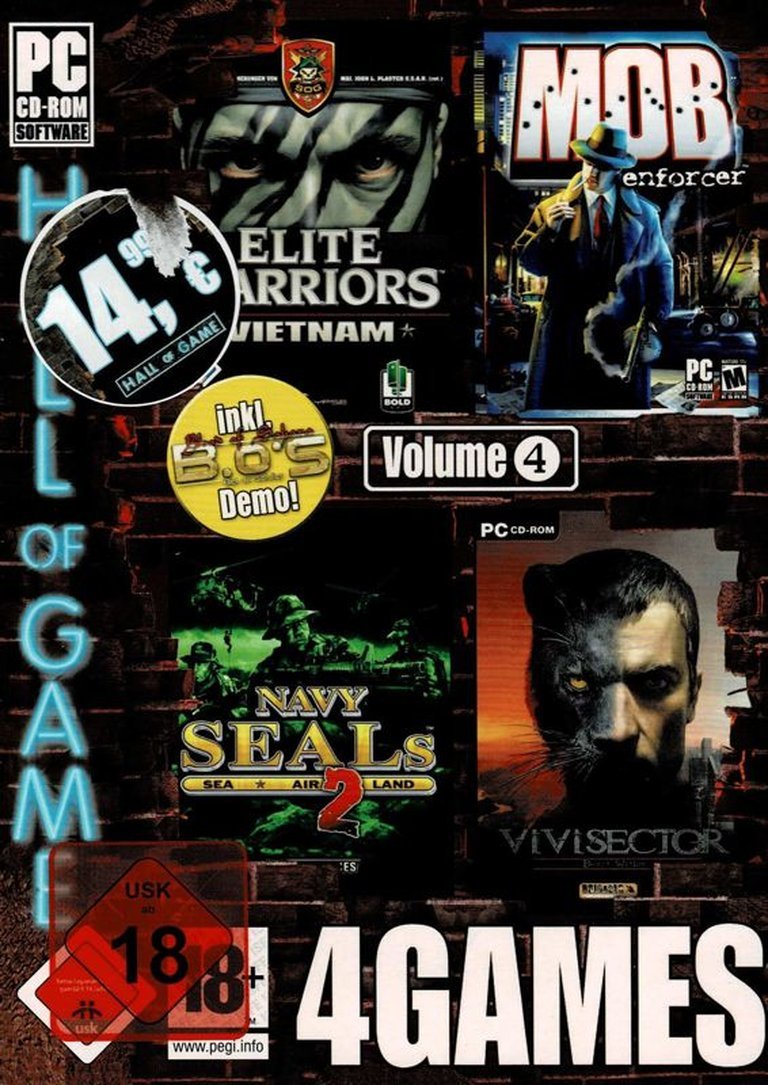
Hall of Game: 4Games – Volume 4 is a mature-rated (PEGI 18) Windows compilation released in 2006, bundling four intense action games: Elite Warriors: Vietnam, Mob Enforcer, Navy SEALs: Weapons of Mass Destruction, and Vivisector: Beast Within. The collection also includes a demo of Bet on Soldier: Blood Sport, offering diverse combat scenarios on CD-ROM.
Hall of Game: 4Games – Volume 4 Reviews & Reception
retro-replay.com : Dive into a powerhouse collection of high-octane military and action titles that will test your skills on every front.
Hall of Game: 4Games – Volume 4: Review
Introduction
In the annals of video game history, few artifacts capture the transitional chaos of the mid-2000s PC gaming landscape quite like Hall of Game: 4Games – Volume 4. Released in 2006 by German publisher Frogster Interactive Pictures AG, this compilation bundles four distinct action experiences—Elite Warriors: Vietnam, Mob Enforcer, Navy SEALs: Weapons of Mass Destruction, and Vivisector: Beast Within—alongside a demo of Bet on Soldier: Blood Sport. It represents a bygone era when budget compilations reigned supreme, offering a “sampler platter” of genres to cash-strapped gamers. Yet, as its paltry 40% critical average (based on a single scathing review) attests, this anthology is less a celebration of interactive entertainment and more a cautionary tale of quantity over quality. This review deconstructs Volume 4 as a historical artifact, examining its development, thematic ambitions, mechanical execution, and enduring legacy to argue that, despite its variety, it stands as a monument to the era’s mid-tier gaming excess—a relic that offers more curiosity than catharsis.
Development History & Context
Hall of Game: 4Games – Volume 4 emerged from the industrial crucible of mid-2000s PC gaming, a period defined by technological fragmentation and market saturation. Frogster Interactive, a German publisher specializing in budget-friendly releases, spearheaded this compilation as part of a sprawling Hall of Game series (Volumes 1–12 released between 2006–2007) designed to capitalize on demand for affordable, genre-spanning packages. The studio’s vision was pragmatic: bundle aging or niche titles from 2003–2005—already past their commercial peak—into a single CD-ROM, priced competitively (€14.99 in Germany) to appeal to cost-conscious players. Technologically, the compilation was a product of its time. The individual games, built on mid-2000s Windows engines, lacked the graphical fidelity or systemic ambition of contemporaries like Half-Life 2 (2004) or Gears of War (2006), released just months earlier. This context is crucial: 2006 marked the dawn of the seventh console generation, with the PlayStation 3 and Xbox 360 shifting industry focus toward high-definition graphics and streamlined experiences. PC gaming, meanwhile, was navigating the rise of digital distribution (Steam launched in 2003), making physical compilations like Volume 4 feel increasingly anachronistic. Frogster’s bundling of four disparate shooters—tactical, crime-themed, military, and horror—reflects a shotgun approach to value, but the absence of unifying technical or creative oversight resulted in a package that felt cobbled together rather than curated.
Narrative & Thematic Deep Dive
Volume 4 eschews a cohesive narrative, instead offering four fragmented vignettes centered on conflict and survival. Each game’s story is self-contained, bound only by a shared focus on high-stakes combat and moral ambiguity, yet they collectively reveal a thematic preoccupation with institutional power and its discontents.
- Elite Warriors: Vietnam (2005) frames the Vietnam War through the lens of Delta Force operatives, weaving historical fiction with conspiratorial VCI (Viet Cong Intelligence) plots. The narrative is a straightforward militaristic fantasy, emphasizing duty and covert operations, but its dialogue is perfunctory, serving as mere mission briefings rather than character development.
- Mob Enforcer (2004) adopts a crime-drama structure, alternating between law enforcement and criminal perspectives to explore corruption and power struggles. Its branching narrative choices—e.g., choosing allies or betraying factions—inject fleeting moral ambiguity, yet the script is hampered by clichés (e.g., “honor among thieves”) and superficial character archetypes.
- Navy SEALs: Weapons of Mass Destruction (2003) leans into geopolitical thriller tropes, pitting players against a rogue arms dealer in a globe-trotting campaign. Character banter attempts camaraderie but feels robotic, reducing squadmates to exposition-delivering tropes.
- Vivisector: Beast Within (2005) stands out thematically as a sci-fi horror parable, centering on a genetically engineered soldier quelling a viral outbreak in a derelict lab. Environmental logs and grotesque creature encounters critique unethical science, yet the narrative’s potential is squandered by repetitive monologues and an abrupt climax.
The demo for Bet on Soldier: Blood Sport (a 2005 title) teases a dystopian future where combat is corporate spectacle, hinting at themes of violence as entertainment—a compelling hook rendered moot by its truncated scope. Collectively, these narratives lack the depth of 2006’s AAA offerings (Oblivion, Gears of War), relying on genre tropes rather than innovation. Their shared emphasis on “man vs. system” feels less intentional than opportunistic, a hodgepodge of military, criminal, and horror tropes packaged for maximal visceral impact with minimal intellectual engagement.
Gameplay Mechanics & Systems
Volume 4’s gameplay is a study in contrasts: varied yet uneven, ambitious yet flawed. Each title operates on a distinct mechanical framework, but all suffer from technical and design limitations common to mid-budget 2000s PC titles.
- Elite Warriors: Vietnam promises squad-based tactics in dense jungles, with suppressive fire and coordinated maneuvers as core mechanics. In practice, the AI is predictably inept, forcing players to babysit teammates during firefights. Cover mechanics are underdeveloped, and mission objectives often devolve into tedious “follow the waypoints” exercises.
- Mob Enforcer shifts to action-stealth hybrids, featuring bank heists, interrogations, and street chases. Its perspective-switching gimmick offers replay value, but controls are clunky, with unresponsive melee combat and inconsistent stealth detection. Weapon variety spices up encounters, but mission design is repetitive, favoring brute force over strategy.
- Navy SEALs: Weapons of Mass Destruction emphasizes gadget-based gameplay—e.g., night-vision goggles, breaching charges—but the execution is shallow. Multi-stage objectives (e.g., planting explosives while sniping) feel artificial, and aiming mechanics, while tighter than peers, are undermined by bland level design and static enemy placements.
- Vivisector: Beast Within attempts a horror-action hybrid, pitting players against mutating creatures in claustrophobic environments. Resource management (scavenging ammo/health) adds tension, but combat is clunky, with hit detection issues and an overreliance on jump scares. Occasional puzzle elements feel tacked on, disrupting the pacing.
- Bet on Soldier Demo showcases futuristic arena combat with cover mechanics, offering a glimpse of potential with its slick movement animations. As a demo, it’s a teaser, not a full experience.
UI and controls are uniformly dated. Clunky menus, unresponsive keybindings, and lack of remapping options plague all titles, while save systems are inconsistent—some games auto-save, others require manual intervention. Technically, the compilation suffers from low-resolution textures, texture pop-in (Mob Enforcer’s urban environments), and simplistic AI that fails to challenge modern players. Innovation is scarce; the mechanics feel like pale imitations of contemporaries (e.g., Vietnam echoes Rainbow Six without its depth), though Vivisector’s blend of horror and action shows flashes of creativity.
World-Building, Art & Sound
Volume 4’s art direction and sound design mirror its narrative and mechanical inconsistencies—each game crafts a distinct atmosphere, but none achieve cohesion or excellence.
- Elite Warriors: Vietnam sports lush, if dated, jungle environments. Foliage and day-night cycles create immersion, but character models are blocky and animations stiff. The audio relies on generic orchestral tracks and perfunctory radio chatter, failing to evoke the era’s tension.
- Mob Enforcer’s urban environments are its strongest visual element, with gritty back alleys, neon signs, and dynamic lighting. Building interiors are detailed, yet texture pop-in and repetitive layouts undermine the setting. Sound design leans on clichéd jazz scores and gruff voice acting, making the crime-world feel superficial.
- Navy SEALs: Weapons of Mass Destruction boasts crisp weapon models and particle effects (e.g., muzzle flashes, water reflections), but environments (desert compounds, icy forts) suffer from repetitive textures. The score is forgettable, blending generic military themes with tinny sound effects.
- Vivisector: Beast Within is the standout artistically. Dark corridors, flickering lights, and grotesque creature designs (blood-splattered mutants, disfigured bioweapons) create a palpable horror atmosphere. Dynamic shadows and a moody color palette elevate its aesthetic, though some creature animations feel unfinished. Its sound design—distorted screams, ambient hums, and tense silence—enhances unease.
- Bet on Soldier Demo contrasts with its sleek, futuristic aesthetic—polished metallic surfaces and neon UI—but the limited scope prevents full immersion.
Collectively, the compilation’s art and sound serve as a time capsule of mid-2000s PC aesthetics—functional but unremarkable, with Vivisector’s horror elements being the only truly memorable contribution. The lack of a unifying artistic vision underscores the package’s fragmented nature.
Reception & Legacy
At launch, Hall of Game: 4Games – Volume 4 was met with near-universal indifference, epitomized by the sole critical review from German magazine GameStar, which awarded it a scathing 40%. The review—translated as “An action collection in which Vivisector is the best game would be too expensive even as a gift. Don’t buy!”—captured the compilation’s core failure: its value proposition was untenable. Gamers in 2006 had little reason to choose a bundle of aging titles over new releases like Ghost Recon: Advanced Warfighter or The Elder Scrolls IV: Oblivion. Commercially, the Hall of Game series was a modest success for Frogster, but Volume 4 sank without a ripple, with no sales figures publicly available and only two players documented on MobyGames as owning it.
Its legacy is one of historical curiosity rather than influence. The compilation has become a footnote in discussions of mid-2000s PC gaming, remembered primarily for its PEGI 18 rating and the inclusion of Vivisector, which developed a niche cult following for its ambition. No individual game within the bundle left a significant mark; Navy SEALs and Mob Enforcer were quickly forgotten, while Vivisector’s sci-fi horror tropes were overshadowed by later titles like Dead Space (2008). The compilation’s primary significance lies in its documentation of a fading business model: physical compilations as a stopgap between AAA releases. Today, it endures only among retro enthusiasts, who study it as an example of a market saturated with mid-tier shooters. Its failure to innovate or maintain quality ensures it remains a relic—an artifact of an era when “more for less” often meant “less for more.”
Conclusion
Hall of Game: 4Games – Volume 4 is a microcosm of mid-2000s PC gaming: ambitious in scope but inconsistent in execution, offering quantity over quality at a time when gamers demanded excellence. As a compilation, it fails to justify its existence—four middling shooters and a demo bundled for €14.99 feels like a poor value even by 2006 standards. Its narratives are generic, its mechanics are dated, and its art and sound, while occasionally inspired (Vivisector), are rarely cohesive. Yet, for historians and retro gamers, Volume 4 offers a fascinating glimpse into an industry grappling with technological transition and market saturation. It stands as a testament to the era’s shotgun approach to game design, where bundling disparate titles was easier than curating a cohesive experience. While it holds little appeal for modern players—its technical flaws and shallow gameplay render it unplayable by contemporary standards—it remains an essential artifact for understanding the evolution of video games. In the grand pantheon of interactive entertainment, Hall of Game: 4Games – Volume 4 is not a classic but a curiosity—a relic that reminds us that not every product deserves a place in history, even if it documents how history was made. Verdict: A historical footnote, not a playable masterpiece.