
- Release Year: 2020
- Platforms: Windows
- Publisher: Raúl Parada
- Developer: Raúl Parada
- Genre: Action
- Perspective: Behind view
- Game Mode: Single-player
- Gameplay: Shooter
- Setting: Fantasy
- Average Score: 84/100
Description
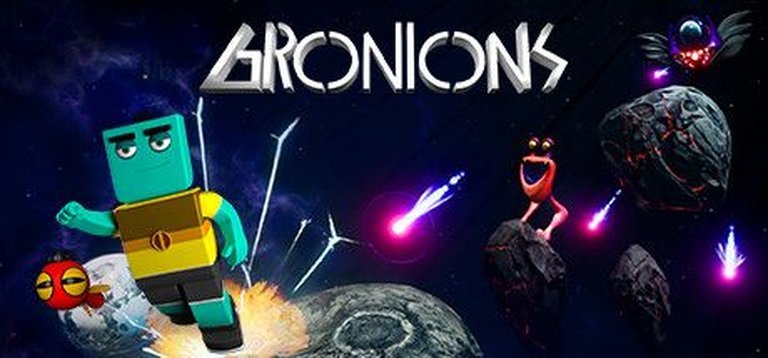
Gronions is a single-player space shooter set in a fantasy sci-fi universe where players control Groom, a Gronion survivor, and his drone ally Harpy on a mission to protect the Ether NIX energy source from three invading emperors threatening their species’ extinction. The game features both first and third-person perspectives across vibrant planets, volcanic islands, frozen rivers, and secret locations, offering intense combat, resource collection, and three distinct game modes: Campaign (ecosystem defense), Frenzy (meteorite survival), and Odyssey (endless space battles).
Gronions Cracks & Fixes
Gronions Patches & Updates
Gronions Guides & Walkthroughs
Gronions Reviews & Reception
metacritic.com (84/100): Gronions is a masterpiece, a game which will be played and studied for years.
thedrastikmeasure.com : There is just something off about the way this game feels. Controls are floaty and a bit sluggish during platforming and exploration segments, and space pod segments feel off as well.
Gronions: A Cosmic Turbulence of Ambition and Flaw
Introduction
In the vast expanse of indie game development, few projects carry the weight of a creator’s singular vision as intensely as Gronions. Debuting on August 8, 2020, this self-published action shooter from Raúl Parada—a solo developer with a team of four—promised a universe of exploration, survival, and galactic warfare. Rooted in Parada’s original book, Gronions aimed to blend third-person on-foot combat, space dogfights, and wave-defense mechanics across three distinct modes. Yet, this ambitious odyssey into a bio-dominant universe reveals itself as a study in contradictions: a game brimming with passion and cosmic wonder, yet shackled by technical shortcomings and design schizophrenia. This review dissects Gronions not merely as a product, but as a cultural artifact—a testament to indie resilience and the perils of unchecked ambition.
Development History & Context
Gronions emerged from the mind of Raúl Parada, a developer whose sole credit belies a universe-sized vision. With a team of four credited individuals (Parada handling creation, development, and trademarks), the game was birthed as a “first-third person space shooter” with advertised “100% Xbox 360 compatibility”—a curious claim for a PC title. Parada’s vision, as detailed on the official site, was to translate his literary universe into an interactive experience, emphasizing “infinite possibilities” and “bio galactic dominance.” Technologically, Gronions operated on modest constraints. Its 2020 release coincided with a gaming landscape saturated with polished AAA titles and thriving indie darlings, yet Parada’s game felt distinctly retro. Its textures, frame rates, and UI mirrored an earlier era, while its launch plagued by crashes, sluggish controls, and AI hiccups. The developer’s post-launch commitment to patching (up to v1.2.62 by January 2021) reflected a desire to evolve, but the core foundation remained unshaken—a relic of passion over polish.
Narrative & Thematic Deep Dive
Gronions’ narrative is a whispered epic, its lore pieced together from environmental cues, sparse dialogue, and Parada’s website lore. The premise unfolds in a universe where the Gronion race teeters on extinction, threatened by three emperors (Oktos, Tyroog, and a third unnamed) seeking the Ether NIX—an energy source capable of granting life or annihilation. Players assume Groom, a sentient Gronion survivor tasked with defending this cosmic artifact alongside Harpy, a drone companion capable of manipulating matter, weapons, and DNA. The story leans heavily on archetypes: the noble hero, the loyal drone, and the corrupt emperors. Thematically, it explores survival as a primal instinct and the ethics of bio-dominance, with the “infection” serving as a metaphor for unchecked power. Paradoxically, the game itself embodies these themes—its combat mechanics oscillate between “overpowered” and “useless,” mirroring the Ether NIX’s dual nature. Yet, the narrative’s true strength lies in its ambiguity. With no tutorials or hand-holding, players are thrust into a mystery, deciphering the Gronions’ fate through exploration. This approach fosters wonder, but the lack of cohesive storytelling leaves emotional resonance adrift in the void.
Gameplay Mechanics & Systems
Gronions’ gameplay is a triptych of modes, each a distinct experiment in action design:
Campaign (Quests)
The core loop blends third-person exploration, resource collection, and arena-based defense. Players traverse volcanic islands, frozen rivers, and alien ecosystems, collecting “shiny things” (resources) and battling “infected” creatures. Periodic arena sequences lock players around the Ether NIX core, demanding wave defense against emperors’ troops. The on-foot controls are infamously “floaty,” with sluggish platforming and imprecise combat that undermines tension. Weapons fall into two extremes: rapid-fire beams that trivialize threats or energy bursts too weak to matter. The “flying pod” (Nimbuz) offers reprieve, enabling seamless transitions to first-person space combat, though its speed and physics feel alien.
Frenzy (Land Score)
A distilled wave-defense mode stripping away exploration. Players protect the Ether NIX “Spark” against relentless meteorite swarms, arenas dynamically shifting with new obstacles. While more focused, it inherits the base game’s combat flaws, with enemy spawning and scaling feeling arbitrary. As one Steam user noted, “it gets super intense, like Tetris,” but lacks the strategic depth to elevate it beyond a time-waster.
Odyssey (Deluxe Edition DLC)
An endless space-battle mode where players defend a core ship using the Nimbuz. It expands on Campaign’s flight mechanics but suffers from repetition, with “fierce crossfire” devolving into bullet-sponge battles against turrets and pods. The $5 price tag feels unjustified for content indistinguishable from the base modes.
Systems & Polish
Progression revolves around collecting DNA samples and resources to unlock upgrades, though the system lacks depth. The UI is bare-bones, with limited customization and performance options (e.g., Vsync added post-launch). Patches improved AI, lighting, and crash stability but couldn’t fix the core dissonance between ambition and execution. As The Drastik Measure lamented, “the quality is quite inferior,” with crashes on view-switching and poor enemy-environment contrast sabotaging immersion.
World-Building, Art & Sound
Gronions’ universe is its greatest triumph. Parada crafts a tapestry of alien worlds: Planet Athros’ fiery volcanic landscapes, Planet Frooz’s glacial caves, and the nebula-strewn void between them. The art direction vibrates with surreal beauty—waterfalls cascading over alien rock formations, bioluminescent flora, and meteor showers painting the darkness. Yet, this wonder is undercut by technical limitations. Textures are low-resolution, and enemy designs blend into dark backgrounds, forcing players into trial-and-error combat. The “mixed colors” create visual noise, while the volumetric clouds and nebula systems (added in v1.2.62) feel like band-aids on a fractured canvas.
Sound design is similarly bipolar. Environmental audio—waterfalls, ice cracking—enhances immersion, yet combat effects and music are generic sci-fi fare. Stock blaster shots and a forgettable score fail to elevate battles, with audio loops breaking after prolonged play (a bug addressed in patches). Harpy’s “matter manipulation” emits satisfying clicks, but overall, the soundscape lacks identity.
Reception & Legacy
Gronions launched to a fractured reception. Professionally, The Drastik Measure awarded it a 3.5/10, criticizing “unfocused gameplay” and “floaty controls.” User reviews were polarized: Metacritic’s 8.4/10 (based on 11 ratings) features gushing praise (“a masterpiece,” “breathtaking visuals”) balanced by negative warnings (“crashes,” “unpolished”). Steam discussions reveal a community torn—some lauding Parada’s post-patch dedication (“thanks for updating the game!”), others questioning design choices (“can I upgrade weapons in Frenzy?”).
Commercially, Gronions remains a niche curiosity. Its $25 price tag at launch was steep for a title of its caliber, though sales may have been buoyed by Parada’s active engagement (he encouraged Steam Award nominations and YouTube/Twitter updates). Its legacy is as a case study in indie ambition. While it hasn’t spawned imitators, its prolonged patching cycle highlights the evolving relationship between developers and players. For Parada, it was a stepping stone; subsequent titles like Star Fighters and Shadowless suggest refinement. For players, Gronions endures as a cosmic enigma—a beautiful, broken star in a crowded galaxy.
Conclusion
Gronions is a paradox: a game brimming with creative energy yet constrained by execution. It offers moments of genuine wonder—the alien vistas, the drone’s symphony of matter, the quiet thrill of unearthing a secret cave—but these are drowned in technical turbulence. Its three modes feel like experiments rather than cohesive experiences, and its narrative, while intriguing, remains frustratingly opaque. Yet, Raúl Parada’s passion is undeniable. Through relentless patching and a commitment to his universe, he transformed a flawed launch into a testament to indie resilience.
Verdict: Gronions is not a masterpiece, nor is it a failure. It is an ambitious artifact—worth exploring for its unique worlds and developer’s spirit, but cautionary in its lessons on scope and polish. In the annals of gaming history, it stands as a reminder that the most compelling journeys often begin with a single, imperfect step. For the curious, it’s a hard pass at full price, but a compelling curiosity on sale—a star chart to a universe still being mapped.