
- Release Year: 1998
- Platforms: Macintosh, Windows
- Publisher: GT Interactive Software Corp., MacSoft
- Developer: Reality Bytes, Inc.
- Genre: Action
- Perspective: Third-person
- Game Mode: LAN, Online PVP, Single-player
- Gameplay: Character selection, Dungeon Crawling, Exploration, Hack and Slash, PvP, Real-time combat
- Setting: Fantasy
- Average Score: 59/100
Description
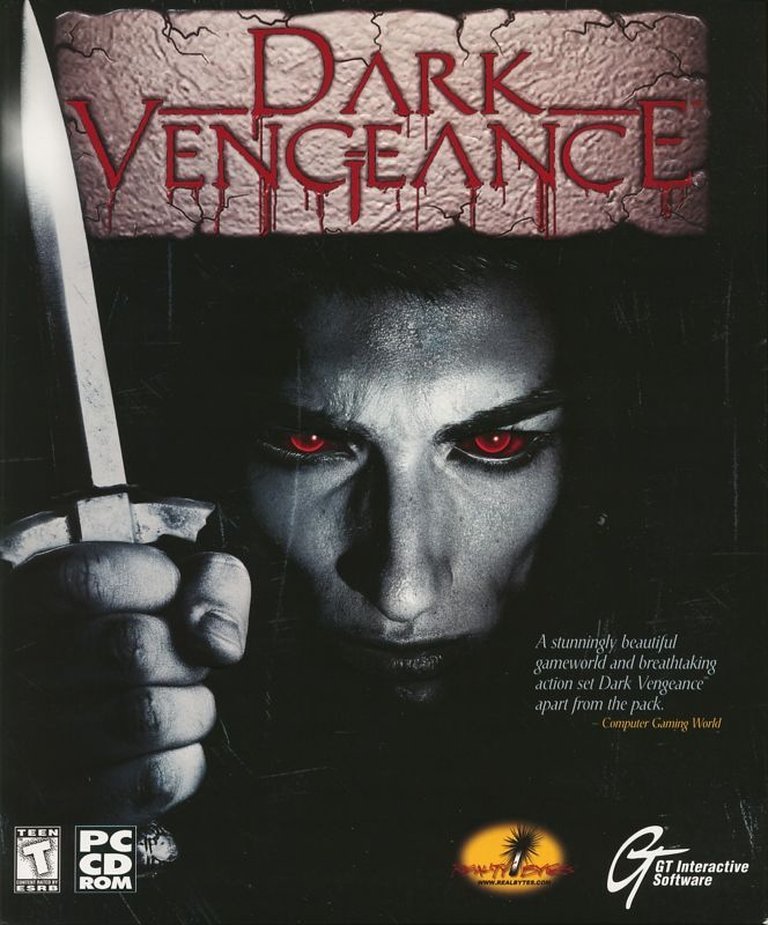
In the magical realm of Amagar, a catastrophic solar eclipse triggered by dark magic unleashes the return of the Dark Elves, forcing you to assume the role of the Chosen One and embark on a mission to vanquish these malevolent forces and restore sunlight to the land. Dark Vengeance is a Tomb Raider-style hack-and-slash adventure set in a medieval fantasy world, where players choose between three distinct characters—Jetrel the Warlock, Kite the Trickster, or Nanoc the Gladiator—each uniquely influencing gameplay through specialized abilities and item interactions.
Gameplay Videos
Dark Vengeance Free Download
Dark Vengeance Patches & Updates
Dark Vengeance Reviews & Reception
metacritic.com : Dark Vengeance isn’t a bad game, but it doesn’t do anything new and doesn’t really provide any compelling reason for playing it.
ign.com : things are looking pretty good.
Dark Vengeance: Review
Introduction
The late 1990s were a crucible for innovation in video games, where genres were redefined by pioneers like Tomb Raider and Heretic II. Amidst this upheaval, Dark Vengeance emerged from the shadows—a third-person hack-and-slash fantasy epic from developer Reality Bytes, published by GT Interactive. Announced in 1996 and released in 1998, it promised a heady cocktail of character-driven storytelling, seamless indoor-outdoor exploration, and revolutionary 32-player multiplayer. Yet, while its ambitions were colossal, its execution proved tragically uneven. This review deconstructs Dark Vengeance as a product of its time: a technically ambitious but flawed artifact that captures the chaotic energy of late-90s PC gaming, where bold ideas often collided with the harsh realities of technological constraints.
Development History & Context
Dark Vengeance began life in 1996 as Reality Bytes’ magnum opus, building on their experience with earlier titles like Sensory Overload. The studio envisioned a game that would surpass its contemporaries by blending Tomb Raider‘s exploration, Die by the Sword‘s combat depth, and Unreal‘s graphical prowess. Using a proprietary 3D engine, they aimed for seamless transitions between claustrophobic dungeons and sprawling outdoor environments—a radical promise for 1998. Announced with fanfare at E3 1998, the game boasted real-time lighting, 40+ enemies, and a unique character progression system.
However, the two-year development cycle exposed Reality Bytes’ inexperience with next-gen rendering. The engine struggled with collision detection and camera AI, issues exacerbated by the competitive landscape. Released alongside genre titans like Heretic II and Tomb Raider III, Dark Vengeance arrived overshadowed. Its cross-platform support (Windows and Mac) was ahead of its time, but MacSoft’s port lacked Glide optimization, leaving Mac players with a visually inferior experience. The game’s legacy is thus a cautionary tale: ambition without polish.
Narrative & Thematic Deep Dive
Set in the war-torn realm of Amagar, Dark Vengeance frames its plot as a cosmic tragedy. A magical spell triggers an eternal solar eclipse, unleashing the vengeful Dark Elves upon a once-peaceful world. Players assume the role of the “Chosen One,” but with a twist: they must select one of three protagonists, each driven by personal vendettas against the Dark Elves.
- Jetrel the Warlock: A disgraced mage seeking redemption through necromantic mastery. His quest explores themes of forbidden knowledge and the corruption of power.
- Kite the Trickster: A rogue haunted by past betrayals, whose arc focuses on trust and subterfuge.
- Nanoc the Gladiator: A warrior fueled by familial bloodlust, embodying cyclical vengeance and honor.
Character choice isn’t cosmetic; it rewrites the narrative. Jetrel’s campaign delves into elven lore, while Kite’s levels emphasize stealth and sabotage. This branching structure—a rarity in 1998—adds replay value, though the dialogue remains functional rather than inspired. The overarching theme of vengeance is rendered ironically: as players slay Dark Elves, they become the very avatars of the cycle they seek to break. Amagar’s decay mirrors this futility, with crumbling dungeons and ghostly acolytes serving as environmental metaphors for a world trapped in shadow.
Gameplay Mechanics & Systems
Dark Vengeance’s core loop revolves around exploration, combat, and puzzle-solving. The third-person perspective offers cinematic flair but introduces critical flaws.
- Combat: Each character wields 9 unique weapons (e.g., Jetrel’s Vampire Staff summons bats; Nanoc’s Fire Brand immolates foes). Attacks—swing, thrust, block—are mapped to complex key combos, leading to jerky, unresponsive controls. The “targeting” mechanic helps mitigate camera issues, but melee often devolves into flailing due to clunky collision detection.
- Character Progression: Weapons require “rune stones” to unlock special abilities, encouraging experimentation. Power-ups are character-specific (e.g., Kite’s traps), but many are useless, creating inventory bloat.
- Puzzles: Predominantly key-and-lever affairs, with solutions changing based on character choice. Jetrel’s magical puzzles contrast with Nanoc’s brute-force obstacles, offering variety.
- Multiplayer: The game’s crown jewel supports 32-player deathmatches and team battles. Maps like “The Underworld” leverage verticality, but netcode issues plagued stability. The “Voyeur” mode—allowing 64 spectators—was a forward-thinking feature, though underutilized.
Ultimately, the combat system feels underdeveloped. Swings lack weight, and enemies exhibit inconsistent AI, turning encounters into frustrating slogs. The promised “seamless” indoor-outdoor transitions rarely materialize, with abrupt loading mar immersion.
World-Building, Art & Sound
Amagar is a gothic-fantasy tapestry, rendered with surprising detail for 1998. Dungeons feature crumbling stone, stained-glass warriors, and flickering torches, all bathed in dynamic lighting that casts eerie shadows. Reality Bytes’ engine excels here, creating atmospheric locales like the Dark Elf Monastery, where spectral acolytes drift through corridors.
Enemy design is imaginative: undead knights shatter from stained glass, while floating priests emit necrotic auras. However, the art style is inconsistent; some environments feel generic, and character models lack polish. The Mac version’s lack of hardware acceleration dulled these visuals, underscoring the game’s technical fragility.
Alexander Brandon’s soundtrack is a highlight—ethereal melodies underscore Jetrel’s melancholy, while percussive battle themes fuel Nanoc’s fury. Sound effects are crisp, with weapon impacts and spell casting adding tactile weight. Yet, the absence of CD audio on Mac limits immersion, and voice acting is sparse, relying on text-driven exposition.
Reception & Legacy
Dark Vengeance’s reception was a study in contrasts. Critics praised its ambition and multiplayer but lamented its execution. GameSpot lauded the “impressive graphics” and “unique weapons,” while Computer Gaming World noted high replayability. Yet, Game Revolution dismissed it as a “rushed” product, and PC Gamer (US) scored it 49%. The MobyGames average of 65% reflects this mediocrity.
Players were equally divided, with a 3.5/5 rating citing “good ideas” but “annoying bugs.” Mac reviews were kinder, thanks to better optimization, but the game never achieved mainstream success.
Historically, Dark Vengeance is a footnote in third-person action history. It preceded God of War’s character-centric design and influenced multiplayer-focused titles like Tribes: Vengeance, but its legacy is defined by what it almost was. A cult following persists for its chaotic multiplayer and unique character mechanics, but it remains overshadowed by its inspirations. Reality Bytes dissolved shortly after its release, leaving Dark Vengeance as a tantalizing “what if” of late-90s PC gaming.
Conclusion
Dark Vengeance is a ghost in the machine of video game history. Its character-driven campaigns, ambitious multiplayer, and atmospheric world-building point to a game that could have been a genre-defining classic. Yet, its execution—marred by clumsy controls, camera woes, and technical instability—relegates it to curiosity status. For modern players, it’s a fascinating artifact of an era when developers dared to dream big, even if their tools were insufficient. Its greatest lesson lies in its ambition: a reminder that innovation, even when flawed, pushes the medium forward. While Dark Vengeance may not “bring sunlight back to the land” of gaming, its flickering ember of creativity ensures it will not be forgotten.