
- Release Year: 2005
- Platforms: PlayStation, Windows
- Publisher: phenomedia publishing gmbh
- Developer: Sproing Interactive Media GmbH
- Genre: Action
- Perspective: 3rd-person
- Game Mode: Single-player
- Gameplay: Catching, Dance, Memory
Description
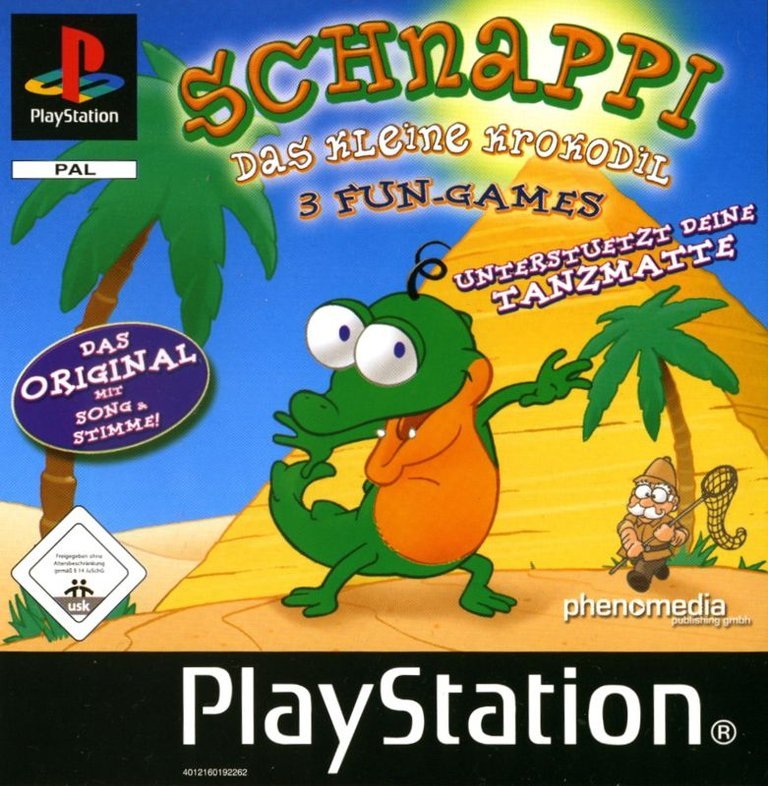
Schnappi: 3 Fun-Games is a compilation of three Flash-based mini-games featuring Schnappi, the little crocodile from the popular German music clip and pop song. The games include Schnappi Snap!, where players catch food insects while avoiding stingy ones; Schnappi Think!, a memory challenge requiring players to repeat Schnappi’s moves in sequence; and Schnappi Dance!, which tasks players with matching dance moves shown on screen across two difficulty modes, all with simple 2D graphics.
Gameplay Videos
Schnappi: 3 Fun-Games Free Download
PlayStation
Schnappi: 3 Fun-Games Reviews & Reception
newqualitipedia.telepedia.net : all of them are boring, easy and have little-to-no originality.
Schnappi: 3 Fun-Games: A Relic of Viral Mania and the End of an Era
Introduction: The Crocodile in the Room
In the crowded pantheon of video game history, certain titles stand not for their innovation or artistic merit, but as stark cultural artifacts—digital thermometers measuring the exact temperature of a specific moment in media convergence. Schnappi: 3 Fun-Games (2005) is one such artifact. It represents the explosive, internet-fueled peak of a German children’s phenomenon, the desperate logic of licensed shovelware, and serves as the unlikely, unceremonious final commercial release for the original Sony PlayStation. To examine this compilation is to dissect a perfect storm of fleeting pop culture, technological transition, and low-expectation game design. This review will argue that while Schnappi: 3 Fun-Games is an undeniable failure by any conventional measure of gameplay depth or artistic ambition, its historical significance as a cultural cash-in and a platform’s epitaph grants it a curious, cautionary place in the medium’s timeline.
Development History & Context: From TV Clip to Retail Shelf
The Schnappi Phenomenon: The game cannot be understood divorced from its source. Schnappi das kleine Krokodil (“Schnappi, the little crocodile”) was not originally a game character, but a one-off sketch from the revered German children’s television show Die Sendung mit der Maus (“The Show with the Mouse”). The character, a young Nile crocodile from Egypt, was introduced through a simple, repetitive song performed by Joy Gruttmann. In 2004, the song was picked up by the radio station RauteMusik.Fm, spiraling into a viral internet sensation. By January 2005, the single reached #1 on the German charts, where it resided for 10 weeks, and topped charts across Austria, Belgium, the Netherlands, Norway, Sweden, and Switzerland. It was a global, cross-generational earworm of the highest order.
The Studio & The Vision: The development fell to Sproing Interactive Media GmbH, an Austrian studio with a portfolio that includes other casual and licensed titles like Crazy Chicken X and Crazy Kickers. The publisher was phenomedia publishing gmbh, a German company specializing in budget and children’s software. The vision, as inferred from the final product and the era’s trends, was straightforward: capitalize on a six-month-old cultural touchstone by throwing together three simple, Flash-esque mini-games and strapping the beloved (or loathed) Schnappi branding onto them. There is no evidence of creative ambition beyond this mercantile goal. The game was built with Macromedia Flash, a tool synonymous with early 2000s web animation and casual games, explaining its primitive 2D aesthetic and simplistic mechanics. This was not a console-native build, but a port of a web-style experience.
Technological & Market Context: The release window is critical. March 2005 placed the game squarely in the twilight of the PlayStation’s lifecycle. Sony had launched the PlayStation 2 in 2000/2001, and while the PS1 still had a massive install base, its time as a primary development target was over. Releasing a full-price (implied by its retail presence) physical game for the PS1 in 2005 was a deeply retrograde decision, highlighting either phenomedia’s cost-cutting (using an older, simpler dev environment) or their targeting of a very specific, possibly unsophisticated demographic with outdated hardware. On PC, it was a typical European budget title. The game’s existence is a snapshot of a transitional period where the lines between web Flash games and “proper” retail software were still blurry for certain publishers.
Narrative & Thematic Deep Dive: An Absence of Story
Schnappi: 3 Fun-Games presents a fascinating case study in narrative minimalism. There is no plot, no character arc, no dialogue beyond the repetitive musical stingers. The “narrative” is entirely extrinsic, residing in the player’s pre-existing knowledge of the Schnappi song and TV sketch.
- Character: Schnappi is not a character here; he is an avatar. The song establishes him as a “small crocodile” from the Nile who “snaps” his way through life, with a cheerful, naive personality. The game strips this down to a green sprite with a moving mouth. No traits from the source material—his curiosity, his song about his “Mama” and “Papa”—translate into gameplay or context.
- Setting & Theme: Thematically, the game gestures at the song’s Egyptian/Nile setting through some background art (as noted in the German review mentioning “2D graphic” and the Qualitipedia description mentioning “Egypt”), but it’s purely cosmetic. The core theme is, cynically, commodification. The game’s existence proves that a sufficiently popular auditory/visual meme, regardless of narrative substance, can be deconstructed into three generic activity templates. It’s a theme of pure, unadulterated brand extension, where the “story” is the consumer’s desire for more of a thing they already know.
Gameplay Mechanics & Systems: The Emptiness of “Fun”
The title promises three fun-games. The critical consensus and logical analysis reveal three simplistic, derivative activity templates with no progression, no stakes, and no lasting engagement.
-
Schnappi Snap! This is a vertical-autoscrolling action game where Schnappi must catch airborne insects while avoiding “stingwasps.” The controls involve left-right movement and a single jump button. The critique from Qualitipedia is devastatingly accurate: it’s a single-screen mechanic (despite scrolling) with enemies that only differ in speed and point value. There is no level design evolution, no new hazards, and the “20 levels” mentioned in one source are likely mere reskins with increased speed. It’s a reflex test with the depth of a 1982 Atari game, lacking even that era’s charm.
-
Schnappi Think! This is a direct, uncredited lift of the “Simon” electronic memory game. A sequence of moves (likely directional arrows or button presses) is demonstrated by Schnappi, and the player must repeat it. The only “innovation” is changing the circular button layout of the original Simon toy to a horizontal one. As Qualitipedia astutely notes, creating a video game version of a standalone electronic toy that requires no console is pointlessly redundant. It offers no new experience, just a different interface for an ancient mechanic.
-
Schnappi Dance! This is a blatant, simplified clone of Dance Dance Revolution or any rhythm-game “follow the arrows” mechanic. Dance moves appear on the right side of the screen, and the player must input corresponding commands (likely via keyboard or controller buttons). Its utter lack of originality is matched only by its limited content: only one song is available—the “Schnappi” track itself (in full and instrumental versions). The “two difficulty modes” likely just change the timing window or arrow speed. It’s a rhythm game stripped of all but the most basic, repetitive core.
Systems Analysis: There is no character progression, no unlockable content, no high-score persistence (given the PC version’s likely lack of save functionality per PCGamingWiki’s stub), and no variation. The UI is described as having “ugly anti-aliasing” and “inconsistent white outlines.” The gameplay loops are not loops at all; they are static, finite activities that exhaust their novelty in minutes. The “innovation” is in the packaging, not the programming.
World-Building, Art & Sound: A Flash in the Pan
The aesthetic presentation is the only area where the game could claim a modicum of coherence, though even here, quality is severely limited.
- Visual Direction: The game is built in Macromedia Flash, resulting in a 2D cartoon style that matches the source material’s look. Screenshots (implied from the MobyGames data) and descriptions confirm a bright, simple color palette with a static (or minimally animated) background. The Qualitipedia critique calls it “crude,” “watered down” on the PlayStation port, and notes the jarring white outlines around sprites. The 3D model credit (Florian Schmoldt) suggests perhaps some pre-rendered elements, but the final product is overwhelmingly low-fidelity 2D. The atmosphere is one of cheap, cheerful, static familiarity for a child who loves the show.
- Sound Design: The audio is the game’s single, defining feature—the “Schnappi, das kleine Krokodil” song. Available in full vocal and instrumental versions, it will play constantly in the Dance mini-game and likely serve as the main theme. For fans of the song, this is a selling point; for anyone else, it’s an immediate and profound irritant. Sound effects are described as “pleasant” by the sole Czech reviewer, but are likely limited to simple jumps, catches, and success/failure bleeps. There is no original score or atmospheric soundscape. The game’s entire audio identity is parasitic on a single pre-existing tune.
- Contribution to Experience: The art and sound do not build a world; they wallpaper a holding pattern. They provide a thin veneer of recognition for the target audience (preschoolers familiar with the TV show), but offer zero environmental storytelling or immersive qualities. The atmosphere is not “skre” or “tense”; it is flat, repetitive, and existentially tied to a auditory hook that loses its charm through sheer repetition.
Reception & Legacy: Charting the Crash
Critical Reception: The game was almost universally panned.
* GameStar (Germany) delivered a scathing 23% review, calling the three mini-games “öd” (dull/boring), criticizing the “outdated comic look with static backgrounds,” and stating that “fun is over after ten minutes.” Its verdict was unequivocal: not even recommended for Schnappi fans due to the lack of long-term motivation.
* PlnéHry.cz / iDNES.cz hry offered a slightly more generous 60%. While still acknowledging the gameplay “doesn’t reach the quality of many other titles from this German company,” it praised the “atmosphere reinforced by the successful 2D graphics and pleasant sounds.” This hints at a reviewer grading on a curve for a children’s budget title, but still found the gameplay merely “adequate,” not good.
Commercial & Cultural Legacy: Commercially, it was likely a modest success within its narrow German-speaking release (Germany, Austria, Switzerland), capitalizing on the song’s peak popularity. Its true legacy is threefold:
1. The Last PS1 Game: It is widely cited, including on the Qualitipedia page, as the final official commercial release for the PlayStation worldwide (barring homebrew). This is its most significant historical footnote. A console that defined a generation (1994-2000) ended its retail life not with a Metal Gear Solid or Final Fantasy, but with a licensed Flash mini-game compilation based on a viral crocodile song. It’s a poignant, almost absurdist epitaph.
2. The Shovelware Archetype: It perfectly encapsulates the early-2000s trend of “celebrity” or “character” shovelware—cheaply made, mechanically barren games relying entirely on brand recognition for sales. It sits alongside other infamous titles like E.T. the Extra-Terrestrial (Atari 2600) or Drake of the 99 Dragons as a benchmark for minimal effort.
3. A Precedent for Mobile Megahits: The game’s model—a simple, repetitive, sound-driven activity based on a single viral concept—is the direct, physical-retail ancestor of the modern mobile hyper-casual game. Schnappi was Flappy Bird or Among Us before those formats existed, but trapped in a $20 PS1 case.
Conclusion: A Historical Curiosity, A Gaming Failure
Schnappi: 3 Fun-Games is, by every metric of game design, a failure. It is a lazy compilation of three derivative mini-games with no depth, no originality, and a punishingly repetitive soundtrack. Its visual style is outdated even for 2005, and its value proposition is non-existent for anyone outside a narrow window of Schnappi-obsessed toddlers in early 2005.
Yet, to dismiss it entirely is to miss its archaeological value. It is a immutable fossil of a specific cultural transaction: the moment a non-interactive media property (a TV song) was so explosively popular that a publisher believed a physical video game, however shoddy, was a viable revenue stream. It is the last gasp of a console generation, a testament to the raw, unthinking commercialism of the licensed-game era, and a prototype for the attention-economy logic that would later dominate mobile gaming.
Its place in video game history is not in the Hall of Fame, but in the Hall of Infamy. It is a compulsory case study in how not to design a game, how not to leverage a license, and how the end of a platform’s life can sometimes mirror the worst excesses of the medium’s less-disciplined corners. Schnappi: 3 Fun-Games is not fun. It is, however, profoundly, instructively, and historicallyimportant.
Final Verdict: 2/10 — An historically significant but artistically bankrupt relic. A must-study for historians, a must-avoid for players.