
- Release Year: 1996
- Platforms: Windows
- Genre: Action, Puzzle
- Perspective: Side view
- Game Mode: Online PVP
- Gameplay: Falling block puzzle, Special blocks
Description
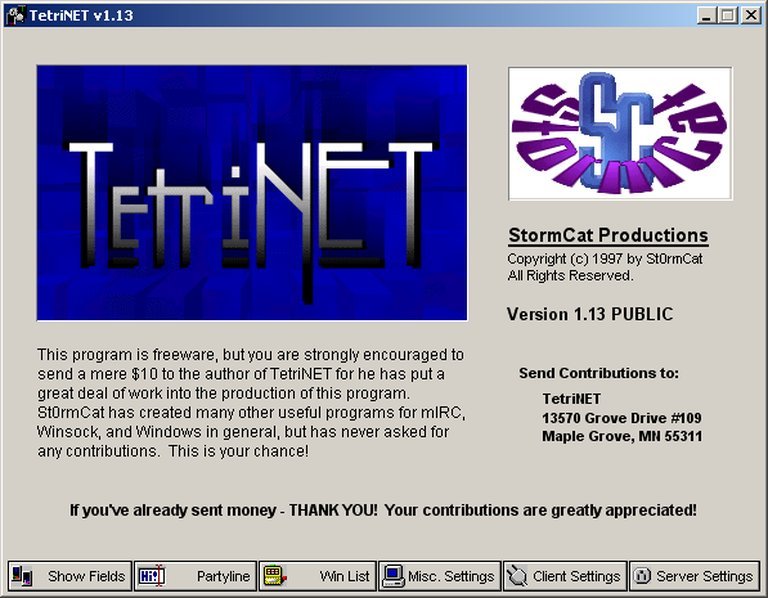
TetriNET is a multiplayer online Tetris variant where 2-6 players compete on individual fields, with clearing lines sending additional rows to opponents. Special blocks acquired from cleared lines enable strategic attacks like adding lines, clearing blocks, or switching fields, and the last player whose field doesn’t overflow wins, offering a fast-paced, competitive puzzle experience.
TetriNET Free Download
TetriNET Cheats & Codes
TetriNET
Enter commands in the partyline during gameplay using Alt-0255 to input the ÿ character.
| Code | Effect |
|---|---|
| ÿ endgame | Ends the current game. |
| ÿsb 5 a 3 | Sends an addline attack from player 3 to player 5. |
TetriNET: The Networked Party Game That Redefined Competitive Tetris
Introduction: A Simple Idea, A Revolution Latent
Long before the era of mass-market online multiplayer and the formalization of esports, a quiet revolution was brewing in the dimly lit corners of the late-1990s internet. It was powered not by 3D accelerators or sprawling MMORPGs, but by the unassuming, universally understood mechanics of falling blocks. TetriNET, conceived and released by the enigmatic developer known as St0rmCat around 1996-1997, stands as a seminal, foundational experiment: what happens when you take the solitary, zen-like puzzle of Tetris and force it into a gladiatorial arena over a TCP/IP connection? More than a mere clone, TetriNET was a paradigm shift. It weaponized Tetris, transforming it from a test of individual spatial reasoning into a brutal, hilarious, and deeply social battle of attrition and psychological warfare. This review argues that TetriNET’s legacy is twofold: it preserved the pure, skill-based core of Tetris while pioneering the “combo attack” and “item-based PvP” mechanics that would become staples of competitive puzzle games for decades. Its freeware, community-driven existence made it a Zeitgeist of the early internet’s open, DIY gaming culture, and its spectral influence is directly felt in modern titans like Tetris 99 and Puyo Puyo Tetris.
Development History & Context: The Polish Underground Meets Dial-Up
The Creator and the Scene
TetriNET was the brainchild of St0rmCat, a developer operating from the vibrant, mod-happy landscape of mid-90s PC gaming. The credits, listed on MobyGames, reveal a project born from a small, passionate team: St0rmCat as lead, with “Darktick” contributing ideas and graphics coding, and a cohort of beta testers and supporters from the #TetriNET IRC channel and the “#square crew.” This was not a corporate endeavor but a grassroots, fan-driven project, typical of an era where enthusiasts could build and distribute sophisticated networked tools to a global audience via FTP sites and nascent web portals.
Technological Constraints and Innovation
The technological canvas was the dial-up modem and the early public internet. Bandwidth was scarce, latency was high, and synchronizing real-time action was a non-trivial programming challenge. TetriNET’s genius was in its simple, robust TCP/IP client/server model. It did not attempt complex state replication; instead, it treated each player’s field as largely independent, transmitting only essential events: piece movements, line clears, and the activation of special blocks. This minimalist network protocol was key to its accessibility and stability on the unstable connections of the time.
The game was initially developed for Windows (with the classic 1.13 version cited) but was swiftly ported to a stunning array of platforms—Unix, Linux (as GTetrinet), Mac OS X, BeOS, and even Haiku. This cross-platform ambition was a direct response to the fragmented OS landscape of the late 90s and early 2000s, particularly the burgeoning Linux community. As noted in the Wikipedia entry and linux.conf.au contest reports, TetriNET became a darling of the open-source world, not just as a game but as a proof-of-concept for networked application development.
The Gaming Landscape
Released in a world dominated by single-player puzzle games (Dr. Mario, Columns) and local multiplayer (Tetris on NES/Game Boy with link cables), TetriNET was a visionary leap. It anticipated the mass adoption of online play that would come with broadband and services like Xbox Live. It existed in the same cultural space as Quake and Unreal Tournament LAN parties, but required a fraction of the hardware. Its freeware status made it the ultimate affordable alternative, as Game Revolution later praised, filling a critical niche for students and budget-conscious gamers seeking competitive camaraderie.
Narrative & Thematic Deep Dive: The Story of the Arena
TetriNET possesses zero traditional narrative. There is no plot, no characters, no dialogue, and no setting exposition. Yet, within its mechanical confines, it fosters the richest possible emergent narrative. The “story” is the match itself—a serialized drama of come-from-behind victories, devastating “nuke” attacks, and the slow, tightening anxiety of a rising stack.
The primary theme is pure, unadulterated competition. It is the Hobbesian Tetris arena: a war of all against all, where alliances are fleeting and betrayal is a key press away. The special block system introduces a layer of tactical storytelling. Using a s: Switch Fields to steal an opponent’s near-winning board, or a n: Nuke Field to reset someone’s hard-earned progress, creates moments of high drama, shock, and trash talk. These are not just game events; they are plot points in a shared story the players author together.
The secondary theme is community and legacy. The game’s history is preserved not in its code, but in the lore of its players. The ResetEra thread is a testament to this: memories are tied to specific friends, to the music of Evanescence, to the ritual of dial-up connections and ICQ chats. The game’s subculture, with its league play (via sites like TetriNET Resource), variant rulesets (pure, 7tetris), and homebrew clients (Blocktrix), created a living mythology. The “story” of TetriNET is the story of the early internet itself—a decentralized, passionate, Sometimes lawless (as seen with The Tetris Company‘s cease-and-desist letters against TetriNET2) but fiercely dedicated user base.
Gameplay Mechanics & Systems: Depth from a Single Mechanic
Core Loop & Victory Condition
The foundation is classic Tetris: a 12×20 (as per TetrisWiki) playfield, standard SRS-like rotation (with its own specific “Tengen-based” rules), and the goal of clearing lines to prevent blocks from reaching the top. The victory condition is a battle royal: the last player whose playfield does not top out wins.
The Trojan Horse: The Special Block System
This is where TetriNET transcends being a simple online Tetris client. It introduces a dual-resource economy:
1. Garbage Rows: Triggered by clearing a Tetris (four lines at once). This is the standard attack, sending “broken” lines to all opponents, raising their stack. It rewards risk-taking and combo building.
2. Special Blocks: These appear as marked blocks within the playfield. Clearing a line containing a special block adds that block to your inventory, with multi-line clears awarding multiple specials. This creates a triple-loop:
* Clearing a special line = Gaining a tactical tool.
* Using the tool = Directly manipulating an opponent’s (or your own) field state.
* The effect = Altering the core competitive dynamics (e.g., c: Clear Line removes a bottom row, g: Block Gravity causes a catastrophic cascade, s: Switch Fields is a high-stakes gamble).
This system is elegant in its simplicity and profound in its strategic impact. It converts every piece placement into a potential opportunity for offense or defense. Do I clear this line with a special to get a n: Nuke Field, or do I hold it to counter an incoming attack? Do I use my b: Clear Special Blocks defensively on myself to remove a field full of dangerous bombs, or offensively on an opponent who is building a chain? The inventory is a visible, limited resource, creating palpable tension.
Game Modes and Variants
The base game’s flexibility is a major strength. The pure mode (disabling specials) caters to “old school” players who want pure stacking and Tetris-attack speed, as championed by some ResetEra users. The 7tetris mode shifts victory to a race for seven Tetrises, emphasizing combo skill over survival. More dramatically, community variants rewrote the rules:
* TetriFast: Removes the standard one-second piece delay, creating a blistering, reflex-based speed game.
* TetriNET 1.14: A “fairness” variant where all players receive the same piece sequence, eliminating random number generator (RNG) luck from the equation—a competitive staple.
* Blocktrix: Added z: Zebra Field (clear every second column) and l: Left Gravity (pull all blocks left), introducing new spatial puzzles.
* TetriNET2: The official sequel expanded the special roster with effects like Immunity, Darkness (screen blackout), and Confusion (control reversal), adding a layer of “status effect” RPG-like strategy.
Interface and Control
The UI is a masterclass in functional clarity. Each player’s field is a fixed, flip-screen window (a holdover from the era of low resolutions). The next-piece preview and inventory are clearly visible. Controls are direct and configurable via keyboard. The number keys (1-6) for targeting opponents are a brilliant piece of ergonomic design, allowing for lightning-fast attacks without clunky menus. The one-second piece delay, while present in the original, became a tunable variable, a design knob the community could turn to suit their preferred meta.
Flaws and Fricitions
The system is not without friction. The RNG of piece sequence can lead to “unlucky” droughts or runs, a point of frustration for pure skill advocates. The first-attack advantage can snowball; a player who gets an early n: Nuke Field or s: Switch Fields on a struggling opponent can create an insurmountable lead. The learning curve for specials is steep; as GameHippo.com noted, “it may be a little difficult to understand the game in the beginning.” New players must learn not just Tetris, but a entire psychic toolkit of offensive and defensive items.
World-Building, Art & Sound: Minimalism as a Virtue
Visual Design: The Arena is Abstract
TetriNET’s “world” is a non-descript, grid-based void. The 12×20 playfield is rendered with simple, boldly colored, high-contrast sprites for the seven tetrominoes. Special blocks are distinguished by a single, clear symbol (e.g., a star, an ‘A’) on the block itself. There is no thematic dressing—no fantasy castles, no sci-fi landscapes. The arena is pure, abstract competition. This minimalism is a strength, not a weakness. During frantic gameplay, there is no visual clutter; the player’s focus is solely on the falling piece, the rising stack, and the inventory of attacks. The simplicity also meant easy moddability, leading to a thriving community of custom skins and palettes, as noted in the Retro Replay summary, allowing players to personalize their gladiatorial stage.
Sound Design: One MIDI to Rule Them All
The audio experience is defined by the single, iconic MIDI track: “The Dance of the Spheres” (attributed to David Lilja, aka Davie M. Karlsson). It is a looping, synth-driven composition with a propulsive, rhythmic bassline and melodic arpeggios. It perfectly captures the game’s rhythmic, mentally engaging, yet urgent pacing. There are no sound effects for line clears or attacks—the music is the sole auditory feedback, its relentless pulse driving the player’s actions. This lack of audio “juice” is another feature of its purity; the player is left alone with their thoughts and the music, heightening the tension of each decision. The music itself became a powerful nostalgia trigger, as evidenced by the ResetEra users’ strong auditory associations.
Atmosphere: The LAN Party and the IRC Channel
The true “world” of TetriNET was social, not visual. It existed in the IRC channel #TetriNET (credited in the credits), where players would congregate, arrange matches, and trash-talk. It was the staple of LAN parties, as several forum users recalled. The atmosphere was one of communal, hacky, late-night revelry—the kind fostered by free, easily distributable software. The game’s world was the sum of its players’ connections, chat logs, and the shared experience of a perfectly timed Blockquake or a humiliating Switch Fields betrayal.
Reception & Legacy: The Cult Classic That Built a Genre
Contemporary Reception (1997-2000)
Official critic reviews were sparse but positive. Both Clubic (80%, 4/5) and GameHippo.com (80%, 8/10) praised its engaging multiplayer twist. Clubic‘s French review summed it up: “Un Tetris en réseau, ça ne vieillit pas, et Tetrinet est toujours aussi accrocheur. Un must pour passer un bon moment à plusieurs!” (“A networked Tetris doesn’t age, and Tetrinet is still as catchy. A must for a good time with friends!”).
Its real success was in passionate, grassroots communities. It was a phenomenon in the Linux community, with dedicated ports like GTetrinet and even a programming contest at linux.conf.au where teams wrote AI bots to compete, with a A$40,000 IBM server as the top prize. This speaks volumes about its perceived depth and the technical interest it inspired.
Evolution of Reputation
TetriNET’s reputation has grown from a beloved niche title to a recognized foundational pillar of competitive puzzle gaming. Game Revolution‘s reviews from 1999 and 2003 were prescient, calling it “truer to its Tetris roots” than contemporary commercial releases and the superior choice for multiplayer. The ResetEra thread is a flood of unvarnished nostalgia, with users unanimously affirming its fun-factor and lamenting its demise. Phrases like “played the hell out of,” “wonderful,” “some of the most fun you can have,” and “it was the shit back then” underscore its cult classic status.
Industry Influence and the Legal Specter
TetriNET’s direct mechanical DNA is visible in a lineage of games:
* Puyo Puyo Tetris and Tetris Battle Gaiden (as noted by ResetEra’s Awakened): Both feature character-specific special attacks triggered by clearing certain lines, a direct conceptual descendant of TetriNET’s inventory system.
* Tetris 99 and Tetris Effect: Connected: The core “attack by clearing lines” mechanic is the standard for battle royale Tetris. While they use a simpler “garbage attack” system based on line clears (with attack strength determined by combo), the spirit of sending junk to opponents is pure TetriNET.
* Modern online clones like tetr.io explicitly model their gameplay on this “item battle” tradition.
However, its legacy is inextricably linked to legal conflict. As detailed in the Wikipedia entry and Gamasutra articles, TetriNET2 and other clones were targeted by The Tetris Company with cease-and-desist letters in 2007. This highlighted the fragile legal position of fan-made Tetris variants. While TetriNET2 was briefly resurrected by fans, the official servers are now long gone. This legal shadow casts TetriNET as a martyr for open, fan-driven game design, a free and open experiment that commercial interests eventually sought to control.
Conclusion: The Indelible Stamp of a Pioneer
TetriNET is not a perfect game. Its graphics are primitive, its audio limited, and its reliance on RNG can frustrate. Yet, to judge it by modern graphical standards is to miss its monumental achievement. In the barren landscape of 1997 internet gaming, St0rmCat and his team didn’t just make an online Tetris; they invented a new genre of social, competitive puzzle gaming.
They took the solitary, meditative act of sorting tetrominoes and infused it with the kinetic energy of PvP combat, the strategy of resource management (the special block inventory), and the unscripted drama of direct player interaction. Its design philosophy—simple protocol, local effect, global consequence—is a blueprint for elegant networked game design.
Its legacy lives on in every “Tetris battle” mode, in every game where clearing lines sends garbage to an opponent, and in the understanding that the deepest social experiences in gaming can emerge from the simplest of mechanics, if you connect enough people. TetriNET was more than a game; it was a social platform, a coding experiment, and a cultural touchstone for a generation of internet pioneers. It is a definitive classic, not for its production values, but for its profound, lasting insight: that Tetris was never meant to be played alone. Its place in history is secure as the humble,警务ugar-code catalyst that made competitive Tetris a global phenomenon.
Final Verdict: 9.5/10 – A foundational masterpiece of networked game design. Its historical importance and enduring design brilliance far outweigh any technical limitations of its era.