
- Release Year: 1983
- Platforms: Commodore 64, Windows, ZX Spectrum
- Publisher: Artic Computing Ltd, Investronica, Pixel Games UK
- Developer: Artic Computing Ltd
- Genre: Action
- Perspective: Side view
- Game Mode: Single-player
- Gameplay: Arcade, Platform
- Average Score: 90/100
Description
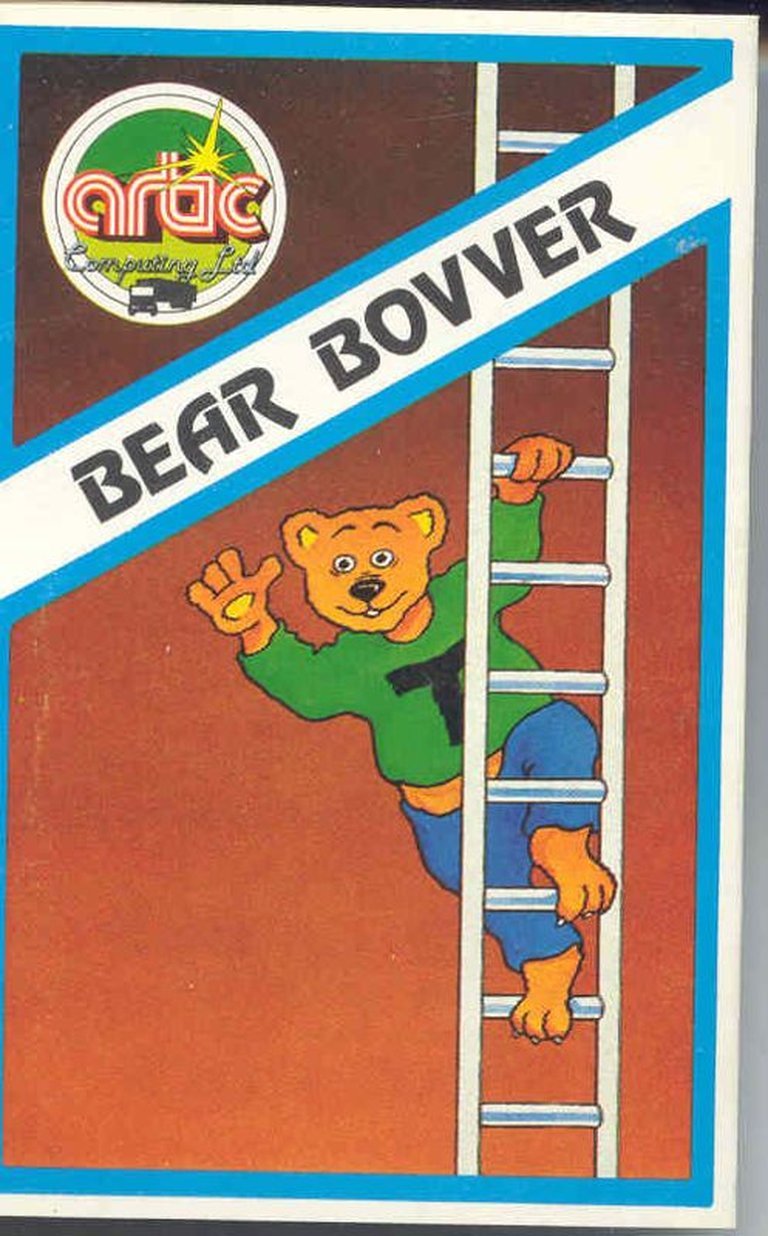
Bear Bovver is a classic 1983 platform game developed by Artic Computing, where players control Ted the Bear as he navigates a multi-level building site to collect batteries for his Sinclair electric truck. The side-view, flip-screen environment features patrolling enemies that can be trapped using strategically dropped bombs, with cartoon-style graphics and a ‘Baby Bear Mode’ for practice. Originally released on ZX Spectrum and later ported to Commodore 64, it offers addictive arcade-style gameplay inspired by BurgerTime.
Gameplay Videos
Where to Buy Bear Bovver
PC
Bear Bovver Free Download
PC
Bear Bovver Reviews & Reception
crashonline.org.uk (90/100): This game is very enjoyable and addictive.
Bear Bovver: The Bear-necessities of a BurgerTime Clone
Introduction
In the sprawling, often-overlooked archives of 1980s British computing, there exists a peculiar and charming relic: Bear Bovver. A game that wears its inspiration—the 1982 arcade hit BurgerTime—on its fuzzy sleeve, yet carves a distinct identity through a potent cocktail of absurdist premise, brutally addictive platforming, and technical polish that defied the limitations of the ZX Spectrum. For the uninitiated, it is a curious footnote; for retro aficionados, it is a beloved classic that exemplifies a golden era of homebrew ingenuity. This review posits that Bear Bovver is more than a competent clone. It is a masterclass in constrained design, a title that leveraged the burgeoning creativity of the UK’s software scene to transform a simple “drop ingredients to form a burger” mechanic into a tense, atmospheric scramble up a scaffolding-ridden construction site, populated by murderous bears and a green dinosaur. Its legacy is twofold: as a high-water mark for publisher Artic Computing and as a crucial stepping stone in the career of a future industry luminary, Jon Ritman. Through exhaustive analysis of its development, gameplay systems, and critical reception, we will uncover why this game about a bear seeking car batteries remains a fascinating, if frustrating, gem.
Development History & Context
Bear Bovver emerged from the fertile, chaotic soil of the early 1980s UK home computer market, a period defined by bedroom coders, one-man studios, and the fierce competition of the “cloning” culture. The game was developed by Jon Ritman, a programmer whose name would later become synonymous with genre-defining isometric masterpieces like Head Over Heels. In 1983, Ritman was working for Artic Computing, a prominent and respected publisher based in the north of England known for quality titles like PSSST and Quizim. Artic’s reputation lent immediate credibility to Ritman’s project.
The germ of the idea came from two disparate sources: Ritman’s observation of the popular arcade game BurgerTime, and contemporary British media chatter about the Sinclair electric car (the C5), a real-world quasi-futuristic vehicle. The developer’s own words, as preserved on his now-defunct personal site and mirrored on Wikipedia, state it plainly: “After seeing BurgerTime and hearing that Sinclair were talking about the release of an electric car, Jon Ritman decided to combine the concepts.” This alchemy—taking a proven arcade formula and grafting onto it a bizarre, locally resonant narrative—was a hallmark of the era’s successful adaptations.
Technologically, the ZX Spectrum 48K presented significant hurdles. Ritman, recognizing the need for greater complexity than his previous works, employed a clever and advanced development hack for the time: he networked two separate ZX Spectrum computers together using three Microdrive tape drives. One machine was used for coding, the other for testing. This “dual-system” setup, as noted in the Wikipedia entry, allowed for the development of a “larger” game in terms of scope and code, a significant advantage on a system with only 48KB of RAM and notoriously slow tape loading. The result is a game that feels surprisingly dense—multiple screens, varied enemy types, and smooth(ish) animation—all squeezed onto a cassette tape.
The gaming landscape of 1983 was saturated with platformers and BurgerTime clones (Barmy Burgers, Mr. Wimpy). Artic’s previous release, PSSST, was a Qbert-style game, showing the publisher’s focus on colorful, accessible arcade experiences. Bear Bovver fit perfectly into this lineup, but its whimsical bear protagonist and construction site setting gave it a unique aesthetic identity amid a sea of generic tile-based mazes.
Narrative & Thematic Deep Dive
Do not be fooled by the cuddly premise. The narrative of Bear Bovver is a masterwork of economical, surreal storytelling that enhances the gameplay’s tension. The official description from MobyGames and the box art sets the scene: Ted the Bear, a “proud owner of a new Sinclair electric truck,” suffers from a catastrophic design flaw—his vehicle lacks functional batteries. Stranded “outside a building site,” he spies his salvation: “three large shiny batteries” atop the scaffolding.
This immediately establishes the core dramatic irony: Ted is abear driving a notoriously unreliable piece of British electronics, now stranded and forced to perform dangerous manual labor. It’s a subtle, humorous critique of consumer optimism and technological hubris, wrapped in a cartoon package. The building site is not a neutral backdrop; it is an active, hostile environment. The antagonists are not merely generic monsters but “bovver bears”—a pun on “bother” and the UK slang “bovver” (trouble/violence, associated with hooligan culture). These are not just animals; they are personifications of workplace hazards and bureaucratic obstruction. Their patrol patterns on ladders and platforms represent the constant, mindless opposition to Ted’s simple goal.
The introduction of a “green dinosaur” (or “robot-like creature resembling Twiggy from Buck Rogers” on later screens, per the CRASH review) escalates the weirdness. It injects a layer of pure, unexplained chaos. Is this a prehistoric creature loose in a 1980s construction zone? A malfunctioning piece of machinery? The game offers no explanation, forcing the player to accept the surreal menace. This aligns with the DEVELOPMENT insight: scenarios get “odder and odder.” The theme becomes one of absurd, illogical danger, mirroring the frustrating, unpredictable nature of the gameplay itself.
The “Baby Bear Mode” is a fascinating narrative and mechanical footnote. It is presented as a “practice” mode, but its name—”Baby Bear”—implies a state of innocent, harmless exploration. It allows Ted to navigate the site “without ever getting captured,” creating a space free from the aggressive bovver bears and the dinosaur. Thematically, this suggests a dichotomy between the harsh, deadly “real” world of the construction site and a safer, tutorial-like dreamscape. It’s a compassionate design choice, acknowledging that the core game’s difficulty could be a barrier, and offering a narrative-justified way to learn the layout without the punitive consequences.
In summary, the narrative is a brief, potent vignette about futile perseverance against absurd odds. Ted is an everyman (everybear) protagonist, his goal elementary, his opposition nonsensical and relentless. The story isn’t told through cutscenes or text, but through the very act of playing: the constant threat of capture, the strategic laying of bombs, the triumphant clatter of a battery dropping into the truck.
Gameplay Mechanics & Systems
At its mechanical core, Bear Bovver is a fixed flip-screen platformer with heavy puzzle-strategy elements borrowed directly from BurgerTime. The player controls Ted, who must navigate a series of interconnected ladders and platforms (the “scaffolding”) to collect three batteries per level and deposit them into his waiting Sinclair truck below.
The core loop is deceptively simple but充满了紧张感:
1. Descend: Exit the truck (the only safe spot) and begin climbing.
2. Collect: Walk over a battery to make it drop one level. If it lands on a bear, that bear is temporarily “squashed” (a satisfying explosion).
3. Deposit: Guide the dropped battery to fall all the way down into the truck bed.
4. Repeat: Collect all three batteries.
5. Escape: Once the final battery is delivered, the screen “clears,” and the truck drives off-screen to the next level.
The primary antagonists are the “bovver bears.” They patrol the walkways on set paths, often vertically on ladders. Contact with them results in Ted’s capture and loss of a life. Their behavior is consistent but can feel aggressively intelligent, as the CRASH critic notes: “At times, the bears in this game can be utterly infuriating, ganging up on you.” They respawn quickly after being squashed by a battery or blown up, making them a constant, recurring threat.
The key strategic tool is the time bomb. Scattered around the level are bombs that Ted can pick up and drop at any point on a platform. After a short fuse, they explode, eliminating any bears (or the dinosaur) within a small blast radius. This is the player’s primary method for clearing a path, creating safe zones, or taking out clustered enemies. However, bombs are a finite resource on each screen, requiring careful management. Using one to clear a path for a single battery drop might leave you defenseless later.
The “Baby Bear Mode” is a critical system. It removes all enemy threats, allowing players to practice the precise movement required to navigate the sometimes-tight ladder-and-platform configurations. This was an unusually considerate feature for 1983, positioning the game as accessible to younger players (as CVG noted) and providing a low-stakes environment to learn the game’s spatial puzzle.
Progression is handled through increasingly complex screen layouts and enemy counts. The CRASH review mentions that after clearing a screen, “there are more bears—on the third a white robot-like creature… joins in.” This escalation forces the player to adapt strategies, using the environment and bombs more efficiently. The game has 4 lives and progressive difficulty, with no formal skill level select—the challenge ratchets up as you advance.
Control responsiveness was a major point of praise. CRASH rated keyboard play as “very responsive,” with configurable keys (e.g., Q/A for up/down, O/P for left/right) and support for popular joysticks (Sinclair 2, Kempston, Fuller). This was crucial; any input lag in such a precision-dependent game would be fatal. The control system is a pillar of the playable experience.
World-Building, Art & Sound
Bear Bovver achieves a remarkable sense of place and personality through its audiovisual design, an impressive feat given the ZX Spectrum’s 15-color (with attribute clash) and single-channel (plus noise) sound limitations.
Visual Direction & Atmosphere:
The game’s graphics were famously described by Artic as “cartoon quality,” a claim the CRASH review found “fairly true.” The art, hand-drawn by Ritman himself (credited for “Programming, Art & SFX”), employs bright, bold primary colors that pop against the black background. The construction site is rendered with a charming, slightly uneven hand-drawn aesthetic. Key details bring the world to life:
* Ted the Bear: A simple but expressive character, often seen hanging from ladders.
* The Bovver Bears: Their animation is the standout feature. As CRASH exclaims, “The animation of the bears is incredible.” They are not static sprites but have multiple frames for climbing and walking, giving them a dEMENTED, energetic menace that perfectly fits their “bovver” persona.
* The Truck: A detailed representation of a Sinclair electric vehicle, with a revolving transmission drive shaft—a tiny but impressive touch of flair noted by critics.
* The Dinosaur/Robot: A garish green (or white) multi-segmented creature that moves with a distinctive, jerky animation, adding to the surreal threat.
* Explosions & Effects: The squashing of a bear by a battery and the detonation of a time bomb are given dramatic, colorful screen shakes and particle effects, providing crucial tactile feedback.
The fixed flip-screen design means each construction site level is a single, self-contained puzzle box. The layout is consistent, allowing players to learn the geography—a necessity for survival. The atmosphere is one of pressured, claustrophobic industry. You are always aware of the bears’ movements, the ticking of any bomb you’ve laid, and the battery’s descent. The vibrant, cartoonish art style creates a delightful dissonance with the harsh, punishing gameplay.
Sound Design:
Guy Stevens’ sound contributions are legendary. The game’s audio is a key part of its enduring charm. It features “well known tunes played at any of 4 presettable volumes,” as the CRASH review highlights. The primary melody is the jaunty, instantly recognizable “Teddy Bear Two-Step” (better known as “The Teddy Bears’ Picnic”). This cheerful, almost aggressively upbeat music plays during gameplay, creating a bizarre and effective contrast with the life-or-death struggle on screen—a musical representation of Ted’s naive optimism. The sound effects for jumps, battery drops, bear squashes, and bomb explosions are sharp and satisfying, providing essential audio cues in a visually noisy environment. The ability to adjust the music volume was a practical godsend for players who found the tune either charming or maddening after the hundredth attempt.
Reception & Legacy
Bear Bovver was met with generally positive, if not universally rapturous, critical reception upon its 1983/84 release. The scores from the three major contemporary magazines averaged 80%, but the tone of the reviews reveals a game that inspired strong feelings, both positive and negative.
- CRASH (90% – “Smash!” Award): The most effusive. It praised the “cartoon quality” graphics, the “incredible” bear animation, and the “excellent” sound. Their criticism centered on the brutal difficulty: “At times, the bears in this game can be utterly infuriating… it’s very difficult.” Yet they concluded it was “Addictive and fun to play—maddening in fact… A fine game—one of Artic’s best.” The “Smash!” award was a significant seal of quality in the Spectrum press.
- Sinclair User (8/10): Called the premise “brilliant” and predicted it would make players’ “top ten ZX Spectrum games.” This review focused on the strength of the central concept and its execution.
- Computer and Video Games (7/10): Was the most lukewarm, deeming it “a great game for the younger computer game fan” specifically because of the Baby Bear Mode. This hints at a perceived lack of depth for hardened arcade veterans, though still a solid recommendation.
The player reception is more complex. On MobyGames, player ratings average 2.3/5 from five votes (as of this writing), a stark contrast to critic scores. This suggests a game that was either loved for its challenge and charm or hated for its perceived unfairness and frustration—a classic love-it-or-hate-it dynamic common in tough-as-nails arcade ports.
Legacy & Influence:
The direct, lineage-clear inspiration from BurgerTime places Bear Bovver within a specific sub-genre of “kitchen-based” or “assembly-line” platformers. Its own legacy is more subtle:
1. Jon Ritman’s Career: It stands as an important midpoint between Ritman’s earlier, smaller works and his future masterpieces. The technical ambition (using dual Spectrums), the focus on responsive controls and clear graphics, and the puzzle-platforming hybridity are all proto-elements of Head Over Heels (1987). Bear Bovver proved Ritman could build a complex, polished arcade game on limited hardware.
2. Artic Computing’s Catalog: It is frequently cited as one of Artic’s best titles, alongside PSSST and The Great Giana Sisters (which Ritman also worked on). It represents the studio’s peak period of creative output before its eventual decline and closure.
3. Cult & Preservation Status: The game has maintained a dedicated retro following. Its appearance in modern compilations like THEC64 (2022) and THEVIC20 (2020) introduced it to new generations. The 2022 Windows re-release by Pixel Games UK (also the current publisher on Steam for $1.49/$2.99) is a direct preservation effort. The existence of multiple Spanish versions (El Oso Bobo, Oso Bobo) testifies to its international reach.
4. “Bear” Game Taxonomy: It sits in a curious niche alongside other bear-themed games like Yogi Bear (1987) and Hover Bovver (another Ritman/Artic game from 1983, this time about lawn-mowing). Its specific “construction site + animal antagonists” formula isn’t widely replicated, but its spirit of absurd, challenging platforming lives on in the broader indie scene’s love of tough, precise mechanics.
Conclusion: A Flawed, Frustrating, & Essential Artifact
Bear Bovver is not a perfect game. Its difficulty can slide from “pleasantly challenging” into “controller-throwing unfair.” The temporary respawn of bears means that a single missed bomb drop or mistimed step can cascade into a hopeless situation. The dinosaur enemy introduces a level of chaotic, unpredictable speed that feels unbalanced. Yet, these same qualities are integral to its identity. The frustration is part of the addictive loop—the belief that “just one more try” will see you finally outsmart those damn bovver bears.
What elevates Bear Bovver beyond a mere curiosity is the sheer craft poured into its creation. Jon Ritman and Artic Computing took a familiar arcade skeleton and infused it with personality through unforgettable visuals, a mischievous soundtrack, and a world that feels uniquely, bizarrely British. The “Baby Bear Mode” shows a developer thinking about accessibility. The technical achievement of packing so much activity onto a Spectrum cassette is undeniable.
Its place in history is secure as a high-quality example of the 1980s “cloning” culture done right—respectful to its source material but confidently original in its dressing. It is a vital piece of Jon Ritman’s creative evolution and a testament to the Artic Computing team’s ability to deliver polished, catchy arcade experiences for the home computer audience. For the historian, it is a snapshot of a specific moment: when the UK software industry was learning to innovate within constraints, blending global arcade trends with local humor and sensibility.
Final Verdict: 8.5/10 – A Classic of Constrained Design.
Bear Bovver is an essential, if sometimes maddening, experience for anyone interested in the history of platformers or the ZX Spectrum era. Its cartoon charm, strategic depth, and historical significance outweigh its occasional spikes in frustration. It is not just a BurgerTime clone with bears; it is Bear Bovver, a title that embodies the creative spirit and technical savvy of early 1980s British game development. Seek it out in a compilation, emulated, or on Steam, and prepare to be both delighted and bovvered.