
- Release Year: 2018
- Platforms: Commodore 64, Windows
- Publisher: GIANTS Software GmbH
- Developer: GIANTS Software GmbH
- Genre: Simulation
- Perspective: Diagonal-down
- Game Mode: Single-player
- Gameplay: Business simulation, Managerial
- Setting: Contemporary
- Average Score: 67/100
Description
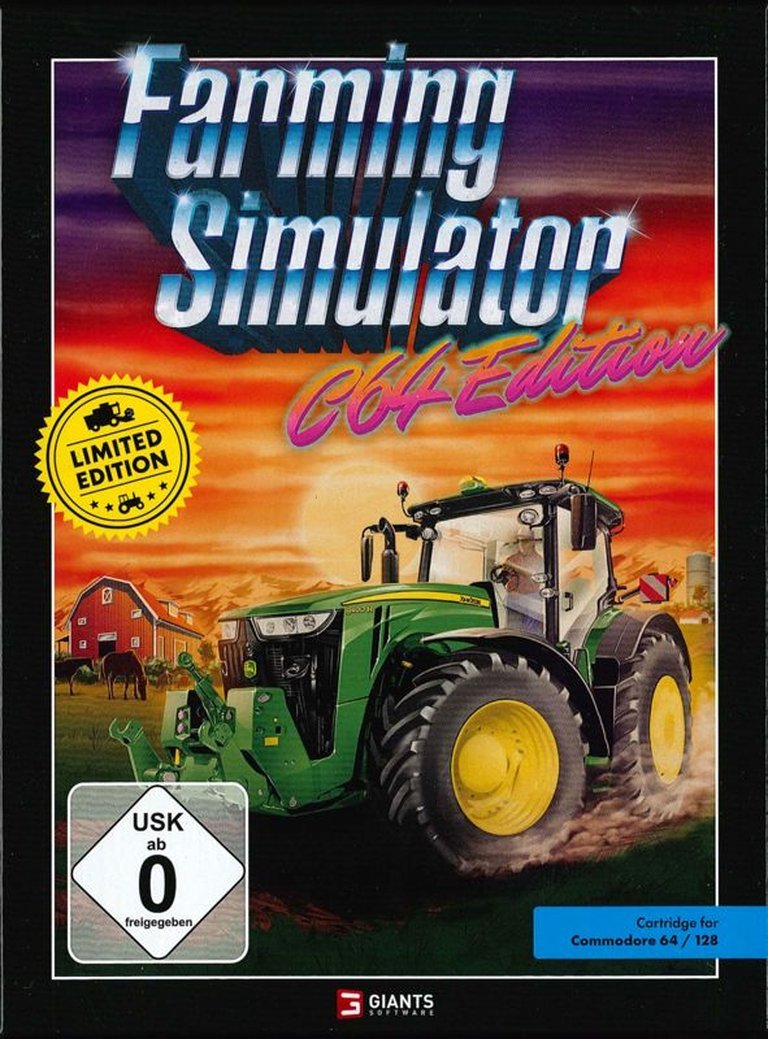
Farming Simulator 19: C64 Edition is a retro adaptation of the modern farming simulation series for the Commodore 64, featuring an isometric 2D perspective on a single contemporary farm map. Players operate agricultural vehicles like tractors and harvesters from brands such as John Deere and Case IH, handling tasks including driving, equipment use, and quick vehicle switching, with support for both emulated play via VICE on Windows and original C64 hardware.
Farming Simulator 19: C64 Edition Reviews & Reception
metacritic.com (70/100): It’s still the best farming simulator around, but you won’t miss much if you skip it.
metacritic.com (86/100): for those with an interest it will likely scratch an itch that doesn’t have another outlet outside of a massive bank loan and a lot of hard labour.
metacritic.com (78/100): proper tools are way out of my price range, so I’ll have to go with cheap equivalents.
metacritic.com (90/100): find a whole new love for the series.
metacritic.com (80/100): I’m just glad the mods will flesh out the game
metacritic.com (80/100): merveilleuse découverte, ce jeu m’a piqué et rendu accro
metacritic.com (100/100): El mejor juego de agricultura de 2019
metacritic.com (0/100): Worst game literally crap
opencritic.com (60/100): an incredibly hardcore simulator, which comes with a high level of freedom of choice.
opencritic.com (70/100): the wealth of things you can do in the game will keep you entertained for hours.
opencritic.com (40/100): very dry and demanding sim that’s devoid of character.
opencritic.com (70/100): a solid place to cut your teeth.
opencritic.com (50/100): Not for everyone, but players looking for the zen that comes with taking care of corn and other crops will rejoice.
opencritic.com (80/100): Quality and quantity of vehicles, animals and crops is outstanding.
opencritic.com (60/100): some very rough AI and a non-existent tutorial are barriers to entry.
opencritic.com (60/100): there is a real pleasure to act as a farmer
Farming Simulator 19: C64 Edition: A Curious Artifact of Agricultural Nostalgia and Technical Bravery
Introduction: The Demake as Historical Dialogue
In an era defined by photorealistic 4K textures, sprawling open worlds, and physics engines simulating the tensile strength of every blade of grass, the release of Farming Simulator 19: C64 Edition in late 2018 stands as one of the most deliberate and fascinating anachronisms in modern gaming. This was not a retro-styled indie project, nor a homebrew hobbyist effort, but an official, commercially released “demake”—a full-title modern franchise deliberatelytranslated onto the severe technical constraints of the Commodore 64, a 36-year-old home computer at the time. Created by the Swiss studio GIANTS Software, best known for the meticulous, bulldozer-heavy realism of the main Farming Simulator series, the C64 Edition represents a profound conceptual pivot. It replaces the signature 3D fields of its progenitor with a stark, charmingly crude isometric perspective, swaps hundreds of licensed vehicles for a mere four, and transforms a complex economic simulation into a minimalist, almost zen-like exercise in vehicular control. This review will argue that Farming Simulator 19: C64 Edition is less a game in the conventional sense and more a brilliant, self-aware piece of meta-commentary and corporate nostalgia-bait. Its value lies not in its depth or longevity but in its existence as a tangible historical artifact—a bridge between the simulation-focused design ethos of the 1980s and the hyper-specific, brand-licensed sims of today. It is a curio, a marketing stunt with surprising technical heart, and a testament to the enduring cultural footprint of the Commodore 64 itself.
Development History & Context: An April Fool’s Turned Serious Business
The genesis of Farming Simulator 19: C64 Edition is a story of corporate humor metastasizing into a genuine product. According to developer notes from Rushing Pixel (the label under which the graphical assets were produced) and MobyGames, the project originated as an April Fool’s joke in 2018. The idea—to imagine the sprawling, modern Farming Simulator 19 on a Commodore 64—was initially a playful jest about the series’ incremental annual releases and the enduring mystique of 8-bit computing.
However, the joke resonated deeply within GIANTS Software and its community. The studio, founded in Schlieren, Switzerland, in 2001, had built its fortune on a deceptively simple premise: licensed agricultural machinery in a sandbox environment. By 2018, they were a major European developer with a multi-million-copy franchise. The C64 Edition became a tangible passion project, a way to pay homage to the foundational era of computer gaming while simultaneously promoting the main Farming Simulator 19 release. It was first bundled as a bonus extra in the physical “Collector’s Edition” of the main game on PC, which included a cartridge and CD-ROM. Its popularity and the sheer novelty of the concept led GIANTS to release it separately as a digital download for €4.99 and produce a limited run of approximately 500 physical cartridges through retro-specialist publisher Protovision. Most physical units were sent to press; the remainder sold out in hours, cementing its status as a coveted collector’s item.
The development team was a small, specialized subset of GIANTS. The credited team for the C64 version (15 people) is a fraction of the 69-person team for the main FS19. Key figures include:
* Attila Kasa (Programmer): The primary coder, who, alongside Zsolt Kajtár, tackled the monumental task of adapting a modern simulation to a machine with 64KB of RAM.
* Balázs Oszvald & Anett Jaschke (Artists): Tasked with creating the isometric sprites for vehicles and environment within severe sprite and color limitations (the C64’s VIC-II chip could display a maximum of 16 colors from a 256-color palette, with strict limitations per sprite and screen region).
* László Vincze (Music and SFX): Composed the chiptune soundtrack and sound effects, utilizing the C64’s legendary SID chip.
* Mihàly Horvath (Music Player and Tracker): Implemented the music driver.
* Tobias Bindhammer & Johan Forslöf (Floppy Disk Routines, Compression): Critical roles in fitting the game onto a standard 1541 floppy disk (typically 170KB) and later creating the cartridge-friendly CRT images.
The technological constraints were immense. The C64’s 6510 CPU ran at a sluggish ~1MHz. Memory was measured in kilobytes. Rendering a convincing isometric view of farm machinery and fields required clever use of “multicolor” mode, which doubled horizontal pixel resolution but halved the number of available colors per sprite—a classic C64 trade-off. The “typical Farming Simulator gameplay” (as the official description states) had to be distilled to its absolute essence: drive vehicle, attach equipment, activate equipment. Concepts like a full economy, livestock management, mod support, or an expansive map were impossible. The team’s triumph was in making the core feeling of driving a tractor recognizable within these chains.
The gaming landscape of 2018 was one of vast, open-world sims and a mature retro revival scene. The C64’s legacy was being actively preserved through projects like the THEC64 Mini (released earlier in 2018), which ran legally licensed games from original developers. FS19 C64 Edition was explicitly designed to be compatible with this device, with its D64 disk image added to the Mini’s carousel via a 2019 firmware update. This was not just a ROM hack; it was a product positioned at the intersection of modern franchise branding, retro computing nostalgia, and hardware preservation culture.
Narrative & Thematic Deep Dive: The Absence of Story as Statement
Here, the analysis must confront a fundamental truth: Farming Simulator 19: C64 Edition has no narrative, no characters, and no dialogue. There is no story, no tutorial, no guiding hand. The player is simply deposited onto a field with a tractor and a vague objective (“tend your fields, sell your harvest”).
This vacuum is, in itself, the game’s most potent thematic statement. The modern Farming Simulator series, for all its mechanical depth, is famously laconic. Its “story” is the one the player writes themselves through the rise of their agricultural empire. The C64 Edition strips this down to an even more radical minimalism. It embodies the abstract, systemic purity of early computer games. The “theme” is pure contemporary agricultural labor, reduced to its base verbs: accelerate, steer, attach, activate, horn. The absence of economic simulation (no seed purchasing, no market fluctuations mentioned in the source material) removes the managerial layer, leaving only the haunting, repetitive ritual of the work itself.
This creates a unique, almost meditative experience. The player is not a CEO but a machine operator. The cycle is endless and self-contained: drive to field, engage implement, work a lane, turn, repeat. The single “horn” key is the only non-functional aspect—a tiny, humorous flourish of personality, a “beep” in a silent world. The selection of four vehicles from major brands (Case IH, Fendt, John Deere, New Holland) becomes a pantheon of industrial icons, stripped of context. They are not investments but tools, identical in function, differentiated only by sprite color and shape.
In this void, the player’s mind supplies the narrative. The low-resolution fields become endless. The simple beep of the horn echoes across a vast, imagined countryside. This is the “simulation as setting” taken to its logical extreme. The game is about the idea of farming—the geometry of plowed earth, the satisfying clunk of an attachment—not the business. It’s a thematic antithesis to the bloated, feature-rich complexity of its 2018 counterpart, proposing that the soul of the “simulator” genre was never in the spreadsheets, but in the clean, repeatable action loop.
Gameplay Mechanics & Systems: The Skeleton of a Giant
The gameplay of Farming Simulator 19: C64 Edition is a masterclass in reduction. Based on the official description and platform specs, its systems can be deconstructed as follows:
Core Loop: The game operates on a single, static map (likely a small isometric tile-set). The player can switch between three tractors and one harvester. The control scheme is direct and utterly minimal:
* Acceleration / Reverse
* Steering (Left / Right)
* Brake
* Use Equipment (The single most important action. Attaching/detaching is likely automatic or context-based based on proximity).
* Horn (A purely cosmetic, humorous addition).
There is no fuel system, no damage model, no crop growth cycle, no economic management (selling harvest is implied but not detailed), and no AI field workers. The “harvester” suggests a single crop type, likely wheat or a generic grain. The “fields” are pre-defined areas of ground texture.
Interface & Innovation: The UI is non-existent by modern standards. All information is likely conveyed visually (crop state, field completion) through sprite changes. The innovation lies not in complexity but in feasibility. The isometric perspective, while a step back from the 3D of the main game, is a clever fit for the C64’s 2D sprite capabilities. The ability to quick-switch between vehicles is a significant usability win on a system with limited screen real estate, allowing the player to manage the “fleet” without cumbersome menus.
Flaws: The omissions are glaring and by design. The game is functionally incomplete as a farming simulator. It cannot simulate farming; it simulates driving farm vehicles. The lack of any progression or purpose beyond “complete the field” renders it a toy, not a game. The controls, while simple, are also inflexible—no cruise control, no camera adjustment. The “single map” is a prison.
Comparative Systems Analysis: Compared to its monumental sibling, FS19 C64 Edition is a ghost. Where the main game boasts over 300 vehicles and tools, a full crop lifecycle (plow, sow, fertilize, harvest, sell), livestock (pigs, cows, sheep, chickens, horses), and a robust economy, the C64 version has four vehicles and an implied single action. This is not a flaw of execution but of intentional, extreme scope reduction. It is a deliberate proof-of-concept: “Can we make you feel like you’re driving a John Deere combine on a C64?” The answer is a qualified, impressive yes. The systems are the bare few required to answer that one question.
World-Building, Art & Sound: The Beauty of Technical Limitation
The world of Farming Simulator 19: C64 Edition is a masterwork of suggestive minimalism.
Visual Direction & Setting: The game uses an isometric, 2D scrolling perspective. The setting is “Contemporary,” but the aesthetic is pure 8-bit. The “map” is a top-down isometric tile set. Fields are likely represented by different colored or patterned ground tiles (dark soil for unworked, lighter for plowed, golden for ready-to-harvest). Boundaries are defined by simple fence sprites or field edge markers. The environment is devoid of life—no trees (or maybe a few static sprites), no buildings beyond perhaps a static garage or silo sprite, no sky, no weather. The “atmosphere” is created entirely through player imagination projected onto the sparse graphics. The choice of isometric view is key: it provides a clear, functional view of the vehicle’s position relative to field rows, prioritizing gameplay clarity over realism. It’s a design decision born of necessity (easier to render than a true 3D perspective on 1MHz) that ironically enhances the tactile, board-game-like focus on spatial navigation.
Artistry: Artists Balázs Oszvald and Anett Jaschke faced the Herculean task of creating recognizable, brand-accurate sprites for Case IH, Fendt, John Deere, and New Holland machinery within the C64’s 16-color limit, strict sprite overlap rules (only 8 multicolor sprites per scanline), and minimal memory. The result, as seen in the few available screenshots, is a triumph of silhouette and color blocking. A John Deere green tractor is instantly identifiable by its shape and hue, even without a logo. The harvester is a complex multi-sprite assembly. The art is iconic, not realistic—a perfect fit for the hardware.
Sound Design: Composer László Vincze and tracker Mihàly Horvath had the SID chip at their disposal, one of the most revered sound chips in history. While no direct audio samples are provided in the sources, one can infer a soundtrack of simple, looping melodic chiptunes and a sparse set of sampled or synthesized sound effects: the rumble of an engine (a low-frequency Sawtooth wave), the clatter of a harvester (rapid noise channel bursts), and the iconic, cheerful “beep” of the horn. The sound design would be utilitarian but evocative, leveraging the SID’s unique timbres to create a soundscape that is immediately, unmistakably “C64.”
Together, art and sound do not create a world but a stage. The player’s mind must fill in the vast emptiness. This collaboration between sparse data and active imagination is a hallmark of classic game design and gives the title its peculiar, haunting charm.
Reception & Legacy: A Curio’s Journey
At launch, Farming Simulator 19: C64 Edition existed in the shadow of its namesake. Critical reception is non-existent—there are no professional critic reviews recorded on MobyGames or any aggregated site. Its audience was niche: retro computing enthusiasts, hardcore Farming Simulator fans collecting the ultimate edition, and journalists reviewing the Collector’s Edition.
Player Reception from the two recorded ratings on MobyGames is a lowly 3.3/5. The verbatim user comments from Lemon64 are brutally succinct:
* VIC1969 (2025): “a very cut down version… with a few of the main features and quite severely limited gameplay, probably interesting for a look at but not much other value to it.” (3/10)
* NM156 (2023): “Good use of mix mode can’t hide the limited playability it offers for a commercial game.” (3/10)
This accurately reflects its dual nature: technically impressive as a feat, but profoundly unsatisfying as a Farming Simulator experience. Its value is as a curio, not a time-sink.
Its commercial performance is a story of scarcity. The physical cartridge run of ~500 units sold out almost instantly to collectors and press. Its digital release was a low-cost, low-expectation storefront item. Its inclusion as a free bonus in the Farming Simulator 19 Collector’s Edition was its widest distribution, serving as a clever premium and a conversation starter.
Legacy and Industry Influence: The C64 Edition’s legacy is not one of direct influence on game design trends—no studio has since announced a Cyberpunk 2077: NES Edition. Its influence is cultural and conceptual:
1. The “Demake” as Marketing Art: It stands as a high-profile example of a demake used not as a fan service but as a branding event. It generated significant press coverage (“GIANTS makes FS19 for C64!”) extending the game’s hype cycle. It validated the retro community’s interest in modern IPs on old hardware.
2. Commodore 64 Preservation Catalyst: By being a new, officially licensed commercial release in 2018, it injected vitality into the C64 homebrew and preservation scene. It demonstrated that the platform was not a museum piece but a living, if archaic, creative canvas. Its files (D64, CRT) became standard preservation items.
3. A Case Study in Scope Reality: For simulation game designers, it is a stark lesson in degrees of simulation. It visually argues that the experience of farming (the vehicle operation, the field geometry) can be separated from the management of farming. The lack of economy makes it feel empty, proving how integral those systems are to the core fantasy of the series.
4. THEC64 Mini Canonization: Its official inclusion on the THEC64 Mini firmware update canonized it as part of the machine’s “official library,” a rare honor for a 2018 title. It now sits alongside Mayday in Space and Attack of the Mutant Camels as a sanctioned piece of C64 history.
Conclusion: A Brilliant, Hollow Relic
Farming Simulator 19: C64 Edition is a paradox. It is a technically audacious, thematically coherent, and fundamentally shallow experience. As a game, it fails. It offers perhaps 15 minutes of novel fascination before its utter lack of systems, goals, or depth becomes apparent. Its 3.3/10 score on Lemon64 is, in isolation, fair.
But to judge it solely by the standards of a traditional video game is to miss its point entirely. It is a conceptual art piece in the medium of software. It is a love letter from a modern simulation studio to the crude, elegant constraints that birthed the industry. It is a physical artifact—a cartridge you can plug into a 1982 computer—that embodies the bizarre, circular nature of technological nostalgia.
Its place in history is secure not as a milestone in gameplay innovation, but as a pivotal moment in franchise meta-commentary and retro platform revitalization. It proves that even the most mundane, spreadsheet-driven modern sim carries within its DNA the ghost of the 8-bit era, where a single screen of colored squares could imply a world. For historians, it is a priceless primary document: a glimpse of 2018’s gaming priorities (licensed brands, open worlds) refracted through a 1982 lens, revealing what is absolutely essential (vehicle feel, spatial awareness) and what is merely accretion (economics, progression).
The final, definitive verdict is this: Do not buy Farming Simulator 19: C64 Edition looking for a farming sim. Buy it, or seek it out, as acuriosity. Play it for five minutes on a VICE emulator or a THEC64 Mini to witness a marvel of constrained engineering. Then put it down and return to the vast, complex fields of Farming Simulator 19 or 22. Its genius is in its existence, not its engagement. It is a hollow, beautiful, beeping monument to both the limits and the limitless imagination of game development.