
- Release Year: 2014
- Platforms: Windows
- Publisher: Daedalic Entertainment GmbH
- Genre: Compilation
- Game Mode: Single-player
Description
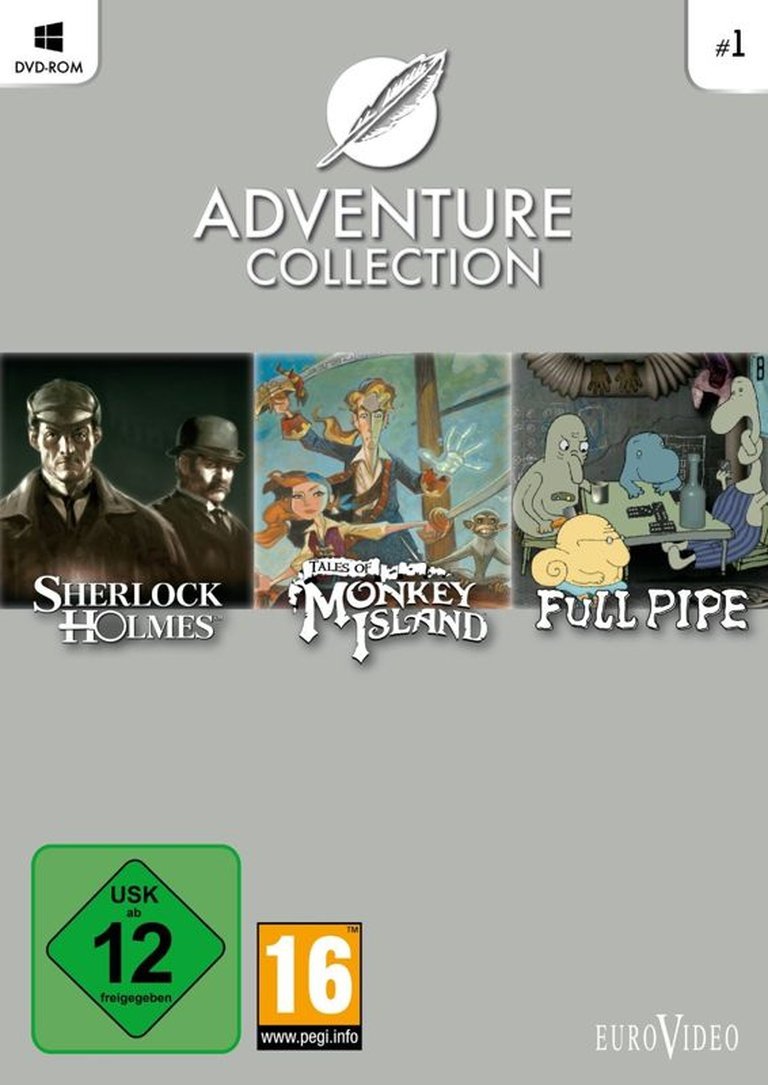
Adventure Collection #1 is a 2014 Windows compilation released by Daedalic Entertainment, featuring three previously published adventure games: Full Pipe (2003), Sherlock Holmes: The Awakened (2006), and Tales of Monkey Island (2009). This DVD-ROM collection brings together diverse adventure experiences, ranging from surreal platforming and detective mysteries to comedic pirate-themed puzzles, all centered around exploration and narrative-driven gameplay.
Adventure Collection #1: A Time Capsule of Mid-2000s Point-and-Click Craftsmanship
Introduction: Preserving a Fragile Legacy
In the vast ecosystem of video game compilations, few are as conceptually straightforward—or as critically overlooked—as Daedalic Entertainment’s Adventure Collection #1 (2014). This DVD-ROM bundle, gathering three narrative-driven titles from the publisher’s back catalog—Full Pipe (2003), Sherlock Holmes: The Awakened (2006), and Tales of Monkey Island (2009)—functions less as a curated experience and more as a digital time capsule. It encapsulates a specific, waning era of the adventure genre: a period where small to mid-sized studios, armed with pre-rendered graphics and voice acting budgets far shy of AAA blockbusters, prioritized intricate puzzles, atmospheric world-building, and literary sensibilities over action or spectacle. My thesis is this: while Adventure Collection #1 offers no original content, no technical enhancements, and virtually no contemporary critical discourse, its true value lies in its role as a historical artifact. It preserves a cross-section of European and American adventure game design circa 2003–2009, highlighting both the genre’s creative resilience and its commercial precariousness on the cusp of the digital distribution revolution. It is a quiet, definitive document of the “mid-2000s adventure renaissance,” for better and for worse.
Development History & Context: The Boutique Studio Ecosystem
To understand this compilation, one must first understand the ecosystem from which its constituent parts emerged. The early-to-mid 2000s represented a curious nadir and renaissance for the point-and-click adventure. The genre’s golden age of the early 1990s (LucasArts, Sierra) had collapsed under the weight of shifting market preferences toward 3D action and real-time strategy. Yet, a dedicated cadre of European and Canadian studios—often operating with modest teams and tighter budgets—kept the faith, leveraging improving PC hardware for lush, static 2.5D environments.
- Daedalic Entertainment, the German publisher behind this compilation, was founded in 2007 with a mission to revive the “classic adventure game.” By 2014, it had become a significant European force in the genre, known for both original titles (Deponia, The Whispered World) and localizations. Adventure Collection #1 is a product of this phase: a budget-priced retail offering aimed at consolidating its burgeoning catalog for the mass market, likely targeting discount bins and curious newcomers daunted by the proliferation of indie adventures on Steam.
- The included games span the company’s formative years:
- Full Pipe (2003) was developed by Russian studio K-D Lab (known for Pathologic), an early sign of Daedalic’s international reach. It was a surreal, physics-based platform-puzzle hybrid that stood apart from pure narrative adventures.
- Sherlock Holmes: The Awakened (2006) was developed by American studio Frogwares, which would become synonymous with the Sherlock Holmes adventure series. This title marked a shift for Frogwares from 2D to 3D environments while maintaining a heavy focus on deduction and clue-pinning.
- Tales of Monkey Island (2009) was the triumphant return of the iconic Monkey Island series, developed by Telltale Games in its narrative-adventure prime. It was a landmark event for genre fans, proving the classic formula could be revitalized with episodic storytelling and modern voice acting.
- Technological & Market Context (2003-2009): These games were built during the twilight of the DVD-ROM retail era and the dawn of digital distribution (Steam’s rise, 2010s). They utilized pre-rendered 360-degree panoramas or fixed-camera 3D models—a cost-effective way to achieve visual fidelity on hardware like 800 MHz Pentium IIIs. The era was defined by the struggle for shelf space against console giants (PS2, Xbox 360, Wii) and the rising tide of free-to-play and mobile gaming. Compilations like this were a lifeline for niche genres, offering perceived value through quantity. The 2014 release date of this collection, however, placed it in a fully digital, Steam-dominated market where such physical bundles were already anachronistic, explaining its near-total obscurity (only 1 collector on MobyGames at the time of writing).
Narrative & Thematic Deep Dive: Three Tales, One Compilation
The collection’s greatest strength is its thematic and tonal diversity, offering a triptych of adventure storytelling.
-
Full Pipe: Surrealism and Physics-Based Misanthropy.
- Plot & Characters: Players control Dzel, a grotesque, pipe-dwelling Everyman in a bizarre subterranean world. The narrative is minimal, delivered through environmental storytelling and the bizarre behaviors of other denizens (giant beetles, tooting plant-people). The goal is simply to escape a perpetually flooding home by navigating a chaotic, interconnected network of pipes and caverns.
- Themes: Full Pipe is less a traditional narrative and more an experiential descent into surreal, almost David Lynchian, discomfort. Themes of claustrophobia, bodily grotesquery, and futile effort dominate. It is a game about pestilence and escape, where the “story” is the player’s growing sense of alienation and the strange, often hostile, ecosystem they navigate. Dialogue is sparse and absurdist.
-
Sherlock Holmes: The Awakened: Rationalism vs. the Occult.
- Plot & Characters: An original Frogwares tale that transplants Holmes and Watson into a Lovecraftian mystery. The pair investigates a series of disappearances linked to a mysterious cult and an ancient, aquatic evil. The narrative is structured around gathering clues, interrogating suspects (from street urchins to elderly academics), and using Holmes’ “deduction board” to link evidence.
- Themes: The core conflict is between empirical reason (Holmes’ method) and cosmic, unknowable horror (the Cthulhu mythos). The game questions the limits of rationality when faced with phenomena that defy natural law. supporting themes of imperial guilt (the cult’s origins in colonial exploration) and the burden of knowledge are woven into the London and Swiss settings. Watson’s narration provides a humanizing, sometimes skeptical, counterpoint to Holmes’ obsession.
-
Tales of Monkey Island: Pirate Farce and Redemption.
- Plot & Characters: The fifth canonical Monkey Island game. Guybrush Threepwood seeks to become a proper pirate, only to accidentally unleash the voodoo curse of the evil Pox of LeChuck. The story unfolds across five episodic acts, featuring the entire classic cast: the beautiful but lethal Elaine Marley, the demon LeChuck, and the wise Herman Toothrot.
- Themes: At its heart, it’s a comedy of errors and a parody of pirate tropes and adventure game conventions. Underneath the humor, however, lie themes of identity (Guybrush’s perpetual struggle to be taken seriously), redemption (LeChuck’s bizarrely heartfelt pursuit of Elaine), and the power of storytelling itself—the game frequently breaks the fourth wall to comment on its own structure. It’s a loving, witty, and self-aware extension of a classic franchise.
Gameplay Mechanics & Systems: A Study in Contrasts
The compilation’s mechanical diversity is striking, reflecting the genre’s experimental phase:
-
Full Pipe: Environmental Physics as Puzzle.
The gameplay is pure physics-driven navigation. Dzel cannot jump traditionally; he must use a vacuum cleaner to suction himself up pipes, ride geysers, and manipulate objects. The core loop is exploration leading to a new physics-based obstacle, solved through trial-and-error with the game’s quirky toolset. It’s a platformer at heart, but with the pacing and failure states of an adventure game—falls are rarely fatal but set you back. The inventory is minimal (keys, valves, etc.), and puzzles are diegetic, arising directly from the environment’s bizarre logic. -
Sherlock Holmes: The Awakened: The Deduction Board.
Frogwares’ signature system is the Deduction Board. Clues gathered (a scrap of paper, a witness statement) are pinned to a corkboard. The player must manually connect related clues to form “deductions,” which in turn unlock new dialogue options, locations, or case progress. This system makes investigation feel active and logical, though it can become a laborious matching exercise. Traditional point-and-click interaction (examining, using, combining) remains, but the core challenge is in synthesizing information, not finding pixel-hunted items. The game also features first-person segments for searching crime scenes. -
Tales of Monkey Island: Episodic Puzzle Integration.
Telltale’s engine here is a streamlined, context-sensitive point-and-click. Left-click to examine, right-click to use/inventory. The puzzles are deeply integrated into the episodic narrative and character-based humor. Solutions often require combining Guybrush’s personality (lying, bribing, insulting) with items, rather than brute-force inventory combining. The “verb coin” is gone, replaced by a cleaner UI. The episodic structure introduces minor carry-over choices, but the core puzzles are largely self-contained within each act, designed for accessibility with a hint system that gently nudges rather than spoils.
Common Threads & Flaws: All three suffer from the era’s pixel-hunting and obtuse logic (especially Full Pipe and Sherlock Holmes). Save systems are limited (often fixed points or manual only). The UI, while functional, feels dated next to later Telltale titles. Full Pipe‘s physics can be frustratingly imprecise; Sherlock Holmes can devolve into clicking everywhere; Tales sometimes holds your hand too much. Yet, each game’s mechanical identity is perfectly aligned with its narrative tone: physics for surrealism, deduction for rational horror, and conversational puzzle-solving for comedic farce.
World-Building, Art & Sound: Atmospheres of Isolation and Intrigue
The compilation’s audio-visual diversity is its most immediately striking feature.
-
Full Pipe: Bleak Industrial Surrealism.
Art Direction: A stunning, grim 2.5D world of corroded metal, dripping sludge, and pulsating fungal growths. The hand-drawn, grimy aesthetic creates a palpable sense of decay and otherness. Environments are static panoramas, but the character animations (Dzel’s waddle, the bizarre movements of NPCs) are smooth and unsettling.
Sound: A oppressive, ambient score with industrial groans, subterranean drips, and unsettling musical stings. Sound design is key to navigation (listening for vents, water flow). The few voice clips are distorted and mumbled, reinforcing the game’s alienation. -
Sherlock Holmes: The Awakened: Gaslight Gothic.
Art Direction: A transition point for Frogwares. The 3D character models are stiff and early-2000s, but the pre-rendered backgrounds are beautifully detailed—foggy London streets, cluttered bookshops, snow-dusted Swiss castles. The lighting is moody and shadowy, perfect for the Lovecraftian tone. It feels like a moving Myst or 7th Guest painting.
Sound: A somber, orchestral score with heavy,吓人的 (haunting) strings. Voice acting (by British actors) is theatrical and deliberate, fitting the period piece. The soundscape is filled with period-appropriate ambience: carriage wheels, crackling fires, howling wind. -
Tales of Monkey Island: Vibrant Cartoon Bermuda.
Art Direction: A faithful, vibrant 2D evolution of the Monkey Island style. Characters are expressive and exaggerated, environments are lush and colorful (jazz clubs, tropical islands, ghost ships). The art direction is a masterclass in cartoon translation to adventure game graphics, bursting with character and playful detail. It’s the most immediately accessible and “fun” looking.
Sound: A swinging, Caribbean-inspired jazz score with memorable leitmotifs for characters and locations. The voice acting is the compilation’s standout—a perfect cast (with the notable exception of a new, less iconic voice for Stan) delivering Ron Gilbert and Dave Grossman’s witty, rapid-fire dialogue with impeccable timing. It’s the audio highlight by a significant margin.
Reception & Legacy: A Ghost in the Machine
Adventure Collection #1 exists in a fascinating critical vacuum.
* At Launch (2014): It was utterly ignored. Metacritic shows no critic or user reviews (a state that persists). MobyGames lists only 1 collector. It received no mainstream press. In an era dominated by The Witcher 3, Destiny, and the rise of Let’s Plays, a budget repackaging of three already-niche games from a non-mainstream publisher was invisible. Its retail existence on DVD-ROM was already a relic.
* Legacy of the Source Games: The compilation’s value is entirely derivative of its parts:
* Full Pipe is a cult curiosity, remembered for its bizarre aesthetic and frustrating-but-unique physics. It has little direct influence but is a beloved oddity.
* Sherlock Holmes: The Awakened was a critical and commercial success for Frogwares, establishing their formula and proving the market for detective adventures. It directly led to a long-running series (Crimes & Punishments, etc.) that refined the deduction board system.
* Tales of Monkey Island was a triumphant comeback. It won multiple adventure game awards, revitalized the franchise, and proved Telltale’s model could work on established IPs. Its influence is seen in all subsequent narrative-focused, choice-driven adventure games, including Telltale’s own later works.
* The Compilation’s Own Obscurity: Adventure Collection #1 itself has no discernible influence. It was not a commercial success, nor did it shape design trends. Its failure is a microcosm of the physical media compilation’s death in the digital age. It simply is—a snapshot of what Daedalic deemed its “essential” adventures at a specific moment. For historians, its primary value is as a primary source artifact: it demonstrates how publishers attempted to package and sell adventure games to a dwindling retail audience in 2014. It is a testament to the genre’s persistence, not its prominence.
Conclusion: An Essential Footnote
Adventure Collection #1 is not a “great” game compilation by any conventional metric. It offers no enhancements, no bonus content, and no cohesive presentation. The games sit together without connective tissue. Yet, as a work of digital preservation, it is quietly significant. It bundles three distinct, high-quality examples of mid-2000s adventure design—the surreal European (Full Pipe), the methodical deduction title (Sherlock Holmes), and the episodic franchise revival (Tales of Monkey Island)—into a single, accessible package.
For the modern player, it’s a low-stakes, low-cost entry point into the genre’s pre-Walking Dead diversity. You can experience the tactile puzzle-solving of Frogwares, the comedic timing of Telltale, and the experimental world of K-D Lab, all in one purchase (when found). Its flaws—dated UIs, pixel hunts, the sheer unevenness of the trio—are instructive, highlighting what was gained and lost as the genre evolved.
Final Verdict: 7/10 as a historical document. 5/10 as a consumer product.
It belongs in the library of any serious game historian or adventure aficionado not for its execution, but for its curation. It is a physical (or digital) time capsule from a genre at a crossroads, preserving titles that represent pivotal steps in the evolution of narrative games. Adventure Collection #1 is the game industry equivalent of a well-intentioned but obscure museum exhibit: imperfect, overlooked, but containing within it undeniable artifacts of craft and passion. Its obscurity is its story—a story of a beloved niche struggling to find its place in a rapidly changing world.