
- Release Year: 2001
- Platforms: Windows
- Publisher: Global Software Publishing Ltd.
- Developer: MVP Software
- Genre: Card, Patience, Puzzle, Solitaire, Tile
- Perspective: Top-down
- Game Mode: Single-player
- Gameplay: Cards, Tiles
Description
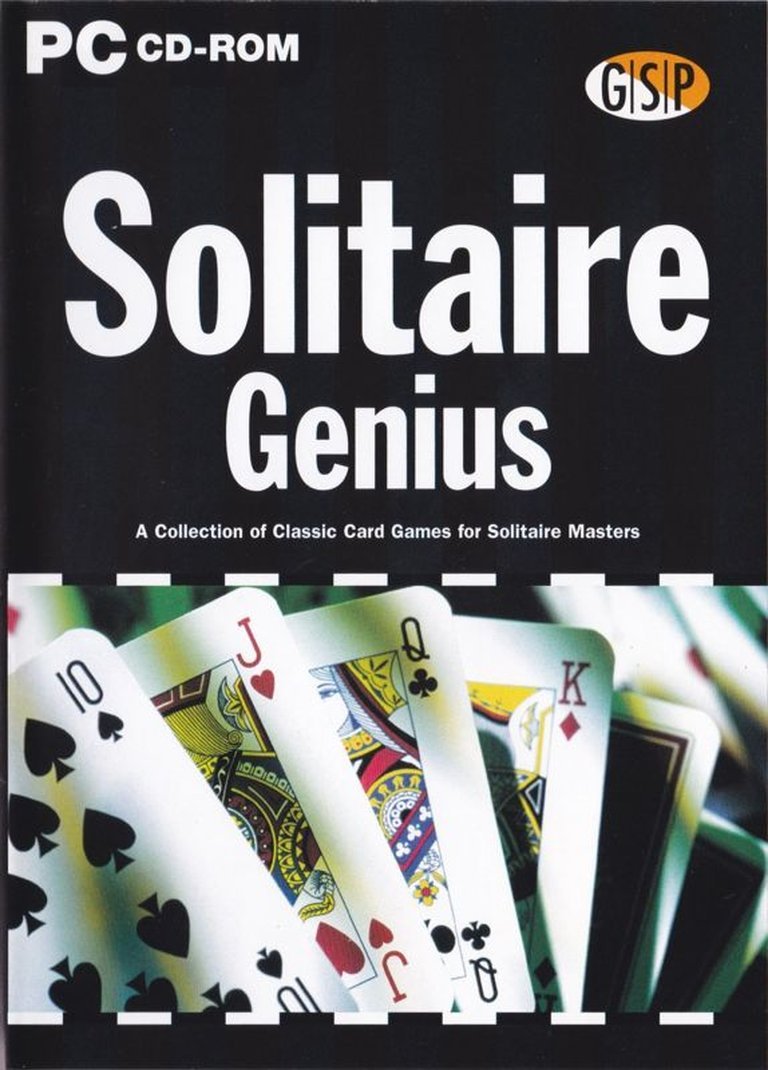
Solitaire Genius is a 2001 Windows game that compiles twenty solitaire card games, including classics like Spider, Forty Thieves, and Golf, developed by the team behind MVP Solitaire: Clubs Edition. Players can customize their experience with six background options and multiple card back designs, offering a diverse and engaging collection for puzzle and card game enthusiasts.
Solitaire Genius: A Quiet Footnote in the Digital Patience Canon
Introduction: The Solitude of a Million-Dollar Idea
In the vast, ever-expanding archipelago of video game history, few genres have achieved the ubiquitous, almost invisible dominance of digital Solitaire. It is the ambient hum of computing, the default mental respite for billions who may not even consider themselves gamers. Against this backdrop, Solitaire Genius (2001) emerges not as a revolutionary tide but as a single, carefully polished stone on an impossibly vast shore. Published by Global Software Publishing Ltd. and developed by the team behind MVP Software’s solitaire offerings, this Windows CD-ROM title represents a specific moment: the late-90s/early-2000s gold rush of “best of” compilations flooding retail shelves, cashing in on the foundational casual gaming boom ignited by Microsoft’s ubiquitous Klondike. This review will argue that Solitaire Genius is a paradox: a technically competent and artistically inoffensive collection that is ultimately rendered historically inert by its extreme conventionality and utter failure to distinguish itself in a genre defined by its own timeless, minimalist purity. Its legacy is not one of influence, but of perfect encapsulation of a low-stakes, pre-smartphone era of casual game publishing.
Development History & Context: The MVP Assembly Line
Solitaire Genius exists within a clear lineage, a fact its very description admits: it is “a collection of twenty card games from the people who developed MVP Solitaire: Clubs Edition” and “may be a rebranded re-release of their game MVP Solitaire: Deluxe Edition.” The core team, credited on MobyGames, was a small, prolific outfit: programmer Craig W. Kellogg, Jeff Guinness, and Jonah Warren; producer David C. Snyder; artist Mark Wilson; and composer David B. Schultz of DBS Music. Their résumé, as listed on MobyGames’ collaborative features, reveals a studio specializing in a narrow but commercially viable niche: card and board game compilations for the Windows CD-ROM market. Titles like MVP Spades Deluxe and The Real Deal 2 paint a picture of a developer operating with efficient, assembly-line precision, repurposing code, art assets, and sound drivers across multiple SKUs targeted at the burgeoning “casual” and “senior” demographics.
The technological context of 2001 is crucial. Windows 98/ME/2000/XP dominated. The “CD-ROM” media type specified on MobyGames is telling—this was an era of retail boxed software, often sold in drugstores and office supply aisles alongside Encyclopedia Britannica and Mavis Beacon Teaches Typing. The constraints were those of the 2D DirectDraw/Graphics Device Interface (GDI): fixed or flip-screen visuals, point-and-click interfaces, and a heavy reliance on pre-rendered card graphics and static backgrounds. There was no expectation of online connectivity, dynamicLeaderboards, or flashy 3D effects. The goal was functional, lightweight, and installable on a wide range of home PCs. In the gaming landscape, this placed Solitaire Genius squarely in the “budget compilation” stratum, a world away from the 3D accelerometer-driven buzz of Max Payne or Grand Theft Auto III. It catered to a vast, underserved audience for whom “gaming” meant a solvable, stress-free puzzle at the end of a workday.
Narrative & Thematic Deep Dive: The Anti-Story
To speak of “narrative” or “plot” in a solitary card game compilation is, by conventional definitions, absurd. Solitaire Genius possesses zero diegetic story, characters, or dialogue. Yet, its thematic core is profound in its simplicity and directly inherited from centuries of the Patience/Solitaire tradition. As the historical sources from Play-solitaire.com and VisualFoodie.com elucidate, the game’s essence is “solitary reflection,” a “form of personal… pastime” that can make “the stress of everyday life melt away.” Solitaire Genius fully embraces this meditative, almost ascetic purpose.
Its theme is not told but enacted: the quiet click of a mouse, the smooth animation of a card sliding to its foundation, the satisfying chime of a completed game (courtesy of David B. Schultz’s unobtrusive sound design). It is a game about order from chaos, about the solitary triumph of logic and pattern recognition over random chance. The choice of six backgrounds—likely serene, static images of wood grains, felt tables, or simple gradients—reinforces this. They are not worlds to explore but environments to tranquilize. The “Genius” in the title is not a protagonist but an aspirational state for the player: the calm, methodical intellect that can conquer Forty Thieves or Spider. In this light, Solitaire Genius is less a narrative experience and more a digital mindfulness tool, a centuries-old ritual digitized with zero pretension. Its lack of story is its greatest thematic strength, aligning perfectly with the game’s historical identity as “Patience.”
Gameplay Mechanics & Systems: Compendium Over Innovation
This is the meat of the product, and also the source of its most damning criticism: there is nothing to criticize because there is nothing new to critique. The game is a straight compilation of twenty classic solitaire variants, as meticulously listed on MobyGames: Accordion, Agnes, Auld Lang Syne, Baroness, Block Solitaire, Calculation, Cribbage Solitaire, Four Seasons, Forty Thieves, Gate, Golf, Monte Carlo, Nestor, Poker Solitaire, Quadrille, Simple Addition, Simplicity, Spider, and Take Fourteen.
The systems are those of the genre:
* Core Loop: Deal cards, move them according to strict ruleset-specific constraints to build up foundational piles (usually in suit and sequence).
* Progression: There is no character leveling or unlockable content (as one might find in modern mobile solitaire games). Progression is purely the player’s skill development in parsing and solving each individual layout’s puzzle.
* UI/UX: A “point and select” interface, standard for the era. The “Fixed / flip-screen” perspective means the tableau is static, with new cards dealt from the stock as needed. The innovation, such as it is, lies in the customization: a choice of six visual backgrounds and multiple card back designs. This is the game’s only meaningful player agency beyond the rules of each variant—a superficial layer of personalization that does not alter the fundamental mathematical challenge of any given deal.
* Innovation vs. Flaw: There is no innovative system here. The “flaw” is the absence of any feature that would elevate it beyond a basic digital card table. There is no hint system, no undo beyond a simple step-back (if even that), no statistics tracking beyond a basic win counter, and certainly no adaptive difficulty. It is a pure, unadulterated ruleset delivery system. For aficionados of obscure Patience games (Agnes or Quadrille are not household names), this compilation is a valuable reference. For the mass market that likely remembers only Klondike, Spider, and FreeCell, it is an intimidating, poorly-explained wall of options. The instruction manual (presumably included on the CD-ROM) would have been essential, but its absence from the digital record highlights the title’s disposable nature.
World-Building, Art & Sound: The Aesthetic of Nothingness
Solitaire Genius builds its world not with polygons or lore, but with the exquisite power of negative space and auditory minimalism. The “world” is the player’s desktop, metaphorically. The six backgrounds are the only “setting”—likely muted, photorealistic or semi-abstract renderings of a card table, a wood grain, a soft cloth. They are not immersive; they are inconspicuous. Their purpose is to fade into the periphery, to not distract from the central, meditative task. This is a masterclass in functional, low-fidelity UI art from Mark Wilson: clear, readable card graphics (presumably based on a standard French deck), clean placement, and zero ornamental fluff.
The sound design, by David B. Schultz, follows the same philosophy. The sounds are likely crisp, sampled audio: a solid thunk for a card drop, a soft shff for a deal, a cheerful but not-jarring melody for a win. There are no epic crescendos, no ominous tones for a stuck game. The audio palette reinforces the game’s identity as a tool for relaxation, not a thrilling experience. Together, the art and sound create an atmosphere of profound neutrality. It is the digital equivalent of a quiet room with sunlight streaming in, as described in Play-solitaire.com‘s poetic opening. This is not a world to get lost in; it is a psychological space to settle into. Its success in this regard is total, but also its ultimate limitation as an “experience”—it aspires to be nothing more than a very good, very quiet room.
Reception & Legacy: The Sound of One Hand Clapping
The critical and commercial reception of Solitaire Genius is best summarized by the haunting silence on its modern record. On MobyGames, it has a Moby Score of n/a and an average player rating of 4.0/5 based on a single vote (with zero written reviews). On Metacritic, both critic and user scores are listed as “tbd” with no reviews available. It has been collected by a mere 2 players on MobyGames’ tracking system. This is not a game that sparked debate, controversy, or acclaim. It is a ghost in the machine of gaming history.
Its legacy is threefold:
1. The Compilation Model: It is a perfect specimen of the early 2000s “greatest hits” model for casual games, a direct descendant of the Microsoft Entertainment Pack and Hoyle’s Official Book of Games. This model would later evolve into the mega-bundles of Steam and the subscription services of today.
2. Historical Obscurity: It represents the vast, watery mid-tier of PC gaming—the titles that sold enough at Walmart to be profitable but left no cultural fingerprint. It is the antithesis of the “Microsoft Solitaire” story, where a simple game became a global phenomenon through platform monopoly. Solitaire Genius had no such vehicle; it was one of dozens of indistinguishable competitors.
3. Preservation of Variants: In a small but meaningful way, its compilation of twenty variants, including more obscure ones like Baroness or Nestor, serves as a digital archive. For historians and enthusiasts tracing the phylogenetic tree of Patience games, titles like this are crucial data points, commercial proofs of the enduring appeal of these specific rule sets.
It had no discernible influence on the industry. It did not inspire clones, nor did it redefine the space. It was, in essence, a product, not a phenomenon. Its place in history is as a perfectly executed but utterly forgettable specimen of its time and place—a game that understood its genre’s requirements perfectly but failed to imagine a future for it.
Conclusion: The Genius of the Unremarkable
Solitaire Genius is a game that asks nothing of the world and, in turn, is asked nothing by it. It is a flawless execution of a simple, dated business plan: identify a popular casual genre, license or create a diverse set of classic variants, apply a thin coat of customizable UI, and press it to CD-ROM for the 2001 holiday season. From a journalist’s perspective, it is the definition of a “skip”—there is no scandal to uncover, no innovation to applaud, no failure to dissect. It is a silent, competent machine.
Its ultimate verdict in the canon of video game history is one of profound insignificance. It contributed nothing to the evolution of game design, narrative, or technology. It did not capture a moment or define a generation. It is the gaming equivalent of a well-made but unbranded towel—functional, present in countless homes, and instantly replaceable. The “Genius” of its title is not a claim of merit but a desperate marketing plea in a saturated aisle. In the grand, centuries-long story of Solitaire—from French nobles to German rulebooks, from Yukon prospectors to Windows desktops—Solitaire Genius is a single, unannotated paragraph on a discarded photocopy. It is a testament not to genius, but to the quiet, unremarkable, and deeply human work of building a simple, peaceful thing, and then letting it fade into the quiet hum of background software where it belongs.