
- Release Year: 1995
- Platforms: Macintosh, Windows 16-bit, Windows
- Publisher: Learning Company, Inc., The, SoftKey Multimedia Inc.
- Developer: MECC
- Genre: Educational, Simulation
- Perspective: 1st-person, Top-down
- Game Mode: Single-player
- Gameplay: Arcade sequences, Business simulation, Events, Fishing, Hunting, Managerial, Problem solving, Resource Management, Sailing, Trading
- Setting: Western
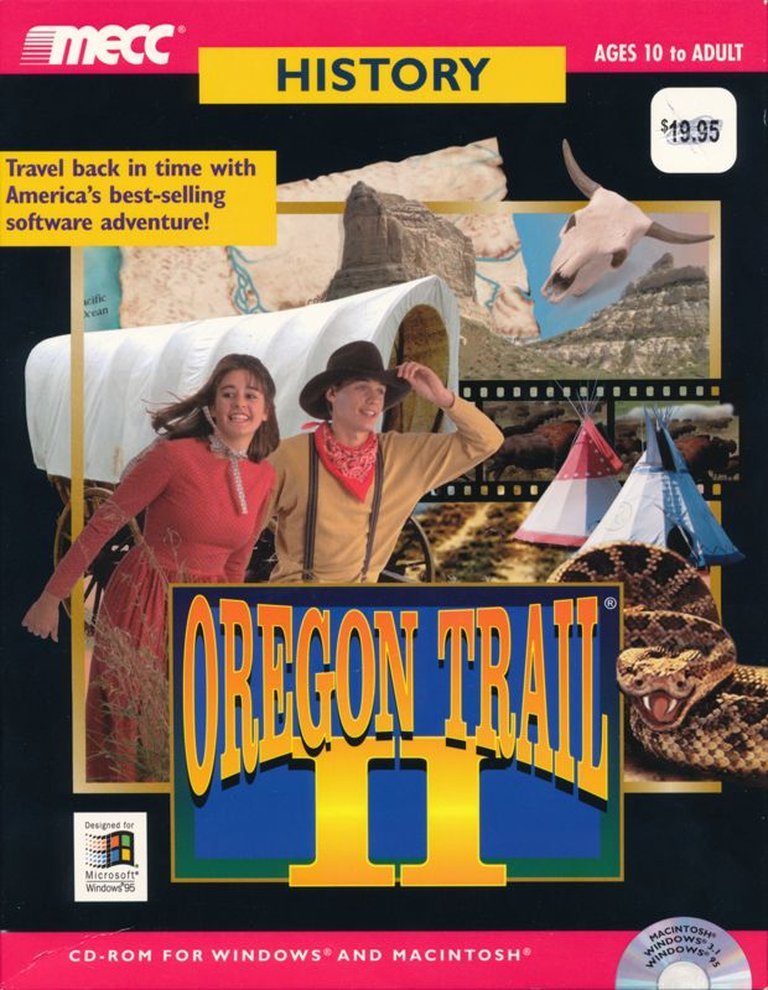
Description
Oregon Trail II is a sequel to the classic educational game, simulating a perilous wagon journey along the historic Oregon Trail from 1840 to 1860 in the American Old West. Players customize their leader’s occupation, companions, and supplies while navigating realistic challenges like hunting, trading, disease, and random events, with enhanced management mechanics and educational content on history, geography, and ecology.
Gameplay Videos
Where to Buy Oregon Trail II
PC
Oregon Trail II Free Download
Oregon Trail II Cheats & Codes
PC
| Code | Effect |
|---|---|
| more money | Receives $400 |
Oregon Trail II: A Landmark of Educational Gaming, Warts and All
Introduction: The Riverbank of Memory
To a generation of American students in the 1990s, the phrase “You have died of dysentery” is not merely a video game quote; it is a cultural shrug, a shared rite of passage. At the heart of that collective memory sits Oregon Trail II (1995), the ambitious and deeply flawed sequel that sought to transform a beloved educational staple into a richer, more immersive simulation of westward expansion. Its legacy is a paradox: a game that is both a pioneering feat in interactive history and a product of its time’s unexamined assumptions. This review argues that Oregon Trail II represents the zenith and the precipice of the classic “edutainment” era. It is a masterclass in systemic gameplay design that marries resource management to narrative consequence, yet it remains fundamentally tethered to a 19th-century manifest destiny narrative it only half-heartedly interrogates. To play Oregon Trail II is to witness the maturation of an educational form, complete with its brilliant innovations and its troubling blind spots.
Development History & Context: From Text to CD-ROM
Oregon Trail II was developed by the Minnesota Educational Computing Consortium (MECC), the non-profit powerhouse behind the original 1971 text-based game and its iconic 1985 Apple II remake. By the early 1990s, MECC was a titan in educational software, and Oregon Trail was its flagship. The development of the sequel, led by Project Director and Historian Wayne Studer (holding a PhD in American Studies), was a deliberate response to both technological opportunity and pedagogical critique. The shift from floppy disk to CD-ROM was not just a storage upgrade; it was a philosophical leap. As noted in its sources, the game leveraged “high-resolution VGA graphics, featuring over 5,000 realistic images” and digitized sound to create an unprecedented sensory experience of the trail. This was a game meant to be seen and heard, moving beyond the original’s text parser and static illustrations.
Studer’s involvement was crucial. He championed “greater historical accuracy and educational depth,” consulting over 200 primary and secondary sources, from pioneer diaries to maps from the Oregon-California Trails Association. His goal was to move beyond a simplistic “survival” mechanic into a nuanced simulation where decisions had cascading historical weight. This era (1993-1995) was the peak of the “multimedia revolution” in schools, where CD-ROMs promised encyclopedic knowledge. Oregon Trail II was MECC’s flagship attempt to fulfill that promise with a coherent, game-based narrative. It was released in February 1995 by SoftKey Multimedia (which acquired MECC later that year for $370 million), a company known for aggressively marketing edutainment to both schools and homes, ensuring the game’s massive distribution.
Narrative & Thematic Deep Dive: The Settler’s Gaze, Slightly Corrected
The core narrative of Oregon Trail II is one of agency within a predetermined story: the player is a white American settler seeking a better life in the Willamette Valley. The game’s structure inherently celebrates the act of westward migration itself. However, in a notable, if incomplete, step forward from its predecessors, the sequel made “an effort to include greater roles for women and racial minorities,” as Wikipedia states. This is primarily executed through the occupation and character creation system.
- Expanded Occupations & Gender: The player can choose from a list including “journalist, butcher, pastor, artist,” and others, breaking from the solely agrarian or merchant roles of the original. Critically, these occupations are not gendered; a player can select “pastor” or “doctor” for a female protagonist, a subtle but significant normalization of women’s diverse historical roles (though still within a settler-colonial framework). The player can also create a full party of up to five members, assigning names, ages, and occupations to all, allowing for diverse family and group dynamics.
- Racial Minorities as Playable? Here, the progress is minimal and largely superficial. While the game’s credits and marketing touted inclusivity, the playable protagonist options, as gleaned from the detailed MobyGames and Wikipedia descriptions, remain within the spectrum of common 19th-century Euro-American settler professions (banker, carpenter, gunsmith, etc.). There is no indication of playable Native American, Black, or Chinese characters with unique narratives or mechanics. Their presence is relegated to the role of non-player characters encountered along the trail—trading partners, guides, or potential obstacles—reflecting a “settler” perspective where Indigenous peoples are part of the landscape to be interacted with, not co-protagonists.
- The Uncritiqued Premise: As the BBC’s retrospective starkly notes, the game presents westward expansion as an “adventure, not an invasion.” The ultimate goal—claiming a plot of land in Oregon—is framed as a prosperity metric (“fortune calculation”), directly tying success to the acquisition of Indigenous territory. The thematic undercurrent of ecological impact is hinted at in “educational” categories like “Ecology / nature,” but the core gameplay loop incentivizes resource extraction (hunting, farming) without systemic consequence. The “hidden controversy,” as the BBC headlines it, is that the game’s mechanics make players complicit in a narrative of dispossession while rarely prompting moral reckoning with it. The most progressive element is occasional dialogue from encountered characters that might “include moments of critique,” but this is passive, not systemic.
Gameplay Mechanics & Systems: A Symphony of Stress
Where Oregon Trail II truly shines is in its dense, interconnected, and often brutally logical gameplay systems. It transforms the original’s simple resource gauge into a complex web of cause and effect.
1. The Creation Engine: Occupation & Skills
This is the game’s most profound innovation. After naming your character, you select an occupation (e.g., banker, doctor, teacher). Each comes with:
* Starting Capital: A banker starts with $2,000; a teacher with $500.
* Automatic Skills: Occupations grant free ranks in relevant passive skills (e.g., a doctor gets high “Medical” skill).
* 120-Point Skill Budget: You spend points on skills like Sharpshooting (for instant-kill hunting), Botany (identifying edible plants—later removed in Trail 5), Repair (for wagon breakdowns), and Scouting (avoiding hazards). Unspent points add to your final score. This system makes party composition a deep strategic exercise, where a “weak” low-income profession like teacher might become powerful with skilled point allocation and their high end-game score multiplier.
2. The Logistics Simulator: Supply & Weight
Supply management is no longer a bulk number but a granular inventory system. As the player review notes, “clothing and food… are now separated into types.” You buy shoes separately from coats; food is split into meat, vegetables, and flour. The wagon has a strict 1,000-pound weight limit. Overpacking halts progress, forcing agonizing decisions. This creates a constant tension between preparedness (extra tools, medicine) and mobility. The review astutely points out a quirk: “you don’t have to buy pots, pans or eating utensils to cook and eat your food–I guess you just eat with your fingers,” highlighting a gap between simulated realism and logistical abstraction.
3. The Journey: Time, Terrain, and Choice
The timeline expansion from a fixed 1848 to 1840-1860 is monumental. Later years offer more forts and towns, easing supply pressure but altering historical context (e.g., post-1848 Gold Rush traffic). The overworld map is a fixed/flip-screen journey between iconic landmarks (Chimney Rock, Fort Laramie). Each day, you set your pace (Leisurely to Grueling) and rations (Generous to Meager), which directly impact health, fatigue, and food consumption. Weather and terrain modify daily mileage, creating a palpable sense of seasonal struggle.
4. Interactive Events & Minigames
True to the “adventure-like gameplay” promise, the game halts for branching narrative events. These are not random pop-ups but contextual scenes: a broken axle requiring repair skills or spare parts; a sick party member needing diagnosis and treatment (where your Guidebook and Medical skill are vital); encounters with strangers or other wagon trains offering trade or advice. The hunting minigame is significantly improved: animals graze and wander before you shoot, and they usually flee after a shot (though the player review correctly notes inconsistency: “Some animals don’t run”). The Columbia River rafting finale is a notorious, real-time obstacle course of navigating rapids—a stark difficulty spike that ends many journeys.
5. The Scoring Paradox
A brilliant, punitive design touch: high-risk, low-income professions like Teacher have a massive end-game score multiplier (e.g., 5x). However, you only earn this multiplier if you reach your originally selected destination. This creates a powerful incentive for risky, efficient play and makes “settling” elsewhere a failure, embedding the game’s manifest destiny goal into its mathematical core.
World-Building, Art & Sound: The Look and Feel of a bygone Era
Oregon Trail II is a time capsule of mid-90s CD-ROM presentation. Its visuals are a vast leap: static screens are replaced with digitized photographs and painted backdrops of forts, rivers, and plains. Characters are depicted with live-action stills of people in period costumes, a common edutainment trope that lends a documentary air but can feel stiff. The interface is a point-and-click dashboard, functional but dated even then.
The sound design is a standout. It features “46 original tunes” in a “film-like soundtrack” by composer Eric Speier, setting an earnest, adventurous tone. Digitized voice clips for events and character dialogue were impressive for the era, though the player review’s critique of “voice acting made me cringe” is fair; delivery is often flat and repetitive. The iconic, jarring “Bad Thing Happened” sound effect remains a psychological trigger for a generation.
The world-building succeeds in atmospheric authenticity through its attention to historical landmarks and seasonal cycles. Yet, this authenticity is carefully curated. The “Western” setting is a sanitized, pioneer-centric landscape. Native American presence is environmental (a tipi on a horizon) or transactional (a character to trade with), never central to the story of the land itself. The game creates a compelling simulation of settler life, not the full history of the region.
Reception & Legacy: From Classroom to Meme
Critical & Commercial Reception:
Upon release, Oregon Trail II was a critical and commercial success. Critics praised its depth and replayability. Electronic Games (83%) highlighted its “lots more player choices” and “deeper” data banks. All Game Guide (80%) noted it gives “a real sense of accomplishment.” It was a CODiE Award winner and a staple of school computer labs, riding MECC’s massive distribution network. Commercially, it was a cash cow, with the Oregon Trail series accounting for one-third of MECC’s $30 million annual revenue by 1995.
Evolving Reputation & Cultural Impact:
Its legacy is dualistic:
1. The Progenitor of Mechanics: As the BBC and Artur Plociennik note, it cemented core gaming conventions: permanent character death, inventory management as strategy, named party members, and random encounters on a strategic map. These became bedrock for CRPGs and survival games like Fallout and, as Tore Olsson argues, the “this generation’s Oregon Trail“: Red Dead Redemption II.
2. The Meme and the Nostalgia Artifact: “You have died of dysentery” transcended the game to become a universal punchline about random misfortune. It is a key shibboleth of the “Oregon Trail Generation,” referenced in novels and now destined for a live-action movie, per the BBC’s 2024 report. For many, it represents a simpler, more earnest time in both computing and education.
3. The Critical Reckoning: Modern analysis, particularly from Indigenous scholars like Margaret Huettl, is damning. The game is cited as a primary example of “an uncritical celebration of eastern white settlers.” Its mechanics make “winning” synonymous with land acquisition, perpetuating myths of empty wilderness and benevolent migration. While later versions (notably the 2021 remake) worked with Native consultants to add playable Indigenous stories and critique, Oregon Trail II sits firmly in the era where such perspectives were an afterthought, if present at all.
Technical Quirks & Preservation:
As the MyAbandonware comments reveal, the game is notoriously finicky on modern systems, requiring cd-rom mounts, compatibility settings, and patience. This fragility has cemented its status as a preservation priority within the retro gaming community, with ISOs and installation guides widely shared to keep the experience alive.
Conclusion: A Flawed keystone
Oregon Trail II is an indispensable artifact in video game history. It represents the apex of the “edutainment” genre’s ambition—a serious attempt to use game systems to teach complex historical themes of risk, resource management, and decision-making under duress. Its occupation and skill systems remain impressively deep, and its atmosphere of solemn struggle is powerfully evoked.
Yet, its historical vision is inherently limited. It asks players to empathize with the settler’s logistical plight while remaining willfully ignorant of the settler’s political and moral one. The game simulates the experience of the trail with remarkable detail but cannot, or will not, simulate its consequences for the peoples already living there. This is not a bug but a feature of its design DNA, inherited from the 1971 original and only superficially updated.
Therefore, its place in history is dual: it is both a landmark of systemic game design that influenced countless genres and a historical document of 1990s educational consensus—well-meaning, expansive in some directions, and strikingly blind in others. To play it today is to engage in a dual exercise: navigating the Green River with a fragile wagon and navigating the ethical assumptions of a bygone era. Its genius and its failing are two sides of the same coin—a coin stamped with the image of a covered wagon, forever headed west, with the map’s empty spaces conveniently left uncharted.
Final Verdict: 8/10 — A brilliant, deeply problematic, and historically essential simulation. Play it to understand the roots of survival gaming and the evolution of educational design; study it to understand the narratives of American expansion we have only just begun to question.