
- Release Year: 2003
- Platforms: GameCube, PlayStation 2, Windows, Xbox
- Publisher: Fox Interactive, Inc., Sierra Entertainment, Inc., Vivendi Universal Games, Inc.
- Developer: Radical Entertainment Inc.
- Genre: Action, Driving, Racing
- Perspective: 1st-person Behind view
- Game Mode: Single-player
- Gameplay: Collecting, Destructible Environments, Driving, Exploration, Open World, Platforming, Racing, Sandbox, Timed missions
- Setting: North America
- Average Score: 77/100
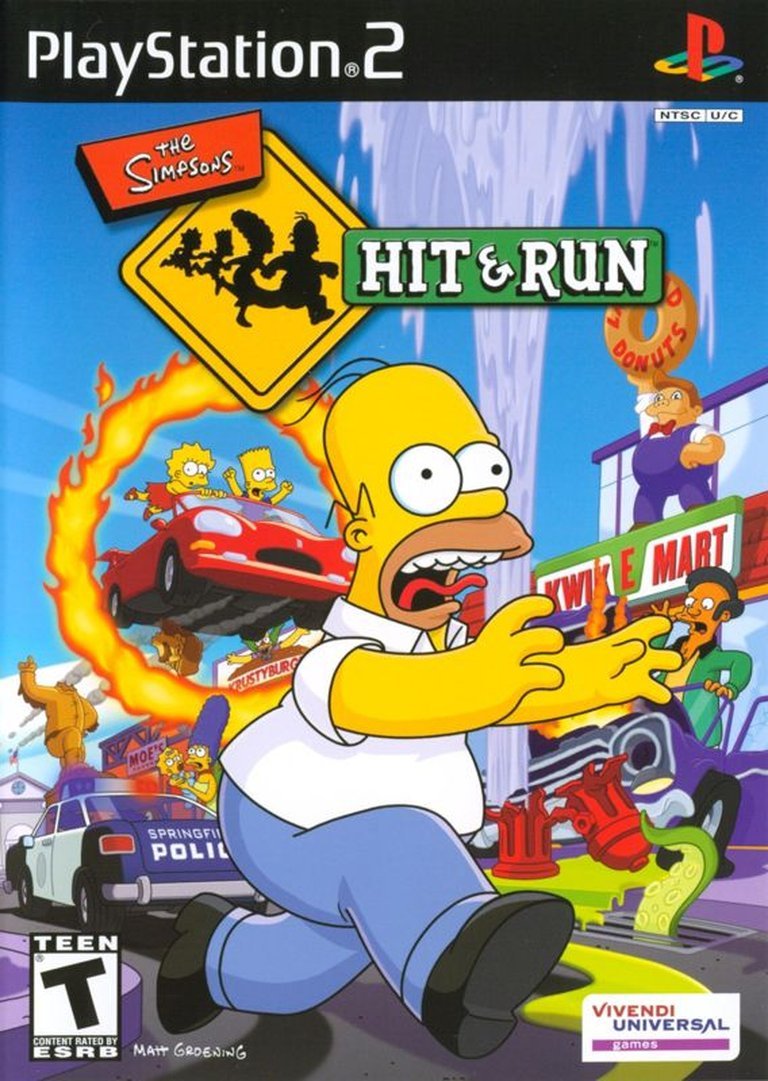
Description
The Simpsons: Hit & Run is an open-world action-racing game set in a 3D re-creation of Springfield, where players control characters like Homer, Marge, Bart, Lisa, or Apu to investigate a conspiracy involving mechanical bees, mysterious vans, and mind-controlling cola through over 50 mission-based driving and exploration challenges, all voiced by the original TV cast.
Gameplay Videos
The Simpsons: Hit & Run Free Download
The Simpsons: Hit & Run Mods
The Simpsons: Hit & Run Reviews & Reception
metacritic.com (78/100): Hit & Run may have swiped nearly all of its gameplay ideas from “GTA,” but the combination of the vast Simpsons universe liberally applied to the “GTA” formula is pure brilliance.
mobygames.com (76/100): Only if you are a Simpson’s fanatic would this game ever be worth a purchase.
The Simpsons: Hit & Run Cheats & Codes
The Simpsons: Hit & Run PC Version
Hold F1 while in the top level of the Settings menu and enter the code using the arrow keys.
| Code | Effect |
|---|---|
| Up, Up, Up, Up | All cards; after 100% completion |
| Left, Right, Left, Right | All character costumes; after 100% completion |
| Up, Down, Up, Down | All vehicles after 100% completion |
| Down, Down, Down, Up | Alternate camera angles |
| Right, Right, Right, Right | Higher acceleration |
| Right, Up, Right, Up | Invincibility for car |
| Left, Left, Left, Left | No top speed |
| Right, Right, Left, Left | One hit traffic death |
| Left, Left, Left, Right | Press (Horn) to jump while in car |
| Down, Down, Right, Left | Red brick car |
| Down, Up, Down, Right | Show rendering tree |
| Right, Right, Down, Left | Speedometer |
| Up, Left, Left, Right | View credits |
The Simpsons: Hit & Run GameCube Version
Hold L + R in the top level of the Settings menu and enter the code using the face buttons.
| Code | Effect |
|---|---|
| A, B, A, B | All Reward Cars |
| X, X, X, X | Fast Cars |
| Y, A, Y, A | Invincible Car |
| Y, Y, Y, Y | High Acceleration |
| X, X, X, Y | Jump Car with Horn |
| Y, Y, X, X | One Hit Kills |
| B, B, B, A | All Cameras |
| A, X, X, Y | Show Credits |
| Y, Y, B, X | Show Speedometer |
| B, B, Y, X | Turn Secret Car into Red Brick Car |
| B, A, B, Y | Grid Mode |
| Y, B, Y, B | Trippy Mode |
The Simpsons: Hit & Run Xbox Version
Hold L + R in the top level of the Settings menu and enter the code using the face buttons.
| Code | Effect |
|---|---|
| A, B, A, B | All Reward Cars |
| X, X, X, X | Fast Cars |
| Y, A, Y, A | Invincible Car |
| Y, Y, Y, Y | High Acceleration |
| X, X, X, Y | Jump Car with Horn |
| Y, Y, X, X | One Hit Kills |
| B, B, B, A | All Cameras |
| A, X, X, Y | Show Credits |
| Y, Y, B, X | Show Speedometer |
| B, B, Y, X | Turn Secret Car into Red Brick Car |
| B, A, B, Y | Grid Mode |
| Y, B, Y, B | Trippy Mode |
The Simpsons: Hit & Run: A Flawed Masterpiece of Licensed Gaming
Introduction: The GTA Clone That Finally Did Justice to Springfield
For over a decade, The Simpsons video game legacy was a graveyard of wasted potential—from the competent but shallow arcade beat-’em-up to the disastrous Road Rage and Skateboarding. Then, in 2003, Radical Entertainment delivered The Simpsons: Hit & Run, a game that didn’t just cash in on a license but genuinely aimed to translate the spirit of Springfield into an interactive medium. Its thesis was audacious: take the then-dominant Grand Theft Auto III open-world template and graft onto it the specific, referential humor and dense world-building of Matt Groening’s creation. The result is a landmark in licensed game development—a title that remains the high watermark for Simpsons games precisely because it so visibly stumbles in its ambition. It is a game of profound contradictions: a scathing parody of GTA that is also its most faithful disciple; a narrative-driven experience that undercuts its own story with repetitive gameplay; a visual feast that eschews the art style that would have made it timeless. To understand Hit & Run is to understand both the peak of what licensed games could achieve in the early 2000s and the fundamental design compromises that came with that approach.
Development History & Context: “GTA for Kids” in a RAM-Constrained World
The genesis of Hit & Run lies in the post-GTA III landscape, where open-world design became the holy grail for publishers seeking the next blockbuster. Radical Entertainment, having just shipped the Crazy Taxi-esque The Simpsons: Road Rage (2001), recognized the driving component was its strongest element but understood the franchise needed more. As lead designer Joe McGinn stated, the game was explicitly pitched as “GTA for kids”—a family-friendly, non-violent take on the revolutionary formula that had defined the era. This philosophical pivot meant replacing GTA‘s guns and gangsters with platforming, slapstick, and pies.
The development cycle was extensive for a licensed title, with a team of roughly 60 people working for about two years. The technical constraints were significant. Porting to the Nintendo GameCube, with its 24MB of RAM, required “tricks such as loading animations into audio memory,” highlighting the resource juggling needed to build a sprawling 3D Springfield on four simultaneous platforms (PS2, Xbox, GameCube, Windows). A scrapped PlayStation Portable (PSP) port reportedly failed due to increased voice actor fees after contract renegotiations—a detail underscoring the high cost of authenticity.
Authenticity was the non-negotiable cornerstone. Radical secured full collaboration from Gracie Films, 20th Century Fox, and Matt Groening himself. The show’s writers—Matt Selman, Tim Long, Matt Warburton—crafted the entire story and dialogue, resulting in 12,231 recorded lines, with Yeardley Smith (Lisa) performing more dialogue than in a full TV season. The original voice cast participated fully, a rarity then and now. This commitment to source material fidelity was both a blessing and a curse; it granted the game unparalleled tonal accuracy but also tethered gameplay to a structure ill-suited to the Simpsons’ chaotic, character-driven humor.
Narrative & Thematic Deep Dive: A Conspiracy of Rehashed Plots
The plot is a classic Simpsons-esque paranoia crescendo: alien surveillance (wasp cameras), corporate mind control (Buzz Cola), and mysterious black vans converge over a Halloween week. Players cyclically control Homer, Bart (twice), Lisa, Marge, and Apu to unravel the conspiracy, culminating in the reveal that Kang and Kodos are filming Springfield for their failing intergalactic reality show, Foolish Earthlings. The finale involves a zombie apocalypse (courtesy of cola-tainted water) and a toxic-waste-laden showdown at the nuclear plant.
On paper, it’s a conceptually sound, if nonsensical, Simpsons plot. In execution, it becomes a narrative straitjacket. The story is told through often-static “talking heads” cutscenes that feel like truncated TV episode snippets. The central failure is the complete dissonance between plot progression and mission design. As a critic astutely noted, the formula devolves into: “I need to save Springfield!” – “Okay, but first help me find 22 fish under 2:35 minutes!” The conspiracy is a backdrop for a relentless parade of unrelated errands. Collecting monkeys, racing delivery drivers, and destroying soda trucks have no logical connection to stopping aliens. This undermines the narrative’s stakes; the player never feels like a detective, but a highly distracted errand boy.
Thematically, the game attempts to mirror the show’s satire of consumerism (Buzz Cola), media (Krusty’s lasciviousness, the alien reality show), and paranoia. However, the writing lacks the show’s signature warmth and layered satire. It relies excessively on one-liners and character catchphrases (“D’oh!”, “Excellent,” “Stupid sexy Flanders”) without the contextual humor that makes them land. The plot is a sequence of wacky incidents rather than a cohesive, meaningful arc. It’s not bad Simpsons writing—it’s Road Runner cartoon logic applied to an episodic TV structure—but it fails to capture the essence of what made the golden age episodes resonate: heartfelt (if dysfunctional) family dynamics wrapped in absurdity. Here, the family is merely a set of avatars for five distinct gameplay types, with minimal interplay.
Gameplay Mechanics & Systems: The Repetitive Heart of the GTA Clone
Hit & Run‘s coreloop is a direct transposition of GTA III‘s structure—drive to a marker, complete a timed objective, watch a cutscene—with two key alterations: no firearms and mandatory on-foot platforming sections. This decision defines the entire experience. Vehicles are the star; you can hijack any civilian car or summon owned vehicles from payphones. The driving physics are arcade-y and fun, with exaggerated stunts and a satisfying sense of mass. The “Hit & Run” wanted meter (a circular gauge that fills when you cause mayhem) triggers police chases, though the police AI is notoriously simplistic.
The fatal flaw is the astonishing uniformity of mission types. A study of critic and player reviews reveals a consensus: virtually every mission falls into one of three templates:
1. Race: Beat a rival vehicle to a destination.
2. Timed Delivery/Collection: Transport an item or collect objects (monkeys, fish, cola cans, etc.) before the clock expires.
3. Vehicle Destruction: Ram or catch a specific car.
There is almost no narrative variation or mechanical evolution. The game introduces new constraints (must use a specific slow car, must collect 30 elusive items in 90 seconds), but the core verbs remain identical for 50+ missions. This repetition is the game’s Achilles’ heel. Where GTA III blended driving with shooting, stealth, and diverse story missions, Hit & Run offers only driving with a timer. The sporadic on-foot sections (kicking objects, jumping gaps) are clumsy, hampered by a notoriously problematic camera that frequently gets stuck or provides poor depth perception, making precision platforming a chore rather than a diversion.
The game is paradoxically forgiving yet punishing. You can instantly restart any mission or even skip it after repeated failures—a QoL feature ahead of its time. However, failure often means losing a significant portion of your coins (currency), and replenishing them via boring, repetitive side activities can be tedious. The progression system is thin: coins buy cosmetic outfits and a few vehicles, most of which are useless for race missions. The only meaningful collectibles are 49 trading cards (unlocking a slot-car mini-game) and wasp cameras (which yield only money). The reward loop is disconnected from the core gameplay’s monotony.
Despite this, the sandbox exploration remains the game’s saving grace. The sheer joy of tooling around a fully realized, dense Springfield—visiting the Nuclear Plant, Kwik-E-Mart, Moe’s, the Android’s Dungeon—and encountering hundreds of NPCs with unique, show-accurate dialogue (which, yes, repeats a lot) creates a potent fan-service dopamine hit. It’s a “collect-a-thon” paradise for completists, but the primary path to completion is a grind.
World-Building, Art & Sound: Springfield, Brought to (Basic) Life
Hit & Run’s undisputed masterpiece is its recreation of Springfield. Divided into four districts (Springfield, Shelbyville, The Waterfront, and The Park), the map is a love letter to fans. Every iconic location is present: the Escalator to Nowhere, the Stonecutters’ tunnel, the monorail (which you can drive), Krustylu Studios, Duff Brewery (with a giant Duff blimp), Camp Krusty. The world is densely packed with traffic, pedestrians, and easter eggs—from Itchy & Scratchy billboards to the “Steamed Hams” restaurant. This environmental storytelling is unparalleled for its time in a licensed game.
Visually, the game employs standard polygonal 3D models with basic textures. The character models, while recognizable, suffer from a “uncanny valley” of cartoonishness—they lack the expressive, 2D squash-and-stretch of the show. Many critics and fans argue that a cel-shaded art style would have been the perfect solution, preserving the 2D aesthetic in 3D space (later seen successfully in The Simpsons Game and Naruto titles). Instead, the graphics are merely competent for 2003, with occasional frame-rate dips, pop-in, and muddy textures. The static cutscenes, using in-game models, are particularly stiff compared to the pre-rendered FMVs of the era.
Where the audio soars is in voice acting and music. The entire main cast returned, delivering thousands of lines with impeccable timing. The writing, while uneven, captures the cadence of the show. The soundtrack, composed by Marc Baril, Jeff Tymoschuk, and Allan Levy, is a highlight—featuring clever, genre-specific motifs for each character (Bart gets hard rock, Lisa gets surf-rock) and brilliant homages to Danny Elfman’s iconic theme. The sound design is crunchy and cartoony; car crashes sound like animated anvils, and pedestrian collisions elicit perfect, silly grunts. It is, sonically, the most authentic Simpsons product ever made.
Reception & Legacy: The Best of a Bad Lot, But Still Flawed
Upon release, Hit & Run was met with generally favorable reviews, with Metacritic scores in the high 70s/low 80s across platforms. Critics universally praised its unprecedented fidelity to the source material and its successful, affectionate parody of GTA. GameSpot called it “the first Simpsons game to really capture the sharp humor,” while IGN hailed it as “pure brilliance” for combining the two icons. The fan reception was similarly warm, with many declaring it the best Simpsons game by a country mile, a title it still holds.
However, the criticisms were just as consistent: repetitive mission design, camera issues, minor bugs, and a lack of depth compared to its GTA muse. The player reviews on MobyGames reveal a stark divide: some revel in the exploration and jokes, others find the gameplay “boring” and “mind-numbingly repetitive.” The game’s commercial success was significant, selling over 3 million copies worldwide and earning “Greatest Hits/Platinum Hits” status. It won the 2004 Nickelodeon Kids’ Choice Award for Favorite Video Game.
Its legacy is complex:
1. The Pinnacle of Licensed Games (of its era): It proved that a licensed game could be made with genuine care for the IP, involving the original creators and respecting the audience’s intelligence. It raised the bar for what a cartoon adaptation could be.
2. A Cautionary Tale on Gameplay First: It demonstrated that even with a beloved world and authentic humor, core gameplay cannot be an afterthought. Its reliance on a single, repetitive mission template remains its greatest sin and a lesson for future developers.
3. A Cult Classic with a Modding Future: The 2021 source code leak ignited a passionate modding community. Projects like the “Fully Connected Map Mod” (stitching all zones into one seamless Springfield) and the breathtaking “Futurama: Hit & Run” total conversion mod prove the underlying engine and world design have lasting potential. Its speedrunning scene is also famously deep and optimized.
4. The Ghost of a Sequel: Radical Entertainment immediately began work on a sequel, but Vivendi Universal declined to re-up the license. Lead designer Joe McGinn has revealed plans for multiple sequels were scrapped by an unknown executive, a decision mourned by fans. The franchise later took a different, more stylized (and also divisive) path with The Simpsons Game (2007).
Conclusion: A Brilliantly Flawed Artifact of Its Time
The Simpsons: Hit & Run is not a great Grand Theft Auto clone, nor is it a flawless Simpsons simulation. It is, instead, a brilliantly flawed artifact—a game whose overwhelming strengths in atmosphere, presentation, and fan service are perpetually at war with its unimaginative, repetitive gameplay core. It captures the feeling of Springfield better than any media before or since, making you feel like you’ve stepped into an episode. Yet, the activities you do within that world feel like a degraded version of the template it apes.
Its place in history is secure as the definitive Simpsons game of the 3D era and a watershed moment for licensed game development. It showed that collaboration with original creators and deep respect for the source material could yield something authentic and beloved. However, its mission design serves as a timeless case study: no amount of polish, voice acting, or environmental detail can compensate for a fundamental lack of gameplay variety and thoughtful design. It is the game you play for the drive through Springfield, not for the destination. For that reason, it remains a frustrating, joyful, and ultimately essential piece of gaming history—a testament to what can be achieved when passion meets compromise, and a reminder that even the best licenses need great games to match.