
- Release Year: 2004
- Platforms: Windows
- Publisher: 1C Company, NovaLogic, Inc., Snowball.ru
- Developer: NovaLogic, Inc.
- Genre: Action
- Perspective: First-person, Third-person
- Game Mode: LAN, Online PVP
- Gameplay: Class-based, Objective-based, Shooter, Team-based, Vehicle combat
- Setting: Modern warfare
- Average Score: 88/100
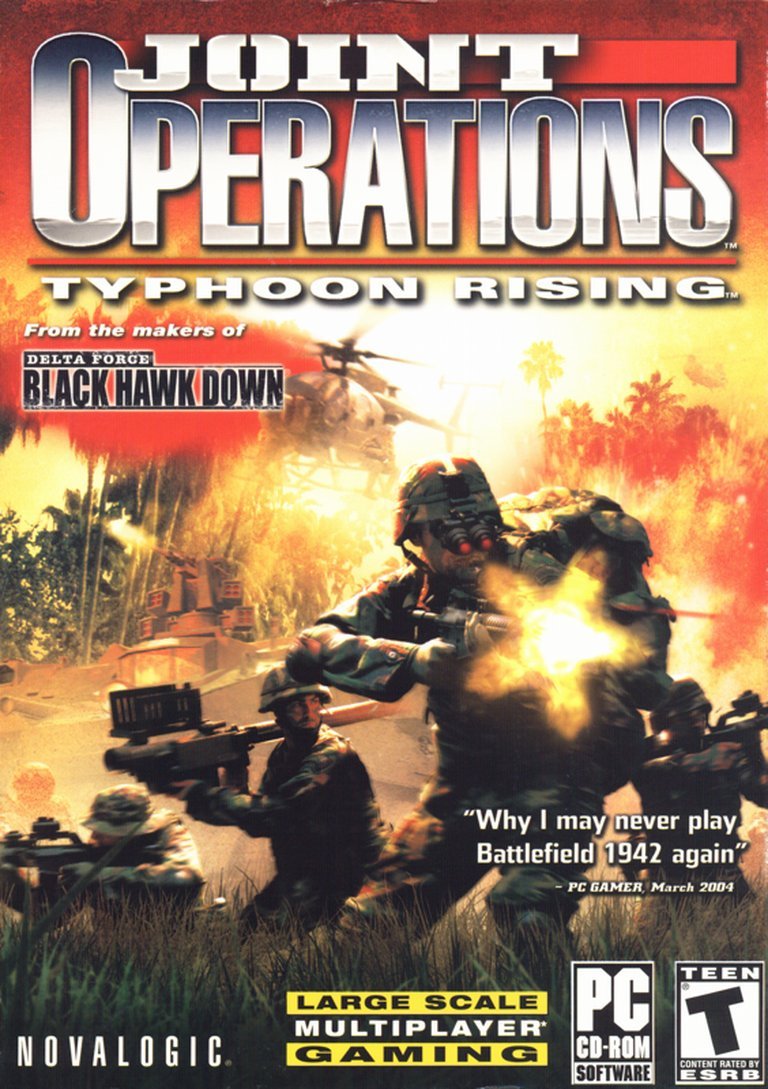
Description
Joint Operations: Typhoon Rising is a multiplayer-centric modern warfare game featuring large-scale tactical battles with up to 150 players per side. Set in contemporary conflict scenarios, players engage in team-based combat across diverse environments, choosing from classes like medic, engineer, soldier, gunner, and sniper, and utilizing 35 weapons and 29 vehicles such as helicopters and APCs, with success heavily reliant on coordination and cooperative strategy.
Gameplay Videos
Joint Operations: Typhoon Rising Free Download
Joint Operations: Typhoon Rising Patches & Updates
Joint Operations: Typhoon Rising Mods
Joint Operations: Typhoon Rising Reviews & Reception
metacritic.com (85/100): What it does have, though, is rock-solid netcode and the most exquisite balancing and map design I’ve ever seen.
metacritic.com (87/100): It is much more suited towards the serious cyber solider rather than the ex-quake junky with its heavy dependency on tactics and planned strategies, and whilst it is far from perfect itself, the detail and depth offered in Joint Operations is quite exceptional to say the least.
metacritic.com (73/100): When it works it works well and offers a very challenging online experience. The fun is hampered by both horrendous load times and the fact that you need a high-end system to coax performance from the engine. There are also some issues with unbalanced units, rampant camping, and the lack of any “functional” vehicles other than transportation.
metacritic.com (90/100): I was completely addicted. It can totally compete with Battlefield, Call of Duty and old Medal of Honor multiplayer.
metacritic.com (80/100): Graphics and sound are great, multiplayer is fun and the single-player is much better than then the one of its many competitors. Great military shooter!
metacritic.com (100/100): It is by far the best FPS out there. The things you can do with this game is awesome, Moding is easy, Map building easy.
metacritic.com (100/100): It still out plays all the latest/modern games. With the ability to make custom maps, and the amount of people you can fill a server with(150+) it is still a great game.
ign.com (76/100): The missions are dangerous, the threat is real.
Joint Operations: Typhoon Rising Cheats & Codes
PC
Enter ‘i am the man’ as your name.
| Code | Effect |
|---|---|
| i am the man | Get all of the guns at once |
Joint Operations: Typhoon Rising: The 150-Player War That Redefined Multiplayer Scale
Introduction: The Thunder of a Hundred Fifty Guns
In the early 2000s, the first-person shooter genre was experiencing a tectonic shift. The single-player, scripted campaign was being challenged by the burgeoning potential of online multiplayer. While Battlefield 1942 had already demonstrated the exhilarating chaos of large-scale combined arms warfare, a smaller studio with a storied history in tactical shooters, NovaLogic, aimed to take the formula to an audacious new extreme. Joint Operations: Typhoon Rising was not merely another military shooter; it was a deliberate, focused attempt to create the ultimate massive-scale online warfare experience. Its central, defining promise—support for up to 150 players on a single server—was a staggering technical feat for 2004 that instantly set it apart. This review will argue that Joint Operations, despite its flaws and niche legacy, stands as a pivotal and brilliantly executed experiment in player-scale, team-based combat. It prioritized a singular, unparalleled multiplayer vision over all else, creating a unique, if inconsistent, benchmark for communal warfare that has left an indelible mark on the design philosophy of “more is more.”
Development History & Context: Novalogic’s Last Stand
To understand Joint Operations, one must understand its developer, NovaLogic. By 2003, NovaLogic was a veteran of the military simulation space, primarily known for the long-running Delta Force series and the innovative helicopter-centric Comanche series. Their proprietary Black Hawk engine, originally built for Delta Force: Black Hawk Down (2003), was a robust piece of technology known for rendering vast, open environments with impressive draw distances—a perfect foundation for large-scale battles. Producer Joel Taubel and Executive Producer John A. Garcia spearheaded a project that was, in their own words from pre-release interviews, a “3rd generation multiplayer experience.”
The technological constraints were immense. Supporting 150 simultaneous players with full client-side prediction, vehicle physics, and projectile calculation pushed the limits of home broadband and server infrastructure. The team engineered their Novaworld online service and implemented PunkBuster anti-cheat software as non-negotiable pillars to maintain fairness in such populous matches. The gaming landscape of mid-2004 was dominated by Battlefield Vietnam and the impending Battlefield 2. Novalogic’s strategy was not to out-polish these giants but to out-scale them. They famously marketed it with the provocative tagline, “The Battlefield Killer,” positioning Joint Operations as the ultimate evolution of the large-team objective-based shooter. This was a bold, some said arrogant, claim from a studio that had seen its flagship franchises wane in relevance against the rising popularity of DICE’s series.
Narrative & Thematic Deep Dive: Setting Over Story
Joint Operations possesses a narrative framework, but it is intentionally skeletal, serving purely as contextual glue for its multiplayer. Set in a near-future Indonesia on the brink of collapse, the plot draws from real-world geopolitical anxieties about regional separatism, state failure, and resource conflicts. The Joint Operations Task Force—a fictional coalition of special forces from the US, UK, France, Germany, Russia, Australia, and Indonesia—is deployed to restore order. They face the Indonesian Separatist Movement (Rebels), who have acquired advanced weaponry as the national military fractures.
There is no campaign, no cutscenes, no character arcs. The “story” is generated entirely by player action. The theme is one of asymmetric, chaotic intervention. The manual (as cited on Wikipedia) explicitly states the Rebels’ motivation: they see themselves as “victims of unfair and inhumane treatment” by the government and military. This is not a black-and-white conflict; it’s a civil war with foreign intervention, a messy, morally ambiguous scenario reflected in the equal footing of the two sides in-game. Both factions have access to near-identical arsenals and vehicle pools, differing primarily in cosmetic model variants. The narrative is thus not about why you fight, but how you fight—a pure sandbox for simulated combined-arms conflict. The atmosphere is one of exhausting, pervasive tension. The vast, dense jungle maps, the constant thrum of distant gunfire and rotor blades, and the sheer number of combatants create a feeling of being a single, insignificant cog in a monumental war machine. It’s a theme of anonymous collective experience over individual heroism.
Gameplay Mechanics & Systems: The Architecture of Chaos
The gameplay is a masterclass in focused, if flawed, systemic design built entirely around its multiplayer core.
Core Loop & Classes: Players select one of five classes: Rifleman (balanced generalist), Sniper (long-range precision), Gunner (light machine gunner for suppressive fire), Engineer (vehicle repair/destruction, mine-laying), and Medic (healing and revival). The class system is brutally pragmatic and interdependent. A team without engineers loses vehicles quickly; without medics, casualty rates become unsustainable. The progression is purely loadout-based; there is no character leveling or unlock system. Your value is measured in real-time score, with bonuses for teamwork (e.g., a driver receiving partial credit for their gunner’s kills).
Vehicle & Combined Arms: The 29 drivable vehicles are the game’s beating heart. They range from fast attack jeeps and APCs to Black Hawk and Little Bird helicopters, AH-64 Apaches, LCAC hovercraft, and patrol boats. Vehicle handling is a frequent point of critique in reviews—often described as “floaty” or “imprecise,” especially on land. However, their sheer variety and the ability to transport entire squads (a Chinook can carry a full team plus vehicles) enable strategic mobility on a scale rarely seen. The gunners on vehicles are often the most critical roles, turning transports into devastating fire support platforms.
Maps & Modes: The maps are gigantic, up to 64 square kilometers with view distances of 1 km. They are predominantly tropical archipelagos and dense jungles, featuring multiple interconnected bases. The primary, defining mode is “Advance and Secure” (AAS). Here, teams must capture a sequential series of control points. Matches can last hours, evolving into grueling, back-and-forth campaigns of attrition. Other modes—Team Deathmatch, King of the Hill, Cooperative (vs. AI)—feel like appendages to AAS, which is the clear design centerpiece. The scale of AAS is both its greatest strength and weakness; as Computer Gaming World noted, it is “a lot more fault-tolerant in the face of massive disorganization” than Battlefield, but it also “can go on a bit too long.”
Systems & Flaws: Several critical systems define the Joint Operations experience:
1. Spawn System: Players spawn at their team’s controlled bases. Losing all bases means a forced march from the initial spawn point across the entire map—a “spawn camp” nightmare that many reviews cite as a primary source of frustration.
2. Ballistics & Damage: The weapon ballistics are simple, with no bullet drop for most guns and extremely high time-to-kill (TTK), especially from snipers. This made snipers notoriously overpowered (“angelina Jolie heiße Blicke” as PC Action quipped), a balance issue repeatedly mentioned across reviews.
3. Netcode & Stability: The ambition to support 150 players came at a cost. Lag spikes, graphical glitches, and connection issues were common during large-scale engagements, as GameSpy and IGN noted. The game was also criticized for its horrendous load times and demanding system requirements for its era.
4. The “No Single-Player” Gambit: The game contains only 12 tutorial/training missions. This was a bold, polarizing design choice. For critics like Game Revolution, it was a “small but substantial issue.” For the developers, it was a resource allocation necessity—every ounce of effort went into perfecting the multiplayer experience.
World-Building, Art & Sound: A Gritty, Functional Realism
Visually, Joint Operations utilized the Black Hawk Down engine to render environments of unprecedented scale for the time. The art direction favored functional realism over graphical flash. Jungles are dense, oppressive, and maze-like. Base structures are utilitarian concrete and corrugated metal. The weather—torrential rain, fog—could dramatically alter visibility and combat. While textures were sometimes criticized as plain, the draw distance and sense of immersion in a living, massive battlefield were unparalleled. The cockpit views for helicopters and vehicles were notably ugly HUDs, but their functional clarity was prioritized.
The sound design is exceptional and a critical component of gameplay. The crack of a sniper rifle, the thump-thump-thump of approaching helicopter rotors, the roar of a boat engine in a river—all are precisely rendered and serve as vital audio cues. The frantic, panicked shouts of teammates (via in-game voice comms or external apps like TeamSpeak) and the constant, ambient jungle soundscape created a tinnitus of war that was both thrilling and terrifying. Composed by Russell Brower and Paul M. Fox, the soundtrack is minimal, mostly tense, atmospheric tracks that underscore the realism rather than pump up the action. The soundscape does more narrative heavy lifting than any scripted line could.
Reception & Legacy: The Giant That Few Fully Conquered
Upon release in June 2004, Joint Operations: Typhoon Rising was met with strongly favorable reviews, aggregating to 82/100 on Metacritic. Critics universally praised its ambitious scale, deep teamwork mechanics, and exhilarating moments when large, organized teams clashed. GamePro gave it a perfect 100%, calling it a game that “tears up the modern-day war zone.” Gamesmania.de declared it the new “Oberst im Genre” (Colonel of the genre).
However, the caveats were consistent and damning. The sniper imbalance, the spawn camping, the dependency on competent teammates, and the technical hiccups prevented it from being an unqualified masterpiece. IGN’s 7.6 review captured the duality: “Multiplayer proved to be the big appeal” in NovaLogic’s past, but “Joint Operations won’t eclipse the powerhouse that the Battlefield series has become, but it offers interesting play in its own right.” It was a “surprise hit” (GameStar), runner-up for Game of the Year at the Golden Joysticks, and nominated for “Computer First-Person Action Game of the Year” at the AIAS awards (losing to Half-Life 2).
Its commercial performance is less documented, but it maintained a dedicated, if smaller, community. The release of the Expansion Pack: Escalation in late 2004, which added parachutes and expanded the conflict to more of Southeast Asia, and the Combined Arms compilation, showed Novalogic’s commitment. Yet, it never achieved the cultural saturation of Battlefield or Counter-Strike. The lack of a robust single-player component limited its audience, and the high player-count requirement created a barrier to entry. Its legacy is that of a cult classic and a technical benchmark. It proved that 100+ player FPS battles were not only possible but could be intensely fun. The “Advance and Secure” mode influenced later objective-heavy designs. Its emphasis on team roles over lone-wolf kills foreshadowed the class-based resurgence of games like Team Fortress 2. For the veterans who stuck with it, Joint Operations remains the pinnacle of its kind; as one user review on Metacritic from 2023 stated, it “can totally compete with Battlefield, Call of Duty and old Medal of Honor multiplayer.”
Conclusion: A Flawed Titan of Teamwork
Joint Operations: Typhoon Rising is not a perfect game. It is technologically rough, balance-weird, and openly hostile to the solo player. Its moments of sublime, large-scale warfare are intercut with frustrating stretches of inactivity, spawn-camping, and technical instability. Yet, to dismiss it for these reasons is to miss its monumental achievement. NovaLogic did not set out to make the most polished or accessible shooter. They set out to make the biggest, and in that singular goal, they succeeded spectacularly.
It is a game that demands a social contract. Its brilliance is not inherent in its code but emergent—born from the rare alchemy of 100+ players cooperating, suppressing, engineering, and advancing together across a kilometer-wide beachhead. When that alchemy occurs, Joint Operations delivers a pulse-pounding, nerve-shattering, historically unmatched sense of scale that few games before or since have matched. It is a game of peaks and valleys, where the highest high—a coordinated helicopter assault on a fortified base amidst a thunderous jungle firefight—is so transcendent that it justifies enduring the lowest lows.
In the pantheon of multiplayer shooters, Joint Operations: Typhoon Rising occupies a unique niche: the massive-scale, hardcore-focused, team-dependent war simulator. It lost the mainstream war to Battlefield, but it won a decisive victory in proving that player scale could be a foundational, compelling mechanic. It is a historical artifact of ambition, a testament to the idea that video games could simulate the overwhelming, chaotic, and cooperative nature of modern combat on a scale previously reserved for strategy games. For those willing to brave its bugs, its snipers, and its sprawling maps, it remains a thrilling, peerless experience—a 150-player war that still echoes in the design halls of today’s massive shooters. Its verdict in history is not “the best,” but “the most audacious,” and in the end, audacity often leaves a deeper mark than perfection.