
- Release Year: 2009
- Platforms: Windows
- Publisher: rondomedia Marketing & Vertriebs GmbH
- Genre: Compilation
Description
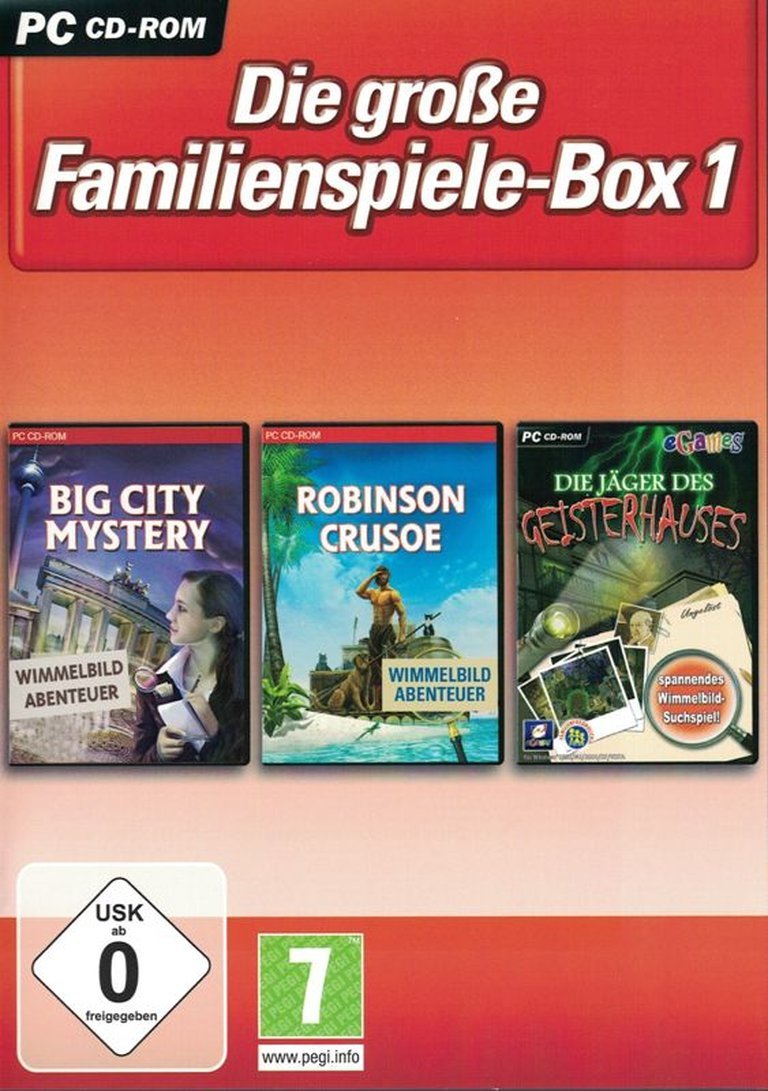
Die große Familienspiele-Box is a 2009 Windows compilation published by rondomedia, offering a curated collection of three family-friendly adventure and mystery games: Big City Mystery, Adventures of Robinson Crusoe, and G.H.O.S.T. Hunters: The Haunting of Majesty Manor. With a PEGI rating of 7, this box set provides casual, all-ages entertainment through varied settings, from urban detective work to deserted island survival and supernatural investigations.
Die große Familienspiele-Box: Review
Introduction: A Time Capsule of German-Style Casual Gaming
In the sprawling, ever-accelerating landscape of video game history, certain artifacts exist not as landmark titles that defined eras, but as perfectly preserved specimens of a specific commercial and cultural moment. Die große Familienspiele-Box (“The Great Family Games Box”), released in 2009 for Windows by the German publisher rondomedia Marketing & Vertriebs GmbH, is precisely such an artifact. It is not a singular game but a curated, budget-priced bundle—a “compilation” in the purest, most transactional sense. To analyze it is to dissect the anatomy of a late-2000s European budget software phenomenon. My thesis is this: Die große Familienspiele-Box holds negligible value as a creative or artistic statement but possesses significant historical value as a primary source document. It exemplifies the peak of the “Wimmelbild” (hidden object) and casual adventure boom in continental Europe, the economics of the budget re-release market, and a specific publisher’s strategy for capturing the “family” demographic just as the gaming world was being irrevocably reshaped by smartphones and the freemium model.
Development History & Context: The rondomedia Assembly Line
There is no singular “development history” for Die große Familienspiele-Box. The title is a commercial product, not a creative project. The “studio” is, in effect, the publisher, rondomedia. To understand this box, one must understand rondomedia’s niche in the late 2000s European (particularly German-speaking) market.
Rondomedia operated in the highly lucrative, low-margin world of budget software distribution. In the era before Steam’s dominance and the prevalence of digital storefronts, physical retail space was precious. Compilations like this served multiple purposes: they cleared aging inventory from publishers’ warehouses, filled bargain bins with perceived value (“three games for one low price!”), and catered to a segment of consumers—older players, families, casual hobbyists—who were skeptical of full-price new releases but recognized a familiar genre or a low-risk purchase. The year 2009 is crucial. The global video game industry, as detailed in the historical context, was in a state of flux. The iPhone’s App Store (launched 2008) was already引爆 the mobile and “casual” gaming explosion, siphoning off the exact audience rondomedia targeted: people looking for simple, accessible, time-wasting entertainment. PC casual games, particularly hidden object puzzles and light adventure games, were a thriving, if critically ignored, sector. This compilation is a last stand of sorts for that physical, PC-based casual market.
The “vision” was purely mercantile: identify three previously released, PG-rated, genre-adjacent games that could be sold together under the family-friendly “Familienspiele” banner. The technological constraints are irrelevant—these are pre-built, off-the-shelf games from the prior few years, running on standard Windows XP/Vista hardware. The gaming landscape context is everything: this was the twilight of the boxed PC game at the mass-market level, a final bulk shipment of content aimed at a demographic less connected to online discourse and more likely to pick up a shiny box at a supermarket or media markt.
Narrative & Thematic Deep Dive: Three Heterogeneous Stories
As a compilation, the box has no unifying narrative. Its thematic through-line is purely marketing: “family-friendly entertainment.” We must therefore analyze the narratives of its constituent parts, which reveal the prevailing story formulas of the mid-to-late 2000s casual adventure/hidden object genre.
1. Adventures of Robinson Crusoe (2009)
This title, released the same year as the compilation, is a straightforward narrative adaptation. It follows Daniel Defoe’s classic novel with the expected liberalities. The narrative is linear, episodic, and driven by survival mechanics and exploration. The themes are colonialist survival, man versus nature, and resource management. In the context of casual gaming, its “adventure” label is misleading; it functions more as a narrative clicker or a simple resource-gathering game with hidden object scenes serving as the primary “puzzle.” The story is a familiar scaffold, providing context for gameplay rather than a driving force. Its thematic simplicity is its asset: players know exactly what they’re getting—a relocated, gamified version of a public domain story.
2. G.H.O.S.T. Hunters: The Haunting of Majesty Manor (2007)
Representing the “paranormal investigation” subgenre that was hugely popular in casual adventure games post-Mystery Case Files. The plot is boilerplate haunted house fare: a ghost is terrorizing a mansion, and the player, as a member of the G.H.O.S.T. (Ghost Hunters of Supernatural Troubles) organization, must investigate. Narrative is delivered through static character portraits, text dialogue, and environmental storytelling. Themes of spectral history, family secrets, and scientific (if shallow) paranormal inquiry are presented. The ghost is not a threat but a mystery to be solved through collecting clues (hidden objects) and interacting with set pieces. The story exists solely to justify moving from one room to the next, a common critique and necessary convention for the genre’s “room-by-room” progression.
3. Big City Mystery
The most generic title and, based on its inclusion pattern, likely the oldest or most generic of the three. The name itself is a placeholder narrative. It promises an urban detective story but almost certainly delivers a formulaic tale of a missing person, a stolen artifact, or a vague “city crime” solved via hidden object scenes in diverse urban locations (subway station, museum, rooftops, etc.). Without specific source details, we can infer its narrative is a pastiche of crime drama tropes, serving as pure functionalism. The theme is urban enigma, with the “big city” itself being the only character of note.
Collectively, these narratives reveal a genre obsessed with reassuring mystery. There is no high-stakes, morally ambiguous storytelling. The player is always a competent, benevolent investigator (castaway, ghost hunter, detective) restoring order to a disrupted but fundamentally safe world. The mystery is a puzzle to be solved, not a traumatic experience. This is comfort food narrative, perfectly aligned with the “family” branding and the casual player’s desire for low-stress, achievable goals.
Gameplay Mechanics & Systems: The Hidden Object Grind
The compilation’s gameplay is not a synthesis but a trifurcation. Each game represents a slightly different permutation of the casual adventure template, but all share a core, addictive, and ultimately repetitive loop.
Core Loop (Universal):
1. Scene Load: Present a static, beautifully illustrated 2D scene.
2. Objective: A list of 10-15 items to find (“Find: Key, Candle, Feather, Rope…”).
3. Interaction: Click on the item in the scene. Successful clicks yield a sound and visual highlight.
4. Progression: Once all items are found, receive a “reward” (often a narrative clue, a key to the next scene, or currency for hints).
5. Scene Transition: Move to the next static scene. This repeats for dozens of scenes per game.
Game-Specific Deviations:
* Adventures of Robinson Crusoe: Integrates a simple resource management layer. Found items are added to an inventory and used to craft tools (Axe = Tree + Rock), which then unlock new exploration areas. This adds a thin veneer of simulation and progression, making it the most “gamey” of the trio. The hidden object scenes are often justified as “searching the beach” or “exploring the jungle.”
* G.H.O.S.T. Hunters: Implements a “paranormal equipment” system. Players might need to use an EMF meter or infrared camera on specific hotspots to reveal hidden clues before an object can be found. This introduces a slight puzzle element on top of the hidden object search, requiring the player to think about how to see something, not just find it.
* Big City Mystery: Likely the most pure, unadulterated hidden object experience. Minimal secondary mechanics. Perhaps a simple “use item on scene” element for a few locked containers, but the focus is squarely on the core seek-and-find loop.
Innovation & Flaws:
The only “innovation” here is the bundling itself, offering a low-risk, high-quantity value proposition. The systems are not innovative; they are the codified, streamlined culmination of years of genre iteration. The major flaw, shared by all, is contextual shallowness. The environments are static paintings with clickable hotspots. There is no systemic interaction; a “key” found in a library will never be used to open a “door” in a different scene unless explicitly scripted in the next linear step. The gameplay is a Skinner box of visual completion, exploiting the player’s innate pattern-recognition and completionist drives without intellectual challenge. The “progression” is entirely quantitative (more scenes, more items found), not qualitative.
World-Building, Art & Sound: The Aesthetics of the Budget Aesthetic
The compilation’s world-building is entirely aesthetic and scene-based. There is no persistent, explorable world. Each “world” is a single, meticulously detailed 2D illustration.
Visual Direction: This is the compilation’s strongest, albeit most uniform, feature. Mid-to-late 2000s casual adventure/hidden object games had a specific, recognizable art style: hyper-saturated, soft-focus, photorealistic illustrations with a warm, inviting palette. Think “Thomas Kinkade meets stock photography.” Every scene—from a misty English manor (Majesty Manor) to a tropical beach (Robinson Crusoe) to a rain-slicked city alley (Big City Mystery)—is rendered with this same glossy, accessible, and ultimately interchangeable aesthetic. There is no artistic vision, only a perfected commercial template. The detail is high, but it is detail for the sake of hiding objects, not for world coherence. A single scene might contain a Viking longship, a modern fire hydrant, and a Renaissance painting—all “hidden” plausibly within the same cluttered space. The art serves the mechanic, not the story.
Sound Design: Equally formulaic. A loop of generic, royalty-free “mystery” or “adventure” music—often melancholic piano or light orchestral swells—plays in the background. Sound effects are sparse but functional: a satisfying “click” or “chime” for a found item, a dull “thud” for a wrong click, perhaps a creaky door sound for scene transitions. Voice acting, if present at all (common in these games for brief character lines), is performed by a small stable of non-union, generic voice actors with flat delivery. The soundscape is designed to be inoffensive background, not an immersive component.
Atmosphere: The atmosphere is one of soothing monotony. The consistent, warm art and non-intrusive sound create a low-stimulus environment ideal for multitasking (playing while watching TV) or winding down. There is no tension, no surprise in the aesthetic. The “world” is a comforting, predictable diorama. This is the antithesis of the atmospheric, terrifying worlds of horror games or the vibrant, reactive worlds of AAA titles; it is a beautifully painted cage.
Reception & Legacy: The Silence of the Budget Bin
The provided source material is tellingly silent on reception. On MobyGames, the title has a “n/a” MobyScore and zero critic reviews or player reviews. This is the ultimate verdict. Die große Familienspiele-Box exists in the realm of the unreviewed, the unremarked-upon. It was not a failure that sparked controversy; it was a non-event in the critical consciousness. It was a product for a market segment that did not read gaming websites or magazines. Its commercial reception is implied by its existence and the numerous related “Große…-Box” series entries listed as Related Games (Sim Box, Zeitmanagement-Box, Abenteuer-Box, Wimmelbild-Box, etc.). Rondomedia’s business model was evidently sustainable enough to spawn a franchise of compilations, each bundling games from a specific sub-genre (simulation, time management, adventure, hidden object).
Its legacy is not one of influence on game design, but on game commerce. It represents the final, physical iteration of a model that would be completely digitalized and miniaturized: the curated, genre-specific bundle. Today’s equivalent is the “casual game bundle” on Steam or GOG, or the algorithmically generated “recommended for you” list on an app store. It pioneered the idea of marketing games not by brand or franchise, but by aggregated genre label and price point.
Its historical significance lies in its position at a crossroads. Released in 2009, it captures the last gasp of the boxed casual PC game before the market fully migrated to digital distribution portals like Big Fish Games’ Game Club and, more broadly, to mobile app stores. The games within—particularly G.H.O.S.T. Hunters (2007)—are descendants of the Mystery Case Files series (2005) that defined the hidden object boom. This boom was a direct, PC-based precursor to the hyper-casual and mobile puzzle game explosion of the 2010s. The “Wimmelbild” (hidden object) genre, so dominant in German and European casual PC gaming, finds its spiritual successor in the “object-finding” mechanics of countless free-to-play mobile titles. Die große Familienspiele-Box is a museum piece of that transition, holding games that are too complex and large for early mobile phones but perfectly sized for a 2009-era PC bargain bin.
Conclusion: A Definitive Verdict on a Non-Event
To assign a traditional star rating to Die große Familienspiele-Box is a categorical error. It is not a cohesive artistic work to be judged on its merits. It is a commercial artifact, a data point.
As a game: It is a collection of three competent, by-the-number examples of the casual hidden object/adventure genre from its peak period. Each provides dozens of hours of low-intensity, repetitive gameplay that may have been satisfying to its target audience in 2009. As a singular experience, it is bloated and directionless.
As a historical document: It is invaluable. It perfectly encapsulates:
1. The rondomedia Business Model: The budget compilation as inventory management and market penetration tool.
2. The Casual Genre Template: The standardized art, sound, and repetitive-but-satisfying gameplay loop that defined a generation of non-hardcore PC gamers.
3. The Pre-Mobile Casual Market: The last physical manifestation of a market segment that would be entirely consumed by smartphones within five years.
4. Genre Hybridization: The bundling of “Adventure” (Robinson Crusoe), “Hidden Object” (G.H.O.S.T. Hunters), and the vague “Mystery” (Big City Mystery) shows publishers testing sub-genre combinations to maximize appeal.
Die große Familienspiele-Box will never appear on a “Top 100 Games” list. It will never be dissected for its narrative themes or mechanical innovation. Yet, it stands as a silent, robust monument to a specific, massive, and now mostly forgotten segment of the industry. It is the game equivalent of a Wikipedia entry for “late-2000s European budget PC software.” Its place in video game history is not in the canon, but in the archive: an essential exhibit on the business of accessibility, the economy of the bargain bin, and the quiet, profitable empire built on the simple joy of finding a virtual key in a beautifully painted digital room. It is, in the end, a perfectly functional product for a need that no longer exists, preserving a gameplay loop that evolved into a thousand micro-transactional mechanics on our phones. For that, it earns its place—not on a shelf of honored classics, but in the catalog of a very specific, very real, and very commercial chapter of our shared history.