
- Release Year: 2005
- Platforms: PlayStation 2, Wii, Windows
- Publisher: Conspiracy Entertainment Corp., Data Design Interactive Ltd, Fairprice Games, Metro3D Europe Ltd.
- Developer: Data Design Interactive Ltd
- Genre: Action
- Perspective: Behind view
- Game Mode: Single-player
- Gameplay: Combat, Hidden Pickups, Item collection, Platform, Time Attack
- Setting: Fantasy
- Average Score: 34/100
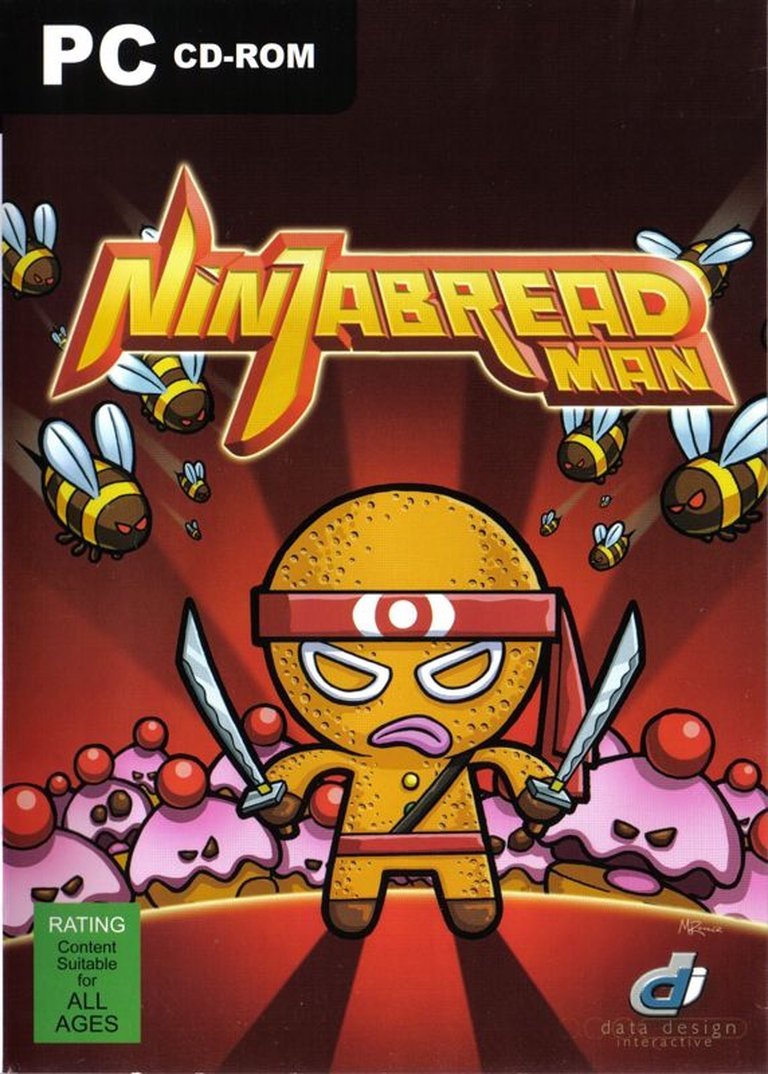
Description
Set in the fantastical Candy Land, Ninjabread Man is an action platform game where a valiant samurai hero must defend the peaceful realm from an invasion of menacing jelly monsters, rageful bees, and snapping cupcakes. Players control Ninjabread Man in behind-view levels, collecting eight scattered rods to progress and using martial arts attacks like a cutting sword, ninja stars, and samurai kicks to defeat enemies, with unlockable modes such as Time Attack and Hidden Pickups adding depth after initial completion.
Gameplay Videos
Ninjabread Man Free Download
Ninjabread Man Guides & Walkthroughs
Ninjabread Man Reviews & Reception
metacritic.com (13/100): It’s awful. Totally awful.
imdb.com (10/100): Horrible game
gamesreviews2010.com (80/100): Ninjabread Man is a sweet and satisfying action-platformer
Ninjabread Man: A Comprehensive Autopsy of Gaming’s Most Infamous “Asset Flip”
Introduction: The Gingerbread Gauntlet
In the vast, often idiosyncratic museum of video game history, certain titles stand not as masterpieces, but as monuments to failure—cautionary tales etched in broken code and wasted potential. Ninjabread Man is one such monument. Released in 2005 for the PlayStation 2 and Windows, with a notorious Wii port in 2007, this game transcends mere poor quality to achieve a distinct, almost legendary status as one of the most critically panned and mechanically broken titles of its era. Its legacy is not one of influential design or cultural impact, but of a stark lesson in budget development, asset recycling, and the perils of the Wii’s early third-party “shovelware” crisis. This review will deconstruct Ninjabread Man not simply to mock it, but to understand why it exists, how it failed so spectacularly, and what its existence reveals about the industry practices of the mid-2000s. My thesis is clear: Ninjabread Man is the definitive, vulgar example of the “asset flip,” a game whose primary innovation was the audacity to repurpose a failed Zool prototype into multiple, equally disastrous products, cementing its place as a nadir in 3D platformer design.
Development History & Context: From Zool’s Ashes to Popcorn Arcade
The origins of Ninjabread Man are a tale of abandoned licenses and pragmatic course correction. According to developer lore and evidence found in the game’s files, the project reportedly began as a planned third entry in the Zool series, the classic 1990s Amiga platformer. Data Design Interactive (DDI), a UK-based studio founded in 1983, created a tech demo for what was to be a new 3D Zool adventure. However, the rights holder, Zoo Digital Publishing, found the demo unimpressive and withdrew the license. Rather than scrap the work, DDI—likely operating under severe budgetary and time constraints—re-skinned the existing assets and levels.
This is the core of the “asset flip” phenomenon. The data indicates that the worlds from the canned Zool 3 demo were simply re-themed: “Sweet World” became Ninjabread Man; “Music World” became Rock ‘N’ Roll Adventures (2007); “Toy World” became Myth Makers: Trixie in Toyland (2005); and “Tooting Common” from Zool 2 became Anubis II (2005). The leaked intro animation featuring Zool crash-landing on a planet visually identical to Ninjabread Man‘s Candy Land is the smoking gun. The game was first announced in November 2004 as Myth Makers: The Ninjabread Man, suggesting a planned series before the branding was simplified.
Technologically, the game was built using a triad of middleware common for mid-2000s budget titles: RenderWare (a popular, accessible 3D engine from Criterion), the GODS Engine (DDI’s in-house tool), and Havok for physics. This combination promised a degree of graphical competence and physical realism that the final product utterly failed to deliver. The development cycle was rushed; it was released in Europe for PS2 on July 13, 2005, and Windows on July 23, 2005. A PSP version was listed in a 2005 Metro3D portfolio but never materialized.
The context of its 2007 Wii release is even more damning. After Nintendo granted developer/publisher status to several studios in 2007, DDI aggressively positioned itself for the new motion-controlled console. They announced Ninjabread Man as one of six launch titles for their new “Popcorn Arcade” budget brand. It was published in North America by Conspiracy Entertainment, a company notorious for low-budget, often low-quality titles. This move placed a fundamentally flawed game—designed for traditional gamepads—into a market desperate for core gaming experiences on the Wii, exacerbating its control issues and contributing to the console’s “shovelware” stigma. The release of three other reskinned games (Anubis II, Trixie in Toyland, Rock ‘N’ Roll Adventures) around the same period confirmed DDI’s business model: minimal effort, maximum product output.
Narrative & Thematic Deep Dive: A Story of Utter Vacuum
The “plot” of Ninjabread Man is a skeletal premise, delivered via the back of the box and a single loading screen. “Happiness and peace reign in Candy Land,” the text begins, “when all of a sudden a horde of menacing jelly monsters, rageful bees and menacing cupcakes invades the land.” Our hero, “a samurai as valiant as Ninjabread Man,” responds to this threat and “starts the journey to save the world, brandishing his cutting sword.”
There is no narrative development. No dialogue, no cutscenes (beyond a faint, recycled intro), no character motivations, and no resolution. The protagonist is a silent, lifeless cipher—a concept the Thunderbolt review astutely criticized: “He could be the Jack Bauer of the bakery, but instead our hero is silent and lifeless.” The setting, “Candy Land,” is not the beloved children’s board game but a generic, vaguely confectionery-themed realm populated by enemies who are literally baked goods (cupcakes, jelly monsters) and insects (bees). The theme is Martial Arts meets Food Fiction, but the collision is purely cosmetic. There is no thematic exploration of gingerbread fragility versus ninja resilience, no satire of sugar-rush culture. The world is a bland, repetitive 3D environment that fails to capture the whimsy its premise suggests. The narrative, such as it is, exists solely to justify the gameplay loop: a hero enters a food-themed world to collect glowing rods and defeat food-themed foes. It is the absolute bare minimum of context, highlighting the game’s primary function as a box-ticking exercise rather than an authored experience.
Gameplay Mechanics & Systems: The Architecture of Frustration
Gameplay is where Ninjabread Man‘s flaws metastasize. It is a 3D platformer with an “action-adventure” label, structured around three main levels plus a tutorial. The core loop is brutally simple: collect eight “Power Rods” scattered in each level to activate a teleporter and proceed.
Core Mechanics & Combat:
* Movement: The Ninjabread Man can walk, jump, and perform a double jump. On the Wii, jumping is executed by flicking the Nunchuk upward—a motion widely criticized as imprecise and tiring. The Z button can also be used, but the default motion control is a fundamental misstep for a precision platformer.
* Combat: Two attacks are available. A shuriken throw uses the Wii Remote’s infrared pointer for aiming (on Wii) or a button on other platforms. A samurai sword swing is performed by shaking the Wii Remote. Both systems are plagued by Hitbox Dissonance—attacks frequently pass through enemies without registering. Enemies (cupcakes, bees, jelly blobs) have basic patterns but require multiple hits, making combat a chore rather than a dynamic engagement.
* Progression: There is no character progression or ability acquisition beyond the initial moveset. After completing a level, replaying it unlocks alternate modes: ‘Score Pickups,’ ‘Time Attack,’ and ‘Hidden Pickups!’. These are not expansions but trivial variations on the same broken core, designed to pad playtime artificially.
Systemic Flaws:
1. The Camera: Repeatedly cited as one of the worst in gaming history. The camera is unresponsive, slow to rotate, and frequently positions itself behind walls or at angles that make platforming jumps guesswork. As Gamestyle noted, it “fails to adapt to changes of direction… prompting you to reposition your character in the vain hope that the game will offer you a useable viewpoint.”
2. Controls & Responsiveness: Input lag is pervasive. The sword swing, especially on the ground, is “unresponsive” and “laggy” (as per user reviews). The game “really is hit or miss as to whether your character will perform the desired action.”
3. Level Design & Length: With only three substantive levels (about one hour of content), the game is criminally short. Levels are large, empty, and repetitive, filled with the same few assets—candy cane rails, licorice platforms, generic sweet-themed geometry. The task of finding eight rods involves tedious backtracking across these barren spaces.
4. Physics & Bugs: The Havok physics engine is misapplied, leading to moments where the character gets stuck on geometry or falls through platforms endlessly—a Game-Breaking Bug noted in PC version analysis. Frame rate issues occur even in “tiny levels,” as IGN observed.
5. Fake Difficulty: The challenge does not arise from legitimate obstacles but from the game’s broken systems. Poor controls, bad camera, and useless weapons create an experience that is hard in the most frustrating, artificial way possible.
In essence, the gameplay loop is not “skillful platformer overcomes challenge,” but “patiently wrestles with uncooperative software to complete a repetitive collection task.”
World-Building, Art & Sound: Aesthetically Bankrupt Confectionery
The game’s presentation is a masterclass in mediocrity, where ambition is constantly undermined by execution and a clear lack of artistic coherence.
- Visual Direction & Graphics: The premise—a world made of sweets—demands a vibrant, playful aesthetic. Instead, Ninjabread Man presents low-polygon, textureless models and environments that look dated even for 2005. The “Candy Land” is a drab collection of browns, pinks, and whites, with flat lighting and zero atmospheric detail. The character model of Ninjabread Man is the sole standout—a mildly clever concept of a gingerbread man in a ninja gi. However, animations are stiff, and the game’s “visuals” are primarily defined by their pervasive ugliness. As one user review succinctly put it, “The graphics look like they’re from an average Nintendo 64 game.” This is a devastating critique for a PS2/Wii title.
- Sound Design & Music: The audio is a point of infamous trivia. The MobyGames credits note that of the game’s ~190MB on Windows, 110MB is occupied by sound files in uncompressed WAV format. This is a staggering waste of disc space for what is described as generic, repetitive, and grating music. The soundtrack is Recycled Soundtrack in its purest form—the same tunes would appear in DDI’s subsequent reskinned titles (Anubis II, My th Makers, Rock ‘N’ Roll Adventures). Sound effects are tinny and ineffective. There is no voice acting, not even for the silent protagonist, reinforcing the world’s emptiness.
- Atmosphere & Cohesion: The world lacks any cohesive atmosphere. The transition from a “candy-coated forest” to a “cupcake factory” is merely a change in the primary texture color palette. No attempt is made to make the environment feel alive, dangerous, or whimsical. The jarring combination of a ninja motif with a bakery setting is never embraced for humor or style; it is simply a mismatched skin on a generic 3D platformer template. The overall experience is one of aesthetic bankruptcy—a missed opportunity to make the game’s strongest selling point (its punny title and concept) into an engaging visual or auditory experience.
Reception & Legacy: The Pinnacle of the “Worst Of” Lists
Upon release, Ninjabread Man was not merely disliked; it was eviscerated. Its reception is a study in universal contempt.
* Aggregate Scores: The PS2 version holds a 31% on GameRankings. The Wii version, plagued by motion controls, plummeted to 17.5% (GR) and 20/100 on Metacritic. These are not just bad scores; they are catastrophic for a commercially released product.
* Critical Scathing: Reviews were brutal and often hilarious in their disdain. Eurogamer (1/10) called it “dross of the highest order,” stating, “We deserve more than this.” IGN (1.5/10) labeled it “buggy, often completely broken,” and a “low-budget shelf-filler.” Nintendo Life (2/10) felt “violated” by the experience, calling it the worst Wii game they’d played. Thunderbolt (1/10) lamented the wasted potential of the character, calling him “silent and lifeless.” The Russian outlet Absolute Games was succinct: “Ни в коем случае не показывайте это детям. Да и взрослым тоже.” (“Do not show this to children under any circumstances. And not to adults either.”).
* Player Reception: User scores are marginally worse, with an average of 1.4/5 on Moby and a Metacritic user score of 1.3/10, with over 90% of reviews rating it “Overwhelmingly Negative.” Common player complaints mirror the critics’: broken camera, awful motion controls, glitchy hitboxes, repetitive levels, and a profound sense of wasted time and money.
* Legacy & Cultural Position: Ninjabread Man did not influence subsequent game design positively. Its legacy is purely as a benchmark for failure. It is a permanent fixture on “Worst Games of All Time” lists, often in direct competition with the likes of E.T. and Superman 64. Its most significant impact on the industry was as a prime example of the shovelware epidemic that plagued the Wii’s early years, where low-budget publishers churned out cheap, cynical products to exploit the console’s massive install base. The game’s business model—releasing the same core product under four different franchises (Ninjabread Man, Anubis II, Trixie in Toyland, Rock ‘N’ Roll Adventures)—is a textbook case of cynical asset exploitation, damaging consumer trust and devaluing the platform’s library.
* The Cancelled Sequel: The announcement of Ninjabread Man: Blades of Fury in January 2008 is a final, ironic footnote. In a sane industry, a game with this reception would torpedo any sequel. Its announcement speaks to a disconnect between DDI’s production-line mentality and any concept of quality or brand reputation. The sequel’s cancellation was inevitable, coming alongside DDI’s dissolution in 2012.
Conclusion: A Sweetly Rotten Artifact
Ninjabread Man is not a game that fails in interesting ways. It fails in the most banal, bureaucratic, and profit-driven ways imaginable. It is the digital equivalent of a factory defect—a product that passed through a development pipeline with no meaningful quality control, its sole purpose being to occupy retail shelf space and generate a quick return. From its origins as a rejected Zool prototype to its multiple, Identical reskins, it represents the nadir of the asset-flip model. Every system—camera, controls, combat, level design, pacing—is either broken, tedious, or both. Its artistic vision is non-existent, its narrative a paragraph, its challenge a product of broken code rather than deliberate design.
Its place in video game history is not that of a cult classic or a misunderstood gem. It is that of a canonical bad game, a necessary reference point for discussions about development ethics, publisher responsibilities, and the dangers of unchecked budget production. It serves as a stark reminder that a clever title and an appealing box art are meaningless without a functional, respectful game at the core. For scholars, it is a case study in ruinous project management. For journalists, it is the easy target that仍需be targeted to uphold standards. For players, it is a warning label: avoid this title not just because it is bad, but because its existence represents a cynical attitude toward the medium that deserves to be financially unsuccessful.
In the pantheon of gaming’s worst, Ninjabread Man is not merely a participant; it is the sugar-filled, gingerbread-scented poster child for everything that can go wrong when creativity is sacrificed at the altar of the bottom line. Its final score is not a number, but a categorical rejection: Do Not Play.