
- Release Year: 2004
- Platforms: Macintosh, Windows
- Publisher: Ubisoft Entertainment SA
- Genre: Compilation, Special edition
- Game Mode: Single-player
- Average Score: 82/100
Description
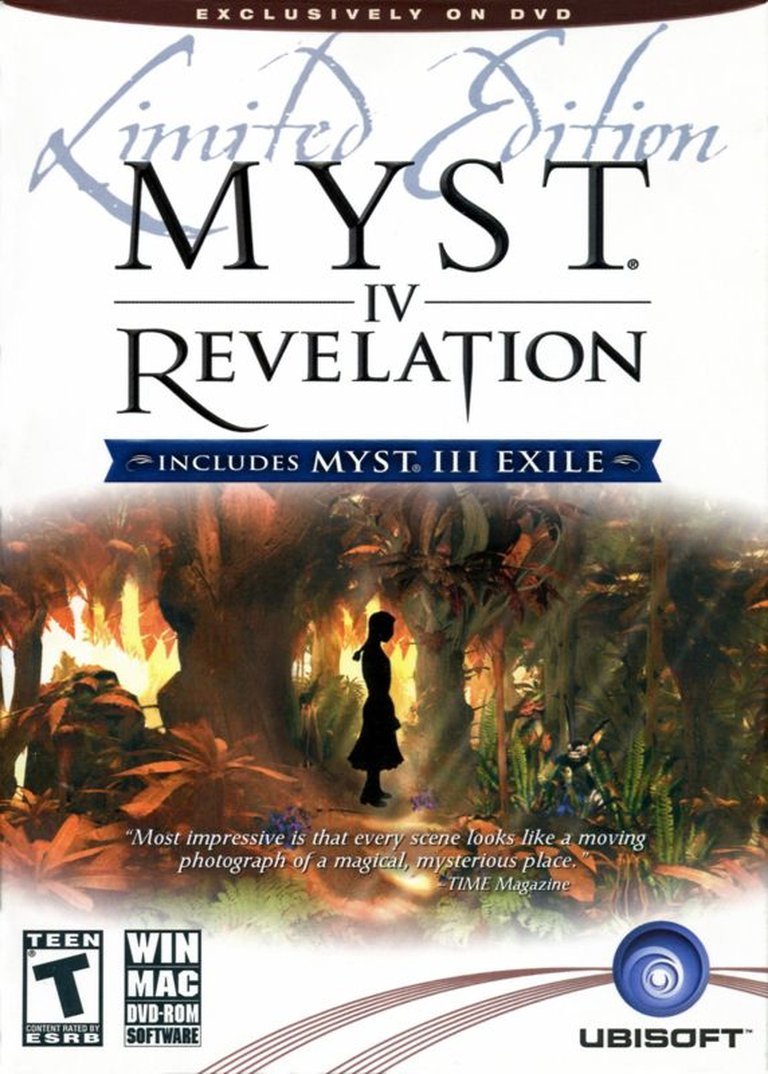
Myst IV: Revelation is a 2004 adventure game and the fourth installment in the Myst series, where players are summoned by Atrus, a creator of linking books to other worlds, to investigate his long-imprisoned sons and rescue his daughter Yeesha from their deceptive plot. The game involves exploring intricately designed Ages—mysterious realms rendered with pre-rendered graphics and full-motion video—through node-based navigation and puzzle-solving, all within a narrative-driven experience. This Limited Edition includes the standard two-disc version of Myst IV: Revelation, accompanied by Myst III: Exile on a single DVD featuring a ‘Making of’ video that provides behind-the-scenes insights.
Gameplay Videos
Myst IV: Revelation (Limited Edition) Patches & Updates
Myst IV: Revelation (Limited Edition) Guides & Walkthroughs
Myst IV: Revelation (Limited Edition) Reviews & Reception
metacritic.com (82/100): Even though Myst IV doesn’t break any new ground for the series, it still remains an extremely compelling adventure game with a fantastic presentation and ranks as the best of the series and one of the best of the genre.
ign.com (85/100): Within the visually awe-inspiring world of Myst, a gripping family drama will slowly unfold.
imdb.com (84/100): Great lively game to consume hours and hours of your life.
Myst IV: Revelation (Limited Edition): A Eulogy for Pre-Rendered Realism
Introduction: The Last Byte of an Era
To understand Myst IV: Revelation is to understand the precipice upon which it stands. Released in 2004 by Ubisoft Montreal, this fourth mainline entry in the epoch-defining Myst series arrived at a moment of profound transition for both the franchise and the adventure genre itself. It was the heir to a legacy of CD-ROM marvels and panoramic puzzles, yet it also bore the first significant tremors of the real-time 3D revolution that would soon render its own technological foundations obsolete. The Limited Edition—bundling the base two-disc game with Myst III: Exile and a “Making of” video—served not just as a value package but as a deliberate artifact, a collected edition of a closing chapter. This review argues that Revelation, particularly in this curated form, is a game of magnificent, melancholic contradictions: a technically sumptuous but creatively conservative swan song for the prerendered aesthetic; a narrative conclusion that ambitiously expands lore while being hamstrung by its own mechanics; and a title that received considerable critical acclaim yet remains a deeply divisive entry among purists. It is the definitive, polished end of an era, beautifully capturing the splendor and the stagnation of the classic Myst formula just before Myst V: End of Ages would irrevocably change the series’ visual DNA.
Development History & Context: A Troubled Genesis and a Studio’s Rite of Passage
The story of Revelation‘s development is itself a tale of corporate upheaval and learning curves, as critical to understanding the final product as the game’s code. When Mattel Interactive held the Myst rights, development was initially contracted to DreamForge Intertainment (of Sanitarium fame). Their version, using real-time graphics, was two years and 20% complete when Ubisoft, having acquired the franchise, cancelled the project and shifted development in-house to Ubisoft Montreal. This left the new studio, with no prior experience in pre-rendered adventure game pipelines, to start from scratch.
Producer Geneviève Lord later reflected in a Gamasutra postmortem that the core narrative—concluding the story of Atrus’s sons, Sirrus and Achenar—was originally intended for Myst III: Exile. Due to time constraints and to avoid conflicting with DreamForge’s still-forming plot, it was shelved and resurrected for IV. Cyan Worlds, the original creators of Myst and Riven, acted as lore custodians, setting “a certain number of rules” Ubisoft had to follow, but granted considerable creative freedom. This handoff from Cyan to Ubisoft marks the crucial context: Revelation was the first Myst game fully developed by a major third-party studio, not by the series’ progenitors.
The chosen path—returning to fully pre-rendered graphics to match the series’ established style—was a double-edged sword. Ubisoft Montreal had to hire over 50 artists skilled in this specific, now-niche discipline. As Lord candidly admitted, full production began before artistic direction and engine tools were solidified, leading to a “bad working relationship” between designers, programmers, and modelers for most of the production. This internal friction is subtly felt in the final product: the visuals are undeniably spectacular, but the puzzle design and integration sometimes feel disjointed, as if the left and right hands of the project were not always communicating.
The game’s scope was massive. Over 80 employees worked for more than three years. The decision to ship exclusively on DVD-ROM (requiring over 7GB of installation space) was a bold statement of intent, leveraging the new standard to deliver an unprecedented density of high-resolution imagery and video. It was also a pragmatic one; a CD-ROM set would have spanned a staggering 12 discs. Technologically, Revelation used the “ALIVE” engine to imbue its static prerenderings with life: water rippled uniquely per scene, trees swayed, clouds drifted, and wildlife moved through environments. This “living painting” effect, combined with over 70 minutes of live-action FMV (featuring actors like Rand Miller as Atrus and Juliette Gosselin as Yeesha), represented the zenith of the Myst visual-philosophy. Yet, this very commitment to a dying format made Revelation the last Myst game to use pre-rendered backgrounds and FMV; Cyan’s subsequent Myst V: End of Ages would go fully real-time, a direct response to the industry’s shift and perhaps to the internal challenges Ubisoft faced.
Narrative & Thematic Deep Dive: Family, Memory, and the Ghosts of the Past
If the Myst series has a central spine, it is the tragedy and legacy of Atrus, the D’ni writer. Revelation pulls the final, taut thread of the original trilogy’s primary antagonist arc: the fate of Sirrus and Achenar, the treacherous sons imprisoned in their “prison Ages” twenty years prior. The player, the canonical “Stranger,” is summoned to Tomahna (Atrus’s new home Age) not to solve a grand mystery, but to perform a moral audit. Catherine, Atrus’s wife, believes in redemption. Atrus, the pragmatic survivor, does not. This core conflict—Can people truly change?—is the engine of the entire plot.
The narrative structure is deceptively simple: find the missing Yeesha, Atrus’s now-teenage daughter. The search becomes a grim tour of the brothers’ penal colonies. Spire, Sirrus’s prison, is a stark, vertical, technological nightmare of steel and explosives, revealing a brother utterly unrepentant, who has engineered a violent escape. Haven, Achenar’s prison, is a lush, swampy jungle where a broken man has found a precarious peace with nature, his journals filled with genuine remorse. This immediate duality—science versus nature, rage versus regret—sets up the central twist: Sirrus has kidnapped Yeesha not for ransom, but for a mind-transfer ritual using the ancient D’ni Memory Chambers.
The plot then evolves into a multi-layered rescue mission across the Ages of Serenia and its metaphysical counterpart, Dream. The themes deepen:
* The Weight of Memory: The Memory Chambers physically store the essences of the dead. The “Life Stone” that powers them becomes a MacGuffin of life and death. Sirrus’s plan is to steal Atrus’s knowledge (the “Art of Writing”) by transferring his consciousness into Yeesha’s body, a violation of the deepest personal and familial boundaries.
* Redemption and Sacrifice: Achenar’s journey is one of atonement. His escape is not for freedom, but to protect Yeesha. His ultimate fate—fatally poisoning himself to stabilize the collapsing Memory Chamber and save his sister—is the game’s emotional and thematic climax. It forces the player to reconcile the monstrous boy from the first Myst with the sacrificial man before them.
* The Liminal Self: The “Dream” realm, accessed via an amulet and guided by the spirit of Peter Gabriel, introduces a Jungian, almost shamanistic layer. Here, Yeesha’s fragmented memories and Sirrus’s clinging, monstrous “Dream-form” are visualized as environmental puzzles. Restoring harmony to the “Ancestors” (preserved Serenian spirits) becomes a metaphor for integrating a fractured psyche. This is Revelation‘s most original and ethereal narrative conceit, though some critics found the ensuing puzzle in Dream overly simplistic and the technobabble explanations heavy-handed.
The branching endings are a significant, if underdeveloped, innovation. The player’s timing and choices in the final Memory Chamber scene lead to:
1. Bad Endings: Hesitation or pulling the “silver lever” (releasing Yeesha/Sirrus) results in Achenar’s death and the player’s murder.
2. The Good Ending: Pulling the “amber lever” reverses the transfer but dooms the chamber. Achenar’s sacrifice in the “waking world” and the player’s success in Dream (destroying Sirrus’s essence) save Yeesha. Atrus, grieving his sons but grateful for his daughter’s safety, resolves to raise her properly. This ending provides catharsis but is bittersweet, lacking a grand reunification and leaving Atrus’s family permanently fractured.
Critically, the narrative is not without retroactive continuity (“retcon”) controversies. The original Myst and Riven described the brothers’ “Trap Books” as subtle modifications. Revelation redefines them as links to actual, physical Prison Ages, a change some fans view as an unnecessary complication that muddles the original’s elegant simplicity. Furthermore, the brothers’ immediate recognition of the Stranger, despite being trapped mid-link years earlier, creates a minor lore hiccup.
Gameplay Mechanics & Systems: Refinement, Innovation, and FamiliarFriction
Revelation operates on the classic Myst node-based, first-person paradigm. You click to move between panoramic viewpoints, rotating 360 degrees at each node. The cursor is a context-sensitive hand: pointing for movement, a magnifying glass for examination, an open hand for manipulating objects (push/pull/tap). This system, while iconic, is the source of the game’s most persistent criticisms. Hotspot hunting is exacting; interactive zones are often tiny and visually subtle. Cursor animations are slow, making exhaustive searching tedious. Computer Gaming World and The Houston Chronicle explicitly called out this “tiresome” navigation as an un-evolved flaw.
However, Revelation introduced several QoL innovations that became series standards and were positively received:
1. The In-Game Camera: Replaces the notepad. You can photograph clues, puzzles, and journal entries, creating a visual log accessible via the bottom menu.
2. The On-Screen Journal: Allows typed notes, further reducing the need for external documentation.
3. The Amulet & Flashbacks: A pivotal tool. Many objects in the world are “memory-tagged.” Using the amulet triggers a short FMV flashback providing backstory, character motivation, or crucial puzzle clues. This seamlessly integrates narrative exposition with gameplay.
4. Zip Mode: A fast-travel system. Once a node is visited, its thumbnail is stored; selecting it instantly “zips” you there, skipping intermediate nodes. This was a godsend for the sprawling Ages of Spire and Haven.
5. Layered Hint System: Activated from the options menu, it offers three tiers of help for every major puzzle, from a vague nudge to a step-by-step solution. This was a direct response to the infamous obscurity of Riven‘s puzzles.
The puzzle design itself is a mixed bag. The four main Ages (Tomahna, Spire, Haven, Serenia) each contain 3-4 major logic puzzles. Some are ingeniously integrated into the environment and lore (e.g., Spire’s gravity-defying chamber powered by light, Haven’s water-flow system). Others, notably the Spider Chair on Spire—a timed puzzle, a first for the series—were criticized as out-of-place and aggravating. The puzzle progression is often nonlinear, especially in the late game, where solutions in Haven and Spire are prerequisites for advancing in Serenia. This can lead to frustrating dead ends if you explore out of sequence or miss a single environmental clue.
The Dream sequence in Serenia is the most divisive gameplay segment. It requires guiding ancestral spirits to harmony, a puzzle many found to be a simplistic, aesthetic detour that broke the game’s logical momentum. It serves the story (removing Sirrus’s anchors from Yeesha’s mind) but feels more like an interactive screensaver than a substantive challenge.
Ultimately, Revelation‘s gameplay is a story of refinement over revolution. It polished the pre-existing formula with useful tools but did not fundamentally rethink the node-based paradigm or the hotspot-hunting fatigue. The systems feel designed to manage the classic Myst experience, not to transcend it.
World-Building, Art & Sound: The Apex of the “Living Painting”
Where Revelation achieves undisputed mastery is in its world-building and audiovisual presentation. Each Age is a masterpiece of distinct, cohesive aesthetic design, powered by the ALIVE engine’s subtle animations.
- Tomahna: A serene, Japanese-inspired garden and Atrus’s home. It’s a place of tranquility and narrative setup, with gentle water features and warm lighting.
- Spire: A brutalist, vertical prison of cold metal, wind, and perpetual twilight. The constant motion of wind-swept debris and groaning structures creates an oppressive, unstable atmosphere. The sense of verticality is palpable.
- Haven: A humid, overgrown jungle swamp teeming with bioluminescent flora and fauna. The dripping water, chittering insects, and slow-moving predators make it feel alive, dangerous, and beautiful—a perfect reflection of Achenar’s reclaimed, wild existence.
- Serenia: A lush, alpine valley monastic community with clear East Asian architectural influences. It’s brighter and more “populated” (with NPCs) than any previous Myst Age, which some players found diminished its mysterious, isolated feel. The Dream realm, accessed here, is a surreal, abstract space of shifting geometries and phosphorescent colors, a stark contrast to the “real” Ages.
The sound design is a cornerstone of the experience. Jack Wall, returning from Myst III: Exile, composed a score of profound emotional range. He expanded upon Robyn Miller’s original leitmotifs (Atrus’s theme, the brothers’ themes) and infused them with an Eastern European flavor (drawing from his love of 90s Warsaw Village Band), giving the Myst universe a new, haunting musical identity. Tracks like “Enter Tomahna,” “The Swamp,” and “The Revelation / The Sacrifice” are not just background music but narrative actors, swelling with drama and melancholy.
The coup de grâce is the involvement of Peter Gabriel. He contributed the song “Curtains” (a reworked B-side) and, most impactfully, provided the voice of the Spirit Guide in the Dream realm. His warm, resonant, slightly ethereal narration during the Dream sequences adds an immense layer of gravitas and otherworldly credibility, bridging the gap between the tangible Ages and the metaphysical plot. This was a major marketing point and a perfect marriage of iconic artist and game universe.
Together, the visuals and sound create what GameSpot described as scenes that feel “like a real place,” not just a panoramic picture. This “living painting” effect is Revelation‘s greatest achievement and its most poignant swan song.
Reception & Legacy: Critical Darling, Neutral Ground for Fans
Revelation was a commercial success, debuting at #6 on the NPD PC charts for its launch week and selling between 100,000 and 400,000 copies in the US by 2006. Combined with other 2000s Myst titles, it helped shift 1.6 million units.
Critical reception was generally favorable, with aggregate scores of 82/100 on Metacritic and 81-82% on GameRankings for PC. The Xbox port scored lower (75/100), a common fate for adventure games on consoles, suffering from control scheme compromises.
Praise consistently centered on:
* Visuals & Atmosphere: The “living” pre-rendered worlds were universally lauded as breathtaking and technically impressive.
* Sound Design: Jack Wall’s score and Peter Gabriel’s contribution were singles out as exceptional.
* Narrative Weight: Concluding the Sirrus/Achenar saga was seen as a satisfying, if dark, full-circle moment.
* Polish &Presentation: PC Zone called it “one of the most polished games” the reviewer had ever seen, a recovery from the disappointment of Uru: Ages Beyond Myst.
* It won GameSpot’s and GameSpy’s 2004 “Best Adventure Game” awards, was a runner-up for Computer Gaming World and IGN, and was nominated for “Computer Action/Adventure Game of the Year” at the AIAS Interactive Achievement Awards. In 2011, Adventure Gamers ranked it the #40 best adventure game of all time.
Criticisms were equally predictable:
* Aging Gameplay: The node-based travel and pixel-hunt hotspots were called out as tired and frustrating.
* Pacing & Structure: The late-game reliance on backtracking and the nonlinear puzzle dependency could lead to hours of aimless wandering.
* Serenia & Dream: The shift to a populated NPC hub and the abstract Dream puzzle were seen as tonally jarring and less engaging than the prison Age investigations.
* System Requirements: The 7GB+ install size and DVD-ROM requirement were noted as steep for 2004.
* One outlier, The New York Times‘ Charles Herold, dismissed the score as “tediously literal.”
Legacy is nuanced. It is the last hurrah of the classic Myst aesthetic. Every visual and storytelling choice in Revelation feels like a conscious culmination—maximizing the potential of pre-rendered art before moving on. For fans of the original trilogy’s vibe, it represents the peak of that style. For those who found the formula stagnant, it represents its final, most polished iteration. Its narrative resolution of the Sirrus/Achenar thread allowed Cyan to begin afresh with Myst V. The Limited Edition itself, pairing Revelation with Myst III: Exile and making-of content, serves as an invaluable historical package for archivists and fans, preserving a key transitional moment.
Conclusion: A Flawed Masterpiece of Its Time
Myst IV: Revelation (Limited Edition) is not a perfect game, nor is it a revolutionary one. Its gameplay mechanics are a refined extension of a 1993 paradigm, burdened by the very design choices (node-based navigation, hotspot sensitivity) that made the original Myst a cultural touchstone. Its narrative, while emotionally potent and themically rich, stumbles into contrivance in its final act.
Yet, to dismiss it would be to ignore its monumental achievements. It stands as the absolute pinnacle of the pre-rendered adventure game. The ALIVE engine’s effect—worlds that breathe, sway, and flow—was a technological and artistic triumph that made the Myst universe feel more tangible than ever before. Combined with Jack Wall’s transcendent score and Peter Gabriel’s celestial narration, the audiovisual experience is intoxicating, a benchmark for atmospheric storytelling.
In the grand arc of video game history, Revelation is a culmination and a closure. It is the last major studio effort to capture the Myst spirit in its original, painterly form before the industry’s full-throttle embrace of real-time 3D. The Limited Edition acknowledges this, framing the game as part of a collected legacy. For the historian, it is an essential study in how a franchise navigates the end of its technological lifecycle—by polishing its signature style to a blinding sheen. For the player, it remains a deeply immersive, visually stunning, and emotionally resonant journey, flaws and all. Its place in history is secure: not as the series’ best (that debate rages between Myst, Riven, and this), but as its most spectacular farewell to an era of CD-ROM dreams. It is the beautiful, knowing, and slightly sad last page of a particular kind of interactive storybook.