
- Release Year: 2024
- Platforms: Macintosh, Windows
- Publisher: Moon Soul Games
- Developer: Moon Soul Games
- Genre: RPG
- Perspective: Diagonal-down
- Game Mode: Single-player
- Gameplay: 2D scrolling, Japanese-style RPG, Turn-based
- Average Score: 75/100
Description
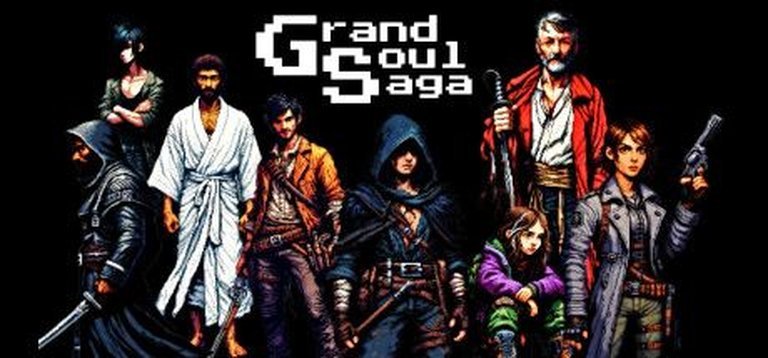
In Grand Soul Saga, you embody a refugee who escapes a violent insurrection to the tumultuous city-state of DuPont, a dystopian realm governed by technocrats, rival drug cartels, and a cryptic cybernetic force called ‘The Eye of God.’ Teaming up with a ragtag crew of smugglers and alchemists, you embark on a perilous trek to the distant port of Yerdan to reunite with your surviving family, immersed in a mature, character-driven JRPG with an open-ended world, multiple endings, and challenging turn-based combat inspired by classics like Final Fantasy VI.
Grand Soul Saga Free Download
Grand Soul Saga Patches & Updates
Grand Soul Saga Reviews & Reception
ign.com (90/100): You can go back in time, but you can’t go back in time, you know?
ign.com (90/100): An enjoyable, personality-packed builder set in a surprisingly deep world.
ign.com (90/100): Classic 2D anime fighting game action with all the modern conveniences
ign.com (60/100): Requiem for a scream.
ign.com (60/100): This sequel mostly delivers the same stealth gameplay as its predecessors, with all the good and the bad you might expect.
ign.com (90/100): This is, unfortunately, Sparta.
ign.com (60/100): The creator of Little Nightmares returns with more of the dark puzzle platforming it has honed over the last decade.
ign.com (70/100): Like a joke you’ve heard before, this sequel just doesn’t land quite as well as the original.
ign.com (70/100): Compelling gunplay and a unique raid mode help this FPS stand out.
ign.com (70/100): It’s a familiar pattern: chaotic multiplayer fun let down by a bland Adventure mode.
Grand Soul Saga: A Solo-Dev’s Masterpiece of Mature JRPG Storytelling
In an era where the term “JRPG” often conjures images of multi-million dollar budgets and sprawling development teams, Grand Soul Saga (also known as Grand Soul Story) emerges as a startlingly profound and accomplished anomaly. Crafted almost entirely by a single developer, Jeremy Reineck, and released into Early Access in February 2024, this game is not merely a nostalgic throwback but a deliberate, sophisticated synthesis of classic form and modern, character-driven narrative ambition. It stands as a testament to the enduring power of the Japanese-style RPG framework when wielded by a creator with a singular, uncompromising vision. This review will argue that Grand Soul Saga is a landmark indie achievement, a game that successfully bridges the gap between the tightly-woven narratives of 16-bit classics like Final Fantasy VI and the expansive, choice-driven worlds of Western CRPGs like Baldur’s Gate II, all while tackling mature themes with a deftness rare in its pixel-art peers.
Development History & Context: The One-Man Band of Moon Soul Games
To understand Grand Soul Saga, one must first understand its creator. Jeremy Reineck, operating under the banner Moon Soul Games, is a solo developer and composer based in New York City. The game’s credits, visible on MobyGames, list Reineck for development, writing, scoring, and direction, with assistance primarily for plug-in coding and specific pixel art assets. This places the project firmly within the thriving but challenging world of the “solo dev” or very small team indie game, a space where ambition is boundless but resources are not.
The technological foundation is the ubiquitous RPG Maker engine (specifically MZ/MV), a tool often dismissed as a “beginner’s” platform. Reineck, however, leverages it with professional-level cunning, utilizing a vast array of community and commercial plugins (from Visustella, Yanfly, Galv, and others) to overcome the engine’s inherent limitations. The result is a game that feels custom-built, from its UI to its combat systems. The press kit explicitly states the game’s inspirations: the “graphics, music, and gameplay of Final Fantasy VI” and the “semi open-world narrative intrigue of Baldur’s Gate 2.” This is a crucial dual thesis. Reineck seeks the emotional resonance, set-piece grandeur, and musical storytelling of the golden age of SquareSoft, while aiming for the player agency, non-linear questing, and reactive world of the classic Western CRPG.
Grand Soul Saga was released for Windows and macOS on February 28, 2024, as an Early Access title on Steam (priced at $14.99) and itch.io. Its release sits within a broader renaissance of “neo-retro” JRPGs—titles like Chained Echoes and Sea of Stars—that prove there is a massive appetite for 16-bit-style aesthetics coupled with modern design sensibilities. However, where those games often use their own bespoke engines or teams, Grand Soul Saga’s use of RPG Maker makes its scope and polish a particularly impressive feat. It represents a new peak for what can be achieved within this accessible but often-demonized toolset.
Narrative & Thematic Deep Dive: More Than a Refugee’s Journey
Plot Synopsis & Structure:
The player assumes the role of a refugee who has escaped a violent insurrection in their homeland. This opening immediately establishes stakes of life, death, and dislocation far more severe than the typical “chosen one” trope. The protagonist arrives in the tumultuous, crumbling city-state of DuPont, a port city that serves as the game’s first major hub. The stated goal is simple: find passage to the distant port of Yerdan where surviving family members are presumed to be waiting.
This straightforward premise rapidly unravels into a complex tapestry. DuPont is no mere stopping point; it is a fully realized, morally ambiguous underworld ruled by competing factions: technocrats (embodying cold, logical progression), competing drug cartels (representing addiction and escapism), and a mysterious, overarching force known as “The Eye of God” (a cybernetic superpower hinting at themes of surveillance, divinity, and loss of self). The protagonist is quickly drawn into this web, joining a “scrappy crew of smugglers, alchemists, and wanderers.”
The narrative is deliberately non-linear and character-driven. As per the developer’s Reddit post, the story features “many dialogue choices,” some of which “alter the course of the game,” others that register for later consequences, and some that simply emphasize the protagonist’s worldview. The quest structure is open, with side quests that can open or close based on player decisions, and some that are intentionally missable, encouraging multiple playthroughs. The goal of reaching Yerdan becomes a winding, morally complex journey where the “family” at the end may be less important than the connections forged—or broken—along the way.
Characters & Themes:
The cast is an ensemble of outsiders and misfits, each representing a core theme:
* Addiction & Recovery: Explored through characters tied to the drug cartels and the “Eye of God’s” potentially intrusive cybernetics. The press kit explicitly lists this as a central theme, suggesting treatments of dependence on substances, technology, or false idols.
* Human Connection & Grief: The protagonist’s familial motivation is the anchor, but the game repeatedly asks if found family is stronger than blood ties. Grief over lost homes and past lives permeates the world.
* Spirituality & The Nature of Reality: The enigmatic “Eye of God” blurs lines between technology and divinity, forcing characters to confront what is “real” and what is programmed. This ties into the theme of self-actualization—defining oneself in a world that seeks to categorize and control.
* Choice & Consequence: This is the gameplay’s backbone. The multiple endings (including a secret ending that requires specific grinding and choices) are not just cosmetic; they reflect the cumulative weight of the player’s interactions.
The dialogue is described as “hand-crafted,” aiming for a mature tone that avoids juvenile humor in favor of these weighty topics. The setting of DuPont itself is a character—a cyberpunk-tinged fantasy where alchemy and cybernetics coexist, creating a unique, atmospheric dissonance that feels both nostalgic and fresh.
Gameplay Mechanics & Systems: Old-School Challenge, Modern Agency
Grand Soul Saga commits fully to its turn-based, Japanese-style RPG (JRPG) combat, but with several crucial modernizations and depth additions.
Core Combat Loop:
Battles are active-time or traditional turn-based (the sources specify “turn-based” with “old-school challenge”). The system features leveling up, classes, and skill acquisition, allowing for party customization. A significant and welcome design choice is the complete absence of random encounters. All battles are scripted or tied to visible enemies on the map/navigation screen. This respects the player’s time and aligns with the “no random battles” feature tag, a hallmark of player-friendly modern JRPG design. However, the developer confirms there are many optional battles for grinding, which is explicitly required for the secret ending. This creates an elegant difficulty curve: the main path is accessible, but mastery is reserved for the dedicated.
Gear & Progression:
Equipment is acquired through both purchase at shops and drops from battles. The game includes “ultimate weapons and some hidden special gear,” rewarding exploration and completionism. Character progression is meaningful, with skill trees or acquisition systems tied to classes.
World Interaction & Questing:
This is where the Baldur’s Gate II influence shines. The world is a “semi-open world” with an “open quest structure.” NPCs have detailed descriptions and schedules. The developer notes that choices have tangible effects: “some [side-quests] open up or get closed off depending on choices made. Quite a few are difficult to find/missable.” This transforms the world from a linear set of corridors into a living system where player agency has cascading consequences. The “highly interactive world with detailed descriptions” suggests a focus on immersion through text and environmental storytelling, a strength of classic RPGs.
UI & Accessibility:
Built with RPG Maker plugins, the UI is designed to be functional and nostalgic. The game is Steam Deck compatible, a critical modern feature for portable play. The 30+ hour estimated playtime is substantial, especially for an indie title, and is bolstered by the multiple endings and missable content.
Potential Flaws:
Given its genre and engine, potential challenges include the possibility of “grindy” segments for the secret ending, which could disrupt narrative pacing. The pixel-art aesthetic, while nostalgic, may not appeal to those seeking a more polished, high-definition look. The sheer volume of text and player responsibility for tracking complex choice chains could be overwhelming for some.
World-Building, Art & Sound: Painting a Dying City with Pixels and Polyphony
Visual Direction & Art Style:
Grand Soul Saga employs nostalgic pixel-art graphics rendered in a 2D scrolling, diagonal-down perspective typical of 16-bit JRPGs. The art style aims for the charm and clarity of Final Fantasy VI. A fascinating and controversial modern element is the use of AI-generated content via DALL-E. The Steam AI disclosure clarifies that DALL-E was used for “some of the enemy battle sprites, character portraits, parallax backgrounds (4 total), and the in-game polaroid pictures,” all further modified by the developer. This is a significant, openly acknowledged aspect of the game’s creation. It raises questions about authorship and asset uniqueness but also demonstrates a pragmatic, 2024 approach to asset creation for a solo dev. The result is a visually cohesive world where AI-assisted assets are blended with traditional pixel art (sourced from RPG Maker DLCs and artists like Gabrelik for the airship), creating a distinct, if sometimes uneven, aesthetic.
The world of DuPont is the star. Described as a “crumbling city-state” with technocrats, drug cartels, and the Eye of God, its art must convey decay, layered technology, and social stratification. The pixel art, within its limitations, succeeds in creating areas that feel lived-in and oppressive, with industrial zones, affluent technocrat districts, and shady alleys all visually distinct.
Sound Design & Music:
This is arguably Jeremy Reineck’s standout skill. The game boasts an original score comprising 40+ compositions (2.5 hours of music) inspired by JRPG classics. The press kit promises a “stirring” soundtrack. In a genre where music is paramount to emotional beats, a strong, melodic, and thematically cohesive score is essential. Reineck’s dual role as composer and developer suggests an unparalleled integration of music with narrative and gameplay beats, a hallmark of the Final Fantasy series he cites as inspiration. The sound design likely complements this with classic 16-bit style soundfonts for effects, reinforcing the retro-futuristic feel.
Atmosphere & Contribution:
Together, the art and sound build an atmosphere of melancholy, tension, and mystery. The cyberpunk-fantasy hybrid world is unusual for an RPG Maker game, and the choice to tackle “psychological themes” demands a soundtrack that can handle pathos, action, and existential dread. The lack of random battles means the overworld music can be longer, more immersive tracks, enhancing the sense of a real space rather than a series of combat zones.
Reception & Legacy: An Early Access Darling with Potential for Cult Status
Critical & Commercial Reception at Launch:
Grand Soul Saga is too new to have metascore-defining critic reviews (Metacritic shows “tbd” for both critic and user scores). However, its Steam user reception is strongly positive. As of the latest data, it holds an “Overwhelmingly Positive” rating with 85% of 27 reviews being positive. This is a significant sample for a niche indie title in Early Access. Positive reviews on Steam likely praise its deep story, challenging combat, and immersive world. The few negative reviews (4) may point to RPG Maker visual quirks, pacing issues, or bugs inherent to an Early Access release.
Community & Developer Response:
The developer is actively engaged, as seen in the Steam community discussions. A key thread where a user asks about classic JRPG elements (leveling, choices, gear, grinding, secrets) receives a detailed, enthusiastic response from “MoonSoulGames” confirming all these features and revealing the secret ending requires significant grinding. This transparency is a positive sign for the game’s ongoing development based on community feedback, a common practice for Early Access titles.
Influence & Place in Industry History:
Grand Soul Saga is not a trendsetter in the way Undertale was, but it is a pivotal example of several converging trends:
1. The Power of RPG Maker: It challenges the stigma around the engine, proving it can produce a game with the depth and ambition of a Chrono Trigger or FFVI spiritual successor.
2. Solo Dev + AI Tools: It openly embraces AI-assisted asset generation as a practical tool for a one-person team, setting a potential template for other indie developers facing art asset bottlenecks.
3. Nostalgia with Maturity: It joins the vanguard of retro-style JRPGs (Chained Echoes, Sea of Stars) that use the aesthetic to tell stories with sophisticated, adult themes, moving beyond the often-innocent fantasies of the 16-bit era.
4. Genre Hybridization: Its explicit borrowing from CRPG non-linear questing is a subtle but important evolution of the JRPG format.
Its legacy will be defined by its completion and whether it fulfills its promise of 30+ hours and multiple meaningful endings. If it does, it will be remembered as a cult classic—a deep, rewarding, and philosophically rich experience that flew under the mainstream radar but garnered immense respect within the niche of story-first, retro JRPG fans. It demonstrates that the core appeal of the JRPG—exploration, growth, choice, and emotional story—can be delivered by a determined individual with a clear vision and the wisdom to use the right tools (including modern plugins and AI) to execute it.
Conclusion: A Formidable, Flawed Pearl from the Depths of Indie Development
Grand Soul Saga is a game of striking contradictions. It is infinitely ambitious yet built on the constrained foundation of RPG Maker. It is a solo project with the scope of a team effort. It uses a childlike art style to explore profoundly adult themes. These tensions are not weaknesses but the very source of its unique character.
Its strengths are monumental: a narrative that treats players as intelligent adults, a world that feels reactive and consequential, a combat system that is classic yet thoughtfully modified, and a soundtrack that promises the emotional depth of its inspirations. The open acknowledgment and integration of AI tools is a bold, pragmatic statement on modern indie development.
Potential flaws lie in the unevenness that can come from a solo dev’s vision—the pixel art may occasionally lack polish, the sheer volume of text could lead to pacing issues, and the grind for the secret ending might feel like a retro relic rather than a welcome challenge. The Early Access label means some rough edges are expected.
Final Verdict: Grand Soul Saga is not just a good indie JRPG; it is an important one. It is a love letter to Final Fantasy VI‘s soul and Baldur’s Gate II‘s structure, filtered through a modern, mature, and philosophically curious lens. For its audacious scope, its successful integration of disparate influences, and its unwavering commitment to player agency and thematic depth, it earns a place in the annals of video game history as a landmark achievement in solo development and a must-play for connoisseurs of narrative-driven RPGs. It may be rough around the edges, but its heart, mind, and soul are as grand as any title from the golden age it reveres. Its ultimate legacy will be measured in the depth of discussion it inspires about its themes and the inspiration it provides to other solo developers dreaming of crafting their own epic worlds.