
- Release Year: 2020
- Platforms: PlayStation 4, Windows, Xbox One
- Publisher: Konami Digital Entertainment Co., Ltd.
- Genre: Special edition
Description
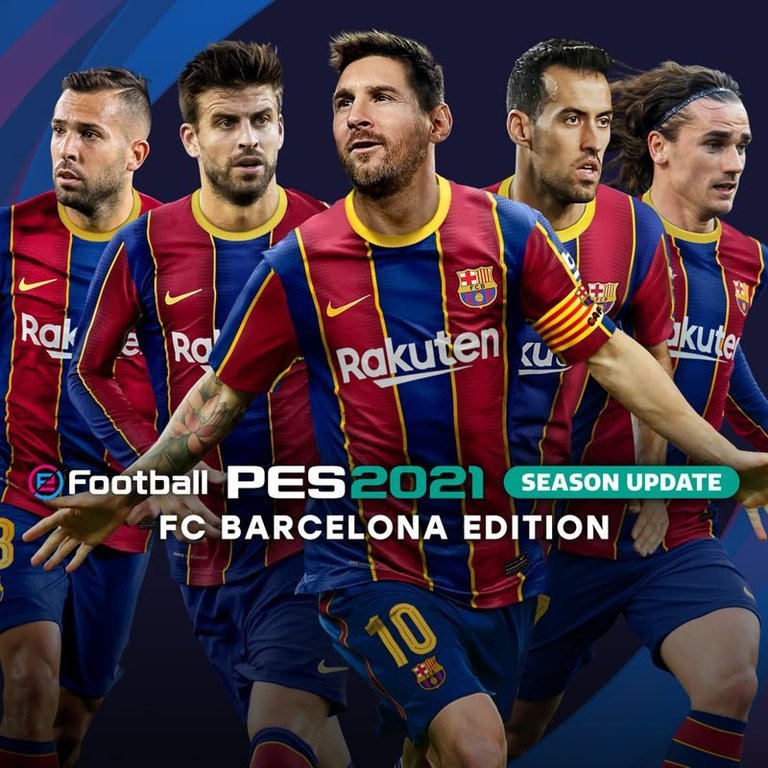
eFootball PES 2021: Season Update (FC Barcelona Edition) is a special edition of Konami’s soccer simulation series, celebrating 25 years of PES with updated player data and rosters for the 2020-2021 season, built upon the award-winning gameplay of eFootball PES 2020. It includes the UEFA EURO 2020 tournament mode and offers exclusive FC Barcelona-themed content such as an ‘Iconic Moment Series’ player, full squad, digital kit, and custom menu themes, alongside standard modes like myClub, Matchday, and Master League for both single-player and online multiplayer experiences.
Gameplay Videos
eFootball PES 2021: Season Update (FC Barcelona Edition) Reviews & Reception
ign.com : It’s last year’s game, but at least it’s honest about it.
eFootball PES 2021: Season Update (FC Barcelona Edition): Review
Introduction: The Honest Stopgap
In the long-running and often fiercely contested battle for football video game supremacy, the year 2020 represented a profound turning point. The global pandemic disrupted development cycles, delayed console transitions, and forced an industry accustomed to annualized releases to confront uncomfortable truths about iteration, innovation, and value. Into this maelstrom stepped eFootball PES 2021: Season Update, a title that, by its very naming and conception, stands as one of the most transparent and consequential experiments in modern sports gaming. This was not a Pro Evolution Soccer 2021 in the traditional sense; it was a Season Update. And the FC Barcelona Edition, one of several “Partner Club” variants, served as a flagship for this new, stripped-back philosophy. This review will argue that PES 2021 Season Update is a fascinating paradox: a game that is both a disappointingly minimal product and a pragmatically honest one. It represents Konami’s reluctant acceptance that the pursuit of a “new” game each year was becoming unsustainable, choosing instead to preserve and present the pinnacle of the Fox Engine’s on-pitch achievement—the critically acclaimed PES 2020—at a reduced price point, while using the extra development breathing room to prepare for a generical leap. The FC Barcelona Edition, with its exclusive club content, becomes a lens through which to examine this strategy: does the promise of a fully licensed Barça squad, a classic kit, and a unique “Iconic Moment” star compensate for a game that is, at its core, a repackaged masterpiece?
Development History & Context: A Year of Pause and Pivot
To understand PES 2021 Season Update, one must first understand the state of the Pro Evolution Soccer franchise entering 2020. The preceding title, eFootball PES 2020, had been a critical darling, widely praised for its unparalleled on-pitch fluidity, refined passing mechanics, and impressive player likenesses powered by the Fox Engine. It had won “Best Sports Game” at E3 2019. However, it was also hamstrung by notorious licensing issues, a dated and clunky menu system, and a myClub mode increasingly scrutinized for its monetization.
The gaming landscape in mid-2020 was defined by the COVID-19 pandemic. Development studios shifted to remote work, creating significant logistical hurdles. Concurrently, the PlayStation 5 and Xbox Series X/S were on the horizon, promising a technological paradigm shift. Faced with the prospect of developing a full, innovative sequel for aging hardware while simultaneously building a next-gen foundation, Konami made a radical decision. As reported by outlets like IGN and GamePressure, they announced that PES 2021 would be a “season update,” not a full sequel. It would be unavailable on PS5/XSX at launch and would use a modified version of the PES 2020 engine. This was an admission: the resources required for a true annual sequel were better spent on the future. The FC Barcelona Edition, alongside editions for Bayern Munich, Juventus, Manchester United, and Arsenal, was born from this strategy. These were not just skins; they were bundled packages designed to incentivize digital sales and deepen partnerships with Europe’s elite clubs, offering club-specific myClub squads, kits, and menu themes as digital extras.
Narrative & Thematic Deep Dive: The Story of a Business Model
Unlike narrative-driven games, a sports titles’ “story” is written in its design philosophy, marketing, and community response. PES 2021 Season Update’s narrative is one of corporate pragmatism and consumer transparency, a stark contrast to the often accusatory “copycat” or “roster update” criticisms levied at both the FIFA and PES series for years.
The official description and Konami’s messaging consistently frame this as a “25th Anniversary” release, celebrating a quarter-century of the franchise. Yet the tone is defensive and explanatory, filling space with disclaimers: “This product is an updated edition of eFootball PES 2020…” and “Due to the ongoing impact of COVID-19…” These are not boasts of new features but caveats outlining limitations. The thematic core is preservation. The game’s primary narrative function is to safeguard the beloved gameplay of PES 2020 from being lost to the technological churn, allowing it to remain relevant and accessible at a “special anniversary price.”
The FC Barcelona Edition adds a secondary, club-specific narrative. FC Barcelona’s press release positions this not as a mere video game, but as an extension of the club’s brand into the digital and eSports realm. The inclusion of the “unprecedentedly detailed recreation of the Camp Nou” and the ability to play as the full Barça squad in myClub ties the game directly to the club’s identity and legacy. The “Iconic Moment Series” player (often featuring a legend like Messi in a career-defining kit) attempts to weave video game fantasy with historical nostalgia, a common tactic in modern sports titles (akin to FIFA’s Icon cards). This edition tells the story of a symbiotic partnership: Barça gains a sophisticated gaming platform to engage its global digital-native fanbase, while Konami gains exclusive content and a flagship product for one of the world’s most popular clubs.
Gameplay Mechanics & Systems: The Fox Engine, Preserved
Here lies the game’s greatest strength and its most glaring point of contention: the on-pitch product is, with minor tweaks, eFootball PES 2020.
Core Gameplay Loop: The fundamental feel remains a high point in football simulation history. The Fox Engine’s physics system delivers a tangible weight and momentum to players. Passing is nuanced and satisfying, with a deep system of manual controls allowing for precise through balls, driven passes, and floated crosses. The “ball control” mechanic, where players can trap or flick the ball with a second button press, returns, enabling creative, organic sequences that feel less scripted than competitors. Dribbling is responsive, and shooting has a variety of outcomes based on player stats, angle, and power.
Innovations (or Lack Thereof): The IGN review succinctly states: “The graphics? They’re the same. Controls? They’re the same too.” The changes are granular and fall under what Konami calls “gameplay adjustments,” primarily found in yearly Data Packs. For PES 2021, this meant improved first touches and “control at sprinting pace,” making the game feel slightly less punishing on counters. However, as the IGN critic notes, these adjustments have historically swung both ways—improving one aspect while sometimes breaking another (like AI decision-making). The infamous AI “ball-watching” persists, where unselected players can stand idle after a deflection, breaking immersion. The pre-set tactical strategies and team instructions remain largely unchanged.
myClub and Monetization: The myClub mode—PES’s answer to Ultimate Team—is central to the “Season Update” monetization strategy. The FC Barcelona Edition directly boosts this mode. The included “3 Player Contract Tickets x 30 weeks” allow users to keep players beyond their standard contract expiration, a significant quality-of-life advantage. The “Premium Agent” (a loot-box style mechanism to randomly acquire players) for 30 weeks provides regular opportunities to sign new talent. Most valuable is the exclusive FC Barcelona full squad for myClub, instantly granting access to the entire Barça roster, including a special “Iconic Moment Series” player (likely a prime version of a club legend like Messi, Xavi, or Iniesta). This is a powerful draw for Barça fans, offering a legitimate shortcut to building a top-tier team. The 3,000 myClub Coins are the in-game currency for purchases. The model remains a “loot box” system with “infinite spend” potential, as classified on PCGamingWiki.
Master League: The premier single-player mode returns with minor updates. The most notable addition is the inclusion of new “Legend Managers” as playable figures, with Pep Guardiola specifically mentioned in official materials for the Barcelona context. The interactive dialogue system and cinematic cutscenes, introduced in PES 2020, carry over, providing a functional, if unspectacular, managerial career experience. No major structural overhauls were implemented.
UEFA EURO 2020 Mode: The marquee “new” feature is the fully licensed offline tournament mode for the rescheduled Euro 2020. It includes all 55 UEFA national teams with authentic kits and Wembley Stadium. This is a substantial, standalone mode that adds clear value, especially for European football fans, and its inclusion at no extra cost is a significant plus.
UI and Presentation: The menus are carry-overs from PES 2020 and are widely criticized as dated, cluttered, and unintuitive. The only novelty for Club Editions like Barcelona’s is a “customised game menu” theme featuring Barça branding, a cosmetic touch that does little to address the underlying UX/UI flaws.
World-Building, Art & Sound: The Stadium as Cathedral
The Fox Engine’s greatest triumph remains its player models and stadiums.
Visual Fidelity: PES 2021 inherits PES 2020‘s state-of-the-art 3D full-body scans and meticulously updated player faces via Data Packs. Star players like Messi look astonishingly lifelike, with subtle muscle definition and accurate facial features. The animation blending is superb, resulting in organic, non-repetitive movement. The FC Barcelona Edition ensures the iconic Blaugrana kit is rendered with perfect accuracy.
The true standout is the Camp Nou. As highlighted by FC Barcelona’s own announcement, the stadium is recreated with “unprecedentedly detailed” precision. The cavernous feel, the distinctive stands, the pitchside details—all are captured with a reverence that turns a venue into a character. This level of authenticity for a single partnered club is a major selling point, offering a sensory experience that generic or poorly licensed stadiums cannot match. Other iconic stadiums in the game (like Signal Iduna Park or Allianz Arena) receive similar treatment, but the Barça version is, naturally, the crown jewel for this edition.
Atmosphere and Sound: The sound design is competent but not groundbreaking. The roar of the crowd, while dynamic, can feel repetitive. The commentary team (featuring Peter Drury and Jim Beglin) is respected but lacks the cultural cachet or emergent storytelling of some competitors. The soundtrack is a generic mix of rock and electronic tracks, easily forgettable. The atmosphere is built more on the visual fidelity of the crowd and the authenticity of the stadiums than on an audial level.
Reception & Legacy: A Pragmatic Pivot
Critical Reception at Launch: The response was measured and understood the game’s context. OpenCritic lists a Metascore of 74. Reviews like IGN’s 7/10 capture the consensus: “Aside from a handful of updates, PES 2021 is ultimately the same as last year’s game… But this release asks an important question… are we prepared to tide ourselves over on off-years with packages like this?” Critics praised the on-pitch quality, the Euro 2020 mode, and the honest pricing. They lambasted the lack of meaningful new features, the archaic menus, and the continued licensing gaps (though the Club Editions mitigated this for their specific teams). The FC Barcelona Edition was seen as a value proposition for die-hard fans of the club, offering exclusive myClub advantages.
Commercial and Long-Term Legacy: Commercially, the lower price point ($29.74 for Club Editions, $25.49 for Standard) and the 20% loyalty discount for PES 2020 owners made it an attractive purchase for the unconvinced or budget-conscious. However, its most significant legacy is not in sales figures but in business model validation. PES 2021 Season Update successfully framed the “season update” as an acceptable, even commendable, alternative to a full-priced, minimally-incremented sequel. It bought Konami crucial development time.
This philosophy directly led to the franchise’s most radical shift. In 2021, Konami announced eFootball, a completely free-to-play, cross-platform, live-service rebranding of the series—the ultimate evolution of the “season update” concept. PES 2021 Season Update can now be seen as the transitional bridge between the old, annualized Pro Evolution Soccer model and the new, Games-as-a-Service eFootball. It was the last “full” paid release before the plunge into F2P.
Its legacy within football gaming history is that of a necessary placeholder. It preserved the best-in-class gameplay during a industry hiatus, funded the future, and tested the waters for a subscription/update-based model. For fans, it represents a bittersweet moment: the last time the Fox Engine’s peak was sold as a premium, standalone product before its mechanics were repackaged into a live-service framework.
Conclusion: A Snapshot in the Beautiful Game’s Digital Evolution
eFootball PES 2021: Season Update (FC Barcelona Edition) is not a traditional video game review subject. It is an audit of a strategy, a preservation of a moment. As a pure football simulator on the pitch, it remains exceptional. The feel of the ball, the weight of a pass, the satisfaction of a perfectly executed team move—these are the work of a development team at the absolute peak of its craft. The FC Barcelona Edition enhances this for a specific audience with its exclusive stadium, kits, and myClub advantages, making it the definitive way to experience Barça in this engine.
However, as a product, it is a statement of intent. It consciously says, “We are not giving you a new game this year. Here is last year’s game, updated, cheaper, and with some club-specific frosting.” The dishonesty lies not in the product itself, but in the marketing’s attempt to frame it as a “new installment” worthy of a full launch cycle. The menus are archaic, the new features are scant (Euro 2020 is the standout), and for anyone who owned PES 2020, the upgrade rationale is virtually non-existent unless you are a Barcelona completist.
Its place in history is secure, but as a pivotal stepping stone rather than a landmark title. It is the game that allowed Konami to break the annual cycle and leap towards eFootball. To evaluate it solely on its own scant merits is to miss the point. It must be evaluated as the last, honest gasp of the old regime—a beautifully played, visually stunning, but fundamentally static snapshot of football gaming at a crossroads. For the FC Barcelona faithful who skipped PES 2020, it is a fantastic, content-rich entry point. For the series historian, it is a fascinating case study in adaptation. For the series veteran, it is a familiar and excellent game, sold at a fair price, that signals the end of an era. Verdict: A superb gameplay engine preserved, but a title defined entirely by the pragmatic, transitional business decision it represents.