
- Release Year: 2013
- Platforms: Windows
- Publisher: rondomedia Marketing & Vertriebs GmbH
- Developer: Inertia Game Studios
- Genre: Adventure, Puzzle
- Perspective: First-person
- Game Mode: Single-player
- Gameplay: Hidden object, Mini-games
- Setting: Fantasy
Description
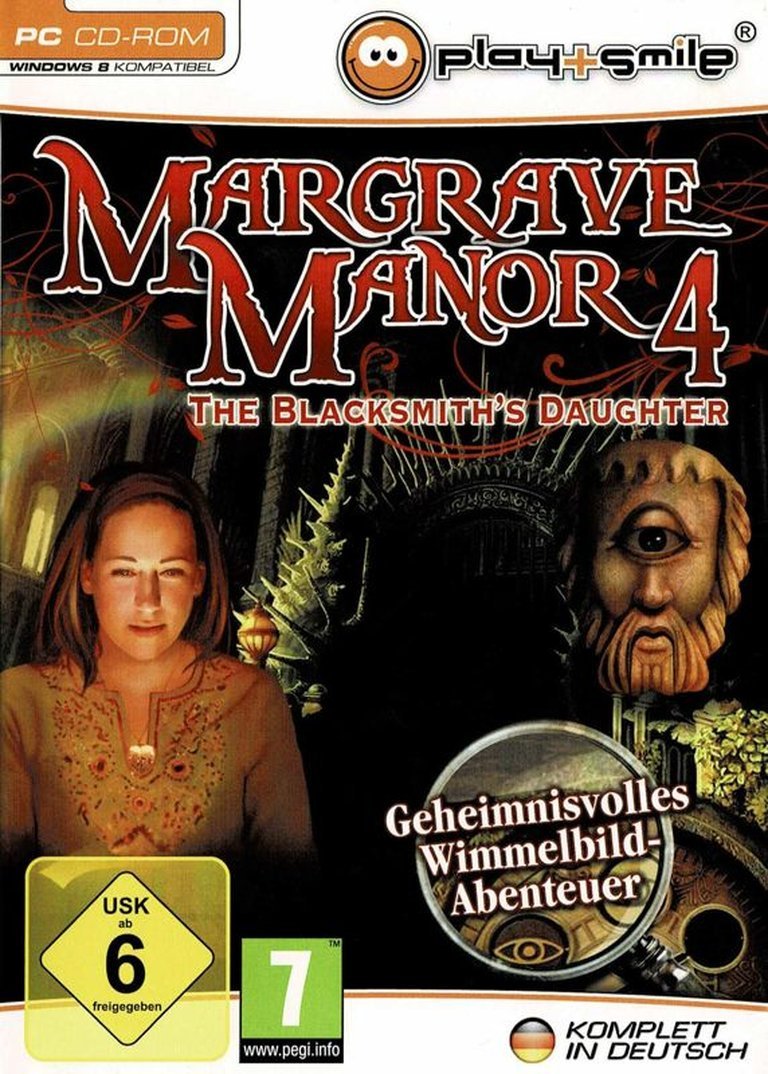
Margrave: The Blacksmith’s Daughter is a first-person point-and-click adventure game with hidden object and puzzle elements, set in a fantastical realm. Players embark on a detective-style rescue mission in the Town of the Cyclops, exploring locations like abandoned villages and standing stones while interacting with characters and solving mysteries through inventory-based challenges and mini-games.
Margrave: The Blacksmith’s Daughter Guides & Walkthroughs
Margrave: The Blacksmith’s Daughter Reviews & Reception
legacygames.com : this is one of the best!
gamezebo.com : The biggest problem with The Blacksmith’s Daughter is the massive amount of backtracking.
casualgameguides.com : Margrave: The Blacksmith’s Daughter is one wild ride. Strange, confusing, unique and totally enthralling.
Margrave: The Blacksmith’s Daughter: A Cyclopean Epic of Memory, Loss, and Lock-Picking
Introduction: A Town That Sleeps for Centuries
In the crowded marketplace of early 2010s casual gaming, where hidden object adventures often relied on familiar ghost stories or romantic mysteries, Margrave: The Blacksmith’s Daughter arrived as a bold, bewildering, and beautifully melancholic anomaly. Released in 2013 by Inertia Game Studios as the fourth (and likely final) entry in the Margrave series, it stands as a self-contained saga that plunges players into a mythic, one-day-only town of cyclopes drowning in lush overgrowth and ancient tragedy. From its haunting opening chords of “The Sunflower Song” to its race-against-sunset climax, the game is an ambitious fusion of detective mystery, gothic fantasy, and intricate puzzle-craft. This review argues that The Blacksmith’s Daughter is a landmark in the hidden object genre, not for its accessibility, but for its audacious narrative depth, its mechanically rich and often taxing puzzle design, and its unwavering commitment to a tone of wistful horror—a game that demands patience and reflection, rewarding players with an experience that lingers long after the final puzzle is solved.
Development History & Context: The Last Breath of a Casual Giant
Margrave: The Blacksmith’s Daughter emerged from Inertia Game Studios, a developer already seasoned in the casual adventure space with several Margrave titles and other hidden object games to their credit. By 2013, the genre was in a period of maturation. The early-2000s boom of casual CD-ROM titles had solidified core mechanics: point-and-click navigation, lists of hidden objects, and a parade of mini-games. Big Fish Games, the dominant publisher and distributor, had perfected the “collector’s edition” model with bonus content and integrated strategy guides. The Blacksmith’s Daughter was a product of this ecosystem, yet it felt like a culmination—a studio pushing against the genre’s perceived limits.
Technologically, the game reflects its era. Built for Windows with a fixed, flip-screen perspective, it uses pre-rendered backgrounds of stunning detail but limited interactivity. Character portraits are static, high-quality images with fully voiced dialogue—a common shortcut in casual adventures that, as critics noted, creates a jarring “lips-don’t-move” disconnect. The development team’s vision was clearly focused on content density and puzzle complexity rather than technical innovation. They leveraged the genre’s constraints to create a sprawling, non-linear townscape filled with interconnected locks and keys, where every item and clue had potential use in multiple locations. This was the pinnacle of a design philosophy: in an age where mobile gaming was beginning to fragment the market with bite-sized experiences, Margrave doubled down on the idea of a substantial, desktop-bound epic that could take players 15-20 hours to unravel.
Narrative & Thematic Deep Dive: A Thousand-Year Ghost Story
The plot of The Blacksmith’s Daughter is a labyrinthine tapestry of personal loss, cyclical time, and societal collapse. Edwina Margrave arrives at a hillside meeting with the enigmatic Miss Thorn, only to witness the miraculous, sun-triggered appearance of the Town of the Cyclops and the immediate abduction of her boyfriend, Tom by a monstrous cyclopean brute. The premise—a city that exists for one day every 300 years—immediately establishes themes of impermanence and haunting legacy. Edwina’s mission is twofold: rescue Tom before sunset and, in doing so, unravel the fate of the cyclopean civilization.
The narrative is delivered through a series of awakenings. The town’s inhabitants are not dead but in a state of suspended animation, their souls housed in “Seer Stones” ( disembodied heads mounted on walls). Waking them via “divination tools” (dream card matching and rune stone memorization) is the primary quest structure, and each Seer provides a fragment of lore, a practical tool, or a key to progression. This creates a story told in vignettes of tragedy: Finna, the Lady Seer, must reconstruct the faces of her eleven husbands and relatives from memory; Rudo and Keelin recount the tale of the Ouphe, an automaton assassin who slaughtered the town; Gazini sleeps in a tower; Morven guards a soul trumpet in a seashell campanile.
The central villain, Uisdean, is revealed to be Keelin’s brother, a puritan who survived a massacre and spent centuries nursing a grudge, using Edwina as a pawn to retrieve the Eye of Brites—a key that opens all cyclopean doors. His motivation is a potent mix of personal vengeance and desperate desire to escape his timeless prison. The thematic core emerges through these characters: the horror of being trapped in time, the weight of memory (embodied by Edwina’s constant note-taking in her “keepsakes” inventory), and the cost of survival. The subplot involving Miss Thorn is particularly tragic. She is revealed to be a centuries-old soul trapped in an automaton body, her sanity fraying. Her liberation requires a wedding—a surreal, darkly comic, and ultimately poignant ceremony where Rudo sacrifices himself to marry her, freeing her soul.
The climax confronts the Ouphe not as a final boss in a traditional sense, but as a lingering threat. The true final confrontation is with Ula, the first Seer, in a psychic combat mini-game after she captures Tom. The resolution sees Edwina and Tom escape with the Eye, but not before Keelin chooses to stay with the dying Uisdean, entrusting Edwina with a doll for her father, the blacksmith Oban. The ending is bittersweet: the town vanishes, a civilization’s legacy erased, but a personal promise remains. The narrative is praised for its ambition and emotional weight but often criticized as “convoluted” or “inconsistent” (as noted in the Casual Game Guides review), blending puritans, automata, psychic combat, and folkloric prophecy into a genre-defying stew.
Gameplay Mechanics & Systems: The Architecture of a Puzzle Box
Gameplay is a meticulously engineered cycle of exploration, item collection, and puzzle-solving, all under a relentless sunset timer.
-
Core Loop & Structure: The town is a vast, interconnected hub initially gated by “see-locks” and “web-locks.” Progression is gated by acquiring “persistent items”—key tools that permanently occupy slots at the top of the screen and are used repeatedly across chapters. These include:
- Divination Tools (Dream Cards & Rune Stones): Used to wake Seer heads. The Dream Cards require matching edge symbols to form a pictograph; the Rune Stones are a memory-matching shell game.
- See-Charms: Disc-puzzle keys that slide and flip to match a code (e.g., the Trident Code, Bone Code). They are consumed when used on a specific door.
- Mechanical Companions: Rudo (the first Seer awakened) replaces the hint button but has a recharge time. Gotto (a mechanical bug) is required to trace constellation patterns on web-locks. Afi (a small bird from a cage) can access high or distant areas, revealing “Afi zoom” scenes.
- The Rose Eye: A late-game tool that wipes away illusions, revealing hidden Seer heads and passages marked with a carved rose symbol.
-
Hidden Object Scenes: Scenes sparkle when enterable. They are the primary source of inventory items, puzzle components (like beetle whistles or fish buttons), and sometimes critical clues. The difficulty is notable; as Zac from Legacy Games states, they are “difficult in a way that never feels unfair,” though the “soft color palette” can make items blend in. Items found in one scene are removed from future iterations of that scene, a detail praised for thoughtful design.
-
Puzzle & Mini-Game Design: This is the game’s true brilliance and primary challenge. It boasts a dizzying array:
- Lock Mechanisms: Frog locks (turn dials to a specific arrangement of leaves/bones), wardian locks (same principle, no hint), bird-song locks (replicate colored notes), and the ever-present see-locks.
- Constellation Web-Locks: Using Gotto to trace star patterns on a web.
- Divination Games: As described, the two-stage process of dream revelation and memory matching is lengthy and requires concentration.
- “Dead Ringers” Bell Puzzle: Identify three correct wooden faces from a crowd based on a riddle.
- “Dead Heads” Memory Game: Recreate relatives’ faces from hairstyle, eyes, mouth, facial hair tabs.
- Soul Jar Sorting: Match numbered jars to shelf symbols.
- Parade Mini-Game: A rhythm-based sequence where you click symbols on a flute to guide automata across a bridge.
- Psychic Combat: A final showdown where you must select a unique shape from two sets.
The puzzles are lauded for their creativity and integration with the narrative (e.g., waking a Seer requires their specific story-related items). However, their sheer number and the game’s non-linear structure can lead to massive backtracking, a major criticism from Gamezebo and others. The promise of fast-travel via secret tunnels is only partially fulfilled, as access is gated by specific story beats.
-
Inventory & UI: Inventory is split into “Items” and “Keepsakes.” Keepsakes store sketches, codes, and letters that often glow when relevant. The map has “Overview” (bird’s-eye with fast-travel to unlocked tunnels) and “Discovery” (tracking visited locations with an exclamation mark for next objective). This system is robust but can be overwhelming. The skip meter for puzzles fills faster in Casual mode, but the game’s intended difficulty on Expert is significant.
-
Flaws: The autosave system is singled out as archaic and potentially punitive. As Zac notes, it can lead to permanently missable collectibles if a save occurs at the wrong moment. The static cutscenes with frozen lips are repeatedly cited as jarring, breaking immersion despite competent voice acting.
World-Building, Art & Sound: The Beauty of Decay
The Town of the Cyclops is a masterpiece of environmental storytelling. The art direction paints a world of majestic, melancholic ruin. Lush vines and wildflowers choke cyclopean architecture: grand arches, towering bell towers, an automata courtyard, and the ominous Sun Tower. The color palette is rich but muted, with golds, greens, and blues dominating, creating a sense of a place both magical and long-abandoned. The contrast between the breathtaking beauty of the landscapes and the disturbing imagery (the faceless creature, the Ouphe’s automaton, Miss Thorn’s decaying form) is potent, making the horror elements “hit hard” as Zac observed.
The sound design is equally celebrated. The opening “Sunflower Song” sets a tone of haunting, folksy wistfulness that persists. Sound effects for mechanisms—clicks, whirls, chimes—are satisfying and distinct. The voice acting, while competent, is hamstrung by the static character portraits. The atmosphere is one of profound solitude and ancient sorrow, a place where the silence is occasionally broken by the whir of a mechanical bird or the distant toll of a bell.
Reception & Legacy: A Cult Classic in the Making
At launch, Margrave: The Blacksmith’s Daughter existed in the quiet, profitable waters of the casual download market. It did not garner widespread mainstream critical attention from outlets like IGN or Eurogamer, and its MobyGames score remains “n/a” due to a lack of aggregated critic reviews. However, within its target community—dedicated hidden object players—it was acclaimed. Reviews from niche sites like Legacy Games and Casual Game Guides are resoundingly positive, praising its ambition, art, and puzzle design while candidly noting its flaws (backtracking, save system, cutscenes).
Its legacy is that of a genre pinnacle. In an era where many hidden object games were becoming formulaic, Margrave demonstrated that the format could support a complex, continuous narrative with persistent mechanical systems and puzzles that felt consequential to the story. The use of multiple permanent companions (Rudo, Gotto, Afi) as tools was innovative. The sheer volume and variety of puzzles set a high bar. It represents the end of an era: the large-scale, PC-exclusive, CD-ROM-based casual adventure that was a mainstay of the 2000s and early 2010s, just before mobile gaming and hyper-casual models changed the landscape. For fans of the genre, it is remembered as a “hidden gem” (a phrase used multiple times in reviews) that took the core tenets of hidden object and adventure gaming and wove them into something resembling a proper fantasy novel.
Conclusion: An Imperfect Masterpiece of Its Time
Margrave: The Blacksmith’s Daughter is not a flawless game. Its pacing is glacial, burdened by necessary but exhausting backtracking. Its narrative is dense to the point of opacity, and its presentation is technically dated. Yet, these very flaws are tangled with its greatest strengths. The backtracking forces you to soak in the world’s detail; the convoluted plot rewards careful note-taking and a sense of discovery. The static cutscenes, while awkward, keep the focus squarely on the environments and puzzles.
This is a game for the patient archaeologist of game design. It asks you to learn a complex language of codes, constellations, and mechanical behaviors, then rewards that learning with moments of profound narrative payoff—a Seer’s remembered face, a tragic backstory revealed through a puzzle, the bittersweet resolution of a centuries-old ghost’s story. Its ambition to be more than a “find-the-hidden-object” game is its defining achievement. In the pantheon of casual adventures, Margrave: The Blacksmith’s Daughter stands as a monumental, melancholic, and wildly creative capstone—a testament to what the genre could achieve when it dared to dream in cyclopean scale. It is, as one review put it, “one of the best” hidden object games ever made, a title whose legendary status within its niche is entirely justified.