
- Release Year: 2003
- Platforms: Macintosh, Windows
- Publisher: Lannoo Nieuwe Media
- Developer: Takka Takka, Telraam
- Genre: art, Educational, Graphics, logic, Math, Pre-school, Reading, toddler, writing
- Game Mode: Single-player
- Gameplay: Puzzle-solving, Reading
- Setting: Forest
Description
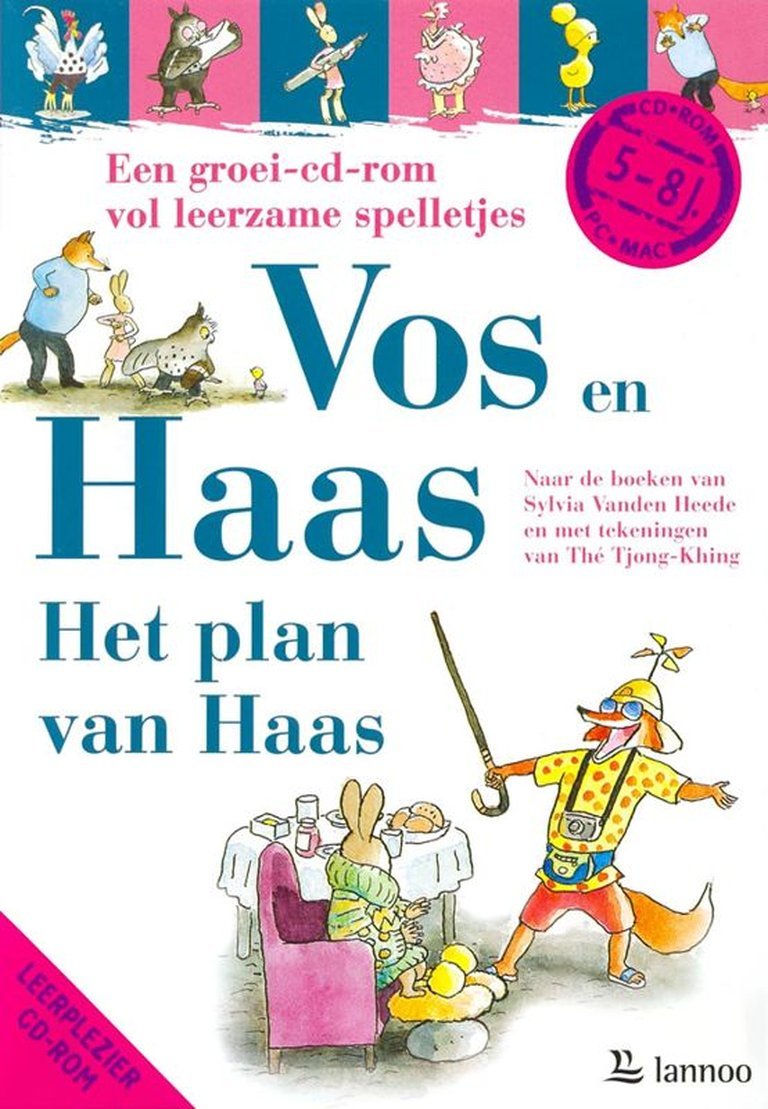
Vos en Haas: Het plan van Haas is an educational adventure game for children aged five to eight, acting as a sequel to the original ‘Vos en Haas’. It immerses players in whimsical stories featuring animal characters like Fox, Hare, Owl, and Piep, where reading along and solving puzzles at the end of each chapter unlocks new narrative progression, all within a playful, literature-inspired setting.
Vos en Haas: Het plan van Haas: Review
Introduction: A Charming Continuation in the Belgian Edutainment Vanguard
In the sprawling, often-overlooked archives of European educational gaming, few series capture the specific cultural and pedagogical spirit of early 2000s Belgium like Vos en Haas. Emerging from the fertile collaboration between publisher Lannoo Nieuwe Media and studios Telraam and Takka Takka, this franchise carved a unique niche in the living room, blending literary heritage with interactive design. Vos en Haas: Het plan van Haas (literally, Fox and Hare: Hare’s Plan), released in September 2003 for Windows and Macintosh, is not a revolutionary sequel but a masterclass in iterative confidence. It is a game that understands its core audience—children aged five to eight—and its foundational DNA with such precision that it transcends mere repetition to become a touchstone of comfort and cognitive engagement. This review argues that Het plan van Haas represents a pinnacle of “assured sequeling” in the edutainment genre: it refines rather than redefines, deepens rather than disrupts, offering a meticulously crafted experience that prioritizes narrative continuity and developmental appropriateness over flashy innovation.
Development History & Context: The synergy of Belgian studios in the CD-ROM era
The early 2000s were a twilight period for the CD-ROM-driven edutainment boom. While global attention was shifting toward online learning and handhelds, Belgium maintained a robust, locally-focused market for premium, narrative-driven educational software. Vos en Haas: Het plan van Haas was born from the synergistic partnership between two specialized studios. Telraam, credited for the “Interactive Scenario,” was likely the narrative and systems architect, while Takka Takka handled “Additional Graphics and Animations” and programming (Wim Soens). This division of labor was typical: Telraam’s expertise in adaptive storytelling for children dovetailed with Takka Takka’s technical implementation of the original game’s beloved engine.
The game exists in the long shadow of its predecessor, Vos en Haas: Het ij van uil (2002). The source material explicitly states that Het plan van Haas “uses the gameplay and interface from the first game, but with new stories, drawings and games.” This is not a disclaimer but a declaration of intent. In an era where sequels often demanded new hardware or genres (think Myst to RealMyst), this approach was economically and creatively astute. It allowed the team to focus resources on fresh content—new chapters written by Sylvia Vanden Heede, new illustrations by the esteemed Thé Tjong-Khing—while leveraging a proven, stable, and child-tested technical framework. The constraints of the CD-ROM format (a fixed 700MB capacity) and the need for broad compatibility on modest early-2000s Windows/Mac hardware made reusing the core engine a pragmatic necessity that evolved into a philosophical strength. The game was a product of its market: a commercial retail release (published by Lannoo Nieuwe Media) aimed squarely at the Flemish (Dutch-speaking) home and educational sector, where the Vos en Haas brand, originally from Vanden Heede and Tjong-Khing’s picture books, already had significant cultural cachet.
Narrative & Thematic Deep Dive: Maturity, Mystery, and Moderation
Where Het plan van Haas truly distinguishes itself is in its narrative architecture, which uses the familiar as a launchpad for subtle thematic maturation. The story picks up with the ensemble cast in a state of gentle flux. Piep, the chick from the first game, is now “grown up,” signaling to the player that they, too, are growing and can engage with more complex plots. The central mystery is introduced not through a grand adventure, but via mundane postal intrigue: Owl (Uil) receives a “strange note by mail” accompanying a new egg. The query, “Hoe gaat het met ons ei?” (“How is our egg doing?”), signed by “Piep and Tok,” is a brilliantly simple hook. It introduces the enigmatic “Tok” and creates a puzzle of identity and connection that echoes through the chapters.
Simultaneously, Hare (Haas) initiates his “plan”—putting Fox (Vos) on a diet. This subplot is a masterstroke of age-appropriate didacticism. It tackles health and moderation not through dry lecturing, but through the relatable, humorous dynamics of friendship and persuasion. Haas’s well-meaning but “unconventional” diet plan promises comedic set-pieces while embedding soft lessons about nutrition and caring for others.
The structure is methodical and pedagogically sound: read a chapter, solve a puzzle, unlock the next part. This loop, as described in the official synopsis, creates a natural breakpoint for a child’s attention span and provides constant, tangible progression. The puzzles are thematically integrated—the nationaalarchiefeducatievegames.nl source suggests one involves puzzling out the mysterious brief—making the learning feel inseparable from the plot’s forward momentum. The dialogues, as noted by Retro Replay, are “short enough to hold attention but rich in character development.” The narrative avoids heavy-handed moralizing; instead, themes of responsibility (Owl’s concern), curiosity (the mystery of Tok), and empathy (Haas’s plan for Fox) emerge organically from the animal characters’ interactions, a hallmark of Vanden Heede’s original writing.
Gameplay Mechanics & Systems: The Elegance of the Known Loop
The gameplay is a deliberate echo of its predecessor, and this consistency is its greatest strength. The interface is “intuitive and child-friendly,” relying on simple mouse actions: point, click, and drag-and-drop. This eliminates barriers to entry. A returning player from Het ij van uil would feel “immediately at home,” a crucial factor for building confidence in young learners.
The core gameplay loop is a narrative-progress puzógico:
1. Consumption: The child reads (or is read to) a chapter of the story. Text is presented in a clear, legible font against the illustrated scenes.
2. Challenge: Upon chapter completion, a puzzle or mini-game blocks progress.
3. Resolution & Reward: Solving the puzzle unlocks the next narrative segment, accompanied by “cheerful sound effects and short animations” that serve as positive reinforcement.
The puzzle design, as categorized by the game’s genre tags (“Math / logic,” “Reading / writing”), is the engine of the “edutainment” claim. They range from “seek-and-find tasks to simple logical riddles” perfectly calibrated for ages 5-8. A puzzle might involve matching silhouettes (visual logic), ordering events (narrative sequencing), or finding specific letters/words in a scene (reading reinforcement). The genius lies in their contextualization; you aren’t just solving a random matching game, you’re “helping Haas invent healthier treats” or “deciphering the contents of Owl’s mysterious letter.” This transforms a generic cognitive exercise into a meaningful act within the story world.
The UI/UX is a study in calm functionality. Buttons and menus are “simple and functional,” contrasting well with the “colorful backgrounds” to avoid overstimulation. The “clear structure” and visible progress bar on the “play board” give children a powerful sense of agency and accomplishment—they see their advancement. There is no fail state; the puzzles are designed for success, ensuring the primary goal—engagement with the story—is never frustrated.
World-Building, Art & Sound: A Hand-Drawn Haven
Thé Tjong-Khing’s illustrations are not merely decorative; they are the bedrock of the game’s atmosphere. The style is described as “warm and hand-made,” with “clear lines and soft pastel colors.” This aesthetic is profoundly soothing and inviting, creating a safe, timeless forest world. Every scene is “rich in details,” from “rustling leaves” to the “cheerfully painted tart” Haas might bake. This density encourages close observation, a skill directly beneficial to the puzzle-solving.
The sequel’s art makes “subtle but meaningful” refreshes. While reusing the interface, it introduces “new backgrounds and character expressions.” Most notably, Piep’s evolution from chick to grown hen is handled with charm and consistency. The “new egg-animations for Owl” add a layer of playful suspense. This careful evolution shows a deep respect for the source material and its characters, avoiding the visual jarring that can plague sequels.
The sound design and voice acting are critical components, listed in the full credits. Voices are provided by a reputable Flemish cast: Erik Goyvaerts (Vos), Katelijne Boon (Haas), Jos Dom (Uil), and Mieke Laureys (for multiple chick/hen roles), with Roger Bolders as the Narrator. This professional, region-specific casting grounds the game in its cultural context. The voice direction (Pascale Pringels) ensures performances are clear, expressive, and appropriately paced for young listeners. The sound effects and music (though less documented) are described as contributing to a “calm” and “rewarding” experience, with audio cues providing essential feedback during puzzle interaction.
Reception & Legacy: A Quietly Beloved Classic
Official critical reception data is sparse; Metacritic lists “0 Critic Reviews,” and MobyGames shows only one player rating (3.7/5). However, its inclusion in the Nationaal Archief Educatieve Games (National Archive of Educational Games) is a profound testament to its perceived cultural and historical value in the Netherlands and Flanders. It has been archived not as a forgotten relic, but as a document of a specific educational gaming philosophy.
Its legacy is one of faithful stewardship within a beloved franchise. It successfully extended the Vos en Haas universe without betraying its essence. The game’s influence is likely felt more in its methodology than its mechanics: it demonstrated that for early readers, a strong, continuous narrative is a more powerful driver than gamification gimmicks. It sits alongside other European, book-based edutainment titles of its era (like the Swedish Pettson och Findus games, with which it shares developer overlap) as an example of high-quality, literature-adjacent software.
Its commercial life was likely confined to the Flemish/Dutch retail market and educational catalogues. The fact that it was released on both Windows and Macintosh was significant for the era, ensuring accessibility in both home and school (Mac-heavy) environments. Today, it is a cult classic for a generation of Belgian and Dutch children, remembered for its cozy aesthetic and engaging puzzles, but largely unknown outside its native linguistic bubble—a common fate for many superb regional edutainment titles.
Conclusion: An Essential Artifact of Patient Design
Vos en Haas: Het plan van Haas is not a game that seeks to awe with technological prowess or reinvent its genre. It is a game that seeks to comfort, engage, and gently educate. Its success is measured in the focused silence of a child reading a chapter, the satisfied click of solving a puzzle that feels meaningful, and the warm glow of hand-drawn art on a screen. In a gaming landscape increasingly obsessed with scale, complexity, and open-endedness, this title is a serene reminder of the power of constraint, continuity, and clear, benevolent design.
It is an impeccably crafted sequel that respects its predecessor, its source material, and its young audience. The reuse of the engine was a wise constraint that fostered creative focus on story and puzzles. The narrative deepens character relationships while introducing accessible new mysteries and themes. The art and sound create an enveloping, non-threatening world. For historians, it is a perfect case study in sustainable, culturally-specific edutainment development. For the nostalgic, it is a time capsule of early-2000s Belgian children’s media. For any student of game design, it is a masterclass in how to build upon a solid foundation without losing the soul of the original. Vos en Haas: Het plan van Haas may not have a high MobyScore, but its place in the canon of thoughtful, European educational gaming is secure, warm, and well-earned.
Final Verdict: 4.5/5 — A near-flawless execution of its specific design goals, Het plan van Haas stands as a timeless, gentle, and profoundly effective piece of interactive storytelling for early readers. Its legacy is one of quiet competence and enduring charm.