
- Release Year: 2017
- Platforms: Macintosh, Nintendo Switch, PlayStation 4, Windows, Xbox One
- Publisher: 2Awesome Studio VOF, Eastasiasoft Limited
- Developer: BoxFrog Games Ltd.
- Genre: Action, Driving, Racing
- Perspective: 3rd-person (Other)
- Game Mode: Single-player
- Gameplay: Arcade Shooter
- Setting: Fantasy, Futuristic, Sci-fi
Description
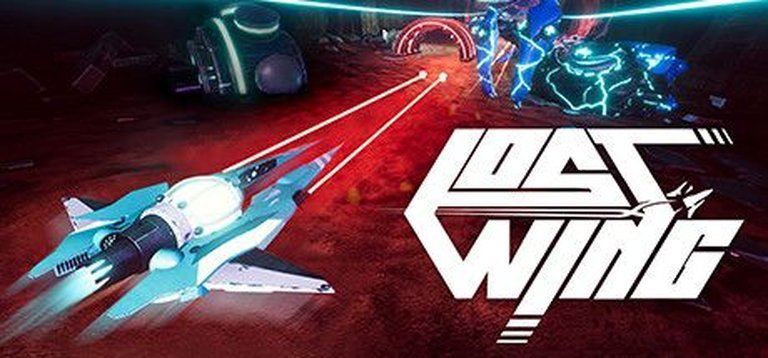
Lost Wing is an arcade-style action game that blends racing and shooter mechanics in a third-person perspective, set in a fantastical sci-fi universe where players pilot a spacecraft through space flight scenarios. The core premise revolves around score-attack challenges with escalating difficulty and unlockable tracks, ships, and variations, providing addictive gameplay despite criticisms of its progress system, menu design, and initial unfairness.
Gameplay Videos
Where to Buy Lost Wing
PC
Lost Wing Guides & Walkthroughs
Lost Wing Reviews & Reception
destructoid.com : The main gameplay loop is maybe a little oversimple.
Lost Wing: A Review
As a purist of the arcade shooter genre, I have long considered the late 2010s a barren period forpure, unadulterated score-attack experiences. Into this void stepped Lost Wing, a title that, based on its surface-level descriptions, promised a revival of the frenetic, ship-based shooting galleries of the 1990s, filtered through a modern indie lens. Developed by the UK-based BoxFrog Games and published by 2Awesome Studio and Eastasiasoft, this 2017 release sought to carve a niche with its minimalist aesthetic, punishing difficulty, and leaderboard-driven core loop. However, a deep dive into its design, reception, and historical context reveals a game that is both a passionate homage and a flawed artifact, struggling to balance its nostalgic aspirations with contemporary expectations of polish and progression.
Development History & Context
Lost Wing emerged from the fertile, if quiet, landscape of late-2010s indie game development. BoxFrog Games, a small studio with a history of mobile and casual titles, leveraged the accessibility of the Unity engine to prototype a concept that felt both retro and immediate. The game’s vision was clear from its earliest public discussions on Steam: a pure, arcade-style experience where every track was unlocked from the start, emphasizing high-score chasing over narrative or unlockable content. This design choice was a direct rejection of the then-common “campaign” or “career” modes in arcade racers and shooters, positioning Lost Wing as a digital leaderboard cabinet.
The technological constraints of the era were minimal compared to the AAA blockbusters, but the team’s ambition created its own limitations. The focus on a tight, responsive control scheme for a third-person spaceship shooter on a platform (PC, later consoles) not traditionally associated with this genre was a significant hurdle. The decision to release simultaneously on Windows, Mac, and later Nintendo Switch, PlayStation 4, and Xbox One (via ports by Eastasiasoft) speaks to a pragmatic, multi-platform strategy typical of small studios seeking maximum reach. The gaming landscape of 2017 was dominated by games-as-service models and sprawling open worlds; Lost Wing’s deliberate, bite-sized, and ultimately ephemeral gameplay was a conscious counter-programming, aiming for the “just one more run” addictiveness of a Super Hexagon or Geometry Wars but with a distinct vehicular shooting flavor.
Narrative & Thematic Deep Dive
It is here that we must confront the most defining characteristic of Lost Wing: its almost total narrative vacuum. There is no story, no characters, no dialogue, and no overarching theme beyond the abstract pursuit of a higher score. The “Lost Wing” of the title is not a character or a faction; it is the player’s own ship, constantly “lost” to catastrophic failure. This is a pure mechanics-first design.
The thematic core, therefore, is one of pure, unadulterated competition—with oneself and with the ghosts of other players on the leaderboard. The game’s “fantasy” is not one of heroic adventure in a “sci-fi/futuristic” setting, but of achieving a state of flow, of mastering a deadly dance through abstract, neon-drenched obstacle courses. The visuals—featuring industrial zones, forest stages, and canyon runs—are not narrative environments but kinetic challenges. They are themes in a musical sense, changing the “feel” and rhythmic pattern of the gameplay rather than telling a story. The game’s legacy, in this respect, is that of a pure system, a digital sport where the only narrative is the player’s own progression from frustrating failure to elusive mastery.
Gameplay Mechanics & Systems
The core gameplay loop of Lost Wing is beautifully simple and brutally demanding. The player controls a small, agile ship from a third-person “other” perspective (slightly behind and above), navigating a narrow, winding track littered with obstacles and enemies. The primary mechanic is a single-button charged shot that must be used to destroy red enemies and obstacles, while carefully weaving through grey environmental hazards. A secondary, limited-use bomb clears the screen but offers strategic depth.
Combat is not about tactical engagements but about rhythmic pattern recognition. Each level is a fixed, memorizable sequence. Success hinges on learning the precise moment to fire, the exact trajectory to hold, and the optimal line through the chaos. The “progression system” is almost non-existent. As confirmed in Steam discussions by developer “Jetset81,” the initial design was to keep all zones unlocked from the start, a pure arcade format. This was later amended to include a “boss run” mode and “sprint” runs—preset pattern challenges designed to let players practice specific sections for maximum points. The unlockable content identified in the source material consists of two additional ships (the “Axe” and “Kadilak,” mentioned in update notes) with different weaponry and handling characteristics. However, the developer mused about making them available from the start, aligning with the arcade ethos. This creates a fascinating tension: a game that is, at its heart, about perfecting a single skill set, yet offers superficial variation through different ships that do not fundamentally alter the core pattern-memory challenge.
The UI and menu systems are the game’s most frequently cited flaws. Critics from Nintendo Life and Use a Potion! specifically called out “awful menus” and a poorly designed progress interface. This is a critical failing for a score-chaser, where checking leaderboards and selecting stages is a constant, repetitive action. A clunky UI directly impedes the primary gameplay cycle of “play, fail, retry.” The difficulty curve is famously steep and, as Video Chums noted, “stupidly unfair at first.” This is not a bug but a feature—the game expects dozens, even hundreds, of failures on early stages before the patterns click. This creates a high barrier to entry but a profound sense of accomplishment for those who persist.
World-Building, Art & Sound
If the narrative is absent, the sensory experience is Lost Wing‘s primary method of communication. The art direction is a masterclass in readability under pressure. Drawing from a “Fantasy” and “Sci-fi” palette, stages use high-contrast colors: vibrant red enemies against muted grey environments, explosive yellow-orange blasts, and a clean, geometric aesthetic for the player’s ship and track. This is not a world to get lost in; it is a reactive diagram. The “Industrial,” “Forest,” and “Canyon” zones provide distinct visual rhythms—grinding metal, organic greens, dusty reds—that subtly cue the player to expected enemy types and obstacle patterns.
The sound design is equally functional yet evocative. The music, when present, is a driving, electronic pulse that matches the high-speed action, but it often fades into the background, replaced by the crucial, crisp audio cues: the pew of the charged shot, the satisfying crunch of a destroyed obstacle, and the catastrophic, screen-shaking screech of a collision. These sounds are not atmospheric; they are gameplay information channels. The silence between shots is as important as the sound of the shot itself, creating a tense, auditory vacuum that makes every successful hit feel like a victory.
Together, the art and sound create a hypnotic, trance-like state. The minimalist visuals reduce cognitive load, allowing the player to focus purely on movement and timing. It’s a world that doesn’t distract from the core mechanical puzzle but instead amplifies it, making Lost Wing feel less like flying a ship and more like conducting a lethal, percussive ballet.
Reception & Legacy
Critically, Lost Wing was met with a moderate, qualified reception. The aggregated score of 70% across four critic reviews tells a story of a game whose strengths and weaknesses were starkly apparent. The Nintendo Switch version notably scored higher (73% from three reviews) than the Xbox One (60% from one review). Critics consistently praised its addictive, “bite-sized” gameplay and the compelling pull of the score-attack loop. Use a Potion! noted it was a game they “keep coming back to time and time again,” while Way Too Many Games explicitly stated it was a “perfect fit for a portable like the Switch,” suggesting its short-burst design was perfectly suited to handheld play.
Conversely, every review highlighted significant flaws. Beyond the UI issues, the progression system was seen as underdeveloped. The lack of a meaningful campaign or unlockable content beyond a few ships left some critics feeling the game was thin. The brutal, seemingly arbitrary difficulty was a double-edged sword—lauded by hardcore players but a major turn-off for others. Its legacy, therefore, is not one of mainstream influence but of cult preservation. It sits firmly in the lineage of games like * Nano Assault* or * Satazius*, titles that prioritize arcade purity over modern conventions. It has not sparked a resurgence of the genre but serves as a reliable, if niche, entry for connoisseurs. Its presence on the Switch eShop, a platform with a strong retro and indie audience, has ensured its survival as a delightful curiosity rather than a forgotten relic.
Conclusion
Lost Wing is a deliberately anachronistic title, a game that understands the DNA of the 1990s arcade shooter but was born in an era that had largely moved on from such pure designs. Its value lies not in narrative depth or technical spectacle, but in its uncompromising commitment to a single, potent gameplay loop: memorize, execute, repeat. The flaws—the poor menus, the sparse content, the punishing difficulty—are inextricable from its strengths. They are the price of admission for a game that offers nothing but the raw, unmediated satisfaction of incremental improvement against a devious, hand-crafted challenge.
In the grand tapestry of video game history, Lost Wing is not a monumental thread. It will not be cited in academic papers on game design evolution, nor will it spawn imitators. Instead, its place is that of a faithful archivist. It proves that the loop of “die, learn, retry” can still be compelling in 2017 when stripped of all modern padding. For those who remember the sweat-inducing focus of R-Type or the leaderboard obsession of Rez, Lost Wing is a brief, potent return to that sacred altar of play. It is a flawed, frustrating, and ultimately brilliant testament to the idea that a game can be nothing more—and nothing less—than a perfect, repeatable moment of challenge. Its legacy is that of a perfectly preserved artifact: a game that knows exactly what it is, and for the right player, at the right moment, that is more than enough.