
- Release Year: 2020
- Platforms: Linux, Windows
- Publisher: SMD Technologies
- Developer: SMD Technologies
- Genre: Driving, Racing
- Perspective: Behind view
- Game Mode: Single-player
- Gameplay: Music, rhythm
- Setting: Futuristic, Sci-fi
- Average Score: 70/100
Description
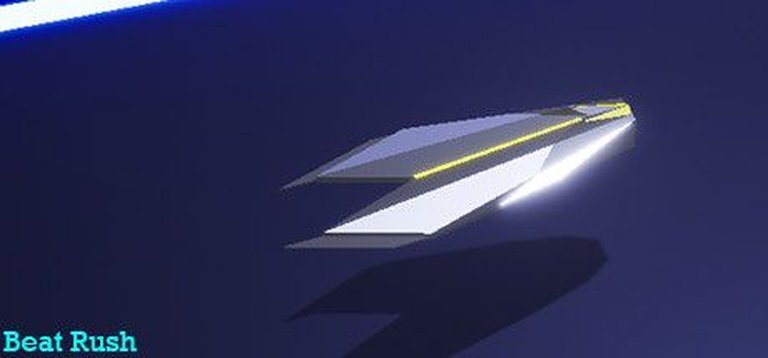
Beat Rush is a sci-fi musical racing game where players pilot a hovercraft on futuristic tracks, aiming to survive through electronic music levels by collecting colored points—blue for currency, pink for jumps, and orange for shield regeneration—while avoiding obstacles and walls that cause damage. As players progress, they upgrade their ship to handle increasing speed and difficulty, all synchronized to a pumped-up soundtrack.
Beat Rush Guides & Walkthroughs
Beat Rush Reviews & Reception
imdb.com (80/100): The music feels great. Mechanics a bit broken, but fun nonetheless.
monstercritic.com (65/100): The electronic beats of Beat Rush make for a prime world to race in, but the simplistic controls limit its long term replayability.
metacritic.com (65/100): The electronic beats of Beat Rush make for a prime world to race in, but the simplistic controls limit its long term replayability.
Beat Rush: A Critical Review of an Obscure Rhythm-Racer’s Fragmented Legacy
Introduction: Hitting the Right Notes in a Crowded Genre
In the vast ecosystem of music-driven games, the subgenre of “rhythm racers”—where musical timing directly dictates movement and survival—has produced iconic titles like Rez, Frequency, and Audiosurf. Into this space stepped Beat Rush, a title shrouded in immediate confusion and conflicting attribution. The official MobyGames entry, our primary source, identifies a 2020 Windows/Linux release from SMD Technologies. Yet, other reputable sources (MonsterCritic, TechLomedia, GameForge) cite a 2018 Nintendo Switch release from “FuryLion Group.” Meanwhile, a separate NamuWiki entry documents a completely different, defunct 2005 Nexon online rhythm game also titled Beat Rush (known as Beatrush). This review will treat the 2020 SMD Technologies Beat Rush as the primary subject, synthesizing the available data while critically addressing the severe lack of concrete information, reviews, and cultural footprint. My thesis is this: Beat Rush represents a conceptually sound but profoundly underdeveloped and poorly documented experiment in the rhythm-racer hybrid, whose execution was hampered by minimal resources, technical shortcomings, and a complete failure to establish a clear identity or legacy in a competitive market. It is a game more notable for its absence from history than for its presence within it.
Development History & Context: A Story of Multiple Identities
The development history of Beat Rush is a puzzle with several missing pieces, a direct result of the source material’s contradictions.
- The SMD Technologies Iteration (2020): According to the authoritative MobyGames entry, the definitive Beat Rush was developed and published by the obscure Czech studio SMD Technologies (not to be confused with the classic Sega Mega Drive hardware). It was released for Windows and Linux on July 8, 2020, as a commercial download, likely via Steam (the description matches Steam’s store blurb). The studio’s name suggests a possible focus on simulation or data tools, making a rhythmic arcade game a curious side project. There is no evidence of a significant marketing push, and the game appears to have vanished into near-total obscurity immediately after release.
- The FuryLion Group Confusion (2018): Multiple aggregator sites (MonsterCritic, TechLomedia, GameForge) list a Beat Rush for Nintendo Switch and PC from a developer named FuryLion Group, released on July 16, 2018. The described gameplay—collecting coins to buy characters, daily quests, 23 characters, “modern pixel graphics”—radically differs from SMD’s ship-upgrade, obstacle-dodging description. This is almost certainly a different game that unfortunately shares the same name. The FuryLion version seems to be a simpler, character-based endless runner with stronger mobile/arcade sensibilities. This conflation in databases severely muddies any attempt to track the game’s reception.
- The Nexon Ancestor (2005): The NamuWiki entry details a completely separate, Korean-developed online rhythm game called Beat Rush (or Beatrush) by Nexon in 2005. This was a keyboard-based O2Jam-style title, infamous for its poor reception and quick shutdown, remembered today mainly for featuring composer Kim Dae-hyun (DK). It occupies a similar conceptual space—rhythm action—but is a different genre (keyboard sim) and era. Its existence highlights how the name “Beat Rush” has been repeatedly applied to music games without a unifying franchise.
- Technological & Market Context (2020): Assuming the SMD version is our focus, its 2020 release placed it in a saturated indie market. It competed with refined rhythm games like Beat Saber (2018) and Thumper (2016), as well as a resurgence of auto-runners (Celeste, Sayonara Wild Hearts). The constraints were likely those of a small team: limited budget, potentially using a generalized engine like Unity or Godot, resulting in the “buggy visuals” noted by the sole IMDb user review. The “pumped-up electronic track” requirement suggests reliance on stock or royalty-free music, a common indie cost-saving measure that can hamper a cohesive artistic vision.
Narrative & Thematic Deep Dive: The Void of Story
The provided source material offers a stark, almost total vacuum regarding narrative. The Steam store description and IMDb synopsis reduce the game to a pure mechanical loop: “You play as a spaceship… avoid obstacles while collecting points… survive throughout the music track.” There is no mention of a setting beyond “space” and a “special platform,” no characters, no dialogue, and no discernible plot.
Thematic Inference from Mechanics: With no explicit story, themes must be extrapolated from the game systems. The core loop—flying a vessel, collecting colored orbs (blue=currency, pink=jump fuel, orange=shield), avoiding obstacles and walls, all to survive a single song—evokes themes of synchronicity, survival through harmony, and incremental ascension. The player’s ship is an extension of the music’s will; success is not about defeating an enemy but about achieving perfect attunement with the track’s tempo and structure. The progressive difficulty (“more obstacles and higher speed” per level) and the goal to “upgrade your ship to the max” suggest a roguelite-lite progression of mastery, where the ultimate victory is transcending the song’s increasing demands. However, without any narrative framing—no reason why the ship is there, what the points represent, or what lies at the end of the track—these themes remain purely implicit, a mechanical poetry with no epic to support it. The game is a pure audiovisual stress test, a void where player interpretation must fill the blanks.
Gameplay Mechanics & Systems: A Promising Core, Flawed Execution
The gameplay description, while sparse, outlines a clear, if familiar, hybrid design.
- Core Loop: The player controls a hovercraft from a behind-the-vehicle perspective on a fixed, presumably grid-like or rhythmic track. The fundamental mechanic is music-synchronized evasion. Obstacles spawn in patterns likely tied to beats or melodic cues. Movement is “direct control,” implying immediate (not input-delayed) responsiveness, but the “simplistic controls” noted by Gamers Heroes suggest limited maneuverability—likely just left/right and a single “jump” action (priced in pink points).
- Resource & Progression Systems: Three colored point types create a basic economy:
- Blue Points: Primary currency for ship upgrades in the Shop. This implies a meta-progression layer where run-specific gains improve future runs (e.g., faster speed, more health, better shielding).
- Pink Points: Consumable resource for the jump ability (“15 pink points = 1 jump”). This ties a core traversal mechanic to collection, creating a resource management tension.
- Orange Points: Shield regeneration, unlocked with the 3rd ship. This introduces a defensive layer that mitigates damage from collisions.
- Health System: All points replenish health, but collisions with obstacles or walls cause damage. Death is permanent per run, though the Switch version (if part of the same lineage) mentions “constant checkpoints” and a coin-based continue system, a significant design divergence.
- Innovations & Flaws: The core innovation is the tripartite point system directly on the track, forcing the player to make split-second risk/reward decisions: collect that blue cluster and risk an obstacle, or play it safe? The integration of a shop for permanent upgrades is a smart nod to the “roguelite” trend. However, the systems are critically underdeveloped. The “bit broken” mechanics cited by an IMDb user and the “simplistic controls” criticism point to a lack of polish: perhaps the hitboxes are unfair, the rhythm cues unclear, or the upgrade balance poor. The description of increasing speed and obstacles per level is a standard difficulty curve but lacks nuance—no mention of new mechanics, varied track layouts, or boss-like sections tied to song climaxes. The game feels, from the outside, like a well-conceived prototype that never received the iterative refinement needed to become a compelling, deep experience. The lack of a tutorial (as noted in the Switch review, if applicable) would exacerbate these issues, forcing players to decipher the systems through failure.
World-Building, Art & Sound: Style Over Substance, With Caveats
- Setting & Atmosphere: The setting is pure * sci-fi minimalism: a “space vessel” flying on a “special platform” in the void. There is no world-building, no environmental storytelling. The atmosphere is generated entirely by the music and the abstract, geometric obstacles. It aims for a *synesthetic experience, where the track layout is the visualization of the music.
- Visual Direction: The Switch review mentions “modern pixel graphics,” suggesting a retro-futurist aesthetic. However, the SMD version on Steam likely uses simpler 3D models or sprites, given the “buggy visuals” comment. The “shining conical objects” for points and unspecified obstacles imply a clean, high-contrast, neon-drenched look typical of early 2010s indie arcade games. The “screen effects will happen that try and put you off” (from the Switch review) indicates a use of visual distortion, shake, or chromatic aberration synced to the music, a common technique to enhance immersion and difficulty. The art style is functional but forgettable, lacking the iconic identity of Rez‘s trance visuals or Thumper‘s hellish geometries.
- Sound Design: This is the game’s stated centerpiece. The “pumped-up electronic track” is not just background music; it is the governing law of the game world. The entire level’s obstacles, speed, and likely the spawning of points are locked to the song’s BPM and structure. This is the genre’s holy grail: perfect audio-visual synchronization. The quality of the soundtrack is everything. The use of generic “electronic” music, as implied, would be a fatal flaw, making the experience feel replaceable. Without licensed or memorably composed tracks, the game loses its soul. The sound design of collected points, jumps, and crashes would need to be tightly woven into the mix to provide crucial feedback, but there is no information on this polish.
Reception & Legacy: A Whisper That Faded
- Critical Reception: The reception is virtually non-existent. Metacritic and OpenCritic show only one aggregated critic review (Gamers Heroes, 65/100), which succinctly states: “The electronic beats of Beat Rush make for a prime world to race in, but the simplistic controls limit its long term replayability.” This encapsulates the core problem: a promising atmosphere undermined by shallow mechanics. The IMDb user review (8/10) offers faint praise: “The music feels great. Mechanics a bit broken, but fun nonetheless. The visuals are buggy, however the overall atmosphere… fills that in.” This suggests a game that can create a compelling moment-to-moment feel but cannot sustain it due to technical and systemic issues.
- Commercial & Community Impact: Collected by only 1 player on MobyGames, Beat Rush (2020) was a commercial non-event. It left no discernible mark on Steam charts, forums, or speedrunning communities. The FuryLion Switch version has slightly more traction (a 2021 review), but with only five levels (per the Switch review) and “small incentives,” its impact was equally minimal. It represents the long tail of the rhythm-racer genre, arriving after the peak interest in the late 2000s/early 2010s and failing to innovate enough to restart the conversation.
- Legacy & Influence: Beat Rush has no measurable legacy. It did not influence subsequent games. It is not cited in developer post-mortems or genre analyses. Its primary function in video game history is as a data point of obscurity. It demonstrates the perils of the “one-good-idea” indie project: a solid core concept (music-driven racing with resource management) that was not supported by sufficient scope, polish, marketing, or community engagement to survive. It exists in the vast graveyard of Steam Early Access titles and forgotten eShop downloads, a cautionary tale about the difference between a prototype and a product. Its only “influence” is in highlighting the success of its better-realized cousins, which perfected the synthesis of rhythm and gameplay that Beat Rush only gestured toward.
Conclusion: A Rhythmic Ghost
Beat Rush (the 2020 SMD Technologies version) is not a bad game in the traditional sense of being offensive or unplayable. It is, instead, a classic example of a missed opportunity. Its foundation—a spaceship weaving through rhythmically generated obstacles to the beat of electronic music—is inherently engaging. The addition of a three-resource economy (blue currency, pink jumps, orange shields) showed ambition to blend arcade action with light progression.
However, this foundation crumbles under the weight of its own limitations. The “simplistic controls” and “broken mechanics” cited by the scant available feedback indicate a failure of game feel and precision, the absolute bedrock of any rhythm or racing title. The “buggy visuals” and lack of narrative or world context leave the experience feeling sterile and disposable. In a market saturated with polished, confident indies, Beat Rush arrived anonymously, with no identity, no hooks, and no support. It was a whisper lost in a storm of noise.
Its place in video game history is that of a footnote and a curiosity. It is a game that demonstrates how a compelling genre fusion is not enough; execution, polish, and a clear voice are paramount. For every Thumper or Race the Sun that carved out a niche, there are dozens of Beat Rushes—games with a spark that was never fanned into a flame. It is a rhythmic ghost, a game that played its tune to an empty room and was never heard from again. The ultimate verdict is one of profound mediocrity born of obscurity, a title that achieved the rare feat of being both technically flawed and culturally irrelevant.