
- Release Year: 2015
- Platforms: Linux, Macintosh, Windows
- Publisher: Glass Bottom Games LLC
- Developer: Glass Bottom Games LLC
- Genre: Adventure
- Perspective: 3rd-person
- Game Mode: Single-player
- Gameplay: Graphic adventure, Platforming, Puzzle
- Setting: Fantasy, Noir
Description
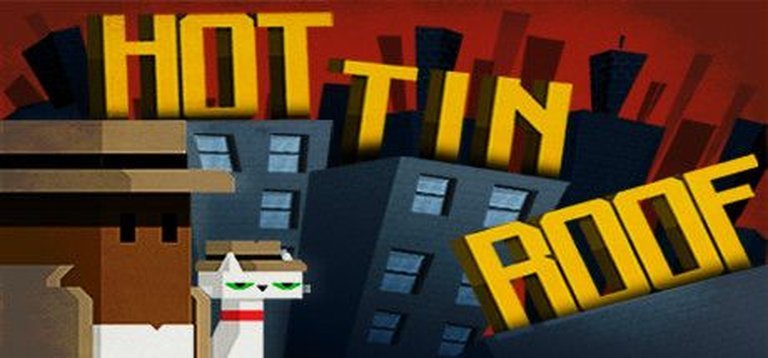
Hot Tin Roof: The Cat That Wore a Fedora is a 3D adventure game where players assume the role of Emma Jones, a private investigator from the Jones on Fire series, partnered with her clever cat Franky. Set in the noir-fantasy metropolis of Tin Roof, the game tasks you with solving a series of gruesome murders through clue gathering, character interviews, and puzzle-solving, all within a point-and-select interface that incorporates light platforming elements.
Gameplay Videos
Where to Buy Hot Tin Roof: The Cat That Wore a Fedora
PC
Hot Tin Roof: The Cat That Wore a Fedora Guides & Walkthroughs
Hot Tin Roof: The Cat That Wore a Fedora Reviews & Reception
destructoid.com : Some things were well executed, while others were distracting and annoying.
Hot Tin Roof: The Cat That Wore a Fedora Cheats & Codes
PC (Steam)
Open the dev console by pressing tilde (~) and enter commands.
| Code | Effect |
|---|---|
| save | Saves the game instantly, regardless of location. |
| save <1-3> | Saves to a specific save slot (1-3) instead of the loaded slot. |
| invulnerable | Makes the player invulnerable to damage. |
| iddqd | Makes the player invulnerable to damage. |
| god | Makes the player invulnerable to damage. |
| unlimitedammo | Bullets are not consumed when firing; no reloading needed. |
| idkfa | Bullets are not consumed when firing; no reloading needed. |
| noclip | Allows the player to pass through walls. |
| idspispopd | Allows the player to pass through walls. |
Hot Tin Roof: The Cat That Wore a Fedora: Review
Introduction: A Noir Gem Polished to a Fault
In the crowded landscape of indie gaming, where每分钟 seems to birth a new “Metroidvania” or noir-inspired adventure, Hot Tin Roof: The Cat That Wore a Fedora emerges as a title that is at once utterly distinctive and profoundly frustrating. Released in 2015 by the tiny, two-person studio Glass Bottom Games, the game promised a potent cocktail: a 3D side-scrolling world, a hardboiled detective story, a feline partner in a fedora, and a non-lethal revolver loaded with inventive ammunition. It was a vision dripping with style, a love letter to film noir and classic platformers filtered through a quirky, cat-centric lens. Yet, for every moment of witty dialogue or stunning visual composition, there is a counterpoint of bewildering design choices that mire the experience in unnecessary friction. This review argues that Hot Tin Roof is a critical case study in ambition versus execution—a game whose foundational ideas are so strong and personality so vivid that its numerous mechanical and systemic flaws become all the more tragic. It is not a forgotten classic, but it is a fascinating, deeply flawed artifact of a specific moment in indie game development, representing both the creative freedom and the stark limitations of a small team operating with big dreams but limited polish.
Development History & Context: A Kickstarter-Fueled Experiment
The story of Hot Tin Roof is intrinsically linked to its developer, Glass Bottom Games, and the boom of crowdfunded indie titles in the early 2010s. Founded by Megan Fox (designer/programmer) and a small rotating team including 3D artist Ellory Gillis-McGinnis and composer Nathan Madsen, the studio’s prior work was the mobile endless-runner Jones on Fire, a game about Emma Jones rescuing kittens. Hot Tin Roof was their first major project, successfully funded on Kickstarter in late 2013. This context is crucial: the game was made with a modest budget and a dedicated, community-driven audience watching its progress. It was also among the last titles to navigate Steam’s Greenlight process before it became overwhelmed, placing its release in a transitional period for PC indie distribution.
Technologically, the game was built in Unity 4.6.6f2, a widely accessible engine that empowered small teams but also imposed certain limitations. The choice of a “retro 3D” aesthetic—characters and environments built from simple, blocky geometry—was both a stylistic decision reminiscent of early 3D PlayStation titles and a practical one, reducing asset complexity. The development team wore many hats, with Fox handling design and programming, and the project shows the hallmarks of a “jack-of-all-trades” approach: concepts like the ammo-based progression system and the rotating 2.5D perspective are inventively rendered, but their implementation often lacks the iterative refinement that larger QA resources would provide.
The gaming landscape of early 2015 was fertile for such an experiment. The success of Super Metroid and Castlevania: Symphony of the Night had cemented “Metroidvania” as a beloved subgenre, but few had attempted a 3D, side-scrolling interpretation with a heavy adventure game emphasis. Games like Guacamelee! had proven the viability of 2D metroidvanias with strong themes, but a 3D, noir-flavored one was uncharted territory. Hot Tin Roof thus entered a market hungry for novelty, yet its execution would see it fall short of the benchmarks set by both indie darlings and genre classics.
Narrative & Thematic Deep Dive: A City of Cats, Rats, and Rusty Revolvers
The narrative of Hot Tin Roof is its most consistently praised element, a stark contrast to its gameplay criticisms. Players assume the role of Emma Jones, an ex-firefighter turned private investigator for the “Depot,” a detective agency operating in the absurdist, feline-dominated metropolis of Tin Roof. Her partner is Franky, a sarcastic, fedora-wearing white cat who serves as both comic relief and a crucial puzzle-solving companion (she can interact with switches and chase certain items). The plot begins with a seemingly simple case—a break-in at the luxury “Ossified Egg” apartments—that spirals into a complex web involving a missing will, grisly murders, and the systemic oppression of the city’s rat population.
The writing, penned by Megan Fox, walks a precarious tightrope between genuinely sharp, self-aware noir parody and uneven, occasionally stilted dialogue. The game excels in its worldbuilding through dialogue. The society of Tin Roof is a masterclass in “fantastic racism” (a TV Tropes designation): a rigid pecking order places the wealthy, Blockian (cube-dwelling) cats at the top, followed by regular cats, then birds, with rats relegated to the garbage-filled ghettos. This satire is delivered with a light, often hilarious touch. A rat character accused of a crime will deadpan accuse Jones of “racial profiling,” a joke that lands perfectly due to the game’s commitment to its own logic. The humor is frequently fourth-wall-breaking, with Franky directly commenting on game mechanics (“But thou must!” before forcing you to answer the phone) or Emma’s blocky appearance (“I’m a woman!”).
The plot is structured around four distinct murder cases that interweave, leading to 15 possible resolutions based on player choices and the order in which clues are discovered. This ambition is commendable; the game attempts a branching mystery where sequence matters. However, this very ambition is the source of its narrative Achilles’ heel. The lack of a robust quest log or journal means the narrative can become hopelessly non-linear and broken. As Hardcore Gamer’s review devastatingly notes, it’s entirely possible to “collect the full set of clues for a murder and acquire an arrest warrant before you’d ever even seen (or heard about) the murder.” This sequence breaking transforms the detective fantasy into a confusing, Self-Service check-out line of plot points, where revelations lose all impact and character motivations become incoherent. The thematic exploration of justice, prejudice, and corruption is consistently intelligent, but its delivery is at the mercy of the player’s potentially catastrophic play order.
Gameplay Mechanics & Systems: The Revolver of Damocles
Hot Tin Roof‘s core gameplay is a hybrid of Metroidvania exploration, graphic adventure puzzle-solving, and basic platforming. The central loop involves exploring the interconnected 3D side-scrolling city of Tin Roof, seeking “clues” (environmental objects or dialogue triggers) to progress cases, and using your revolver to overcome obstacles. The game’s most celebrated mechanic is its ammo-based progression. Instead of finding a “double jump” or “morph ball,” you find new types of non-lethal revolver rounds, each with a unique function:
* Thud Rounds: Break boxes and fragile objects.
* Bubble Rounds: Reveal hidden platforms and items (bubbles “clean” things).
* Hook Rounds: Act as a grappling hook.
* Explosive Bubble Rounds: Can be ignited with fire rounds for a detonation.
* Knockdown Rounds: Physically push objects and Emma herself, enabling multi-jumps.
This system is brilliantly thematic, reinforcing the detective fantasy (solving environmental puzzles) and the noir aesthetic (a versatile, custom-loaded revolver). The act of manually reloading—removing spent casings and clicking new rounds into the cylinder—is tactile and immersive, at least initially.
However, the game’s implementation of these systems is where the cracks appear, widening into canyons:
-
Navigation & The Absent Map: The single greatest design flaw is the complete lack of a map or objective marker. The city rotates around you as you move, a clever “2.5D” trick that forces the developers to model every building face. While visually impressive, it creates a perpetual state of disorientation. As Destructoid’s review states, you must “memorize all of Castlevania: Symphony of the Night’s map, but with turns and corners.” Finding a new NPC or clue location becomes a exercise in frustrating retracing of steps. The police chief’s vague instructions (“go solve the case”) are useless without a spatial reference point.
-
Manual Reload Tedium: While the reloading mechanic is smart, the default method is unnecessarily cumbersome. You must press ‘R’ to open the cylinder, click to eject spent rounds, select a new ammo type from a radial menu, and click to load each chamber. For complex puzzles requiring rapid ammo switching, this becomes a joyless chore. Crucially, the game does not tutorialize the quick-reload function (holding ‘R’ to reload the exact previous loadout), a fact several reviewers discovered only after hours of play. This represents a fundamental failure in player onboarding.
-
Platforming & Camera: The platforming is described as “not particularly satisfying” but “not clumsy.” It is, however, exacerbated by a camera that stubbornly enforces the side-scrolling perspective, sometimes obscuring platforms or hazards just as you need to see them. The “invisible platforms” complaint from Hardcore Gamer is particularly damning, as these essential navigation tools reset on save/load, forcing players to rediscover them repeatedly.
-
Dialogue & Progression: The dialogue tree system is basic but functional. The major issue is the inability to skip or reset conversations. If you accidentally pick a branch or want to re-ask a question, you must exit the dialogue, re-approach the NPC, and sit through the entire exchange again. This, combined with the fact that many dialogue triggers do not reset after story progression, leads to the absurdist scenario of Emma and Franky speculating about a long-solved crime because the game’s scripts haven’t updated. It breaks narrative immersion and wastes player time.
-
Economic System: Defeated enemies drop specific ammo types, tying combat to progression. However, this creates a grindy, un-Fun loop if you are missing a specific bullet type and must farm a specific enemy type in a specific location, all while navigating the labyrinthine city without a map.
In essence, the game possesses the skeleton of a brilliant Metroidvania—ability-gated exploration, a focused toolset, a cohesive world—but the flesh is riddled with outdated adventure game friction (no journal, no skip) and a UI that actively works against the player.
World-Building, Art & Sound: A Masterclass in Stylized Atmosphere
If the gameplay is the game’s weakness, its art and sound design are its unequivocal strengths, the very elements that make its mechanical failures so lamentable. The game’s visual identity is instantly iconic. Using a deliberately blocky, low-polygon 3D aesthetic, Glass Bottom Games creates a world that is both retro and timeless. Characters are composed of simple cubes and spheres, yet they are animated with a surprising amount of personality. Emma’s walk, Franky’s tail flicks, and the saving animation (Emma perched on a toilet with a satisfied sigh) are full of charm. This “retraux” style does heavy lifting for the noir tone, evoking the stark shadows of black-and-white film through clever use of a limited, high-contrast color palette.
The city of Tin Roof itself is a character. The “Ossified Egg” luxury apartments gleam with sterile whites and golds, while the “Rat’s Nest” ghetto is a polluted, brownish sprawl of garbage and shanties. The constant rotation of the side-scrolling perspective means the team had to build every facade, and the result is a world that feels dense and explorable, despite the 2D constraint. The environmental storytelling is rich: propaganda posters for the Depot, signs in rat-runes, the tiny hats on cats and pigeons. It’s a world that tickles the funnybone through visual detail, as Adam Smith of Rock Paper Shotgun noted.
This visual style is perfectly complemented by Nathan Madsen’s “chip noir jazz” soundtrack. The music is a highlight, featuring looping, melancholic piano and bass lines overlaid with the chirpy, synthetic beeps of chiptune. It’s an inspired fusion that feels both classic and modern, perfectly underscoring the game’s unique blend of genres. The sound effects are similarly crisp and thematic, from the click-clack of the revolver to the satisfying pop of a bubble round.
The synergy between these elements creates an atmosphere thicker than the smog over the Rat’s Nest. For every moment of frustration with the map, there is a countervailing moment of delight in discovering a new, beautifully realized corner of the world, underscored by a perfect musical cue. This is the core tragedy of Hot Tin Roof: it builds a phenomenal sandbox but gives the player a broken bucket and spade to play in it.
Reception & Legacy: The Cult of the Flawed Gem
Upon release, Hot Tin Roof met with mixed-to-average critical reception. Its Metacritic score hovers around 66/100, reflecting a wide divergence in opinion. The schism is almost perfectly along the lines of its strengths and weaknesses:
* The Positives (Twinfinite 80%, Ragequit.gr 68%): Reviews praising the game consistently highlight the worldbuilding, writing, art style, and soundtrack. They see a charming, funny, and original noir adventure that justifies its price for those willing to engage with its peculiarities. Twinfinite’s review calls it “a well-made, interesting tale that’s entirely its own.”
* The Negatives (Hardcore Gamer 50%, Destructoid 60%): Critics focused relentlessly on the gameplay friction. The absence of a map, the relentless backtracking, the sequence-breaking narrative, the tedious reloading, and the non-skippable dialogue are cited as “deal-breakers” that “kill any enthusiasm.” Hardcore Gamer’s verdict is brutal: “it just won’t let you” like it.
Commercially, the game was a modest success, recouping its Kickstarter funds and finding an audience on Steam. It has maintained a small, dedicated fanbase, as evidenced by its “55 players collected” status on MobyGames and generally positive user reviews (69% positive on Steam). Its legacy is that of a cult favorite and a cautionary tale. It did not influence a wave of 3D noir Metroidvanias; its design quirks are too specific and its flaws too fundamental to be widely emulated. However, it stands as a landmark for Glass Bottom Games, proving they could scale up from mobile to a full PC experience. The studio would later find broader success with SkateBIRD, suggesting the creative spark evident in Hot Tin Roof was refined and channeled into more accessible projects.
Its true historical importance lies in its documentation of indie development pain points. It is frequently cited in discussions about the necessity of quality-of-life features (maps, journals, skip dialogue), the perils of non-linear storytelling without robust scaffolding, and the challenge of marrying a strong aesthetic to clumsy interaction. In this sense, Hot Tin Roof is an invaluable case study.
Conclusion: A Beautiful, Broken Case File
Hot Tin Roof: The Cat That Wore a Fedora is a game that demands to be judged on a curve of ambition. Its world of Tin Roof is a triumph of stylized world-building, a place where jazz plays over garbage heaps and social commentary is delivered by a cat in a fedora. Its central mechanic—the customizable revolver—is a clever, thematic twist on the Metroidvania formula. Its writing, when it hits, is witty, sharp, and full of heart.
But these glorious peaks are set in a valley of mechanical despair. The lack of a map is not a “hardcore” feature; it is a fundamental flaw in user experience design. The sequence-breaking narrative is not emergent storytelling; it is un-checked scripting that destroys plot coherence. The tedious reloading and frozen dialogue are not “old-school” quirks; they are unforgivable omissions in 2015.
Therefore, its definitive place in history is as a flawed masterpiece of indie potential. It is not a game to be recommended broadly, but one to be studied and, for a certain breed of patient, lore-hungry player, endured. The joy of exploring its world and unraveling its funny, dark story is perpetually at war with the irritation of its interfaces. It is a testament to the fact that a fantastic aesthetic and brilliant ideas cannot, on their own, carry a game. They require the alchemy of polished, player-respecting systems to become truly great.
For the historian, Hot Tin Roof is a snapshot of a studio finding its voice, for better and worse. For the player, it is a gamble: a chance to experience a world unlike any other, if you are willing to accept a frustrating, often broken, investigative process to get there. It is, in the end, a game that wears its heart—and its fedora—on its sleeve, even as it trips over its own feet.