
- Release Year: 2006
- Platforms: Windows
- Publisher: ValuSoft, Inc.
- Genre: Compilation
- Game Mode: Single-player
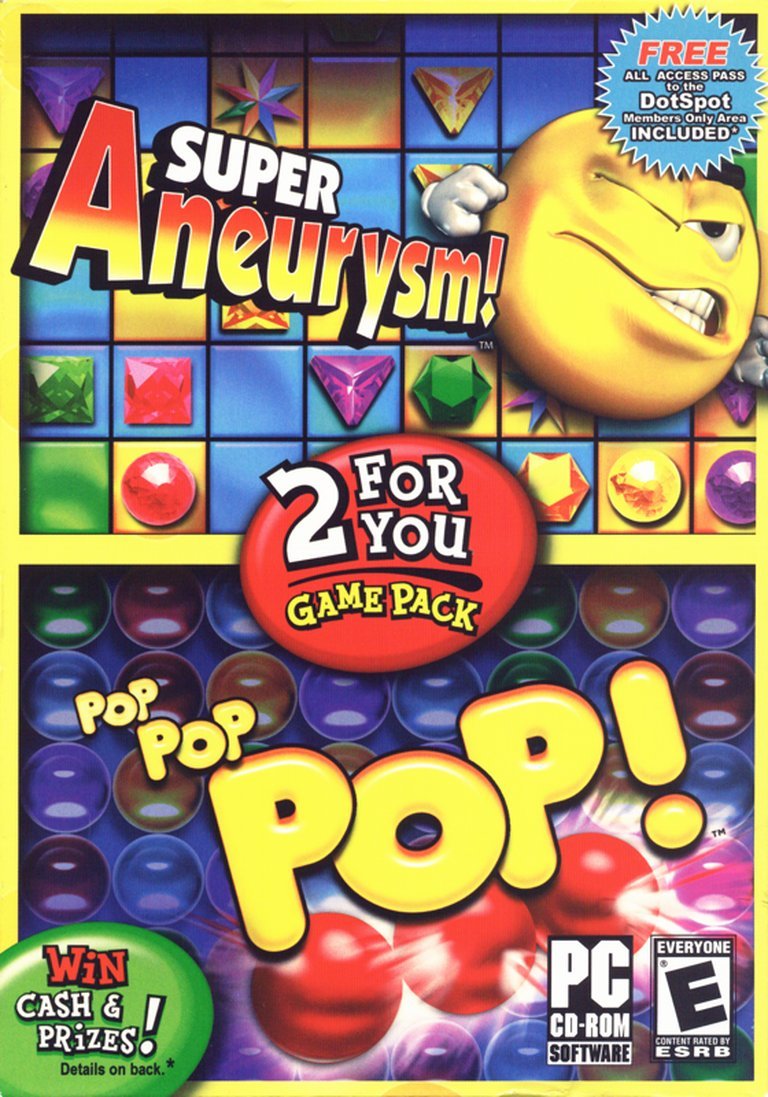
Description
The ‘2 For You Game Pack: Super Aneurysm! / Pop Pop Pop!’ is a 2006 Windows compilation that bundles two simple, family-friendly puzzle games: ‘Super Aneurysm!’ and ‘Pop Pop Pop!’, both designed for single-player enjoyment with keyboard and mouse controls, offering lighthearted and accessible gameplay experiences.
2 For You Game Pack: Super Aneurysm! / Pop Pop Pop! Free Download
2 For You Game Pack: Super Aneurysm! / Pop Pop Pop!: A Forensic Review of the Unseen Casual Artifact
Introduction: The Ghost in the Discount Bin
In the vast, crowded archives of video game history, certain titles exist not as celebrated classics or notorious failures, but as pure, unadulterated data points. They are the quiet, unassuming entries on a publisher’s spreadsheet, the games that clogged the “$9.99” and “Buy 2, Get 1 Free” aisles of big-box retailers in the mid-2000s. 2 For You Game Pack: Super Aneurysm! / Pop Pop Pop! (2006) is one such artifact. Comprising two single-screen puzzle games—Pop Pop Pop! (2005) and Super Aneurysm! (2006)—this Windows compilation, published by ValuSoft and developed (for the latter) by ZEMNOTT, Inc., represents a fleeting moment in the casual PC gaming boom, a period before smartphones redefined the genre. It exists in a strange liminal space: utterly forgettable by design, yet profoundly revealing about the economic and design logic of its era. My thesis is this: The “2 For You Game Pack” is not merely a collection of two obscure puzzle games; it is a documented case study in the commodification of casual gameplay, a minimalist exercise in risk-averse design that speaks volumes about the realities of the budget software market.
Development History & Context: The ValuSoft Assembly Line
To understand the 2 For You Game Pack, one must first understand its publisher: ValuSoft. Operating from 1996 until its assets were sold to Cosmi Corporation in 2012, ValuSoft carved out a niche as a purveyor of value-priced software, primarily for Windows PCs. Their model was straightforward: acquire or develop simple, broadly appealing games—often utilities, card games, or basic puzzle titles—and distribute them en masse through mass merchandisers like Walmart, Best Buy, and Toys “R” Us. The packaging was invariably bright, garish, and promising “FUN!” or “HOURS OF ENTERTAINMENT!” often with a price point that screamed impulse buy.
Super Aneurysm! provides our only concrete developer link: ZEMNOTT, Inc. A name that leaves virtually no digital footprint beyond MobyGames credits for this title and a few other obscure early-2000s PC games like 3D Bug Attack and Cogs. ZEMNOTT represents the countless small, transient studios that fuelled the budget PC market—teams with enough skill to create functional, derivative gameplay clones but without the resources or ambition for innovation. They were the engine for ValuSoft’s “one-puzzle-game-plus-another” compilation formula.
This context defines the 2005-2006 technological and market landscape. The “casual” genre was exploding, driven by the success of PopCap’s Bejeweled (2001) and Zuma (2003), and the rise of browser-based portals like Yahoo! Games and Big Fish Games. However, the PC physical retail space for these games was rapidly contracting, squeezed by the rising tides of digital distribution (Steam was gaining traction) and, most critically, the impending smartphone revolution (the iPhone launched in 2007). ValuSoft’s strategy was a last gasp of the old model: take two cheap-to-produce puzzle games, bundle them on a single CD-ROM, slap a $9.99 price tag, and move units through shelf presence. The “2 For You” branding itself is a direct appeal to the value-conscious shopper, promising double the content for a single low price. There is no evidence of a grand creative vision here; this is a business calculation, a product assembled from existing, low-cost components to meet a perceived market demand for affordable, family-friendly (hence the ESRB “Everyone” rating) mindless entertainment.
Narrative & Thematic Deep Dive: The Aesthetics of the Abstract
Any narrative analysis of these games must begin with a confession: there is none. This is not a critique of poor writing, but of a conscious or resultant absence of narrative. Pop Pop Pop! and Super Aneurysm! are pure, unadorned abstract puzzle games. There are no characters, no plot, no dialogue, and no setting beyond the grid itself.
Yet, from this vacuum, we can infer a thematic dichotomy that is almost accidentally profound.
-
Super Aneurysm! derives its title from a medical condition—a bulging, weakened area in an artery wall that can lead to fatal rupture. In the game’s mechanics, as documented by its MobyGames description, the “Aneurysm” is a specific piece on the grid that acts as a wildcard (“any crystal can be placed next to him”) and a source of chaos (“he will add random crystals to the grid until he is removed”). Thematically, this is a stunningly apt metaphor. The player’s goal is to methodically fill a grid with matching crystals—a process of order, pattern, and control. The “Aneurysm” is an element of hidden instability within that system. It breaks the rules of adjacency, and if left unchecked, it expands the chaos by adding more random elements. The act of “removing” it (by matching it, as with any other crystal) is a surgical intervention to restore order and prevent systemic failure. The game, perhaps unintentionally, simulates the tension between homeostasis and pathological growth, between player agency and an embedded, proliferating flaw.
-
Pop Pop Pop!, by contrast, evokes a primal, almost infantile satisfaction. The title is onomatopoeia for a simple, repetitive action—bursting bubbles. This game represents the other pole of the casual spectrum: pure, unthinking stress relief. It has no procedural generation of chaos, no rogue element. It is a Skinner box of auditory and visual feedback, where the act of clicking (or popping) provides immediate, gratifying sensation with zero cognitive load. The theme is pure id: release, repetition, and the soothing nullification of simple tasks.
Together, the pack presents a curious dualistic view of casual play: one as a battle against systemic, almost biological entropy (Super Aneurysm!), and the other as a Zen-like dissolution of discrete objects into nothingness (Pop Pop Pop!). That this duality exists in a product with zero narrative framing is a testament to how gameplay mechanics themselves can resonate with primal metaphors, even when born from a vacuum of creative intent.
Gameplay Mechanics & Systems: The Grammar of the Grid
Both games operate within the classic “tile-matching puzzle” paradigm established by Tetris and perfected by Bejeweled, but with distinct, minimalist rule sets.
-
Super Aneurysm! (as per the MobyGames description) is a game of constrained placement. The core loop:
- The player is presented with a grid (size unspecified, but growing in complexity).
- The objective is to fill every square.
- The constraint: any newly placed crystal must match both the color AND the shape of all its adjacent crystals. This is a brutally strict rule that creates a cascading logic puzzle. Placing one tile incorrectly can block the placement of dozens more.
- The saving grace: completing a full row or column causes all tiles in that line to vanish. This is the primary tool for clearing space and strategically reconfiguring the grid.
- Systems: Two power-ups exist: a Hammer (destroys a single tile, acting as a correction tool) and a Chromatic Crystal (a wildcard that can be placed adjacent to any tile, temporarily bypassing the matching rule). Two bank slots allow the player to store a crystal for later use, adding a minor layer of planning. The Aneurysm tile itself is the key dynamic element: initially a helpful wildcard, on higher levels it becomes a proliferating threat, forcing the player to prioritize its removal.
The design is clever in its austerity. It creates a puzzle where the grid is both the puzzle and the solution space. The game’s “innovation” is the dual-match rule and the line-clearing mechanic coupled with the aggressive expansion of the Aneurysm threat. Its flaw is likely high difficulty spikes and a lack of depth in later levels beyond simply increasing grid size or Aneurysm growth rate.
-
Pop Pop Pop! is the more traditional of the two. Based on the title and its lineage (related to games like Bubble Pop and Iggle Pop!), it is almost certainly a bubble shooter or bubble popper. The expected core loop would be:
- A cluster of colored bubbles (or analogous shapes) adheres to the top or sides of the screen.
- The player launches a projectile of a specific color from a cannon or turret at the bottom.
- Upon impact, if the projectile matches the color of two or more adjacent bubbles, they “pop” and disappear. The goal is to clear the screen or prevent the bubble cluster from reaching a “lose line.”
- Attached bubbles may drop like Puzzle Bobble/Bust-a-Move, potentially clearing more.
This is a well-established, highly polished genre. Pop Pop Pop! likely offered no mechanical innovation, relying instead on competent execution, appealing (if generic) graphics, and satisfying sound effects for the pop mechanic. Its value is in its pure, undemanding accessibility.
The compilation’s “gameplay systems” are thus two separate, parallel puzzle grammars. The “2 For You” promise is purely quantitative, not qualitative. There is no linking narrative, no shared UI beyond a basic launcher, no upgrade or point system that carries over between games. They exist as two distinct islands of interactivity on a single disc. This reinforces the product’s identity as a value bundle, not a cohesive experience.
World-Building, Art & Sound: The Aesthetics of the Generic
Here, the historical record is silent. No screenshots are provided in the source material, and no descriptions of art style exist. We must reconstruct based on era, platform, and genre conventions.
- Visual Direction: For 2005-2006 Windows puzzle games targeting a broad audience, the art style would have been bright, saturated, and uncomplicated. Resolutions were likely 800×600 or 1024×768. Pop Pop Pop! would feature cheerful, rounded bubbles with glossy highlights and satisfying “pop” animations (a quick shrink/fade). Super Aneurysm! would use distinct, easily identifiable crystal or gem sprites—likely simple polygons or pixel-art shapes in a limited palette of 4-6 clear colors (red, blue, green, yellow). The “Aneurysm” piece would be visually distinct, perhaps pulsating or styled like a medical diagram. The UI would be functional: a grid, a score counter, a level indicator, buttons for power-ups. There would be no artistic ambition, only the goal of clarity and visual appeal to a non-gamer audience.
- Sound Design: The audio would be equally generic. Pop Pop Pop!‘s signature would be a crisp, high-pitched “pop” or “bloop” sound, accompanied by a cheerful chime for successful clears. Background music would be a short, looping, inoffensive MIDI or low-bitrate track—likely upbeat, repetitive pop or “zen”电子 music. Super Aneurysm! would use more somber, perhaps synthetic or puzzle-game classic sounds: a solid “clunk” for tile placement, a satisfying “shatter” for line clears, and an ominous “thrum” for the Aneurysm’s actions or its removal. The soundscape’s goal is not immersion but feedback.
- Contribution to Experience: These elements serve one purpose: to facilitate the core gameplay loop without distraction. The bright colors provide high contrast for easy tile recognition. The satisfying sounds provide immediate positive reinforcement. The entire aesthetic is designed to be consumable and forgettable. It is the visual and auditory equivalent of elevator music—functional, pleasant, and engineered not to provoke thought. In this, it perfectly achieves its commercial aims.
Reception & Legacy: The Echo in the Void
The source material provides a stark testament to this game’s cultural position: there are zero critic reviews and zero player reviews on MobyGames. The Amazon listing is defunct or irrelevant, and Walmart’s page is blocked. The eBay listings confirm its existence as a physical product sold years later at deep discount by liquidators. Its “Moby Score” is listed as “n/a.” It is, effectively, a review vacuum.
- Contemporary Reception (2006): It received no coverage from mainstream or niche gaming press. Its audience was not gamers reading PC Gamer or IGN, but parents and grandparents browsing the PC software aisle at Walmart. Its reception was therefore purely commercial and anonymous: it sold, or it didn’t. Its placement in a “2 For You” pack suggests it was not seen as a strong standalone seller.
- Long-Term Legacy: The legacy is one of complete erasure. It influenced no games. It is cited in no developer post-mortems. It has no cult following, no speedrunning community, not even a nostalgic “so-bad-it’s-good” forum thread. It exists only in the archival databases (MobyGames, redump.org) and in the occasional eBay lot of “unopened PC game classics.” Its primary legacy is as a data point. It demonstrates the production velocity of the budget PC puzzle market. It is a contemporary of the original Bust-a-Move clones and Collapse! variants, but so generic it doesn’t even merit a spot in “worst of” lists. It is the gaming equivalent of a generic pharmaceutical—chemically identical in function to its name-brand counterparts, with no memorable characteristics.
Conclusion: A Definitive Verdict on the Invisible
2 For You Game Pack: Super Aneurysm! / Pop Pop Pop! is not a bad game in the traditional sense. It is not insulting, buggy, or broken. It is, instead, a perfectly adequate product. It delivers exactly what its packaging promises: two simple puzzle games with functional mechanics, clear visuals, and cheerful sounds. For less than ten dollars in 2006, a casual player could receive dozens of hours of mindless diversion.
Its true significance, and the reason it demands this forensic analysis, is what it reveals about the economics and aesthetics of its time. It is the endpoint of a pipeline that commodified gameplay mechanics, stripping them of narrative, artistic ambition, and technical ambition to create the most affordable, least risky product possible. It represents the moment before the smartphone became the dominant “casual” device, when the PC was still a battleground for these disposable entertainment units.
To place it in video game history, we must consign it to a specific, minor stratum: the Peak Physical Casual Bundle. It is a contemporary of hundreds of similarly anonymous titles from publishers like ValuSoft, Encore, and ZOO Digital. It has no descendants because its entire business model—physical distribution of generic puzzle clones—was rendered obsolete. Its spiritual successors are the thousands of identical, ad-supported “Match-3” games on mobile app stores, which operate on the same principle of massively scaled, minimally creative production.
Ultimately, 2 For You Game Pack is a ghost. It is a game that was, for a brief moment, a thing someone could buy, but which left no impression, inspired no passion, and suffered no loss when it faded. It is the sound of a single bubble popping in an empty room, heard by no one, and forgotten the instant it bursts. Its value is not in its play, but in its existence as a perfect, unassailable example of the utterly disposable artifact that formed the vast, quiet foundation upon which the glamorous edifice of “gaming culture” was built. It gets two stars not for quality, but for purity of purpose. It is exactly what it set out to be, and that, in its own invisible way, is a kind of perfection.