
- Release Year: 1999
- Platforms: Windows
- Publisher: Take-Two Interactive Software, Inc., TalonSoft, Inc.
- Developer: Refraction Games AB
- Genre: Action
- Perspective: 1st-person
- Game Mode: LAN, Online PVP, Single-player
- Gameplay: First-person shooter, Mission-based, Multiplayer, Vehicle gameplay
- Setting: Alternate history, Europe
- Average Score: 74/100
Description
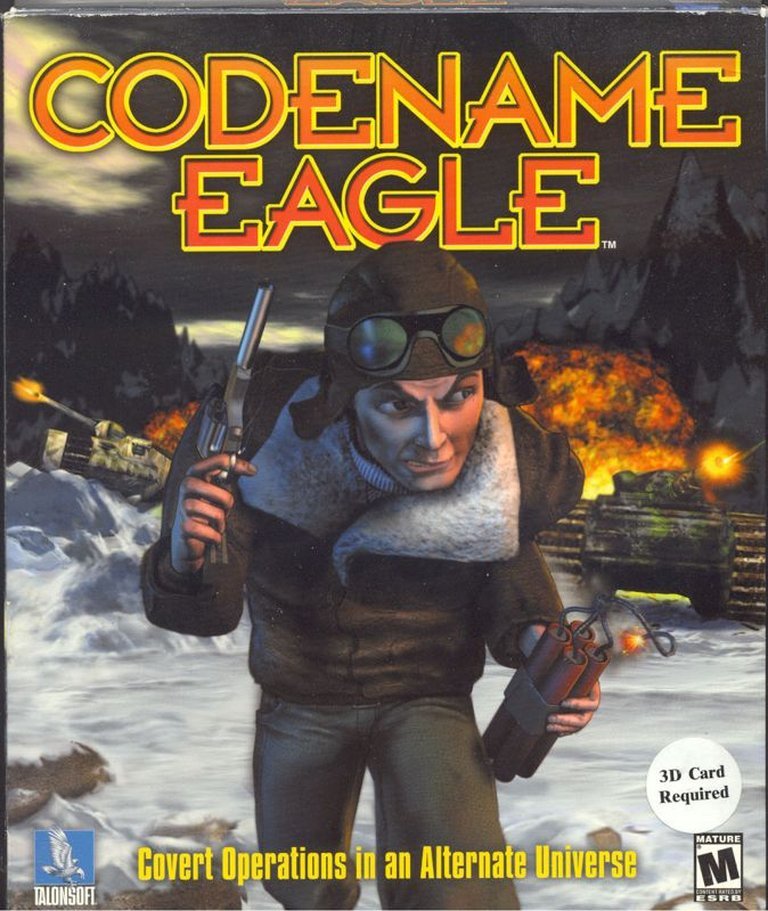
Set in an alternate history 1920s Europe, Codename: Eagle is a first-person shooter where players join an alliance to stop Tsar Pietre’s Russia, a war machine bent on global conquest after the assassination of his father. The game offers plot-driven missions across diverse landscapes, from stealing biplanes to battling wilderness foes, with both single-player campaigns and multiplayer support featuring large maps and various vehicles like tanks and planes.
Gameplay Videos
Codename: Eagle Free Download
Codename: Eagle Patches & Updates
Codename: Eagle Reviews & Reception
metacritic.com (89/100): Codename Eagle is a short, linear, and really goofy game that’s much more frustrating than it is interesting.
mobygames.com (60/100): Wonderful multiplayer game but could be better
ign.com (73/100): New action game from Talonsoft hits several highs and several lows.
Codename: Eagle Cheats & Codes
PC
Press Alt+S to open the console, then enter a code.
| Code | Effect |
|---|---|
| codenamegod | God Mode (invincibility) |
| weaponmaster | All Weapons |
| armorgod | 200% Armor |
| itemgod | All Items |
| missionmaster | Level Select (unlock all missions) |
| healthmaximum | Full Health |
Codename: Eagle: A Historical Review of Gaming’s Unpolished Precursor
Introduction: The Diamond in the Rough
In the crowded annals of late-1990s first-person shooters, dominated by the technological spectacles of Quake III Arena and Unreal Tournament, Codename: Eagle emerged not as a polished contender but as a fervent, idiosyncraticclamor for innovation. Released in November 1999 by the Swedish studio Refraction Games, the game was a chaotic, ambitious, and deeply flawed experiment that dared to ask: what if an FPS was less about tight corridor shooting and more about a sprawling, vehicular sandbox of wartime sabotage? Its legacy is a tale of two halves: a single-player campaign marred by janky AI and sparse environments, and a multiplayer mode that, against all odds, forged a chaotic, libertarian funhouse of aerial dogfights and tank rampages. This review will argue that Codename: Eagle is a seminal “what-if” in gaming history—a technically deficient but conceptually revolutionary title whose DNA is inextricably woven into one of the most successful shooter franchises of all time, Battlefield. Its true value lies not in its execution, but in the audacity of its vision and the direct lineage it provides to the large-scale, combined-arms combat that would later define a genre.
Development History & Context: The Swedish Upstart and the Refractor Engine
The Studio and the Vision: Refraction Games AB, founded in Stockholm in 1997 by a young Patrick Söderlund (who would later become Chief Design Officer at DICE/EA), was a small team with outsized ambition. Led by designer Niklas Pehrson and lead programmer Mats Dal, the studio’s core philosophy was to create an FPS that broke from the scripted, linear design of its contemporaries. The team was inspired by the freedom of action cinema and the potential of emerging 3D hardware to render vast, open spaces. The goal was a game where the player wasn’t just a foot soldier but a versatile operative capable of commandeering any vehicle—from a motorcycle to a biplane to a torpedo boat—to complete objectives. This was a radical proposition in an era where vehicle sections were often tightly scripted or non-existent (as noted by critics who praised its “unique blend of puzzles, action, and strategy”).
Technological Constraints and the Refractor Engine: The game was built on the proprietary Refractor engine, a piece of technology born of necessity and ambition. The engine was engineered from the ground up to support expansive, non-linear outdoor environments and, most critically, a robust physics model for drivable vehicles. This was a monumental technical hurdle. As sourcing from Hardcore Gaming 101 and Wikipedia details, the physics for tanks, planes, and boats were notoriously finicky—planes could fly at improbable angles, tanks would spectacularly flip on railroad tracks, and zeppelins could become incorporeal glitch-moths immune to anything but explosives. These were not features; they were symptoms of an engine straining to simulate a complex, systemic world on late-90s hardware. The trade-off was scale: maps were enormous for the time, but detail was sacrificed. Textures were low-resolution, buildings were often non-interactive “blenders” (as player reviewer phlux noted), and pop-up was a persistent issue. The development team was attempting to build a systemic, “everything is a tool” simulator on a budget that couldn’t fully support it.
The 1999 FPS Landscape: Codename: Eagle launched into a ferociously competitive market. The golden age of the FPS was in full swing. id Software’s Quake III Arena (December 1999) set the standard for pure, arena-based multiplayer. Epic’s Unreal Tournament (same period) offered brilliant bot AI and customizable game types. Valve’s Half-Life (1998) had redefined narrative integration. Into this arena stepped a small Swedish studio with a game about alternate-history Russian tsars and buggy biplanes. Its niche alternate-history setting—a world where the Bolshevik Revolution failed and a militarist Tsar conquered Europe—was intriguing but poorly marketed, further burying it beneath the weight of giants. Its European release (Nov 1999) preceded its North American launch via TalonSoft (March 2000), a delay that stifled any momentum it might have gained.
Narrative & Thematic Deep Dive: A Romanov Fantasy of Betrayal and Redemption
The plot of Codename: Eagle is a fantastical, trope-laden alternate history that freely mixes historical touchstones with comic-book espionage. The divergence point is 1917 Petrograd. Tsar Nicholas II is assassinated not by revolutionaries but by his treacherous general, General Popov, who stages a cover-up and installs a puppet, “Prince Oleg.” The real royal heirs—Prince Alexander and Princess Anastasia—are secretly rescued by the loyal Colonel Sergei. To protect Alexander, he is hypnotized by Dr. Meier and given false memories as an English farm boy.
Ten years later (1927), this amnesiac prince is Agent Red, the premier operative of “Shadow Command,” an allied resistance force. The narrative is delivered through sparse, melodramatic FMV sequences and terse mission briefings from thenasal-voiced Captain Potter (a detail praised by Power Play for its “charme”). The story is a straightforward revenge thriller: Red undertakes sabotage, assassination, and rescue missions against Popov’s war machine, gradually recovering his memories through “flashbacks” triggered by encounters with his past. Key narrative beats include rescuing the now-adult Anastasia (who becomes a symbol of legitimate rule), discovering the betrayal of the fellow agent Mortar, and a final confrontation involving a doomsday device-laden Zeppelin threatening London.
Themes and Contradictions: The narrative explores classic themes of betrayal (Popov’s coup, Mortar’s treachery), identity (Red’s struggle to reconcile his amnesiac present with his imperial past), and restoration (the goal of reinstating the Romanov line via Anastasia). However, the implementation is notoriously inconsistent, a fact highlighted by the Wikipedia article’s own parenthetical note: “Most online sources cover up the true story and say that the main villain is Pietre instead of Popov, whose father died earlier.” This confusion stems from the game’s official description (citing “Pietre,” the Tsar’s son) versus the in-game plot (where Popov is the mastermind). It points to a rushed or incoherent writing process.
The game’s portrayal of its antagonists is also culturally problematic. As the Russian-language review from Absolute Games (AG.ru) sarcastically notes, the game’s treatment of Russian history is a nationalistic caricature—the only “Russian” thing allowed is vodka, used as a bribe item. The villainous Popov is a mustache-twirling imperialist, while the “true” heirs are westernized allies. It’s a “light-hearted romp” (as the official site states) that plays into early 20th-century Western stereotypes rather than engaging with the era’s complexities.
Ultimately, the narrative serves as a flimsy, cinematic through-line for the gameplay. It’s a B-action movie plot: amnesiac hero, secret identity, global threat, climactic zeppelin battle. Its value is in providing a context for the varied mission locales—from Volga Dam to alpine train ambushes—rather than in literary depth.
Gameplay Mechanics & Systems: A Buggy Sandbox Before Its Time
Codename: Eagle’s core design philosophy is unfettered tactical freedom within large, objective-based missions. This aspiration is both its greatest strength and its ultimate failing.
Core Loops and Innovation: The single-player campaign consists of 12 linear but sprawling missions. Each begins with a minimal briefing listing primary and secondary objectives. The genius—and frustration—lies in the lack of prescribed paths. Objectives like ” Destroy the AA guns” or “Rescue Dr. Meier” can be approached via stealth, direct assault, or, most distinctively, by commandeering any available vehicle. The inventory system allows for a mix of scavenged weapons (revolvers, rifles, flamethrowers, “Necro-Gas” launchers) and tools like explosives. A unique scoring system tracks mission performance, but it had little tangible impact on progression.
The vehicle integration was the game’s headline feature and its primary legacy. As GameSpy highlighted, the ability to seamlessly transition from on-foot infiltration to piloting a biplane or driving a tank was “a different twist on the genre.” Vehicles included:
* Land: Motorcycles, trucks (useful for run-and-gun), various tanks (slow, armored, with mounted guns).
* Air: Biplanes (with separate pilot and gunner seats, a precursor to Battlefield‘s multi-crew vehicles), later patches added a helicopter.
* Sea: Torpedo boats, ships.
Physics were simulation-adjacent. Tanks had momentum, planes required careful cursor control (no free-look), and fuel was a limited resource. This created a systemic, emergent gameplay feel: one might steal a truck to reach a base, switch to a tank to blast through walls, then hop into a waiting plane for an escape. Critics like IGN and user Joel Segerbäck saw the potential: “The opportunity to switch from running around and shooting stuff to hopping into motorcycles, torpedo boats or Russian bombers is well worth your time.”
Flaws and Friction: This vision was consistently undermined by execution.
1. AI: Enemy AI was famously “psychic” and unintelligent. As player reviewer phlux exasperatingly documented, guards would utter a warning but fail to engage a knife-wielding player in their line of sight. They would also open fire from unrealistic distances, creating unfair difficulty spikes. This was a deal-breaker for tactical stealth.
2. Controls and Interface: Vehicle controls were a frequentCriticism-point. Computer and Video Games noted the stark contrast: on-foot controls were standard and functional, but vehicle control was “limited to just the keys, making for some seriously drunk driving.” The inability to crouch (a staple since Duke Nukem 3D) was cited as a glaring omission by multiple reviews.
3. Mission Design and Pacing: Many missions were linear in objective despite open environments. Escort missions (like protecting Dr. Meier) were frustrating due to fragile allies. The infamous “wolf” encounters in wilderness levels were jarring, unpredictable hazards. The lack of a detailed briefing system (just a list of objectives) left players often unsure of precise goals or map layout.
4. Technical Issues: The Refractor engine struggled with its own ambitions. The “ghost zeppelin” glitch (where vehicles pass through terrain and become intangible) became a legendary, game-breaking—yet somehow hilarious—feature in multiplayer. Pop-up, blurry textures, and jerky animations (as noted by phlux) were constant visual distractions.
Multiplayer: The Salvation: Here, the game’s flaws transformed into features. Supporting 2-16 players on LAN or early internet (with notoriously bad netcode), the three modes—Deathmatch, Team Deathmatch, Capture the Flag—were played on massively expanded versions of campaign maps. The sheer, unadulterated chaos of 16 players in tanks, biplanes, and boats on a map the size of a small country was unprecedented. The glitchy physics, weird vehicle interactions (like picking up a player mid-flight in a bomber), and lack of balance created a sandbox of absurd, emergent fun. As GameSpy nostalgically recalled, it was a LAN party staple where “it was one of the greatest multiplayer games ever created.” This “silly-factor,” documented by Hardcore Gaming 101, is the direct, unvarnished ancestor of the chaotic joy found in later Battlefield titles.
World-Building, Art & Sound: A Diegetic Futurism
Setting and Atmosphere: The game’s world is a striking dieselpunk/steampunk alternate 1920s. The Russian Empire never fell and accelerated its technology, fielding gear-driven machine guns, giant armed zeppelins, and heavily stylized tanks. The aesthetic is a fictionalized, exaggerated version of WWI-era Europe, rendered in a palette of grays, browns, and muted greens. Maps span frozen rivers, dense forests, dam complexes, and alpine passes. The atmosphere is one of grim, mechanized imperialism, but the low-poly models and blurry textures often undercut any sense of immersive grandeur. The world feels big but empty—a vast diorama with few interactive details.
Visual Direction: The Refractor engine’s greatest achievement was drawing these vast distances, but at a severe cost. Textures were famously low-resolution. Characters were blocky, animations stiff (the “swallowed a stick” walk cited by phlux). Environments were composed of simple geometric shapes. It was a world of potential but not of detail. The few FMV sequences, produced by Kaktus Film, provided a necessary cinematic anchor but were of mixed quality.
Sound Design: Sound was another area of uneven quality. The soundtrack by Örjan Standberg was functional and moody, fitting the wartime aesthetic. Weapon sounds were frequently panned as unconvincing—phlux derided the revolver as sounding “like fireworks.” However, the voice acting, while objectively poor (with stilted delivery and a muted script), acquired a certain campy charm for some, as Power Play noted the “herrlich-nasalen Oxford-Englisch” of the briefing officer. It contributed to the game’s overall “so-bad-it’s-good” B-movie sensibility.
Reception & Legacy: From Commercial Failure to Cult Progenitor
Critical and Commercial Reception upon Launch: Codename: Eagle was met with mixed-to-negative reviews at release, holding a 58% aggregate on MobyGames (from 22 critics) and a 62% on GameRankings. The critical consensus was remarkably consistent:
* Praised: Ambitious vehicle integration, large maps, potential in multiplayer, unique setting.
* Panned: Terrible AI, poor graphics, clunky controls (especially vehicles), short/linear single-player campaign, technical instability.
Scores ranged from the highly positive (Świat Gier Komputerowych at 80%, GameSpy at 78%) to the scathing (Computer Gaming World’s 30%, Génération 4’s 33%). The commercial performance was abysmal. As famously stated by former DICE employee Sean Decker, it sold approximately 20,000 units—a catastrophic failure for a publisher like Take-Two. Reasons cited include the saturated market, the niche setting, the delayed NA release, and the game’s unpolished state.
Evolution of Reputation: Over time, Codename: Eagle has undergone a significant critical rehabilitation, not as a good game, but as a profoundly influential one. The rise of the Battlefield series cast it in a new light. Retrospectives from Kotaku (2011), Rock Paper Shotgun (2016), and Hardcore Gaming 101 have re-framed it as the “forgotten origin” of large-scale FPS warfare. The focus shifted from its flaws to its pioneering mechanics: the seamless infantry-vehicle transition, the focus on objective-based play in huge spaces, and the sheer, unscripted multiplayer pandemonium.
Influence and Community Legacy: The link is direct and undeniable. In 2000, DICE (Digital Illusions CE) acquired Refraction Games. The Refractor engine technology, the core multiplayer philosophy, and several developers (including Lars Gustavsson, who became DICE’s lead multiplayer designer) migrated into DICE. This fusion directly produced Battlefield 1942 in 2002. Kotaku‘s seminal article states plainly: “The Game That Started the Battlefield Series.” Gustavsson himself credited the Codename: Eagle multiplayer community’s enthusiasm as the catalyst.
The influence is clear:
1. Vehicle-Centric Combined Arms: The core fantasy of every Battlefield game—jumping from a tank to a plane to a boat—was prototyped here, bugs and all.
2. Large-Scale, Objective-Based Multiplayer: The “Capture the Flag” on huge maps with vehicles established the template.
3. A Sandbox of Systemic Fun: The glitches and physics quirks, rather than being patched out completely, evolved into the more polished but still chaotic emergent gameplay of Battlefield.
Furthermore, the game has maintained a dedicated, preservationist cult following. The website codenameeaglemultiplayer.com, launched around 2015, provides community patches (like version 1.43), a custom client (CEClient), and server listings, keeping the multiplayer alive on modern Windows systems using wrappers like dgVoodoo. As one Metacritic user review (2017) stated, it’s the “great grandaddy” worth playing to see the roots of Battlefield. Mods like “CE: Legends” for Battlefield 1942 and Battlefield 2 are direct acts of homage.
Conclusion: A Flawed Foundation Stone
Codename: Eagle is not a game to be judged by traditional standards of polish or balance. Its single-player campaign is a frustrating, often broken gauntlet of poor AI and barren landscapes. Its graphics are a product of a constrained engine. Its controls are frequently unwieldy. By the metrics of 1999, it was a commercial and critical disappointment.
Yet, to dismiss it on these grounds is to miss its monumental historical importance. It is the ur-text of the large-scale, vehicle-based FPS. Its refusal to confine the player to a single mode of engagement—its insistence that a mission could involve a knife fight, a tank barrage, and an aerial dogfight in succession—was a revolutionary idea that the industry, through DICE, would spend the next two decades perfecting. Its multiplayer, for all its netcode issues and physics glitches, created a specific, joyous, and Systemic form of chaos that Battlefield would refine but never fully replicate.
In the canon of video game history, Codename: Eagle is the rough draft, the prototype on the workshop floor that somehow works despite itself. It is the game that proved the concept of “everything is a vehicle” was worth pursuing. Patrick Söderlund and the team at Refraction Games did not make a classic. Instead, they made a crucial experiment—a buggy, ambitious, multiplayer-focused sandbox that provided the foundational bedrock for one of gaming’s most enduring franchises. For that reason alone, Codename: Eagle deserves its place not on a shelf of masterpieces, but in a wing of the museum dedicated to pivotal, imperfect, and wildly influential innovations. It is the messy, glorious, and essential ancestor of the modern battlefield.