
- Release Year: 2011
- Platforms: Windows
- Publisher: Desunoya
- Developer: Desunoya
- Genre: Action
- Perspective: Side view
- Game Mode: Single-player
- Gameplay: Collection, Exploration, Metroidvania, Platform, Power-ups, Puzzle
- Setting: Fantasy
Description
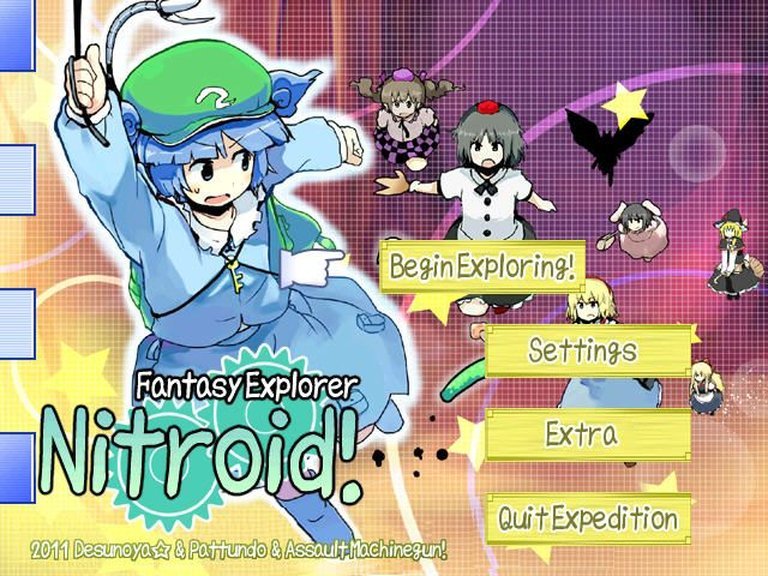
Fantasy Explorer Nitroid! is a 2D Metroidvania-style platformer set in the fantasy world of Gensokyo from the Touhou series. Players control Nitori Kawashiro, an engineer Kappa, as she explores five distinct worlds, solving block puzzles, collecting mushrooms as currency, and acquiring power-ups to pursue the missing hell raven Utsuho Reiuji.
Gameplay Videos
Fantasy Explorer Nitroid! Mods
Fantasy Explorer Nitroid! Reviews & Reception
minus.world : A solid experience, with a few flaws that are less difficulty related and more just… there’s potential there that doesn’t really get used
Fantasy Explorer Nitroid!: A Comprehensive Review of Touhou’s Puzzle-Platforming Masterpiece
Introduction: The Kappa’s Quest in a Labyrinth of Gensokyo
In the sprawling, self-published ecosystem of Touhou Project fangames, few titles capture the essence of their source material while carving out a distinct mechanical identity as confidently as Fantasy Explorer Nitroid! (幻想探索 にとろいど!, Gensou Tansaku Nitroid!). Developed by the doujin circle Desunoya and released in 2011, this Windows-exclusive title presents itself with a portmanteau title promising a fusion of its protagonist, Nitori Kawashiro, and the seminal exploration title Metroid. Yet, a deep dive into its architecture reveals a game that, while borrowing the Metroidvania framework, ultimately forges its own path as a meticulously crafted puzzle-platformer. This review will argue that Nitroid is a seminal work within the Touhou fangame canon—not for its fidelity to the bullet-hell origins of the series, but for its sophisticated translation of Gensokyo’s whimsical aesthetic into a challenging, tool-based puzzle ecosystem. Its legacy is one of brilliant design juxtaposed against a fundamental tension between its advertised identity and its executed form, creating a experience that is both deeply satisfying and quietly subversive.
Development History & Context: Desunoya’s Craft in the Doujin Landscape
To understand Nitroid, one must first situate it within the career of its developer, Desunoya (ですのや☆). The circle had already established a reputation for innovative Touhou fangames with titles like Marisa and Alice (a Mario & Wario-style item-tossing puzzle game) and Guruguru Suika. Their pedigree was in clever, often asymmetric, multiplayer or puzzle mechanics that reinterpreted the Touhou cast through distinct gameplay lenses. Nitroid, then, represented a shift toward a single-player, narrative-driven platforming experience, albeit one still deeply rooted in puzzle-solving.
The game emerged in 2011, a period of prolific creativity for the Touhou fangame scene. ZUN’s official series, on a relatively consistent release schedule, provided a vibrant world (Gensokyo) and a cast of characters that fueled endless reinterpretation. Desunoya’s choice to focus on Nitori Kawashiro—the engineer kappa from the Mountain of Faith era—was telling. Nitori, a character defined by her inventiveness and tinkering, was a perfect avatar for a game centered on acquiring and mastering tools. The technological context was that of the RPG Maker 2000/2003 era’s lingering influence and the burgeoning use of more flexible engines for doujin development. The game’s fixed 640×480 resolution and Direct3D 9 specification (as noted on PCGamingWiki) place it firmly in the early-2010s indie aesthetic, prioritizing clean, readable sprites and precise collision over graphical spectacle. Its release model—a one-time purchase with no microtransactions, sold via platforms like DLsite and Booth—was standard for quality doujin works, relying on word-of-mouth and dedicated fan channels for distribution. Crucially, its initial Japanese-only release meant its international reach was gated until the creation of a robust fan translation patch (requiring game version 1.10), a common hurdle for Touhou fangames that shaped their global reception.
Narrative & Thematic Deep Dive: A Simple Premise, Rich Context
The plot of Nitroid is refreshingly straightforward, serving primarily as a scaffolding for the gameplay. As summarized on the Touhou Wiki: Utsuho Reiuji, the hell raven tasked with controlling the nuclear reactor beneath the Moriya Shrine, has absconded from her post. Nitori, motivated by a sense of duty to the mountain (and hinted personal benefit), takes it upon herself to track down the missing Utsuho. This premise is a clever slice of Touhou lore. Utsuho’s transformation into a “nuclear reactor” is a reference to her Undefined Fantastic Object storyline, where she gains the power of the “Utsuho Reiuji” Yatagarasu. Nitori’s involvement ties into her established role as a gadgeteer and her connection to the Moriya shrine grounds.
The narrative is delivered minimally—primarily through sparse text boxes between worlds and character cameos. There is no extensive dialogue or character development; the story is an excuse to traverse Gensokyo. Yet, this minimalism is thematically resonant. The game embodies Nitori’s mindset: an engineer’s problem-solving expedition. The “exploration” is not of personality but of physical and mechanical space. Thematically, it touches on responsibility (Nitori’s quest), the chaos of unchecked power (Utsuho’s departure), and the joy of invention (the entire tool acquisition system). The final confrontation, implied rather than shown in the standard route, resolves not with a dramatic showdown but with the simple, practical act of finding and presumably corralling a wayward colleague. The optional Extra World, unlocked by collecting UFOs for Nue, adds a layer of cryptic, youkai-centric mystery, perfectly aligning with Touhou’s penchant for hidden, esoteric layers beneath a surface of playful chaos.
Gameplay Mechanics & Systems: The Tool-Based Puzzle Engine
Here, Nitroid reveals its core brilliance and its primary point of contention with its Metroidvania billing. The gameplay loop is as follows: enter a world (e.g., Forest of Magic, Youkai Mountain), navigate its interconnected “stages” (screens), solving block and platforming puzzles to progress, collect mushrooms (currency), and find power-up tools. These tools are not merely keys to new areas; they are the fundamental verbs of the game’s puzzle language.
The toolset, as documented on the Touhou Wiki and analyzed in the Minus World review, is deceptively simple yet profoundly versatile:
* Drill: Allows for horizontal dashing and drilling through certain blocks. Its use extends far beyond simple barrier removal; as noted, it can be used to control fall speed and land precisely on dangerous spikes.
* High-Speed Boots: Greatly increase movement speed. This isn’t just for running; it becomes crucial for timing-based switch puzzles and outrunning hazards.
* Jetpack: Grants sustained flight. Its fuel management introduces a resource puzzle element.
* Bombs: Can be placed and detonated, used to destroy specific blocks, defeat certain enemies, or create temporary platforms.
* Boomerang: A ranged tool that can hit distant switches and return.
The genius lies in how these tools are recombined. The game’s puzzle design, as observed by the Minus World reviewer, starts with simple timed switches and switch blocks in World 1 and escalates to “blocks that only break if you dash at them, looping jets of fire, moving platform blocks” by World 4. A puzzle might require drilling to drop a bomb at a specific angle, then using the jetpack to navigate the ensuing explosion’s debris. The “Metroidvania” element is almost exclusively reserved for optional completionism. As the reviewer starkly puts it, “All of the worlds (with two exceptions) are about progression rather than exploration.” You do not frequently return to earlier worlds with a new tool to access previously unreachable critical path areas. Instead, you return for collectibles: Mushrooms for Marisa’s shop, “Sparkling Cucumbers” to max out energy, and UFOs for the Extra World. The progression is primarily linear within each world, segmented by boss doors.
This is the game’s defining structural flaw if judged strictly as a Metroidvania. The “vania” aspect—the feeling of the map opening up, of old areas transforming with new abilities—is largely absent from the core journey. The “metroid” aspect of tool-gating is present but applied almost solely to optional content. However, judged as a puzzle-platformer, its structure is impeccable. Each world is a self-contained puzzle gauntlet that introduces and masters a specific set of mechanics before the boss, who is almost always a puzzle boss. The first two bosses have unique, non-standard defeat conditions. The third is a survival challenge. The fourth and fifth incorporate health bars but still require puzzle solutions to phase them or deal damage. This consistent focus on problem-solving over pure reflex or combat creates a cohesive, intellectually demanding experience.
The shop system, run by the ever-opportunistic Marisa Kirisame, is a peripheral but charming economy. Mushrooms gathered from levels can be exchanged for consumables (like health refills), permanent upgrades (extra health, energy), and tools that facilitate travel between worlds. This adds a light metagame of resource management and risk/reward—do you spend mushrooms on safety or on potential long-term access?
World-Building, Art & Sound: Gensokyo as a Puzzle Box
The game’s world is Gensokyo, the fantasy land of the Touhou Project, divided into five distinct zones plus the Extra World. Each world visually interprets a canonical location—the Forest of Magic, Youkai Mountain, the Netherworld—through a side-scrolling puzzle platformer lens. The art style is pure doujin Touhou: colorful, detailed anime sprites with a slightly chibi flair, set against lush, parallax-scrolling backgrounds. The aesthetic is consistently whimsical and inviting, which provides a pleasing contrast to the often-frustrating precision the puzzles demand. The sprite work for Nitori and the various enemy youkai is expressive and clear, crucial for a game where recognizing an enemy’s pattern or a block’s type is a matter of life and death.
Sound design follows the typical Touhou fangame template: a soundtrack of arranged, original-composed tracks that evoke the series’ iconic danmaku themes but reimagined as exploratory or tense puzzle music. The sound effects are crisp—the clink of a mushroom, the hiss of the drill, the satisfying thud of a solved puzzle—and provide essential auditory feedback. While the source material doesn’t list specific composers, the music’s quality aligns with Desunoya’s other works, effectively building atmosphere without distracting.
Collectively, the world, art, and sound create a immersive pocket dimension of Gensokyo that feels both familiar to fans and functionally unique. It’s a Gensokyo where the primary threat isn’t a spell card barrage, but a poorly timed jump onto a vanishing block.
Reception & Legacy: A Cult Classic with a Caveat
The commercial and critical reception of Nitroid is muted by mainstream standards but significant within its niche. MobyGames lists it with an average score of 4.0/5 from a single rating and zero written critic reviews, a testament to its obscurity outside dedicated Touhou circles. On Steam250’s 2011 list, it does not appear, confirming it was never released on the platform and had minimal penetration into the broader PC gaming market. Its sales were through doujin channels (DLsite, Booth), common for Japanese fan works.
Its legacy is therefore threefold:
1. Within the Desunoya Oeuvre: It stands as one of their most ambitious and polished single-player projects, showcasing a mastery of puzzle construction that their later works (like Marisa and Alice’s Trap Tower) would revisit in different forms. As the Minus World reviewer laments, “Nitroid’s one of those games where I wish Desunoya did more games that reused the mechanics they have,” highlighting its status as a potentially fruitful, under-explored design well.
2. Within the Touhou Fangame Sphere: It is cited as a prime example of the “puzzle-platformer” subgenre (listed explicitly on the Touhou Wiki). It demonstrated that a Touhou game could thrive without danmaku, focusing instead on character-specific abilities (Nitori’s engineering) in a non-combat context. It carved out a respected, if quiet, niche for thoughtful, challenging platforming in a scene dominated by shooters and fighting games.
3. As a “Metroidvania” Case Study: It serves as a cautionary tale about title expectations. Its frequent labeling as a “Metroidvania” (on MobyGames, PCGamingWiki, and RAWG) sets players up for a specific experience of nonlinear exploration that the game deliberately avoids. This has led to a common critique, echoed in the Minus World review, that it fails to deliver on the promise of its name. In this sense, its legacy is also one of definitional clarification—what happens when a game adopts the tools of a genre but not its structural ethos? Nitroid answers: a great puzzle game, but a misleading Metroidvania.
The fan translation by vgperson was pivotal, unlocking the game for the international community. vgperson’s own assessment that it is “much more fair in its challenges” than the notoriously brutal MariAri is a significant endorsement, positioning Nitroid as an accessible entry point into Desunoya’s demanding design philosophy.
Conclusion: A Flawed Gem in Gensokyo’s Vault
Fantasy Explorer Nitroid! is not the Metroidvania its title claims. To judge it as such is to engage with a fundamental misconception and risk undervaluing its true achievements. It is, instead, one of the most precisely tuned puzzle-platformers to emerge from the Touhou fangame scene. Its strength is in the elegant, escalating complexity of its tool-based puzzles and its consistently creative, puzzle-centric boss designs. Its weakness is a linear progression that sacrifices the exhilarating “aha!” moment of using a new ability to backtrack and conquer an old obstacle, which is the heart of the Metroidvania genre.
Yet, this linearity serves its puzzle-focused design impeccably. It allows Desunoya to craft a perfectly pitched challenge curve, introducing mechanics, testing them, combining them, and climaxing with a final exam in the form of the world bosses and the terrifyingly complex Extra World. For players who relish learning a system’s grammar and then writing increasingly complex sentences with it, Nitroid is a masterclass. Its Gensokyo is a beautiful, hazardous playground. Its protagonist, Nitori, is the perfect engineer-heroine for this context.
In the grand tapestry of video game history, Nitroid is a footnote—a cult doujin title with limited reach. But within the specialized history of puzzle design and Touhou fangames, it is a major entry. It proves that the rich world and characters of Touhou can support a genre far removed from its danmaku roots, and that a game can be mechanically brilliant even while failing to meet the specific expectations its own branding creates. For those willing to approach it not as a Super Metroid with a kappa, but as The Lost Vikings or Stephen’s Sausage Roll in a Gensokyo skin, Fantasy Explorer Nitroid! offers a deeply rewarding, intellectually rigorous adventure that remains, over a decade later, a uniquely compelling artifact of fan-driven creativity.
Final Verdict: 4/5 Reimus – A brilliant, focused puzzle-platformer trapped in the body of a misleadingly named Metroidvania. Its linearity is a conscious design choice that serves its strengths, but it inevitably leaves players expecting nonlinear exploration feeling shortchanged. A must-play for puzzle fans and Touhou enthusiasts, but approach with adjusted expectations.