
- Release Year: 2008
- Platforms: Windows
- Publisher: Ubisoft Entertainment SA
- Genre: Compilation
- Game Mode: Online PVP, Single-player
- Average Score: 70/100
Description
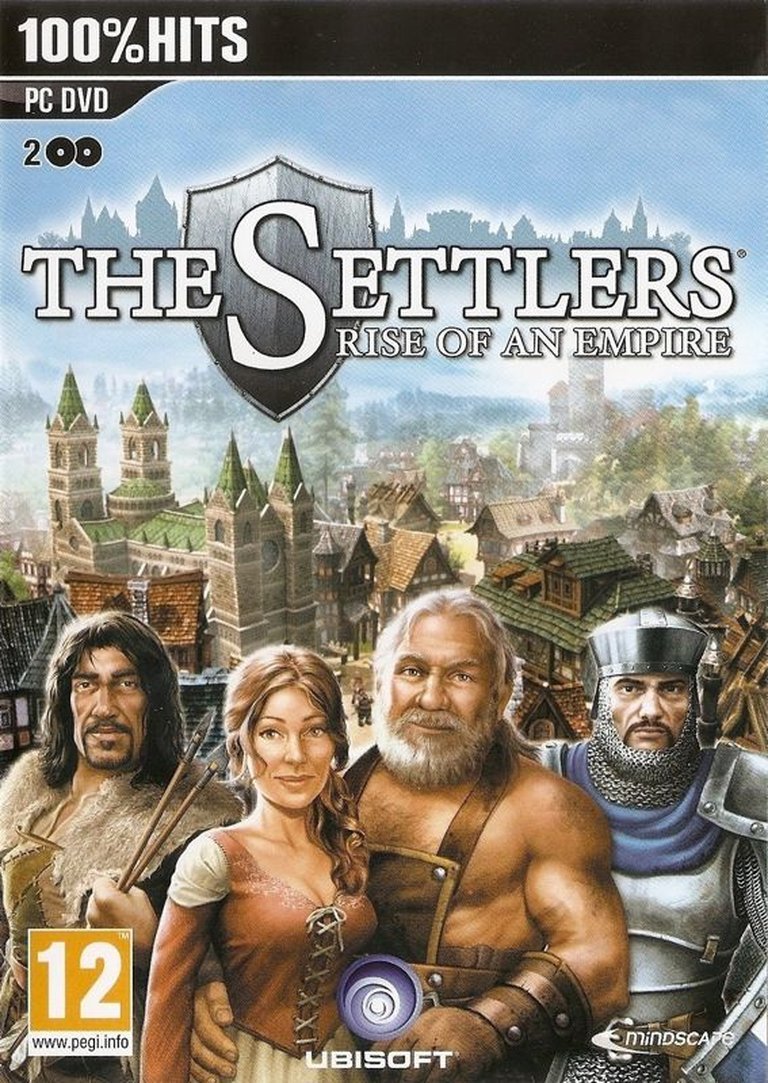
The Settlers: Rise of an Empire – Gold Edition is a city-building strategy game set in a captivating medieval fantasy world. Players create and manage bustling empires, balancing economic development with military defense against looming threats. This Gold Edition compiles the base game and the Eastern Realm expansion, offering extended gameplay with new maps, content, and enhanced depth for a comprehensive empire-building experience.
Where to Buy The Settlers: Rise of an Empire – Gold Edition
PC
The Settlers: Rise of an Empire – Gold Edition Guides & Walkthroughs
The Settlers: Rise of an Empire – Gold Edition Reviews & Reception
ign.com (70/100): The two pack of Rise of an Empire and the Eastern Realm expansion pack features an immersive, yet transparent economic system based on the resources, wares and goods produced by the settlers in their various trades and occupations.
The Settlers: Rise of an Empire – Gold Edition Cheats & Codes
PC (Gold Edition)
For building unlocks, enter codes at the title screen under Options. For in-game cheats, activate cheat mode by pressing CTRL+SHIFT+/, CTRL+SHIFT+*, CTRL+SHIFT- quickly on the numpad, then use the key combinations during gameplay.
| Code | Effect |
|---|---|
| 1703848010 | Unlock Family Statue |
| 0025722953 | Unlock Pavilion |
| SHIFT+4 | Squad of Archers to cursor position |
| SHIFT+5 | Squad of Swordsmen to cursor position |
| SHIFT+6 | Summon unbuilt Catapult to cursor position |
| SHIFT+7 | Summon Battering Ram to cursor position |
| SHIFT+8 | Summon Siege Tower to cursor position |
| SHIFT+9 | Summon built Catapult to cursor position |
| CTRL+F1 | Add 50 Gold |
| CTRL+F2 | Add 10 Wood |
| CTRL+F3 | Add 10 Stone |
| CTRL+F4 | Add 10 Grain |
| CTRL+F5 | Add 10 Milk |
| CTRL+F6 | Add 10 Herbs |
| CTRL+F7 | Add 10 Wool |
| CTRL+F8 | Add 10 of every resource |
| SHIFT+F1 | Add 10 Honey |
| SHIFT+F2 | Add 10 Iron |
| SHIFT+F3 | Add 10 Fish |
| SHIFT+F4 | Add 10 Meat |
| CTRL+F9 | Increase Food |
| CTRL+F10 | Increase Clothing |
| CTRL+F11 | Increase Hygiene |
| CTRL+F12 | Increase Entertainment |
| SHIFT+F9 | Decrease Food |
| SHIFT+F10 | Decrease Clothing |
| SHIFT+F11 | Decrease Hygiene |
| CTRL+V | Win current Mission |
| CTRL+SHIFT+F | Toggle Fog of War |
| ALT+F10 | Burn selected building |
| ALT+F11 | Hurt selected unit |
| CTRL+SHIFT+1 | Toggle FPS display |
| NUMPAD1 | Return to playing as yourself |
| CTRL+NUMPAD4 | Give bowmen at cursor |
| CTRL+NUMPAD5 | Give swordsmen at cursor |
| CTRL+NUMPAD6 | Give catapult cart at cursor |
| CTRL+NUMPAD7 | Give battling ram cart at cursor |
| CTRL+NUMPAD8 | Give siege tower cart at cursor |
| CTRL+NUMPAD9 | Give catapult at cursor |
| CTRL+SHIFT+Q | Remove border lines |
| CTRL+SHIFT+F9 | Show stockpile numbers and cursor position |
| CTRL+SHIFT+W | Remove water |
| CTRL+SHIFT+R | Remove roads |
| CTRL+SHIFT+K | Remove roads |
| CTRL+SHIFT+T | Black out territory |
| CTRL+SHIFT+S | Remove shadows |
| CTRL+SHIFT+G | Remove interface icons |
| CTRL+SHIFT+H | Remove rocks |
| CTRL+SHIFT+C | Remove grass |
| CTRL+SHIFT+M | Turn territories colors |
| CTRL+SHIFT+V | Show red grid line |
| CTRL+SHIFT+B | Show blue buildable grid line |
| CTRL+SHIFT+N | Clear grid lines |
The Settlers: Rise of an Empire – Gold Edition: A Bridge Too Streamlined?
Introduction: The Weight of a Legacy
In the long and storied chronology of the city-building genre, few series carry the pedigree of The Settlers. For over a decade, Blue Byte’s flagship franchise was synonymous with intricate economic webs, charming “Wuselfaktor” (busy-bee) aesthetics, and the satisfying hum of a perfectly optimized medieval microcosm. By 2007, however, the series found itself at a crossroads. Its immediate predecessor, Heritage of Kings, had controversially pivoted toward traditional real-time strategy combat, alienating a core segment of its audience. The sixth mainline entry, The Settlers: Rise of an Empire, and its subsequent Gold Edition compilation, represent a decisive, and ultimately divisive, course correction. This review will argue that while Rise of an Empire is a technically proficient and visually lavish game that successfully captures the serene joy of settlement growth, its profound simplification of the legendary Settlers economic depth and its underdeveloped narrative campaign result in an experience that feels both ambitiously scaled and curiously hollow—a beautiful, bustling city with a hollow core.
Development History & Context: Hunting the “Settler Gene”
The development of Rise of an Empire began immediately after Heritage of Kings: Legends Expansion Disc in 2005. Under the guidance of producer Benedikt Grindel and designers Alex Brüggemann and Andreas Suika, Blue Byte—by then a Ubisoft subsidiary—embarked on a philosophical mission to identify the quintessential “Settler gene.” This internal quest was a direct response to feedback that Heritage of Kings had strayed too far from the series’ city-building roots, foregrounding military conflict at the expense of economic simulation.
The resulting design philosophy was one of conservative synthesis. The team elected to cherry-pick popular mechanics from across the series’ history: the road networks from the first two games, territory expansion via military outposts from titles past, the prosperity-linked military strength from Settlers IV, and the hero units, taxation, and soldier salary systems from Heritage of Kings. Crucially, they deliberately scaled back combat’s importance, aiming for a game where warfare was an “optional challenge,” not the primary goal. The economic model was radically streamlined, eliminating the complex, daisy-chain production chains of earlier games in favor of a more direct “resource building -> storehouse -> produce building” flow. This was a conscious move to reduce micromanagement and make the game accessible to newcomers, a goal frequently cited by the developers.
Technologically, the game was built on a heavily modified version of the RenderWare engine used in Heritage of Kings. The team pursued a specific visual goal termed the “aquarium effect”—a level of detail so clear that the player could instantly understand a settler’s task by watching their animation. This demanded a fivefold increase in polygon count for buildings and a threefold increase for settlers compared to its predecessor. The game’s launch in September 2007 was supported by a substantial marketing campaign, including a promotional mini-game (“Honey for a King”), an open beta, and multiple collector’s editions in German-speaking regions. The subsequent Eastern Realm expansion (March 2008) and the Gold Edition (September 2008) were part of a standard lifecycle, adding content and the new “Far East” climatic zone with its monsoon mechanic.
Narrative & Thematic Deep Dive: A Kingdom of Clichés
Set centuries after the events of Heritage of Kings, the campaign unfolds in a fractured “Darion Empire.” The player assumes the role of an unnamed “First King” on the island of Westerlin, tasked with reuniting the warring provinces. The narrative is delivered through cinematic cutscenes (which won a Deutscher Entwicklerpreis award) and via the player’s hero knight, who acts as a narrative avatar and receives quests. The story is a straightforward, almost archetypal, tale of political reunification.
The primary antagonists are the Red Prince, a power-hungry megalomaniac, and his cunning general, Crimson Sabatt. The plot follows a familiar “rally the provinces” structure, featuring betrayals (the knight Marcus’s defection), rescues, and a climactic siege. A notable twist involves Sabatt’s persuasive abilities, suggesting a thematic layer about the fragility of loyalty, though it’s not deeply explored. The campaign’s conclusion, with a frame story set 600 years in the future where the unification is already dusty textbook history, introduces a poignant, if brief, theme about the ephemeral nature of empires versus enduring legend.
The Eastern Realm expansion shifts the setting eastward, introducing a new threat: Khana, a false goddess leading a cult, and the conflicted Mogul Praphat of Hidun, who is manipulated by her. This campaign introduces more morally gray territory—brainwashing, familial betrayal, and the recovery of a legacy (the treasure of Dario). The connection to the main plot is tenuous, but it expands the world’s mythology. Overall, the narrative is functional and serviceable, providing context for missions, but it lacks the depth or character development to be memorable. It serves primarily as a scaffolding for the gameplay, a common trait in the genre but one that feels particularly thin here when compared to the richer emergent storytelling of the best Settlers titles.
Gameplay Mechanics & Systems: The Engine of Simplicity
Rise of an Empire’s gameplay is a study in deliberate simplification, built around a new core loop that prioritizes settler happiness and city growth over economic micromanagement.
The Central Loop & Settler Life: The player begins with three “Special Buildings”: the Castle (military/tax), Cathedral (settler limit/sermons), and Storehouse/Marketplace (trade/festivals). The revolutionary change is that workers live in their workplaces. Building construction and upgrades are performed by the settlers who will staff that building, with each upgrade adding a new settler who brings the materials. This creates a seamless, visually intuitive link between construction and population growth. The introduction of female settlers was a major marketing point. They emerge during festivals (called at the Marketplace). If a male and female settler connect, they form a couple; the woman then moves in with the man, taking on cleaning and food acquisition duties, which boosts the male worker’s productivity. This charming, automated social simulation was a standout feature.
Needs, Wants, and Reputation: Settlers in resource buildings have only a need for food. Those in produce buildings develop needs (food, clothes, cleanliness, entertainment) and wants (prosperity and decoration items). Meeting these raises the city’s Reputation, a crucial global metric. Reputation directly scales military unit strength—a high-reputation city fields powerful soldiers, while a low-reputation one fields weak ones. Reputation is affected by building upgrades, rare goods, festivals, sermons, tax rates, and strikes. This system elegantly ties economic health to military capability, making taxation and citizen satisfaction matters of strategic defense.
The Knight & Progression: The player controls a single hero knight from a roster (6 in base, +1 in Eastern Realm). The knight has a passive ability and a powerful active ability with a cooldown. The knight’s level of promotion is the primary campaign progression metric. To promote, the settlement must meet specific criteria (e.g., certain buildings built, needs met, gold earned). Promotion unlocks new building types, increases settler limits, and introduces more complex needs. The knight also physically travels the map to build outposts, steal via the thief unit (new to this game), and interact with scripted events. This hero-focus gives the campaign a personal, RPG-lite feel.
Economy & Diplomacy: The economic chain is simple: resource buildings (e.g., Farm) gather raw materials from nearby sources and store up to 9 units (via upgrades). Produce buildings (e.g., Bakery) take raw materials from the Storehouse and output finished goods for sale. Gold is earned via taxation (set at the Castle), sermons, and trade. Diplomacy exists on a simple 5-tier scale (Enemy to Allied), but is largely binary—trade is either possible or not, with “Allied” providing automatic defense. Critics rightfully noted this was “basically non-existent” compared to the nuanced diplomacy of Anno or even older Settlers titles.
Military & Expansion: Territory is claimed by building Military Outposts in neutral zones (costing gold based on territory richness). Outposts require no garrison. To take occupied territory, you must destroy an enemy outpost. Combat uses two basic unit types: Swordsmen and Bowmen, recruited in fixed groups of six. They use torches to burn buildings and must return to a barracks/outpost/castle to resupply. Siege engines (catapults, rams, towers) are required to breach walls/gates and require a full battalion to operate. Walls (palisades vs. stone) and defensive traps are available. Combat is intentionally simple and, as designers admitted, often optional. In multiplayer, victory can also be achieved by promoting your knight to the max level or causing an economic strike.
The Eastern Realm Additions: The expansion’s major additions were the Far East climatic zone (with a two-month monsoon season halting farming/fishing/river travel), the Geologist (who can partially replenish depleted mines/quarries), Trading Posts (for automated monthly trade), a new knight, and new maps/embellishments.
World-Building, Art & Sound: A Living Painting
The game’s most universally praised aspect is its presentation. The RenderWare engine delivers a world of unprecedented detail and vivacity for the series at the time. The “aquarium effect” is in full force: one can watch a settler in the siege engine workshop operate machinery, see dogs urinate on walls, observe butterflies land on flowers, and note how settlers’ animations change with the seasons (e.g., being unsteady after leaving a tavern). The art style successfully merges the caricatured charm of the early Settlers (“Wuselfaktor”) with the more realistic 3D models of Heritage of Kings. The world feels alive and responsive.
The game is divided into four climatic zones (Northland, North Temperate, South Temperate, Southland), each with distinct seasons that visually and mechanically impact gameplay (e.g., winter halts crop growth/fishing). The Eastern Realm‘s Far East zone added a dynamic monsoon season. This environmental variety adds significant atmospheric and strategic depth.
The sound design is immersive, with a pleasant, unobtrusive medieval-inspired soundtrack by Michael Pummel that adapts to the player’s actions and the map’s climate. The soundscape is filled with ambient noises of settlement life, hammering, animal sounds, and the chime of the marketplace bell. The cutscenes are well-animated and voiced (in German and English), contributing to their award-winning status.
Reception & Legacy: Critical Split, Commercial Triumph
Rise of an Empire was a commercial smash hit, particularly in its native Germany. It sold over 200,000 units in its first two months and became the best-selling German-developed game of 2007. It swept the 2007 Deutscher Entwicklerpreis, winning six awards including the coveted “Best German Game”—a first for the series.
Critical reception, however, was notably mixed, holding a Metacritic score of 66/100. The dichotomy in reviews is telling:
* Praises: Universally lauded for its stunning graphics, “best ever seen in a strategy game” (PC Games). The “lively,” “detailed” world and animations were consistently highlighted. The accessible, gentle learning curve and the charm of the automated social systems (festivals, couples) were also noted positively.
* Criticisms: The core criticisms were targeted and severe. The economic system was deemed overly simplistic—”simplified to an almost insulting degree” (Eurogamer). Reviewers found that “even the worst settlement somehow runs fine,” removing meaningful optimization challenge. The mission design was called “linear and predictable,” “boring,” and “formulaic.” The AI was weak, and the diplomacy system was barebones. The combat was widely panned as shallow and lacking tactical depth. Many felt the game was a step back from the depth of the first four Settlers titles and even inferior to competitors like Anno 1701.
Legacy and Position in the Series: This game represents a definitive pivot point. It consciously rejected the RTS-heavy direction of Heritage of Kings and attempted to reclaim the series’ city-building soul. However, in doing so, it arguably over-corrected, stripping away the intricate economic chains that defined the classic titles (I-IV). Its legacy is therefore paradoxical:
1. A Commercial Success & Awards Darling: It proved the Settlers brand remained a potent force in the German-speaking market and validated Blue Byte’s design direction with the public and awarding bodies.
2. A Critical Pivot Point: It is often cited, especially in retrospectives like Thomas Wilke’s 2010 PC Games piece, as the beginning of the series’ decline in critical esteem. The simplification trend it championed would be seen by many purists as a dilution of the franchise’s unique identity.
3. A Cultivated Community: The inclusion of a powerful map editor fostered a strong modding community. As noted by user reviewer Sotaria, sites like settlersmaps.com saw a flood of custom maps, extending the game’s playability for years and creating a lasting, if niche, legacy.
4. The Predecessor to Settlers 7: The hero-knight system and streamlined production would be inherited and iterated upon by the poorly-received Settlers 7: Paths to a Kingdom, suggesting the core design changes of Rise of an Empire set a new, and ultimately contested, template for the series.
Conclusion: A Beautiful, Flawed Pivot
The Settlers: Rise of an Empire – Gold Edition is a game of magnificent scale and profound concessions. It is a technological showcase with perhaps the most visually delightful and animated settlements in the series’ history. The core joy of watching your tiny, industrious settlers build a thriving, visually complex city remains potent. The innovations of integrated social dynamics (festivals, couples) and the clear link between prosperity (Reputation) and military power are elegant.
However, these strengths are undermined by a fundamental simplification of the economy that removes the intellectual challenge of optimization that was the hallmark of the classic titles. The campaign, while improved by the hero-knight framework, is a forgettable string of scripted objectives. The combat is a shallow afterthought. For the historian, this title is not a return to form but a rebranding—a conscious effort to make The Settlers palatable to a broader, less hardcore audience by sacrificing the very complexity that gave it its “gene.”
Its commercial triumph and award wins stand in stark contrast to its lukewarm critical reception and divisive fan response. The Gold Edition, including the solid if unspectacular Eastern Realm expansion, is the most complete package for this chapter of the series. Yet, it marks the point where the series’ identity became a subject of intense debate: was it a city-builder first, or an RTS? Rise of an Empire chose the former but in doing so, emptied the city of much of its soul. It is a beautiful, competent, and ultimately shallow monument to a franchise searching for its future at the expense of its past. For newcomers, it’s an accessible and charming introduction; for veterans, it is a fascinating, frustrating, and beautiful misstep.