
- Release Year: 2017
- Platforms: Linux, Macintosh, Nintendo Switch, PlayStation 4, PlayStation 5, Windows, Xbox One, Xbox Series
- Publisher: Radical Phi, Ratalaika Games S.L.
- Developer: Radical Phi
- Genre: Adventure
- Perspective: 1st-person
- Game Mode: Single-player
- Gameplay: Dating simulation, Visual novel
- Setting: Futuristic, Sci-fi
- Average Score: 67/100
- Adult Content: Yes
Description
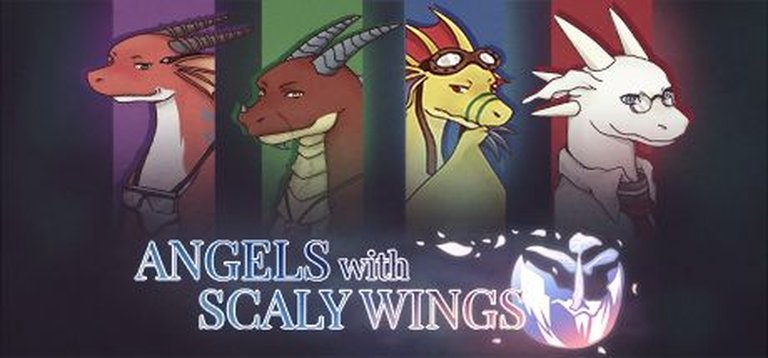
Angels with Scaly Wings is a science fiction visual novel and dating simulation game set in a futuristic world where players interact with dragon-like characters in a detective-style mystery. Featuring first-person perspective, anime-style art, and branching narratives, the game emphasizes player choices that lead to multiple endings, blending romance, intrigue, and fantasy elements in an immersive story.
Gameplay Videos
Where to Buy Angels with Scaly Wings
Angels with Scaly Wings Patches & Updates
Angels with Scaly Wings Mods
Angels with Scaly Wings Guides & Walkthroughs
Angels with Scaly Wings Reviews & Reception
metacritic.com (67/100): Angels with Scaly Wings generally overcomes its goofy setup and simplistic presentation to deliver a character-driven plot with some good surprises, making for a decent little diversion of a game.
lifeisxbox.eu : I was not immediately sure I would enjoy the drastic contrast between the two but it worked incredibly well and balanced the good from the bad nicely.
Angels with Scaly Wings: A Fractured Masterpiece of Dragon Dating, Time Loops, and Bittersweet Salvation
Introduction: More Than a Dragon Dating Sim
To encounter Angels with Scaly Wings is to navigate a profound dissonance between marketing premise and narrative reality. Billed—and often dismissed—as a “dragon dating simulator,” the game is, in truth, a meticulously constructed sci-fi thriller and time-loop mystery wrapped in the aesthetic of a visual novel. Its legacy is one of profound ambition, emotional devastation, and a persistent struggle against its own most attention-grabbing element. As a work, it is both a heartfelt exploration of trauma, sacrifice, and second chances, and a product whose foundational premise creates an almost insurmountable barrier for many players. This review argues that Angels with Scaly Wings is a significant, if flawed, artifact of the 2010s indie visual novel boom: a game that uses its genre’s repetitive, choice-driven structure to deconstruct the very idea of a “happy ending,” all while asking players to invest in relationships that are as conceptually unsettling as they are emotionally resonant. Its ultimate success lies not in the elegance of its dragon romance, but in the brutal, iterative logic of its time-loop tragedy.
Development History & Context: From Programming Exercise to Cosmic Tragedy
Angels with Scaly Wings was developed by Radical Phi, a small independent studio led by M. B. Saunders. Its origins are telling: it began as a simple “Dragon Dating Simulator” programming exercise. After a failed crowdfunding attempt for that bare-bones concept, the team undertook a significant retooling, transforming the project into a narrative-driven experience with deeper themes. This pivot was funded via a successful Indiegogo campaign, and the game entered a two-year development period before its January 31, 2017, release for Windows, Mac, and Linux.
The technological context is crucial. Built on the Ren’Py engine—the industry standard for accessible visual novel development—the game’s technical scope was inherently limited. Its “anime/manga” art style, while serviceable, often betrays its indie budget, with inconsistent shading and a certain MS Paint-like cleanliness that multiple critics noted as jarring against the dark narrative. The choice of Ren’Py also dictated its core gameplay loop: text-heavy scenes, static character sprites, and a choice-driven structure. The studio’s ambition far outstripped these constraints, leading to a game where the writing carries the immense weight of world-building, mystery, and emotional payoff, while the art and interface remain functional at best.
The 2017 release date placed it in a fertile period for niche, story-rich indie games. It followed the cult success of similarly tonally complex visual novels like Hatoful Boyfriend (which its marketing directly invoked) and Steins;Gate, and preceded a wave of console ports (2021) that attempted to bring its peculiar blend of genres to a broader, albeit more skeptical, audience. Its publisher, Ratalaika Games S.L., is known for bringing niche Japanese-style indies to consoles, a partnership that speaks to the game’s specific, if narrow, market appeal.
Narrative & Thematic Deep Dive: The Anatomy of a Time Loop Apocalypse
The Premise and The Reveal
The surface plot is straightforward: humanity discovers a portal to a world of intelligent dragons. You, the featureless protagonist, are chosen as an ambassador to deliver PDAs filled with human knowledge in exchange for “generators”—a mysterious clean energy source. Your human colleague, Reza, accompanies you. Quickly, dragons begin turning up murdered, with Reza as the prime suspect. You must assist the local police, befriend the dragon populace, and uncover the conspiracy.
The genius of the narrative lies in its slow, devastating unraveling. The first major “Wham Episode” (Chapter 3) does not just reveal a killer; it traps you in the dragon world by shattering the portal and delivers the second, world-shattering revelation: humanity’s world has already been destroyed by a solar flare. The dragon world is not an alien planet; it is Earth, 65 million years in the past, moments before the Chicxulub asteroid impact. The “generators” are the dragons’ only hope to deflect the asteroid. Reza is killing dragons not out of simple psychosis, but to steal their generators and save the last vestiges of humanity in the far future. The conflict becomes a brutal triage: save the dragons from extinction, or save the last scraps of human civilization.
The Loop and The True Ending
After achieving an ending (good, bad, or neutral), the game justifies a “Groundhog Day” Loop. The portal can be used as a time machine. With each reset, you retain Ripple-Effect-Proof Memory, learning from failures. The core gameplay becomes an exercise in “Set Right What Once Went Wrong,” but with catastrophic stakes. Each “good” ending for a specific character route (Remy, Anna, Adine, Bryce, Lorem) typically saves that character and their civilization, but dooms the other. The true ending requires you to earn every “good” ending, accumulating the knowledge and trust needed to orchestrate a “Save Both Worlds” plan. This involves recruiting the full ensemble, revealing the full truth to them, and executing a complex plan to divert the asteroid and evacuate the dragons to the post-apocalyptic human future.
Thematically, the game is a meditation on grief, survivor’s guilt, and iterative healing. Characters like Remy (depressed after his fiancée’s death), Anna (terminally ill scientist conducting illegal experiments), and Adine (an athlete facing her own mortality) are not just romance options but case studies in trauma. The game argues that “saving” someone often means saving them from themselves. The dating sim mechanics are thus framed not as frivolous titillation, but as a therapeutic process—building the trust and emotional bonds necessary to convince these broken individuals to fight for a future.
The Controversial Core: Dragon Romance
Here lies the game’s most polarizing element. Critics aredivided: Kotaku felt the romance was a bait-and-switch, replaced by grim murder mystery. TechRaptor called it a “‘dragon porn’ game that doesn’t completely succeed as one.” PlayStation Country dismissed the romantic subplots as “shallow” and “sudden.”
Yet, the narrative integrates the romance into its central mechanic of bonding for survival. To unlock a character’s “good” ending, you must build a profound level of trust and intimacy. With Remy, it involves discussing his deceased fiancée and suggesting adoption. With Anna, it means offering hope for a cancer cure. The romance is the vehicle for the emotional payoff that makes their potential death (or your failure to save them) so devastating. It weaponizes the player’s desire for a happy ending to make the inevitable tragedies more powerful. However, the execution is uneven. As PopZara noted, “The romance between the main character and the dragons… I often felt like there wasn’t enough time spent to get to know each dragon.” The intimacy can feel rushed, undermining the emotional weight it’s meant to carry. The “anatomically impossible” nature of the relationships, while explained in-universe (dragons are bio-engineered dinosaur-human hybrids), creates a persistent cognitive dissonance for many players that no amount of lore can fully dissolve.
Gameplay Mechanics & Systems: Choice, Consequence, and Clunky Iteration
As a Ren’Py visual novel, gameplay is minimal: reading text, selecting dialogue/action choices, and occasional puzzle-like segments (e.g., decoding messages, investigation mini-games). The system’s greatest strength is its perma-death and consequence tracking. The iconic “Snowy Screen of Death” on the status screen—a character portrait replaced by static—is a brutally simple notification of irreversible failure. Choices have ripple effects across timelines. Saving Anna from her late-night murder by convincing her to go home early means her assistant Damion dies instead. Each save file is a snapshot of a divergent timeline.
The “System” itself is a clever meta-element. The save/load menu is personified as a glitchy AI you can interact with in the secret ending, breaking the fourth wall and commenting on the player’s obsessive reloading. Achievements often mock this behavior, like “Nuisance” for refusing Bryce’s requests 99 times, or “Daredevil” for drinking a random, unlabelled liquid.
However, the replay structure is notoriously clunky. While a “skip read text” function exists, reviewers like LifeisXbox reported it was “very temperamental,” often failing to skip already-read sections, forcing manual clicking through hundreds of lines. This turns the essential task of achieving the true ending—a multi-hour, 13+ ending grind—into a tedious chore. The game demands immense patience, testing not just strategic choice-making but also the player’s tolerance for its own interface limitations.
World-Building, Art & Sound: A Study in Contrasts
The Lore
The dragon world’s lore is exceptionally well-realized for an indie VN. The “Dinosaurs Are Dragons” reveal is handled with scientific pretension (bio-engineering, breath weapons as leftover bioweapon traits). The societal detail is impressive: dragons use human-like technology because their civilization was “kick-started” by a human, Izumi, via learning programs, leading to a fascinating “Creative Sterility”—they adapt human tech without innovating beyond it, even down to furniture ill-suited for tails. The prequel comic, Angels with Broken Hearts, expands this world, showing the apocalypse in the human world and Reza’s origins.
The Art
This is the game’s most consistent criticism. The character art is uneven. Some main dragons (Remy, Anna) are striking, but others and especially background human characters can look crude, with flat shading and simplistic designs that clash with the game’s serious tone. Backgrounds vary wildly in quality—some are beautiful watercolor or anime-style scenes, while others (like a simplistic fence in a fireworks scene) undermine immersion. The lack of a unified artistic vision makes the world feel fragmented. As a result, the game’s powerful narrative is often at odds with its presentation, which can feel amateurish.
The Sound
The soundtrack, composed by Shinji Hosoe (renowned for Naruto: Clash of the Ninja, Zero Escape series), is a highlight. It successfully shifts from serene, melancholic tracks for slice-of-life moments to tense, pulsing themes for investigation and horror. The main menu theme is frequently praised for its soothing quality. However, some reviewers noted repetitive loops and a lack of dynamic range in certain scenes, where the music fails to escalate to match dramatic plot turns.
Reception & Legacy: A Cult Phenomenon Divided
Critical Reception at Launch
Metacritic scores (67 from critics, 8.7 from users) reflect a deeply divided reception. The critical spread (40% to 80%) is stark.
* Praise focused on its ambitious, mind-bending story (GameCola, 80%; Nintendo Blast, 80%), meaningful choices, and emotional impact. It was lauded for being “more than its premise.”
* Criticism centered on shallow romance (RPGFan, 72%: “failure in the fundamentals of the genre”), inconsistent art (PopZara acknowledged this), and the jarring tonal clash between dating sim and apocalyptic thriller (Kotaku’s “bored instead of blushy”). Many felt the dragon romance was either poorly executed or an outright turn-off that undermined the serious narrative.
Evolution of Reputation & Influence
Over time, Angels with Scaly Wings has solidified as a cult classic within a specific niche: fans of intricate, multi-path sci-fi visual novels who can accept or embrace its dragon-romance premise. Its influence is subtle but present in later visual novels that blend mundane life-sim with cosmic stakes (e.g., Analogue: A Hate Story). It demonstrated that a game built on a seemingly absurd premise could, with enough narrative rigor, achieve genuine pathos and philosophical weight. The “time-loop to save multiple factions” structure has precedents (Steins;Gate, Zero Escape), but its application to a dating-sim framework was relatively novel.
Its legacy is also one of anatomy of a true ending. The extreme gatekeeping—requiring all five character routes’ good endings—has become a benchmark for “completionist” difficulty in narrative games. It fostered a community dedicated to parsing its dense lore, timeline diagrams, and hidden conditions, a testament to its compulsive, if frustrating, design.
Conclusion: A Flawed, Indispensable Artifact
Angels with Scaly Wings is not a great game by conventional metrics. Its art is inconsistent, its core romantic premise will alienate as many as it attracts, and its interface hampers the very repetition it demands. Yet, it is an important and unforgettable one. It is a game that dares to ask: what if the “dating” was a necessary prelude to coordinating a multi-species rescue from two simultaneous apocalypses? It takes the repetitive, save-scumming nature of visual novels and weaves it into the narrative itself, making the player’s obsessive backtracking a literal, plot-crucial time-loop.
Its greatest achievement is emotional alchemy. It transforms the potential absurdity of “kissing dragons” into a framework for exploring profound themes: the weight of second chances, the morality of triage, the Found Family of broken individuals, and the crushing cost of universal salvation. The bittersweet endings—where one world lives and one dies—are more haunting than any simple victory or defeat.
Ultimately, Angels with Scaly Wings earns its place in video game history as a passionate, over-ambitious experiment. It is a game that swings for the fences, connecting with sublime narrative force when it lands, but occasionally striking out on the ugly, uneven pitch of its own presentation. It is a testament to the power of writing to elevate a concept, and a cautionary tale about how that same concept can be a barrier to entry. For those willing to suspend disbelief and endure its flaws, it offers a singular, devastating, and ultimately hopeful journey—a reminder that even angels with scaly wings can fall, and sometimes, through endless repetition and shared grief, learn to fly again.
Final Verdict: 7.5/10 – A narratively brilliant but aesthetically uneven and thematically challenging cult classic. Its faults are glaring, but its ambition and emotional payoff render them secondary for the audience willing to meet its difficult, scaly heart.