
- Release Year: 2011
- Platforms: Macintosh, Windows
- Publisher: GameHouse, Inc.
- Genre: Compilation
- Game Mode: Single-player
- Average Score: 84/100
Description
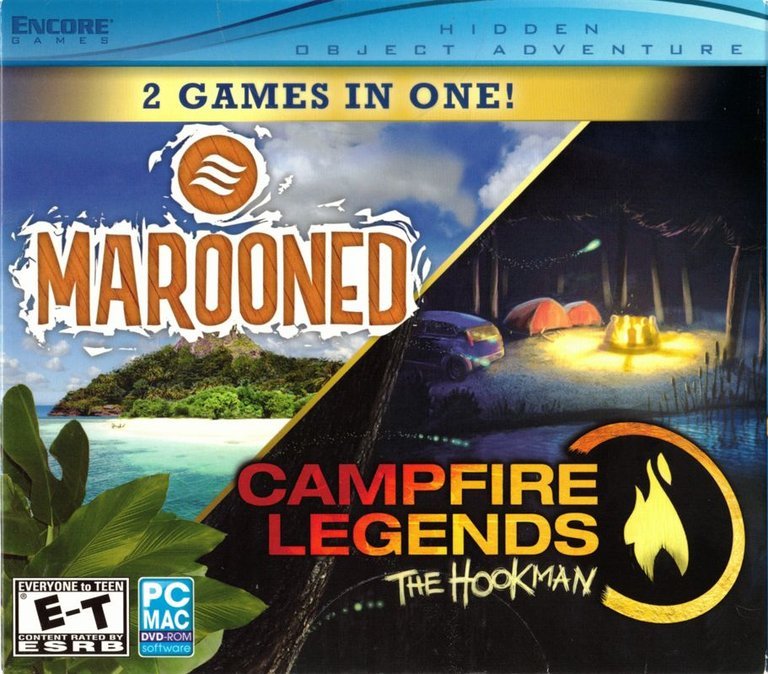
Marooned / Campfire Legends: The Hookman is a 2011 compilation of two horror-themed adventure games, highlighting Campfire Legends: The Hookman. In this first-person hidden object title, players follow Christine as she drives to her parents’ woodland cabin for a romantic getaway, only to face terror after hearing radio reports of the Hookman, a mass murderer, forcing her to explore eerie environments, solve puzzles, and uncover dark secrets to survive.
Gameplay Videos
Marooned / Campfire Legends: The Hookman Guides & Walkthroughs
Marooned / Campfire Legends: The Hookman Reviews & Reception
jayisgames.com (88/100): A scary and stylish retelling of Campfire Legends: The Hookman!
gamearchives.net (80/100): The Hookman isn’t just a hidden object game; it’s a masterclass in atmospheric storytelling.
Marooned / Campfire Legends: The Hookman: A Masterclass in Atmospheric Casual Horror
Introduction: The Hook That Captured a Generation
Gather ’round the digital campfire, fellow gamers and horror enthusiasts, because Campfire Legends: The Hookman is the kind of tale that lingers like smoke in the night air—eerie, intimate, and impossible to forget. Released in 2009 as the inaugural entry in a planned trilogy, this hidden object adventure transformed the classic urban legend of the Hookman—a hook-handed stalker terrorizing lovers’ lanes—into an interactive nightmare that defined a subgenre. Published by GameHouse and developed by the Dutch studio RealGames B.V. (operating as GameHouse Studios Eindhoven), it arrived not with a Hollywood budget, but with a potent, focused vision: to deliver genuine scares within the accessible framework of casual gaming. My thesis is straightforward yet profound: The Hookman isn’t merely a hidden object game; it is a masterclass in atmospheric storytelling and logical game design that punched far above its weight in an era dominated by flashier AAA titles, proving that concise, focused horror can carve a lasting legacy in the genre. Its subsequent bundling with the unrelated 2009 game Marooned in the 2011 compilation Marooned / Campfire Legends: The Hookman does little to diminish the singular impact of its primary offering, which remains a touchstone for narrative-driven casual adventures.
Development History & Context: The Dutch Dawn of Casual Horror
The development of Campfire Legends: The Hookman is a case study in the burgeoning casual gaming boom of the late 2000s—a period where downloadable titles were revolutionizing accessibility and challenging perceptions of what “simple” games could achieve. The project was helmed by GameHouse, Inc., a Seattle-based pioneer in casual games synonymous with hits like Bejeweled and the Delicious series. For this venture into horror, they tapped RealGames B.V., a Dutch studio formerly known as Zylom, which had been rebranded as GameHouse Studio Eindhoven. This was their first foray into the hidden object genre, and the team approached it with the ambition to elevate the format beyond simplistic object hunts.
Producer Bas van den Berg led a compact yet potent team of 33 developers. Key technical figures included scripters Roeland Knijnenburg, Wouter Burgers, and Bob van der Putten, who utilized Lua as the game’s scripting language—a flexible choice for a project of this scale. The visual identity was crafted by a dedicated art team: Jeremy Hoffman, Gemma Tegelaers, Ruud Havenith, Jimmy de Meza, Lennart Verhoeff, and Kiet Duong, who hand-painted the game’s atmospheric environments. Engine and tool support came from David Dunham, Luc Bloom, Roel Verbroekken, and Brian Wren, ensuring smooth point-and-click interactions on modest hardware. For its audio—a critical component of its horror—the team outsourced to SomaTone Interactive Audio, providing music, sound effects, and sparse voice-over work. A robust QA team, featuring veterans like Marcus King (credited on 85+ games) and Chuck Little (79+ games), polished the final product.
Technologically, the game was a product of its time’s constraints and opportunities. Released as shareware for Windows (with a Macintosh port) in October 2009, it was optimized for low-spec PCs, requiring only an 800 MHz Pentium 3, 512MB RAM, and DirectX 9.0. This made it ideal for the download-centric market, distributed via platforms like Big Fish Games where free trials hooked players before a full purchase (typically $6.99). The gaming landscape of 2009 was bifurcated: consoles were dominated by Call of Duty: Modern Warfare 2 and Uncharted 2, while the PC casual space was fertile ground for innovation. The Hookman arrived amid a surge in urban legend-inspired media (paralleling Paranormal Activity’s found-footage horror) and a hidden object market exploding from browser games to premium downloads. The vision was clear: deliver “casual market” simplicity infused with genuine, unnerving tension. This debut also served as the foundation for the Campfire Legends trilogy, followed by The Babysitter (2010) and The Last Act (2011).
Narrative & Thematic Deep Dive: Deconstructing the Legend
Plot Structure and Thematic Core
Campfire Legends: The Hookman employs a brilliant meta-framing device: a group of girls around a campfire recounting ghost stories, seamlessly seguing into the Hookman legend. This narrative “comes to life” through the protagonist, Christine, a young woman driving to her parents’ remote woodland cabin for a romantic weekend with her boyfriend, Patrick. What begins with eerie radio reports of an escaped mass murderer quickly spirals: the cabin is ransacked, Patrick vanishes, and Christine uncovers clues pointing to a vengeful, hook-wielding killer lurking in the woods. The plot unfolds non-linearly across static, first-person scenes, blending exploration with cutscenes that ratchet up dread. Key revelations include discovering the killer’s backstory—a tragic scientist from the Stillwater Sanatorium, Dr. Nate Haken, who lost his family and became obsessed with a tissue-regenerating formula—and the horrifying truth that his experiments have created a zombie-like victim. The story climaxes in a crypt confrontation where theHookman attacks, only for Patrick’s belated arrival to provide a narrow escape. Clocking in at approximately four hours, the script by Ed Kuehnel is taut, delivering its shocks without narrative bloat.
Characterization and Dialogue
Christine stands as a refreshing subversion of the “final girl” trope. Rather than a passive victim, she is depicted as resourceful, pragmatic, and competent—a “handiest horror heroine” who fixes fuses, repairs radios, and changes tires. Her inner monologue (via sparse voice-over) conveys escalating fear without melodrama, grounding the supernatural terror in relatable panic. Patrick, conversely, embodies the “disappearing boyfriend” trope, his skepticism and suspicious absences serving as plot catalysts. The Hookman himself (Dr. Haken) is an archetypal boogeyman, but the game enriches him through environmental storytelling—journals, medical files—painting him as a figure of tragic perversion rather than pure evil. Supporting characters, like radio announcers and flashback victims, add texture through broadcasts and scraps of paper.
Dialogue is minimalistic, fitting the casual format. Lines like “Something’s not right here” are crisp and expository, avoiding verbosity. The lack of full voice acting beyond effects and breathy gasps is a constraint that becomes a strength, forcing players to imagine the terror.
Underlying Themes
Thematically, The Hookman is a rich exploration:
1. The Power of Urban Legend: It examines how myths perpetuate fear in isolated spaces, questioning where the legend ends and reality begins.
2. Isolation and Vulnerability: Christine’s solitude in the woods transforms a romantic getaway into a survival nightmare, echoing primal fears of being cut off from help.
3. Gender and Agency: While evoking slasher film roots (Friday the 13th), it subverts them by empowering Christine. Her competence directly contrasts with Patrick’s uselessness, flipping conventional gender roles in horror.
4. Science and Monstrosity: Dr. Haken’s regenerative serum blurs the line between healing and abomination, critiquing obsessive science divorced from ethics.
5. Cycle of Trauma: The connection to the wider trilogy suggests a cycle of victims and perpetrators, with the sanitarium’s legacy haunting multiple generations.
In a post-9/11 cultural landscape wary of unseen threats, the game’s unseen, relentless pursuer taps into a fundamental anxiety about the dangers lurking just beyond perception.
Gameplay Mechanics & Systems: Logic Over Padding
The Hookman’s greatest innovation lies in its steadfast commitment to logical, context-driven gameplay. It rejects the “junk-drawer” hidden object model in favor of a integrated point-and-click adventure where every item has a clear, narrative purpose.
Core Loops and Exploration
Navigation occurs through beautifully illustrated static scenes (forest paths, cabin interiors, the woods). Clicking reveals hotspots. The core loop: identify interactive elements, collect necessary items, and apply them logically to solve problems—e.g., using a screwdriver to repair shutters, gasoline to start a fire, or car parts to fix a vehicle. There is no combat; tension is built through environmental storytelling (creaking floors, sudden shadows, distant calls) and the ever-present threat of the Hookman.
Puzzles and Progression
Puzzles are varied and integrated into the story:
* Simple Assemblies: Replacing a radio’s knob or reassembling a torn memo.
* Environmental Logic: Using a rust dissolver and cloth to repair a shutter mechanism.
* Multi-Step Sequences: Restoring power by finding and placing specific fuses in a basement box, where lamp feedback (green=correct position, orange=correct fuse/wrong position) guides but does not solve the puzzle for you.
* Complex Deductions: Reassembling a punch card from scraps to operate a decoder, involving a separate lamp-switching puzzle.
* Spatial Reasoning: Several sliding-block puzzles (runestone combinations, a “parking lot” puzzle swapping figurines) that are skippable at a high cost.
Character “progression” is purely narrative-driven. Christine gains access to new areas and backstory as the plot advances, with no RPG stats or branching paths. The experience is linear, but feels organic.
UI and the Firefly System
The UI is intuitive: a bottom inventory strip shows silhouettes of needed items, a “Goal” button clarifies current objectives, and arrows guide scene transitions. The signature innovation is the firefly hint system. Glowing fireflies are hidden in every scene; collecting them grants hints. Crucially, they can:
1. Point to a missing item’s location (if you’re on the correct screen).
2. Provide text hints for puzzles.
3. Be “spent” (five at a time) to skip a puzzle entirely.
This system encourages exploration and rewards thoroughness but is notoriously flawed. As critic The Hidden Object Guru notes, fireflies are difficult to find, hints are useless if you’re on the wrong screen, and the skip cost (a full inventory’s worth) is prohibitively high. This creates tension not just from the horror, but from the resource management of hints—a design choice that feels archaic and frustrating compared to refilling hint meters in later games.
Flaws and Innovations
Flaws include occasional pixel-hunting (tiny, dimly lit items), a lack of autosave (risking lost progress), and a hint system that punishes rather than assists. However, its innovations are significant:
* Justified Searching: Every item is needed for a logical, in-story purpose. You never search for “a rubber duck and six playing cards.”
* Seamless Integration: Hidden object scenes are the environments themselves, not separate clutter screens. Finding a screwdriver in a cluttered shed feels earned and realistic.
* Puzzle Diversity: A wider variety of logical and mechanical puzzles than the genre typically offered at the time.
World-Building, Art & Sound: Painting Dread in 2D
Setting and Atmosphere
The world is a confined yet deeply evocative woodland expanse: a perpetually twilight forest, a disheveled cabin, an abandoned boat house, and a grim crypt. Isolation is the primary antagonist. The setting builds dread through environmental storytelling—overturned furniture, bloodstains, cryptic notes, and the pervasive sense of being watched. There is no safe haven; even the car, a symbol of escape, breaks down. The subtle world-building, like learning of the Stillwater Sanatorium’s Experiments through found documents, expands the horror beyond the immediate locale.
Visual Direction
The art direction is the game’s crown jewel. The Eindhoven team’s hand-painted, illustrated realism creates a grounded yet stylized look. Scenes are rich with detail—cluttered tool sheds, cozy but ransacked cabins, murky waterways—rendered in desaturated palettes of gray, brown, and green, punctuated by visceral crimson accents (blood, the Hookman’s hook). Subtle animations (rustling leaves, flickering lights, drifting smoke) bring the static scenes to life without resorting to full 3D models, which would have dated poorly. This 2D approach lends the game a timeless, storybook-gone-wrong aesthetic. Characters are expressively drawn, their fear and frustration palpable despite occasional “rubbery” proportions. Critics, including GameZebo, lauded the “gorgeous artwork” and “stunning” visual polish, a remarkable achievement for a casual title.
Sound Design
SomaTone Interactive Audio’s contribution is equally masterful. The soundtrack blends low, orchestral dread with folk-horror motifs—whining strings, distant howls, and oppressive silence that makes every creak and footstep unbearable. Sound design weaponizes the lack of noise: the sudden scratch of a hook on metal, a muffled breath, a crow’s sudden takeoff. Sparse voice-over (Christine’s gasps, radio announcers) and effective jump-scare stingers are used sparingly but impactfully. The audio doesn’t just accompany the visuals; it defines the atmosphere, making solo play feel oppressively lonely. For a 2009 casual title, it achieves a level of immersive horror that rivals dedicated horror games.
Reception & Legacy: A Cult Classic Forged in the Casual Fires
Critical and Commercial Reception
Upon release, The Hookman garnered solid acclaim within its niche, averaging 80/100 from aggregated critic sources. Highlights include:
* GameZebo (90% / 4.5/5): Praised its “stunning soundtrack, gorgeous artwork,” and debut status, calling it “outstanding.”
* Gry Onenet (80%): Noted its brevity as an intro to a trilogy but ideal for casual newcomers.
* Mac Games (70%): Highlighted engagement and scares, warning of intensity for children.
* JayIsGames (User Score 4.4/5): Published an extensive rave, dubbing it a “high bar” for the series with “more love and polish” than competitors, though critiquing its four-hour length and abrupt ending.
Commercially, as shareware via Big Fish Games, it sold steadily in the casual market. Its bundling with Marooned in the 2011 Marooned / Campfire Legends: The Hookman DVD-ROM compilation (ESRB Teen-rated) extended its reach. Despite its cult success, it flew under the radar of mainstream outlets like Metacritic, which lists no critic scores.
Evolving Reputation and Influence
Initially overshadowed by blockbuster releases, its reputation has grown in retrospectives, celebrated for pioneering serious horror in the casual space. Its direct influence is clear:
1. Genre Benchmark: It set a new standard for narrative integration in hidden object games. Titles like Enigmatis and Grim Legends later adopted its philosophy of logical item placement and cohesive world-building.
2. Trilogy Success: The success of The Hookman spawned two sequels—The Babysitter (2010) and The Last Act (2011)—creating a connected trilogy that explored the Stillwater Sanatorium’s legacy from multiple perspectives, a rarity in casual series.
3. Studio Legacy: GameHouse Studios Eindhoven (the rebranded RealGames team) went on to develop numerous other hits, including Delicious crossovers, carrying forward its emphasis on polish.
4. Urban Legend Adaptation: It normalized adapting folk horror for interactive media, predating mainstream titles like Until Dawn (2015) in exploring how myths prey on isolated groups.
5. Female-Led Horror: It contributed to the early 2010s trend of strong female protagonists in casual adventures, proving a female lead could anchor a horror experience without sexualization.
Today, it’s a historical footnote preserved on MobyGames (ID 43728 for the standalone, 245130 for the compilation) and celebrated by genre enthusiasts. Its relatively small player base (only five collectors listed on MobyGames for the compilation) underscores its niche, but dedicated, legacy.
Conclusion: An Enduring Legend in Casual Horror
Campfire Legends: The Hookman is a gem of restraint and ingenuity. It distills the essence of urban legend terror—isolation, the unknown, the mundane made monstrous—into a four-hour experience that belies its casual roots. From its Dutch team’s visionary debut to its haunting narrative, seamless mechanics, and sensory immersion, it excels in evoking primal fears without excess. Its flaws—a brevity that feels like a compressed film, an archaic hint system, a technically abrupt climax—are outweighed by its atmospheric triumph.
For video game historians, it is a crucial artifact of the late-2000s casual renaissance, demonstrating that downloadable games could deliver sophisticated, adult-oriented horror. For players, it remains a masterclass in “less is more,” where a hand-painted forest and the sound of a hook scraping on concrete can be more terrifying than any polygon count. While the included Marooned (a separate 2009 title with no narrative connection) is a curious footnote, it does not tarnish the legacy of its companion.
Final Verdict: Campfire Legends: The Hookman is essential for horror and adventure game aficionados. It earns an 8.5/10—a landmark title that carved its hook into the collective psyche of a generation of casual gamers and proved that the scariest stories need not be the longest, just the most impeccably crafted. It is, and remains, a legend worth retelling.