
- Release Year: 2008
- Platforms: Macintosh, Windows
- Publisher: 21 Rocks, LLC, GSP Software, iWin, Inc.
- Developer: 3 Blokes Studios, iWin, Inc.
- Genre: Adventure, Puzzle
- Perspective: 1st-person
- Game Mode: Single-player
- Gameplay: Hidden object, Match-three, Tile matching
- Setting: Egypt
Description
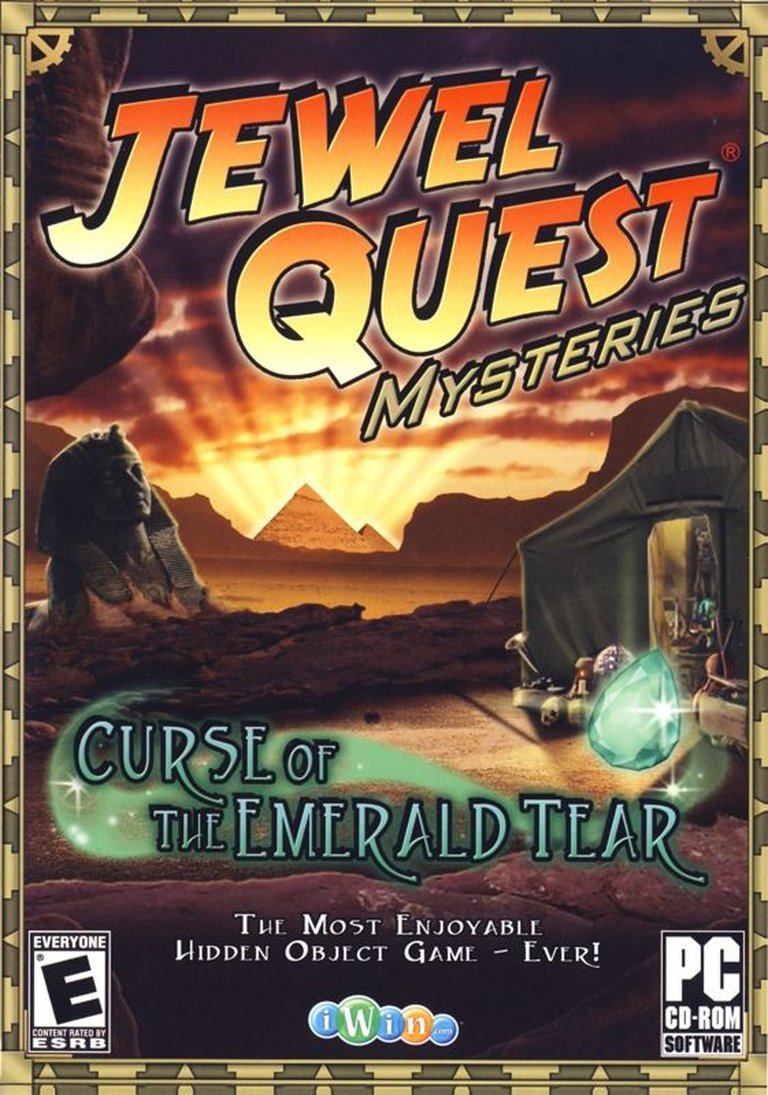
Jewel Quest Mysteries: Curse of the Emerald Tear is a casual adventure-puzzle game set in Egypt, where players engage in hidden object searches and match-three gem mini-games. The gameplay involves finding listed items against a time limit, solving geometric puzzle grids at stage starts, and completing tile-matching challenges to progress, all while collecting coins and jewels for upgrades. With an atmospheric Egyptian backdrop and a curse-themed narrative, it offers a blend of seek-and-find and puzzle mechanics for a relaxing yet engaging experience.
Gameplay Videos
Jewel Quest Mysteries: Curse of the Emerald Tear Free Download
Jewel Quest Mysteries: Curse of the Emerald Tear Reviews & Reception
godmindedgaming.com : this is a great game for Christians
metacritic.com : You ever play a game that just refuses to f$*king end?
Jewel Quest Mysteries: Curse of the Emerald Tear: Review
Introduction: The Casual Conundrum
In the mid-2000s, the video game landscape was undergoing a quiet but profound revolution. While blockbuster titles dominated headlines, a parallel universe of “casual” games was burgeoning, primarily on PC and soon to explode on mobile platforms. Within this生态, one series carved a distinctive niche: Jewel Quest. What began as a straightforward Match-3 cascade puzzle game evolved into a multimedia franchise, spawning sequels, board games, and, notably, narrative-driven spin-offs. Jewel Quest Mysteries: Curse of the Emerald Tear (2008) represents a critical pivot point—the series’ full-throated embrace of the “hidden object game” (HOG) format, a genre then peaking in popularity. This review will argue that while Curse of the Emerald Tear is a mechanically derivative and frustratingly repetitive entry, it serves as a fascinating, if flawed, case study in genre hybridization, franchise extension, and the specific design pressures of the late-aughts casual gaming boom. Its legacy is not one of critical darling or commercial titan, but of a connective tissue, a game that tried to marry two powerful formulas and revealed both the synergies and fault lines between them.
Development History & Context: From Match-3 to Mystery
The Jewel Quest series was the brainchild of iWin, Inc., a company founded in 1999 that became a cornerstone of the downloadable casual game market. By 2007’s Jewel Quest Expeditions, the series had established its core identity: a Match-3 puzzle overlay on a light adventure narrative about the mystical “Jewel Board.” The transition to a pure hidden object game with Mysteries was a significant gamble. Development was a collaboration between iWin and 3 Blokes Studios, with key creative work outsourced to PresentCreative LLC for art and Michael Scott for audio—a common, cost-effective model for casual titles of the era.
The year 2008 was the zenith of the hidden object phenomenon. Games like Mystery Case Files and Hidden Expedition were top sellers on platforms like Big Fish Games and iWin’s own portal. The technological constraints were defining: low-resolution 2D art (often sourced from stock photo libraries like JupiterImages, as credited), simple point-and-click interfaces, and small file sizes (~100MB) optimized for dial-up downloads. The business model was equally crucial— these were not full-priced retail games but impulse-buy downloads ($19.99 on Steam, often discounted or offered as free ad-supported trials), or bundled into “10 Packs” years later. Curse of the Emerald Tear was thus a product of its time in every sense: a franchise leveraging its name to enter a trend, built on a tight budget for a distribution channel that valued accessibility and recognizable branding over innovation.
Narrative & Thematic Deep Dive: A Familiar Curse
The plot of Curse of the Emerald Tear is standard-issue adventure serial, heavily indebted to Indiana Jones and The Mummy franchise, but filtered through the Jewel Quest lore. Protagonists Rupert and Emma Pack, now in possession of the original Jewel Board from previous games, seek one of its original jewels: the Emerald Tear, a gem rumored to possess miraculous healing powers. Their journey takes them to Egypt, where they intersect with their perennial rival, the unscrupulous Sebastian (though the Metacritic review confusingly names a “Philip Westing,” likely a misremembering or regional variant of the character). The inciting incident is a poisoning—Rupert (or “Richard” in some source descriptions) is felled by a mysterious illness after a confrontation.
This sets up Emma’s solo journey through “stunning gardens and relic-laden palaces,” as the official description states. The narrative framework, delivered through static images and text between scenes, is serviceable but thin. It leverages real-world Egyptian history (Tutankhamun, Alexander the Great) as a backdrop for the treasure hunt, a common trope in these games that adds a veneer of educational veneer to the fantastical plot. The central theme is the corrupting influence of power and knowledge, symbolized by the jewel. However, the narrative takes a dark turn with Sebastian’s use of poison to eliminate competition—a serious act that is never resolved or confronted in the story’s conclusion, a notable narrative gap highlighted by the God Minded Gaming review. This lack of consequence undermines the stakes and makes the villain’s threat feel unearned.
The true thematic core, revealed in the gameplay loop, is one of compulsive collection and incremental progression. The story is less about uncovering a deep mystery and more about providing motivation for the repetitive act of scouring scenes. The “mystery” is the McGuffin; the real protagonist is the player’s accumulating stockpile of gems and upgrades.
Gameplay Mechanics & Systems: The HOG Engine, Strained
Curse of the Emerald Tear is a hybrid, but it is a lopsided one. The gameplay is approximately 80% hidden object, 20% Match-3/puzzle.
The Hidden Object Core Loop: This is the game’s primary activity. Players are presented with a beautifully illustrated, static scene set in an Egyptian locale (palace interiors, gardens, tombs). A list of objects (e.g., “Ankh,” “Papyrus Scroll,” “Golden Cobra”) appears on the left. The player must find and click each item within a generous but present time limit. This loop is enhanced by two critical systems:
1. Specials (Hints): Found as golden coins hidden within the object lists themselves (e.g., find a “Hidden Coin” among the other items). Three coins grant one Special. Using a Special highlights the location of a missing object. The upgrades “Intuition” (more Special slots) and “Journal Study” (start with Specials) attempt to mitigate frustration.
2. Gems (Currency): Scattered jewels are clickable collectibles found passively during searches. They serve no purpose in the hidden object scenes themselves but are spent after each completed “chapter” (a set of scenes) on permanent upgrades in a shop.
The Puzzle Framing: Before a set of hidden object scenes (a “chapter”), a simple puzzle grid appears. This is a polyomino-style fitting game: the player must place golden geometric shapes to fill an empty grid. It’s a brief, logic-based palate cleanser. At the end of a chapter, a classic Match-3 board appears. The goal is to create matches that turn all background tiles gold. Success here is required to “close” the chapter and progress the story.
Systems Analysis: Flaws and Friction
* The Repetition Engine (The “Permutation” Problem): This is the game’s most infamous design choice, brilliantly dissected in the Metacritic user review. Unlocking new hidden object scenes is not linear. To access Scene 5, you must complete Scenes 1-4. To then access Scene 6, you must re-complete Scenes 1-5. Scene 7 requires 1-6, and so on. This creates a brutal “permutation” grind where late-game scenes must be played 10+ times to unlock the final ones. The difficulty doesn’t scale with repetition; instead, it becomes a test of memory, not observation. As the Metacritic reviewer quipped, it shifts from “find the hidden object” to “remember where you last saw your keys.”
* Upgrade Uselessness: The gem-purchased upgrades are largely irrelevant due to the game’s baseline ease and the repetition system. By the time a player can afford “Prep” (extra time) or “Jewel Sense” (cursor glimmer), they already know the scenes intimately. The upgrades solve a problem that disappears with playtime, creating a pointless progression treadmill.
* The Match-3 Afterthought: The tile-matching sections feel shoehorned in to satisfy the series’ identity. They are disconnected from the narrative and offer a different, often more frustrating, challenge. The reviewer from God Minded Gaming notes they are “unwelcome,” a sentiment echoed by many. The board shapes become irregular, and the coin mechanics (which can permanently block tiles) introduce an element of luck that clashes with the skill-based hidden object core.
* Ease and Skipping: The game openly allows skipping both the puzzle grids and the Match-3 levels, confirming their peripheral status. The overall time limit is so lenient that pressure is minimal. This cement’s the game’s identity as a relaxation tool, not a challenge.
World-Building, Art & Sound: A Gilded Cage
The game’s setting is Ancient Egypt, but a sanitized, museum-piece version. The backgrounds are lush, hand-painted (or digitally composed from stock assets), with meticulous attention to hieroglyphics, sandstone textures, and exotic flora. Each scene is a clutter of thematic paraphernalia: canopic jars, scribe palettes, lotus flowers, scarabs. This creates a coherent, appealing aesthetic that is the game’s primary strength. However, as noted in the Metacritic review, the art suffers from “low resolution scaling.” On modern displays, some fine details are muddy, and objects can be obscured by visual noise—a critical flaw in a game about visual discrimination.
The sound design is functional and unobtrusive. Composer Michael Scott delivers a soundtrack of calm, Middle Eastern-inspired melodies using synthesized oud and flute. It’s pleasant and mood-appropriate, reinforcing the leisurely pace. Sound effects for clicks and correct finds are satisfying but sparse. The overall audio experience is designed to soothe, not excite.
The world-building, however, is superficial. The narrative alludes to “greater conspiracies” and historical events, but the hidden object scenes themselves are populated with anachronisms (modern dollar bills, kitchen utensils) that undercut any sense of authentic immersion. This is a common genre convention—the “I Spy” logic—but it keeps the world firmly in the realm of playful abstraction, not historical mystery.
Reception & Legacy: A Modest Echo
Curse of the Emerald Tear was not a critical darling. The sole professional critic review on MobyGames, from GameZebo, awarded it 70% (3.5/5), praising its “many levels and attractive music and graphics” as a “relaxing casual game” but bluntly stating it has “a number of flaws it doesn’t rank as high as more polished hidden object puzzlers.” This is a fair summary.
The user reception, as captured by the scathing Metacritic review and the low 1.0/5 score on MobyGames’ player section, was far harsher. TheMetacritic user’s diatribe against the “permutation” system and the game’s bloated, repetitive length struck a chord. It became a potent example of a genre excess: padding disguised as content.
Its legacy is twofold:
1. As a Franchise Pivot: It successfully transitioned the Jewel Quest brand from pure puzzle to narrative HOG. This direction proved viable, spawning direct sequels like Jewel Quest Mysteries: Trail of the Midnight Heart (2009) and The Seventh Gate (2011), as well as the Mah Jong Quest crossover. The “Mysteries” sub-series continued the formula with different settings.
2. As a Genre Artifact: It stands as a textbook example of the mid-to-late 2000s HOG design template: beautiful static art, memory-dependent repetition, a light puzzle hybrid, and a shop-based upgrade system. Its specific flaws—the permutation unlocks, the irrelevant upgrades—are frequently cited in discussions about padding in casual games. It demonstrates how the economic model (sell a 4-hour experience as a 20-hour one through repetition) could conflict with player good will.
Conclusion: A Flawed Artifact of Its Time
Jewel Quest Mysteries: Curse of the Emerald Tear is not a “good” game by traditional standards of design, pacing, or narrative depth. Its core loop is artificially bloated, its secondary systems are pointless, and its villain’s actions have no consequence. Yet, to dismiss it entirely is to ignore its value as a historical artifact. It is a perfect lens through which to view the casual game gold rush: the reliance on stock art, the emphasis on “relaxation” over challenge, the conversion of a franchise into a genre template, and the sometimes-exploitative use of repetition to extend playtime.
For the historian, it is essential. For the player in 2008 with a dial-up connection and a need for a mindless distraction, it likely served its purpose. For the modern critic or player, it is a curiosity—a game that is more interesting to analyze than to play, a testament to an era where the business of fun often overrode the craft of it. Its place in history is secure not as a masterpiece, but as a representative specimen of a specific, commercially vital, and critically undervalued period in game development. It is the sound of one hand clapping: the casual genre, vast and profitable, yet often critically silent, echoing into the empty chambers of a repetitively unlocked Egyptian palace.