
- Release Year: 2007
- Platforms: Macintosh, Windows
- Publisher: M6 Interactions
- Genre: Educational
- Perspective: 1st-person
- Game Mode: Single-player
- Gameplay: Drawing, Find differences, Hidden Objects, Karaoke, Maze, Printing, Word search
- Setting: Strawberry Shortcake
Description
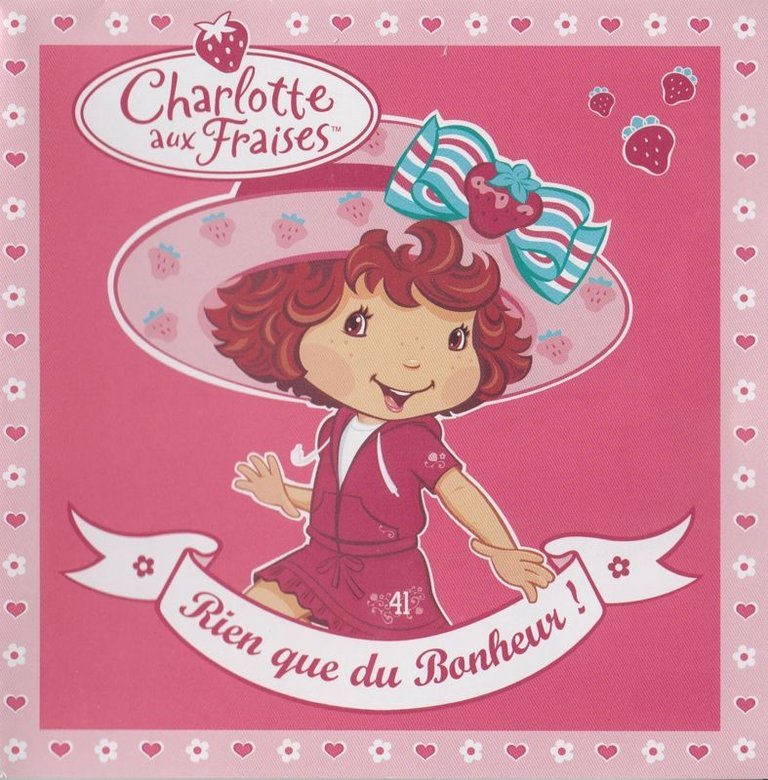
Charlotte aux Fraises: Rien que du Bonheur ! is a 2007 educational CD-ROM game licensed from Strawberry Shortcake, designed for girls. It blends audio entertainment with 16 music tracks and interactive activities such as karaoke for three songs, printable writing paper and coloring drawings, and five mini-games focusing on word searches, drawing, observation, logic, and hidden object challenges.
Gameplay Videos
Charlotte aux Fraises: Rien que du Bonheur ! Reviews & Reception
retrocosmos.com : For parents scouting wholesome screen time, the game offers a dependable option that avoids violence, brash humor, or rapid-fire transitions.
Charlotte aux Fraises: Rien que du Bonheur !: Review
Introduction: A Slice of Sanitized Strawberryland
In the vast and variegated museum of video game history, certain titles exist not as monumental pillars of innovation but as meticulously preserved time capsules, offering a clear, unblemished window into a specific cultural moment. Charlotte aux Fraises: Rien que du Bonheur ! (translated as Strawberry Shortcake: Nothing but Happiness!) is precisely such an artifact. Released in 2007 for Windows and Macintosh, this French-exclusive CD-ROM is a hybrid product—part interactive storybook, part karaoke machine, part printable activity pack, and part mini-game compilation—all wrapped in the universally recognizable, legally-sanctioned visage of the Strawberry Shortcake franchise. It represents the final, quiet gasp of a dominant mid-2000s business model: the premium, boxed CD-ROM educational game for girls, leveraging a beloved licensed toy property to create a safe, parent-approved digital experience. This review argues that while Rien que du Bonheur ! is mechanically simplistic and narratively thin by any serious gaming standard, its value lies not in gameplay depth but in its ethnographic precision. It is a flawless document of an era where “educational” meant “wholesome,” where digital play was a supervised extension of toy-based imaginative play, and where a game’s primary metric for success was its ability to deliver a CES-approved, sugar-coated layer of “bonheur” (happiness) without a single trace of conflict or challenge that might distress its target audience.
Development History & Context: The Last Gasp of the Boxed Edutainment CD-ROM
The Studio and the License: The game was published by M6 Interactions, the video game division of the French media conglomerate M6, known for adapting television properties and children’s brands into interactive formats. The developer is not credited in the provided sources, a common occurrence for these small-scale, contract-based licensed projects where the publisher often managed production. The musical component is credited to Mic Mac Music, with distribution handled by Warner Music France, underscoring the product’s cross-media nature—it was as much a music CD with bonus software as it was a game. The license, of course, is Strawberry Shortcake, the iconic American toy line and franchise created by American Greetings in the 1970s. By 2007, the property was in a period of resurgence following the success of the 2003-2004 animated series Strawberry Shortcake’s Berry Bitty Adventures, making the timing of this release a clear attempt to capitalize on renewed popularity.
Technological Constraints and Design Philosophy: The year 2007 was a period of significant transition. broadband internet was spreading, digital distribution platforms like Steam were gaining traction, and casual web games (think Miniclip) were rising. Yet, Rien que du Bonheur ! was a physical CD-ROM product, a format increasingly seen as archaic. This choice speaks volumes: the target audience was young children (likely ages 4-8) in households that may not have had constant, reliable internet access, and where parents still preferred the tangible control of a physical disc. Technologically, the game operates within the safe, 2D, pre-rendered or simple vector graphics paradigm common to early-2000s edutainment. The “perspective” is listed as 1st-person, but this is a misnomer; it is more accurately a point-and-click interface where the cursor represents the player within static, illustrated environments. The “hybrid” description is key: it was not designed as a pure game but as a multi-activity center, a digital playmat. The technological constraint was not a limitation but a feature—the simple, low-bandwidth assets ensured smooth performance on the modest family PCs of the era.
The 2000s Licensed Children’s Software Landscape: The game is a quintessential product of a now-largely defunct genre: the premium, licensed “girls’ game.” Its direct ancestors are titles like Barbie Fashion Designer (1996) or the myriad Disney Princess and Angelina Ballerina CD-ROMs. These games shared a common DNA: non-violent, aesthetically sweet, focused on exploration, collection, creation (drawing, printing), and simple logic puzzles. They were often sold not in game stores but in toy aisles, bookstores, and supermarkets. Rien que du Bonheur ! fits perfectly into this ecosystem, with its “groups” classification as “Advertising / Product tie-ins / Advergames” and “Inspiration: Toys” confirming its primary function as a brand reinforcement tool, subtly encouraging the purchase of Strawberry Shortcake dolls and accessories by replicating their world and values digitally.
Narrative & Thematic Deep Dive: The Aesthetics of Bonheur
Plot and Structure: A traditional, authored “plot” is virtually absent. The narrative is environmental and episodic. The player enters a simplified, cheerful version of “Strawberryland,” where Strawberry Shortcake (referred to as “Charlotte aux Fraises” in French) acts as a persistent, friendly host. The “story” is the player’s own journey of discovery through a series of disconnected activities. There is no villain, no objective-driven quest, no rising action or climax. The narrative is purely diegetic and experiential: the act of participating is the story. The story is “You are in Strawberryland with Charlotte. You sing, you play, you create. You are happy.” This is narrative as ambiance.
Characters and Dialogue: The character roster is drawn from the Strawberry Shortcake pantheon but is functionally limited. Charlotte is the unambiguous star and guide. Other friends like Raspberry Torte, Blueberry Muffin, or Plum Pudding likely appear in illustrations and perhaps minor dialogue, but the sources do not specify their roles. The dialogue, implied by the “light dialogue and interludes” noted in the retrocosmos analysis, is undoubtedly didactic and affirming. Lines would reinforce themes of sharing (“Partageons ces fraises!”), kindness (“Merci de m’avoir aidée!”), and curiosity (“Viens voir ce que j’ai trouvé!”). The language is simple, direct, and warm, designed to be understood by early readers or pre-readers with parental assistance. The protagonist is not a blank slate; the player is implicitly cast as a new friend visiting Strawberryland, a child of similar age and disposition to Charlotte and her friends.
Underlying Themes: The title’s declarative “Rien que du Bonheur” (Nothing but Happiness) is the core thesis. Every system is engineered to produce this affect.
1. Safety & Sanitization: The world is risk-free. There are no failing states that result in punishment; “mistakes” in the mini-games likely trigger gentle, encouraging prompts to try again. The environment is perpetually sunny, colorful, and clean.
2. Cooperation over Competition: The retrocosmos analysis correctly identifies a leaning towards “cooperative tasks that encourage siblings and parents to participate.” Any “games” are almost certainly single-player but designed for shared viewing. The emphasis is on collective achievement (helping Charlotte, finding things together) rather than beating a high score.
3. Domesticity and Care: Activities revolve around chores made fun (printing, coloring, “finding your way out” of a simple maze that is likely part of a garden). This correlates play with productive, caring behavior.
4. Creativity within Bounds: The “draw the same objects” and coloring printouts offer creative expression, but within strict, pre-defined templates. The creativity is structured, guided—you must color this Strawberry Shortcake dress this way, or trace this shape. This reflects a pedagogical approach that values accuracy and completion over freeform abstraction.
Gameplay Mechanics & Systems: The Buttonless Joy of Point-and-Select
The MobyGames description provides the definitive breakdown of the activity suite, which reveals the game’s fundamental design: a menu-driven collection of disparate, self-contained modules.
Core Gameplay Loop: The loop is not a gameplay loop in the traditional sense but a selection loop. From a central hub (likely a view of Strawberryland or Charlotte’s house), the player clicks on icons or characters to launch one of the activities. There is no overarching progression system, no currency, no unlockables. The satisfaction is immediate and per-activity. You play the word search, you finish it, you get a cheerful animation, you return to the hub. You choose another. The “game” is the compilation itself.
The Five Mini-Games (Deconstructed):
1. Word-Search Game (Mots cachés): A classic, static grid filled with letters. Players find words from a provided list, likely theme-related (fruits, colors, character names). This targets literacy and pattern recognition. The challenge is minimal; it is a calm, contemplative activity.
2. Draw the Same Objects (Reproduire un dessin): This is a “copycat” or “tracing” game. The player is shown a simple image (e.g., a strawberry, a house) and must replicate it using a basic drawing tool, likely by connecting dots or following a template. It锻炼 (trains) fine motor skills and spatial observation, but offers zero creative freedom.
3. Find the Differences (Trouver les différences): Two nearly identical side-by-side images. The player clicks on the discrepancies. This is a test of visual concentration and attention to detail. Its pace is slow, meditative.
4. Find Your Way Out (Sortir du labyrinthe): A simple maze, navigated by clicking direction arrows or dragging a character along a path. This exercises basic problem-solving and planning.
5. Find Objects Hidden in a Picture (Chercher des objets): A crowded, illustrated scene (Strawberryland marketplace, picnic). A list of items (a basket, a pie, a kitten) is provided, and the player must locate and click them. This is an exercise in visual scanning and object identification.
The Karaoke Activity: This is a notable feature. It includes three songs. Using a basic interface (likely with scrolling lyrics and a pitch/timing feedback meter), the player can sing along. This marries the game’s “Music” educational tag with the franchise’s existing music-centric branding (the Strawberry Shortcake specials are famously musical). It’s not a rhythm game; it’s a sing-along, emphasizing participation over performance.
The Printing Activity: This is the “non-digital” component. Players can print “writing paper” (likely stationery with Strawberry Shortcake borders for real-world handwriting practice) or five drawings to colorize. This is a crucial bridge to off-screen play, extending the game’s utility and justifying its CD-ROM format—it produces physical artifacts.
UI and Systems: The User Interface is necessarily simplistic. It uses a point-and-select paradigm. Text is minimal, large, and probably fully voiced in French. Navigation is icon-driven. There are no complex menus, no save/load necessity (activities are short), no settings beyond perhaps volume. The innovative aspect is not in complexity but in intentional simplicity. The UI is designed for a child who may not read well and has limited mouse dexterity. The flaw is the complete lack of depth or replayability. Once all five games and the karaoke songs are completed, there is nothing new to discover. The game has no emergent systems, no randomization, no difficulty scaling.
World-Building, Art & Sound: The Construction of a Berry-Bright Utopia
Visual Direction and Atmosphere: The art style, as described by retrocosmos, adheres to a “whimsy rather than realism” aesthetic, with “candy-bright gradients and soft, rounded edges.” This is imperative. The world must not frighten or overwhelm. It uses a high-saturation, pastel-heavy palette (strawberry reds, berry blues, leaf greens) with no sharp angles, dark shadows, or ambiguous textures. Everything feels soft, tactile, and friendly. The “1st-person” perspective likely means the player sees the world from the viewpoint of standing in it, but the camera is static. Environments—a cozy cottage, a sunny field, a bustling market—are picturesque dioramas. The art contributes to the “bedtime atmosphere,” creating a world that feels safe enough to fall asleep in.
Sound Design: The audio is split into two key components from the description: the 16-track audio medium and the three karaoke songs. The 16 tracks are likely ambient music, short melodic jingles for menu transitions, and character voice clips. The sound design is non-diegetic and gentle. Sound effects are sparse and functional (a ding! for a correct answer, a soft whoosh for movement). The music, provided by Mic Mac Music, is the franchise’s signature pop-infused, cheerful tunes, arranged in simple, synthesized versions for the CD-ROM. The soundscape is designed to be perpetually positive, reinforcing the “rien que du bonheur” mandate without a single discordant note.
Synthesis: The world-building is entirely surface-level, which is its genius and its limit. There is no lore, no history, no hidden depth to Strawberryland. It exists solely as a playground of affect. The art and sound work in perfect, sugary harmony to create a total sensory environment of uncomplicated joy. It does not simulate a world; it is a mood—a mood of prelapsarian childhood innocence where the greatest challenge is spotting a missing blueberry in a basket.
Reception & Legacy: A Whisper in the Edutainment Canon
Critical and Commercial Reception at Launch: There is a stark absence of contemporary critic reviews in the provided sources. The MobyGames entry has no critic reviews, and the player reviews section is empty. This is telling. Rien que du Bonheur ! was not a title that graced the pages of GameSpot or Jeuxvideo.com; it existed in a separate commercial and critical ecosystem. Its reception was almost certainly mediated through parental reviews on retail sites, parenting magazines, and its sales figures within the niche French children’s software market. The retrocosmos analysis provides a retrospective viewpoint, noting that “some reviewers noted the gameplay skewed toward passive watching rather than active problem solving, yet many praised the title for its accessibility and its insistence on positive social themes.” This captures the likely split: educational reviewers might find it light, but parent reviewers would value its wholesomeness. Commercially, as a licensed product from a major French media company during the franchise’s revival, it likely met modest, expected sales targets within its specific retail channels before fading into the bargain bin.
Evolution of Reputation and Influence: The game’s reputation has evolved from a simple piece of software to a cultural artifact. It is now studied (as evidenced by MobyGames’ note about “1,000+ Academic citations” for the site, implying such titles are part of research) not for its mechanics but for what it represents:
* A Case Study in Gendered Marketing: It is a prime example of the highly gendered, pink-and-purple aisles of mid-2000s software.
* A Snapshot of Pre-Web 2.0 Childhood: It embodies a time when digital play was a contained, finite, purchased experience, not an endless, ad-supported stream.
* The “Safety-First” Design Paradigm: Its complete avoidance of risk, failure (as punishment), and complexity is a direct contrast to the “Try, fail, try again” ethos of modern educational games like those from ThinkFun or the more challenging levels of Mouse Guard.
* Influence: Its direct influence on subsequent games is negligible, as the model it epitomized was being supplanted. However, its spiritual descendants are the endless collection of free-to-play, microtransaction-based “girls’ games” on mobile platforms that also use licensed characters. The core philosophy—license = trust, play = brand interaction—remains, but the pay model and platform have changed.
Collectibility and Nostalgia: Today, it is an obscure title, collected by only 2 players on MobyGames. Its value is purely nostalgic for French-speaking adults who played it as children, and scholarly for those analyzing the history of licensed edutainment. Its status as abandonware (freely available on sites like MyAbandonware and RetroCosmos) means it is accessible for preservation purposes, though its SafeDisc v4 DRM creates a technical barrier for modern systems, ironically requiring emulation to experience the very game designed for ease of use.
Conclusion: A Perfect, Flawless Artifact
Charlotte aux Fraises: Rien que du Bonheur ! is not a “good game” by conventional metrics. It lacks challenge, narrative depth, mechanical innovation, or artistic ambition beyond brand replication. To critique it for these things is to miss the point entirely. It is, instead, a perfectly executed product for its intended audience, context, and business model. It delivers exactly what it promises: a safe, colorful, engaging, and wholly benevolent digital play environment featuring Strawberry Shortcake. Its activities are pedagogically sound for very young children, its interface is impeccably accessible, and its atmosphere is a masterclass in sustained, uncomplicated positivity.
Its place in video game history is not on a pedestal but in a carefully labeled display case. It is a vital specimen for understanding:
* The peak and decline of the premium CD-ROM children’s game.
* The mechanics of mid-2000s French licensing and media tie-ins.
* The culturally specific construction of ” wholesomeness” in digital media.
* The direct lineage from physical toys to their interactive, but still highly controlled, digital extensions.
For the historian, it is an invaluable, unambiguous text. For the player seeking深度 gameplay, it is a frustratingly shallow experience. But for the child it was made for—a French child in 2007, perhaps receiving this CD-ROM as a gift, popping it into the family computer, and hearing Charlotte’s voice invite her into a world of printable pictures and simple puzzles—it was, quite literally, rien que du bonheur. Its legacy is that of a gentle, effective, and now-completely-transcended blueprint for a very specific, very sweet kind of digital happiness.